
lovethailand home >North Travel Attractions >Chiang Mai Travel Attractions >Mae On >Mae Tha > Wat Si Bun Rueang (Mae Tha)
TL;DR: Wat Si Bun Rueang (Mae Tha) is located at 61 Ban Kho Klang, Moo 3, Mae Tha, Mae On District, Chiang Mai 50130, Thailand, open Daily, hours 08.00 – 17.00.

Wat Si Bun Rueang (Mae Tha)
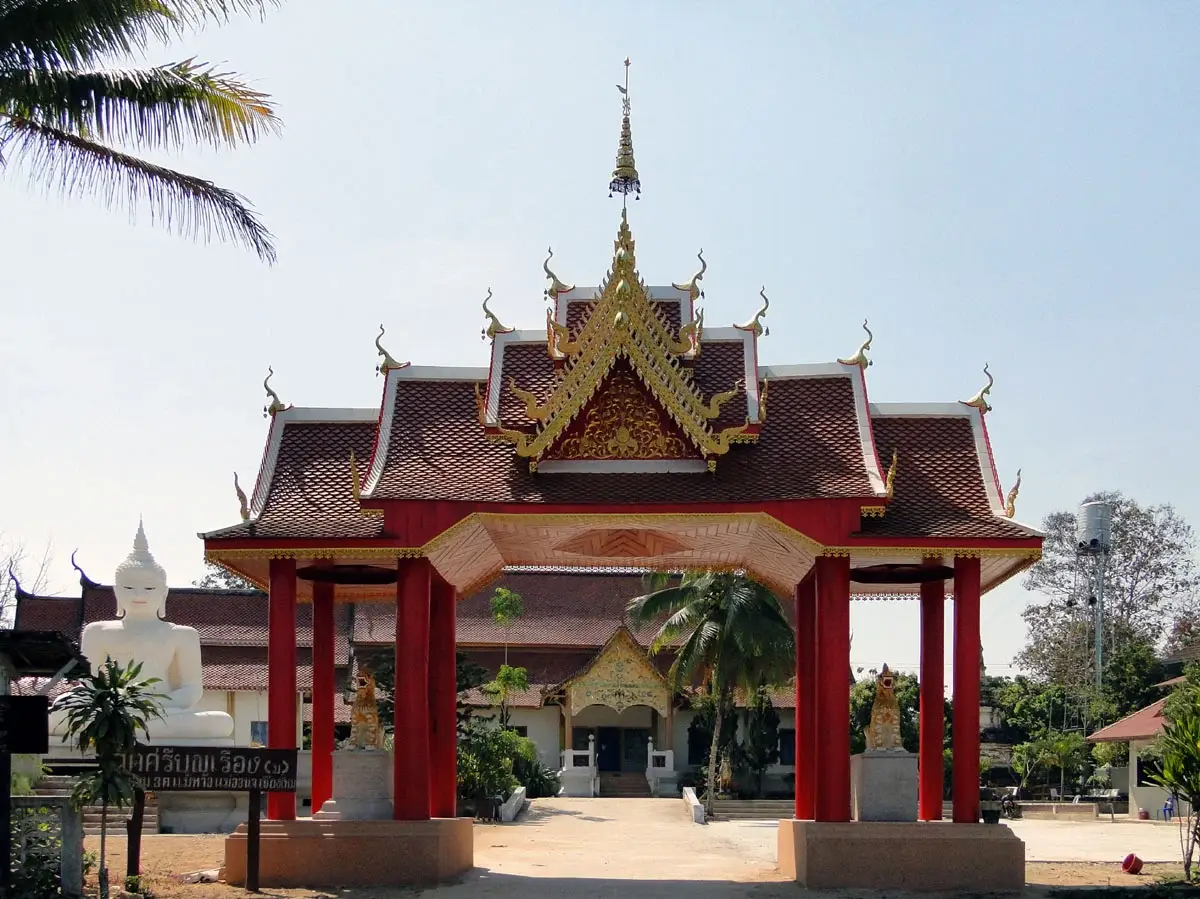
Open Days: Daily
Opening Hours: 08.00 – 17.00
Wat Si Bun Rueang (Mae Tha), located at 61 Ban Kho Klang, Moo 3, Mae Tha Subdistrict, Mae On District, Chiang Mai Province, is a historic community Buddhist temple belonging to the Mahanikaya order. The temple was established in 1807 and received its royal Wisungkhamasima boundary on 1 January 1841. It stands on a low hill traditionally described as a small doi surrounded by agricultural land, and local residents have long referred to it as “Wat Luang,” or the principal temple of the community. Today, Phra Khru Amon Thammawong Tissavamso serves as abbot, while the temple continues to accommodate resident monks, annual Kathin ceremonies, Buddhist education and community religious activities.
For travelers looking for a concise introduction, Wat Si Bun Rueang is important not because it was developed as a large tourist attraction, but because it preserves the character of an old Mae Tha village monastery. The compound contains an ubosot, viharn, large assembly hall, monks' residences, stupa, dining hall, alms-bowl pavilion, kitchens, cremation facilities and a range of sacred images. Important devotional objects include the Naga-protected Buddha image in the assembly hall, a statue of former abbot Kruba Kong Kham Sukhanto, an image of Luang Pu Thuat of Wat Chang Hai and a representation of Luang Pu Du.
The temple stands within the rural landscape of Mae Tha rather than in a densely built urban area. Local history describes the original temple setting as a low hill in the middle of rice fields, some distance from the main settlement. This location reflects the agricultural character of Mae Tha, where village life has historically depended on farmland, local irrigation systems and shared natural resources. Wat Si Bun Rueang therefore belongs to a wider cultural landscape rather than functioning as an isolated religious compound.
The registered temple land covers approximately 6 rai, 3 ngan and 20 square wah under title deed no. 7068. Public roads form the northern and western boundaries, while communal irrigation channels border the southern and eastern sides. The presence of these channels is significant in a Lanna context because the traditional muang-fai irrigation system has long supported farming communities across northern Thailand. The temple's setting beside irrigation infrastructure reflects the close relationship between religion, water management and agriculture in Mae Tha.
Wat Si Bun Rueang is located at approximately 18.59603, 99.27675. Travelers should enter the full place name “Wat Si Bun Rueang Mae Tha Mae On” when using navigation because many temples across Thailand share the name Wat Si Bun Rueang. Even within Chiang Mai Province, similar temple names can lead navigation systems to the wrong district if Mae Tha and Mae On are not specified.
The recorded foundation year of 1807 places Wat Si Bun Rueang in the early Rattanakosin period, when Chiang Mai and the wider Lanna region were undergoing political and demographic recovery. Rural temples established during this period were vital institutions. They provided spaces for Buddhist worship and merit-making, but they also supported education, village gatherings and collective activities. Wat Si Bun Rueang has therefore accompanied Mae Tha through more than two centuries of social change.
Local residents have traditionally called the temple “Wat Luang.” In village usage, such a name often reflects the perceived importance of a temple as a principal or longstanding religious center. Local historical records connect this title with the idea that Wat Si Bun Rueang may have been among the earliest temples in Mae Tha and perhaps the first major temple of the subdistrict. Although the precise sequence of every local temple cannot be established conclusively, the 1807 foundation date confirms that Wat Si Bun Rueang belongs to the oldest group of religious sites in the area.
The original setting on a low hill, or doi noi, would also have given the monastery a distinct presence in the surrounding rice-field landscape. Before the modern road network and contemporary buildings developed, a temple on slightly raised ground would have been visible from the surrounding agricultural area. Elevated sites also provided practical protection from seasonal water and created a symbolic transition between cultivated land and sacred space.
Only thirty-four years after its recorded establishment, Wat Si Bun Rueang received its royal Wisungkhamasima boundary on 1 January 1841. This was an important stage in the temple's institutional development because the boundary formally defines the sacred area used for important Sangha acts such as ordination. The early grant indicates that the monastery developed beyond the scale of a temporary religious community and became an established Buddhist temple with a formal ordination function.
The recorded succession of abbots is unusually valuable for local historical research. Phra Naphalop served from 1807 to 1827, followed by Phra Athikan Kham from 1827 to 1867, Phra Polima from 1867 to 1910, Phra Sit from 1910 to 1931, Phra Kawichai from 1931 to 1937, Kruba Chao Athikan Kong Kham Sukhanto from 1937 to 1970, Phra Insom Chinawaro from 1970 to 1971, Phra Chamnong Indavamso from 1971 to 1974, and Phra Khru Amon Thammawong from 1974 onward. This succession spans more than two centuries.
Kruba Chao Athikan Kong Kham Sukhanto remains particularly visible in the temple's collective memory because a statue of the former abbot is preserved among its devotional objects. In rural Lanna communities, respected abbots were often remembered not only as monks but as builders, teachers and community leaders. The presence of his image therefore connects contemporary visitors with a period of temple history that might otherwise survive only in written records.
Phra Khru Amon Thammawong Tissavamso has served as abbot since 1974 and was also recorded in 2022 as the ecclesiastical head responsible for the Mae Tha–Tha Nuea area. The 2025 Kathin information continued to list Phra Khru Amon Thammawong as abbot and recorded five monks in residence during the rains retreat. His long period of leadership corresponds with several important construction and institutional developments within the monastery.
The contact number associated with Phra Khru Amon Thammawong and Wat Si Bun Rueang is 081-287-9615. It appears in both local temple records and Chiang Mai Provincial Office of Buddhism documentation. Groups planning merit-making activities or travelers wishing to confirm special religious events can use this number to contact the temple directly.
The ubosot was constructed in 1983 as a reinforced-concrete building. The available local register does not provide complete dimensions or details of its principal Buddha image, so those details are not added here. The building nevertheless has considerable religious significance because it serves the ordination function associated with the temple's Wisungkhamasima boundary granted in 1841.
The viharn was constructed in 1960 as a reinforced-concrete building. In a Lanna temple, the viharn is normally among the religious spaces most closely associated with lay worshippers. It accommodates Buddha images, merit-making and communal religious practice. The 1960 construction date shows how the temple gradually replaced or rebuilt earlier structures using modern materials while maintaining the traditional function of the monastery.
The sala kan parian, or preaching and assembly hall, is considerably newer. Constructed in 2019, it measures approximately 10 metres wide and 35 metres long and is built in reinforced concrete. Its size allows the temple to accommodate large gatherings for sermons, communal merit-making, meals, meetings and annual ceremonies. It is one of the clearest examples of Wat Si Bun Rueang continuing to adapt its facilities for contemporary community use.
Inside the assembly hall is a principal Buddha image in the Naga-protected posture. The image measures approximately 29 inches across the lap and about 1.70 metres high and was created in 2019. The posture refers to the Buddhist narrative in which Mucalinda Naga protected the Buddha from severe weather after enlightenment, giving the image associations with protection, composure and steadfast meditation.
Wat Si Bun Rueang has two monks' residences: one reinforced-concrete building and one timber building. The use of different materials reflects different phases of construction within the monastery. Visitors should recognize these areas as private monastic living spaces and avoid entering them unnecessarily or creating noise nearby.
Other facilities include two kitchens, a storage building, an alms-bowl pavilion, a monks' dining hall, four toilet buildings and a cremation facility. These structures may appear less visually important than the ubosot or viharn, but they are essential to the practical operation of a community temple. Rural merit-making events often involve large quantities of food, communal preparation and ceremonies attended by entire extended families.
The temple also contains at least one stupa. Public records do not provide a confirmed construction date, architectural classification or information about relics contained within it, so those details are not stated. The existence of the stupa nevertheless preserves one of the core architectural elements of a Lanna Buddhist monastery and provides another important place of reverence within the compound.
Other sacred objects include a statue of Kruba Chao Athikan Kong Kham Sukhanto, an image of Luang Pu Thuat of Wat Chang Hai, an image of Luang Pu Du and Buddha images placed on a traditional altar base. These objects reveal several layers of devotion, ranging from reverence for a former local abbot to faith in nationally respected monks from other regions of Thailand.
The presence of Luang Pu Thuat and Luang Pu Du does not change Wat Si Bun Rueang's fundamental identity as a historic Lanna community temple. Instead, it illustrates how contemporary Thai Buddhist devotion can incorporate local monastic memory, mainstream Buddhist worship and reverence for widely respected meditation masters within the same sacred environment.
The temple also plays a continuing role in Buddhist outreach. A subdistrict public-training unit was established at Wat Si Bun Rueang in 2019. Such programs use Buddhist ethical principles in community development, family life, social cooperation and public-benefit activities. The temple's importance is therefore not confined to preserving historical structures but extends into contemporary social and religious work.
Buddhist education is another element of the temple's identity. Wat Si Bun Rueang has been associated with Dhamma studies, while the abbot's role in the local ecclesiastical administration strengthens the temple's position within the Buddhist institutional network of Mae Tha and Tha Nuea. This combination allows the monastery to function as both a village temple and a wider local religious center.
Kathin is one of the temple's best-documented annual events. In 2025, Wat Si Bun Rueang scheduled its Kathin ceremony for 1 November at 09.00, with five monks recorded as residing at the monastery during the rains retreat. Kathin is especially meaningful in a village setting because it brings together residents, former residents, relatives and supporters to offer robes and other necessities to the Sangha.
Religious festivals transform the atmosphere of the temple. On ordinary days, Wat Si Bun Rueang is quiet and closely tied to the agricultural environment. During Kathin and major Buddhist observances, villagers participate in food preparation, ceremonies and collective merit-making. Travelers interested in living community traditions may find these occasions especially meaningful, while visitors seeking a quiet architectural experience may prefer an ordinary weekday.
The wider cultural context of Mae Tha also makes the temple particularly interesting. The subdistrict is well known for sustainable and organic agriculture, farmer cooperatives and community-based resource management. At the same time, local cultural traditions include rituals related to water, forests and village guardian beliefs. Wat Si Bun Rueang therefore exists within a cultural system that combines Theravada Buddhism with agricultural practice and older northern Thai community traditions.
This relationship is typical of Lanna cultural life. Buddhist merit-making, local spirit traditions and communal irrigation practices do not necessarily exist in opposition to one another. A family may participate in temple ceremonies on Buddhist holy days and also join rituals connected with water or village protection at other times. Understanding this cultural background gives a visit to Wat Si Bun Rueang greater depth.
For visitors interested in history, the most important feature of Wat Si Bun Rueang may be its unusually long institutional timeline rather than any single building. The sequence from Phra Naphalop in 1807 through successive abbots to Phra Khru Amon Thammawong spans political, economic and social transformations across northern Thailand, from an agricultural Lanna society to the modern road-connected communities of contemporary Chiang Mai.
A thoughtful visit can begin by observing the temple's relationship with the surrounding fields and irrigation channels before entering the main sacred area. Visitors can then pay respect in the viharn or assembly hall, see the Naga-protected principal Buddha image, continue to the stupa and spend time with the statues of respected former monks. This sequence helps place individual sacred objects within the larger history of the community.
Morning is generally the most comfortable time to visit. The temple's agricultural setting is relatively open, so midday temperatures can be warmer than at forest monasteries or mountain temples. Light, respectful clothing that covers the shoulders and knees is appropriate. Visitors should allow at least 45 minutes to one hour for a relaxed visit.
Normal Thai temple etiquette applies. Shoes should be removed before entering designated sacred buildings. Visitors should not climb on Buddha-image bases or stupas, should avoid touching sacred objects and should keep noise low near monks' residences. When village ceremonies are taking place, local worshippers and monks should be given priority in the use of sacred spaces.
For photographers, Wat Si Bun Rueang is best approached as a landscape and community temple rather than as a single architectural landmark. The combination of religious structures, agricultural land and an open rural setting communicates the character of a northern Thai village monastery especially well during the green season and early cool season.
The temple is also a useful starting point for exploring the five principal community temples of Mae Tha Subdistrict: Wat Chom Tham, Wat Don Chai, Wat Pong Ka, Wat Huai Sai and Wat Si Bun Rueang itself. Each has a different history and contemporary role, making a Mae Tha temple circuit considerably more informative than visiting only one site.
Wat Pong Ka is particularly useful for historical comparison. Mahathera Sangha records state that it lies approximately five kilometres from Wat Si Bun Rueang and that the previously abandoned temple was restored to active monastic status in 2008. Visiting both allows travelers to compare a monastery with more than two centuries of continuous history with another local temple that underwent modern revival.
Wat Don Chai is connected with the history of settlement and environmental adaptation in Mae Tha, while Wat Huai Sai remains another functioning village monastery. Together these sites demonstrate that Buddhist institutions in the subdistrict developed in relation to water systems, village expansion and agricultural patterns rather than as isolated religious monuments.
Wat Chom Tham offers a contrasting experience because it combines a historic village-temple background with much larger contemporary devotional monuments. Visiting Wat Si Bun Rueang and Wat Chom Tham in the same journey gives travelers an opportunity to compare a quiet agricultural community monastery with a temple that has developed a stronger modern pilgrimage and visitor profile.
Another worthwhile stop is Maetha Organic Farm and the community's organic-agriculture learning network. The site introduces visitors to vegetable harvesting, local food, sustainable farming, community forests and village-based tourism. Combining Wat Si Bun Rueang with an agricultural learning experience helps explain both the religious and economic identity of Mae Tha.
Mae Tha's organic movement has also expanded into community tourism and small-scale accommodation. Young farmers and local cooperatives have developed learning programs and homestays, creating a form of tourism that emphasizes local food, agriculture and environmental responsibility. A morning temple visit followed by an organic-farm activity is therefore one of the most coherent ways to experience the subdistrict.
Travelers with a full day can extend the route to Muang On Cave and San Kamphaeng Hot Springs. Muang On Cave combines natural limestone formations with religious elements, while the hot springs provide a well-established recreational stop. Beginning the day at Wat Si Bun Rueang adds local historical depth before moving to the better-known attractions of Mae On.
Food choices within Mae Tha include small local restaurants and cafés. Maetha Organic Cafe is closely connected with the area's organic-farming identity. Khao Soi Ka Kai is suitable for a simple northern Thai lunch, Ban Nai Chang Coffee provides a small local café stop, while Huen Hom Doi and Suksamer Cafe & Homestay provide additional options within the wider Mae Tha area.
Maetha Organic Cafe is especially suitable for travelers interested in sustainable food systems because it is connected with the local organic network. Khao Soi Ka Kai is a practical daytime meal stop, while Huen Hom Doi remains open later and can work for travelers returning from a full-day route around the subdistrict.
Accommodation in and around Mae Tha is mostly small-scale rather than large-hotel based. Small Cottage in the Big Forest and Ma Baan Puean Farmstay are in Mae Tha, while Suksamer combines café and homestay functions. Travelers who prefer resort-style accommodation can stay farther into Mae On at 100 LOVE Resort or Blessing Homestay.
This accommodation pattern suits the character of Mae Tha. Visitors are more likely to be looking for rural atmosphere, community contact and access to agricultural experiences than urban hotel facilities. Staying locally also makes it easier to continue toward Tha Nuea, Wat Mae Takhrai or the Mae Kampong area on the following day.
Getting There is easiest by private car, rental car or hired driver. From Chiang Mai city, travel east through San Kamphaeng into Mae On District and continue to Mae Tha Subdistrict and Ban Kho Klang, Moo 3. The temple is at no. 61 and the approximate coordinates are 18.59603, 99.27675. Public transport within Mae Tha is limited, making independent road transport the most practical option.
Travelers approaching from Lamphun can also enter the wider Mae Tha area via rural roads connected with Ban Thi and neighboring districts. These routes pass through agricultural communities, so drivers should reduce speed and watch for motorcycles, agricultural vehicles and local residents.
A visit focused only on Wat Si Bun Rueang can take around 45 to 60 minutes. Visitors interested in the stupa, former abbots, the history of the buildings and the rural setting should allow one to two hours. The temple's value comes from the relationship among several modest elements rather than a single monumental attraction.
The nearly complete sequence of abbots is one reason Wat Si Bun Rueang is particularly valuable for local history. Each generation of monastic leadership witnessed a different phase of Mae Tha's development, from traditional irrigation-based farming to modern roads, communications, education and tourism. The monastery therefore functions as a record of community continuity as much as a religious site.
Kruba Chao Athikan Kong Kham Sukhanto, who led the temple from 1937 to 1970, remains part of this living memory through his statue. His long tenure covered World War II and the early decades of national rural-development programs, making his period of leadership an important bridge between older Lanna village life and modern Thailand.
Phra Khru Amon Thammawong's period from 1974 onward corresponds with another major phase of modernization. The ubosot was built in 1983, the present assembly hall and Naga-protected Buddha image were completed in 2019, and the subdistrict public-training unit was established in the same year. These developments show a monastery adapting its facilities while maintaining its historical identity.
Wat Si Bun Rueang therefore appeals to several types of traveler. History enthusiasts can follow more than two centuries of institutional continuity. Buddhist visitors can pay respect to the Naga-protected Buddha and revered monks. Travelers interested in Lanna culture can examine the relationship among temple, fields, irrigation channels and village life, while slow travelers can combine the temple with organic farms and neighboring monasteries.
The temple should not be understood simply as an old site. It remains an active monastery with resident monks, an abbot, annual Kathin, community training, cremation facilities and regular religious functions. Its importance comes as much from continuous use as from historical age.
The atmosphere makes Wat Si Bun Rueang especially valuable for travelers who want to experience Chiang Mai beyond the famous urban temples. There are no large tourist crowds or purpose-built visitor zones. Instead, visitors encounter a working village monastery within an agricultural landscape and can observe the continuing relationship between Buddhism and rural community life.
Taken together, the 1807 foundation, the 1841 Wisungkhamasima, the 1960 viharn, the 1983 ubosot, the 2019 assembly hall and Naga-protected Buddha image, the long abbatial succession and Mae Tha's organic agricultural context form a remarkably complete local story. Buildings, people and community activities each preserve a different layer of the temple's history.
A deeper Mae On itinerary can begin at Wat Si Bun Rueang and continue to Maetha Organic Farm, Wat Pong Ka, Wat Don Chai, Wat Huai Sai and Wat Chom Tham. If time permits, the day can then extend to Muang On Cave or San Kamphaeng Hot Springs. Such a route combines religious history, rural culture, sustainable agriculture, food and nature without relying only on Mae On's most famous tourist stops.
Wat Si Bun Rueang is ultimately valuable not merely because it is more than two centuries old, but because it remains a living record of Mae Tha. It preserves the memory of generations of monks, the community's identity as a farming society and the continuing role of the temple as a spiritual center. Travelers who arrive with some understanding of this history will find that the most meaningful aspect of Wat Si Bun Rueang is not any single monument, but the continuity of faith linking old Lanna community life with Mae Tha today.
| Name | Wat Si Bun Rueang (Mae Tha) |
| Type | Community Buddhist Temple, Mahanikaya Order |
| Address | 61 Ban Kho Klang, Moo 3, Mae Tha, Mae On District, Chiang Mai 50130, Thailand |
| Coordinates | Approximately 18.59603, 99.27675 |
| Established | 1807 |
| Wisungkhamasima | Granted on 1 January 1841 |
| Traditional Local Name | Locally known as “Wat Luang,” reflecting its longstanding importance in Mae Tha |
| Abbot | Phra Khru Amon Thammawong Tissavamso |
| Ecclesiastical Role | Ecclesiastical head for the Mae Tha–Tha Nuea area |
| Main Contact Number | 081-287-9615 |
| Temple Land | Approximately 6 rai, 3 ngan and 20 square wah, title deed no. 7068 |
| Ubosot | Reinforced-concrete building constructed in 1983 |
| Viharn | Reinforced-concrete building constructed in 1960 |
| Assembly Hall | Approximately 10 x 35 metres, reinforced concrete, constructed in 2019 |
| Principal Buddha In Assembly Hall | Naga-protected Buddha image, approximately 29-inch lap width and 1.70 metres high, created in 2019 |
| Important Sacred Objects | Statue of Kruba Chao Athikan Kong Kham Sukhanto, image of Luang Pu Thuat of Wat Chang Hai, image of Luang Pu Du and Buddha images on the altar base |
| Other Buildings And Facilities | Two monks' residences, two kitchens, storage building, alms-bowl pavilion, dining hall, stupa, cremation facility and four toilet buildings |
| Buddhist Outreach | Subdistrict public-training unit established in 2019 |
| Annual Religious Activity | Kathin and regular Buddhist observances; the 2025 Kathin ceremony was scheduled for 1 November at 09.00 with five resident monks |
| Open Days | Daily |
| Opening Hours | 08.00 – 17.00 |
| Travel Information | Drive east from Chiang Mai through San Kamphaeng into Mae On District, then continue to Mae Tha and Ban Kho Klang. Private car or rental car is the most convenient option. |
| Current Status | Active Buddhist monastery with resident monks and continuing religious activities |
| Nearby Tourist Attractions | 1. Maetha Organic Farm, about 3 km 2. Wat Pong Ka, about 5 km 3. Wat Don Chai, about 6 km 4. Wat Huai Sai, about 8 km 5. Wat Chom Tham, about 17 km |
| Nearby Restaurants And Cafés | 1. Maetha Organic Cafe, about 3 km, Tel. 096-697-0079 2. Khao Soi Ka Kai, about 5 km, Tel. 099-396-7056 3. Ban Nai Chang Coffee, about 6 km, Tel. 062-190-2595 4. Huen Hom Doi Restaurant, about 8 km, Tel. 080-135-1848 5. Suksamer Cafe & Homestay Mae Tha, about 8 km, Tel. 088-805-3426 |
| Nearby Accommodations | 1. Small Cottage in the Big Forest, about 5 km, Tel. 062-048-7766 2. Ma Baan Puean Farmstay, about 5 km, Tel. 062-048-7766 3. Suksamer Cafe & Homestay Mae Tha, about 8 km, Tel. 088-805-3426 4. 100 LOVE Resort Mae On, about 18 km, Tel. 065-462-5627 5. Blessing Homestay @Mae-On Chiang Mai, about 20 km, Tel. 089-011-4668 |
Frequently Asked Questions (FAQ)
Q: Where is Wat Si Bun Rueang in Mae Tha?
A: Wat Si Bun Rueang is at 61 Ban Kho Klang, Moo 3, Mae Tha Subdistrict, Mae On District, Chiang Mai 50130. Its approximate coordinates are 18.59603, 99.27675.
Q: When was Wat Si Bun Rueang established?
A: The temple was established in 1807 and received its royal Wisungkhamasima boundary on 1 January 1841, making it one of the oldest Buddhist temples in Mae Tha.
Q: Why do local residents call Wat Si Bun Rueang “Wat Luang”?
A: Wat Si Bun Rueang has long served as an important religious center of Mae Tha. The traditional name “Wat Luang” reflects its longstanding status and its place among the earliest temples in the local community.
Q: Who is the current abbot of Wat Si Bun Rueang?
A: Phra Khru Amon Thammawong Tissavamso is the abbot and also holds an ecclesiastical leadership role for the Mae Tha–Tha Nuea area. The temple contact number is 081-287-9615.
Q: What should visitors see at Wat Si Bun Rueang?
A: Important features include the ubosot, viharn, assembly hall, stupa, Naga-protected principal Buddha image, statue of former abbot Kruba Kong Kham Sukhanto, Luang Pu Thuat image, Luang Pu Du image and other Buddha images.
Q: What annual religious events are held at Wat Si Bun Rueang?
A: The temple participates in the Buddhist annual calendar, with Kathin being one of its most important documented community ceremonies. The 2025 Kathin ceremony was scheduled for 1 November at 09.00.
Q: How do I get to Wat Si Bun Rueang?
A: From Chiang Mai city, drive east through San Kamphaeng into Mae On District and continue to Mae Tha Subdistrict and Ban Kho Klang. Private car or rental car is the most practical option. Search for “Wat Si Bun Rueang Mae Tha Mae On Chiang Mai” to avoid temples with the same name elsewhere.
Q: What attractions can be combined with Wat Si Bun Rueang?
A: Nearby stops include Maetha Organic Farm, Wat Pong Ka, Wat Don Chai, Wat Huai Sai and Wat Chom Tham. Travelers with a full day can continue to Muang On Cave and San Kamphaeng Hot Springs.
 Category: ●Places of Worship
 Group: ●Temple
Last Update : 1 WeekAgo
 Last Update : 1 WeekAgo
 Click to Access the Navigation Map GPS
Wat Si Bun Rueang (Mae Tha) Map
Recommend

 Muang Chiang Mai(121)Chom Thong(47)Mae Chaem(25)Chiang Dao(33)Doi Saket(68)Mae Taeng(85)Mae Rim(69)Samoeng(29)Fang(71)Mae Ai(59)Phrao(70)San Pa Tong(103)San Kamphaeng(66)San Sai(73)Hang Dong(73)Hot(32)Doi Tao(22)Omkoi(11)Saraphi(74)Wiang Haeng(15)Chai Prakan(28)Mae Wang(32)Mae On(22)Doi Lo(33)Galyani Vadhana(1)


