
lovethailand home >North Travel Attractions >Chiang Mai Travel Attractions >Muang Chiang Mai >Phra Sing > Wat Phan Waen
TL;DR: Wat Phan Waen is located at Phra Sing Subdistrict, Mueang Chiang Mai District, Chiang Mai Province, open Daily.

Wat Phan Waen
Open Days: Daily
General Visiting Hours: 08.00 – 17.00
Wat Phan Waen is an old Buddhist temple in Chiang Mai’s historic old city. It is located at 50 Phra Pok Klao Road Soi 4, Phra Sing Subdistrict, Mueang Chiang Mai District, Chiang Mai Province, close to Chiang Mai Gate, Bumrung Buri Road, Ratchamankha Road, Wat Phra Chao Mengrai, Wat Puak Taem, Wat Muen Tum, Wat Chang Taem, Wat Chedi Luang, and several old-city walking routes. The temple is a local Buddhist monastery under the Mahanikaya order. Although it is compact and stands in a quieter neighborhood than the major tourist temples, Wat Phan Waen has strong historical and artistic value, especially because of its white chedi with highly detailed stucco decoration.
Wat Phan Waen was built in 2040 B.E. and formally registered as a temple in 2060 B.E. It was founded by a local nobleman with the rank of “Phan” whose personal name was “Waen,” which gave the temple its name. Naming temples after the rank and name of their founders was a common practice among Lanna local temples. Other examples in Chiang Mai include Wat Phan On, Wat Phan Tong, and Wat Phan Tao. The word “Phan” refers to a lower-ranking official in traditional Lanna society, connected with the supervision of people and local responsibilities. The name Wat Phan Waen therefore preserves social history as well as religious memory.
Although Wat Phan Waen is not as prominent in chronicles as Chiang Mai’s major royal temples, its value remains significant. Large temples often reveal the history of royal power, city centers, and state patronage, while smaller local temples reveal neighborhood life, lower-ranking officials, family merit-making, and community devotion. Wat Phan Waen is therefore suitable for visitors who want to understand Chiang Mai beyond famous landmarks. It helps complete the picture of the old city through the history of a compact neighborhood monastery.
The history of Wat Phan Waen clearly reflects the rise, decline, and revival of many old temples in Chiang Mai. The temple received its royal granting of the visungkhamsima in 2327 B.E. Later, in 2475 B.E., it was recorded as an abandoned temple. During that period, some religious objects and temple possessions were moved to other monasteries, and the compound deteriorated over time. When monks and local supporters later returned to maintain the site, the temple was gradually restored and became active again. This history of abandonment and restoration gives Wat Phan Waen a deeper identity as a revived old temple inside Chiang Mai’s historic urban fabric.
A major phase of restoration took place during the residence of Phra Athikan Bunmi Phothisampanno, around 2510–2519 B.E. At that time, the temple compound was overgrown, the viharn and ordination hall were damaged, the old teak scripture hall was badly deteriorated, and some areas still contained ponds or wet ground. Phra Athikan Bunmi began restoring the viharn in 2512 B.E., and the restored viharn was celebrated in 2514 B.E. The original viharn had been built entirely of teak, including its wall panels, in a manner reminiscent of Wat Phan Tao’s wooden viharn. The old scripture hall was removed in 2517 B.E. because of its severe condition, and the ordination hall and kitchen were restored and celebrated in 2519 B.E.
After this restoration period, Wat Phan Waen continued to develop. Later works included new monks’ residences, buildings, a sermon hall, restrooms, a merit-making hall, a kitchen, and further restoration of the chedi and viharn. Buddha images in the viharn and ordination hall were also gilded in later restoration phases. These works helped the temple regain the facilities needed for worship, merit-making, monastic life, Buddhist learning, and community religious activities.
Today, Wat Phan Waen is under the care of Phra Khru Siripariyattanusak, Dr. Khuttasilo, the current abbot. The temple remains active, with resident monks and continuing religious activities involving the Sangha and the local community. These include Kathin events, Mother’s Day merit-making, gratitude ceremonies, life-prolonging rites, recognition of monks and students who complete Buddhist studies, and educational scholarship activities. This confirms that Wat Phan Waen is not only an old monument, but also a living Buddhist temple in Chiang Mai’s old city.
The most important artistic feature of Wat Phan Waen is its white chedi. It is a Lanna bell-shaped chedi influenced by Burmese bell-shaped stupa traditions, later adapted into a distinctive local form. The lower base is square, supporting a lotus base with recessed corners and decorative moldings. Above this rises a three-tiered octagonal structure, followed by the bell section, which has been transformed into a divine face motif. The upper part continues into a tapering spire and a golden umbrella finial. The chedi combines a strong base, intricate decoration, and a graceful vertical form.
The chedi’s special value lies in its dense stucco decoration. Around the base are the 12 zodiac animals, while the four corners include three-headed elephant stucco figures and small subsidiary chedis. Other areas of the chedi are decorated with Buddhist narrative scenes, celestial figures, scrollwork, and ornamental motifs. Visitors should observe the chedi slowly from base to top because its beauty is not limited to its overall silhouette. It lies in the base courses, niches, stucco work, divine face section, tapering spire, and golden finial.
The chedi also relates to Buddhist cosmological ideas, especially the concept of Mount Meru as the cosmic center. In Buddhist and Brahmanical cosmology used widely in Lanna art, the summit of Mount Meru is connected with the Tavatimsa heaven and the realm of Indra. The zodiac animals, celestial figures, three-headed elephants, Buddha niches, and umbrella finial make the chedi more than a sacred monument. It can be read as a symbolic architectural representation of a religious universe.
On the eastern side of the chedi, facing the viharn, there is a niche containing a Buddha image. This position strengthens the relationship between the chedi and the viharn in Lanna temple planning. The viharn is where worshippers approach Buddha images and religious teachings, while the chedi represents sacred memory and a higher symbolic center. The eastern niche therefore gives both the visual axis and the visitor’s movement through the temple a stronger religious meaning.
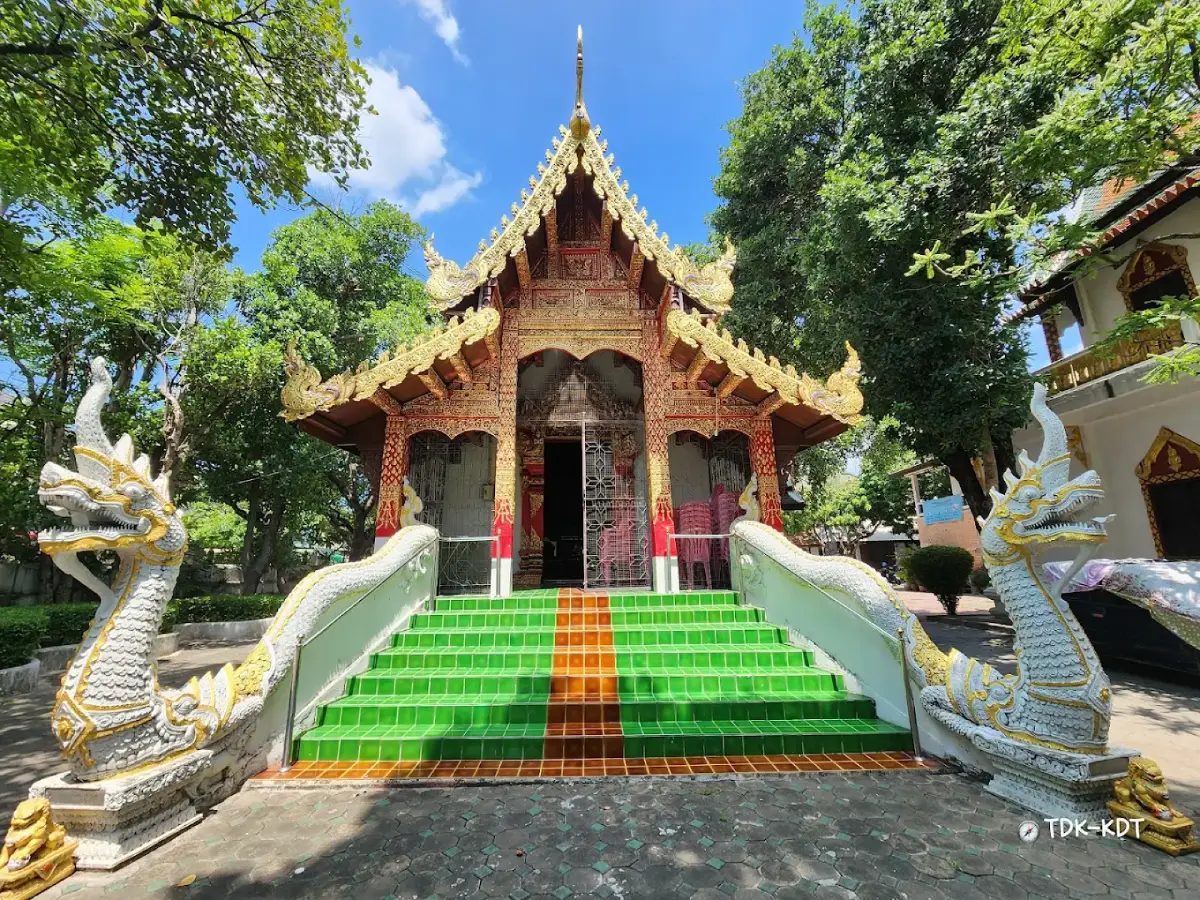
The viharn of Wat Phan Waen is a Lanna-style assembly hall built of brick and plaster. On the northern side, a projecting porch covers a naga stairway used as an entrance for monks. At the front are another naga staircase, a gable in the ma tang mai style, and gilded lacquered doors. These elements reflect Lanna craftsmanship, where the entrance to a sacred building is shaped through guardians, stairways, roof forms, and decorative surfaces. The naga staircase marks protection and transition, while the gable and doors give the building both beauty and religious dignity.
Although the original viharn was once a full teak building and was later repaired and altered, its essential role remains unchanged. It is the temple’s devotional center, where worshippers pay respect, make merit, listen to teachings, and join community religious activities. To appreciate the viharn properly, visitors should consider both its architectural form and its restoration history. It is not only an old building, but a structure repeatedly repaired and adapted so that the temple could continue functioning in Chiang Mai’s changing old city.
The ordination hall is another important feature. In Buddhist monastic practice, an ordination hall is used for formal Sangha activities and marks the temple’s completeness within the monastic system. After the temple had deteriorated, Phra Athikan Bunmi restored the ordination hall and celebrated it in 2519 B.E. Together with the viharn, chedi, monks’ residences, merit-making hall, and kitchen, the ordination hall helps Wat Phan Waen serve both monastic and community functions.
The temple once had an old teak scripture hall, but it was removed in 2517 B.E. because it had become too damaged. This detail is still historically important. In Lanna temples, scripture halls were used to preserve Buddhist scriptures, palm-leaf manuscripts, and religious texts. The fact that Wat Phan Waen once had a teak scripture hall shows that it had a broader role in preserving Buddhist knowledge, even though the original structure no longer survives.
Wat Phan Waen is best understood together with other old temples whose names reflect social rank, founders, or craft-based communities. Wat Phan On, Wat Phan Tong, Wat Phan Tao, and Wat Phan Waen help show the tradition of naming temples after the rank and personal name of the founder. Other nearby temples such as Wat Puak Taem, Wat Puak Chang, Wat Puak Pia, and Wat Puak Hong show the traces of occupational or community groups. When seen together, these temples reveal Chiang Mai as a network of communities, not merely a collection of separate religious sites.
Getting There is convenient because Wat Phan Waen is located within Chiang Mai’s old city. From Chiang Mai Gate, visitors can walk into Phra Pok Klao Road and nearby lanes. From Wat Chedi Luang or Wat Phan Tao, the temple can be reached by a short walk toward the southern part of the old city. Visitors staying around Ratchamankha Road, Samlan Road, Wua Lai, or the southern old-city area can reach the temple by walking, red songthaew, tuk-tuk, motorcycle taxi, or private car.
Visitors driving to Wat Phan Waen should plan carefully because the temple is located in an old-city neighborhood with narrow lanes, small accommodations, restaurants, houses, and other temples nearby. Parking can be limited, especially on weekends, in the evening, and on Sundays when the old-city walking street is active. Walking from nearby accommodation or using local transport is often the most convenient option, especially for visitors who plan to combine several temples in one route.
The best time to visit Wat Phan Waen is in the morning or late afternoon. These periods are more comfortable for walking and provide better natural light for seeing the stucco decoration on the chedi, details of the viharn, and the quiet local temple atmosphere. Visitors interested in photography should spend extra time around the white chedi, as it is the temple’s most detailed architectural feature. Ancient surfaces and stucco details should not be touched.
Wat Phan Waen can be included in several old-city walking routes. A short southern old-city route may include Chiang Mai Gate, Wat Phan Waen, Wat Muen Tum, Wat Chang Taem, and Wat Phra Chao Mengrai. An art-focused route can link Wat Phan Waen with Wat Puak Taem, Wat Puak Hong, and Wat Muen Ngoen Kong. A wider historic-temple route can continue to Wat Chedi Luang, Wat Phan Tao, Wat Phra Singh Woramahawihan, and the Sunday Walking Street area.
Visitors should follow normal Thai temple etiquette. Dress respectfully, speak quietly, remove shoes before entering designated sacred areas, avoid disturbing monks or worshippers, and do not touch ancient objects, Buddha images, chedi stucco, or religious structures without permission. Because Wat Phan Waen’s chedi contains important decorative stucco, careful and respectful observation is part of preserving the temple’s artistic heritage.
In summary, Wat Phan Waen is an old Chiang Mai temple whose value is greater than its size. It was built in 2040 B.E. by a local nobleman named Waen, formally registered in 2060 B.E., granted visungkhamsima in 2327 B.E., listed as abandoned in 2475 B.E., and later restored into an active temple. Its strongest highlight is the white Lanna bell-shaped chedi influenced by Burmese forms, decorated with zodiac animals, three-headed elephants, Buddhist narrative scenes, celestial figures, scrollwork, divine face motifs, a tapering spire, and a golden umbrella finial. For travelers interested in old temples, Lanna art, community history, and walkable cultural routes inside Chiang Mai’s old city, Wat Phan Waen is a meaningful place to include in an itinerary.
| Name | Wat Phan Waen |
| Temple Type | Local Buddhist temple under the Mahanikaya order |
| Location | Phra Sing Subdistrict, Mueang Chiang Mai District, Chiang Mai Province |
| Address | 50 Phra Pok Klao Road Soi 4, Phra Sing Subdistrict, Mueang Chiang Mai District, Chiang Mai Province 50200 |
| Coordinates | Latitude 18.78306, Longitude 98.98575 |
| Highlights | White Lanna bell-shaped chedi with Burmese influence, detailed stucco decoration, 12 zodiac animals, three-headed elephants, Lanna viharn, and quiet old-city temple atmosphere |
| History | Built in 2040 B.E., registered as a temple in 2060 B.E., granted visungkhamsima in 2327 B.E., listed as abandoned in 2475 B.E., and later restored into an active Buddhist temple |
| Name Origin | Named after the founder, a local nobleman with the rank of “Phan” and the personal name “Waen,” following the Lanna practice of naming local temples after the founder’s rank and name |
| Chedi | A white bell-shaped chedi with a square base, recessed lotus molding, three-tiered octagonal structure, divine face motif, tapering spire, and golden umbrella finial |
| Important Decorative Details | 12 zodiac animals, three-headed elephant stucco figures, small subsidiary chedis, Buddhist narrative reliefs, celestial figures, scrollwork, divine face section, spire, and umbrella finial |
| Viharn | A Lanna-style brick-and-plaster viharn with a northern porch covering a naga stairway for monks, a front naga staircase, ma tang mai gable, and gilded lacquered doors |
| Important Areas | White chedi, viharn, ordination hall, monks’ residences, merit-making hall, kitchen, courtyard, worship area, and community religious activity spaces |
| Major Restoration | Phra Athikan Bunmi Phothisampanno restored the viharn in 2512 B.E., celebrated it in 2514 B.E., removed the deteriorated old teak scripture hall in 2517 B.E., and restored the ordination hall and kitchen, celebrated in 2519 B.E. |
| Abbot / Caretaker | Phra Khru Siripariyattanusak, Dr. Khuttasilo |
| Current Status | Open to worshippers and visitors; it remains an active local Buddhist temple with resident monks and ongoing community religious activities |
| Open Days | Daily |
| General Visiting Hours | 08.00 – 17.00 |
| Travel Information | Accessible from Chiang Mai Gate, Wat Chedi Luang, Wat Phan Tao, Phra Pok Klao Road, Ratchamankha Road, and Samlan Road by walking, red songthaew, tuk-tuk, motorcycle taxi, or private car |
| Facilities | Viharn, worship area, courtyard, merit-making hall, kitchen, and limited parking depending on old-city conditions |
| Main Areas / Zones | Entrance area, viharn, ordination hall, white chedi, courtyard, worship area, monks’ residences, merit-making hall, and religious activity areas |
| Nearby Tourist Attractions | 1. Wat Phra Chao Mengrai, about 0.3 km 2. Wat Muen Tum, about 0.3 km 3. Wat Chang Taem, about 0.4 km 4. Wat Puak Taem, about 0.5 km 5. Wat Chedi Luang, about 0.6 km 6. Wat Phan Tao, about 0.7 km 7. Chiang Mai Gate, about 0.7 km 8. Wat Phra Singh Woramahawihan, about 1 km |
| Nearby Restaurants | 1. Khanom Jeen Pa Pom In Front Of Wat Phan Waen, about 0.1 km, Tel. 086-198-2679 2. Laab Kai Mueang Pan Waen, about 0.2 km, Tel. 082-888-5566, 053-814-743 3. Coconut Shell, about 0.6 km, Tel. 086-654-2746 4. Huen Phen, about 0.6 km, Tel. 053-814-548 5. Rachamankha Restaurant, about 0.7 km, Tel. 053-904-111 6. Dash Teak House, about 1 km, Tel. 053-279-230 |
| Nearby Accommodations | 1. Jomkitti Boutique Hotel, about 0.3 km, Tel. 098-831-2015 2. Chala Number 6 Hotel, about 0.4 km, Tel. 052-010-466 3. Pastell Oldtown Chiang Mai, about 0.5 km, Tel. 053-272-989 4. The Inside House, about 0.6 km, Tel. 053-904-699 5. Makka Hotel, about 0.7 km, Tel. 053-281-636 6. Rachamankha Boutique Hotel, about 0.8 km, Tel. 053-904-111 |
Frequently Asked Questions (FAQ)
Q: Where is Wat Phan Waen located?
A: Wat Phan Waen is located at 50 Phra Pok Klao Road Soi 4, Phra Sing Subdistrict, Mueang Chiang Mai District, Chiang Mai Province, close to Chiang Mai Gate, Wat Phra Chao Mengrai, Wat Puak Taem, Wat Muen Tum, and Wat Chedi Luang.
Q: What are the opening days and visiting hours of Wat Phan Waen?
A: Wat Phan Waen is open daily. The general visiting period is 08.00 to 17.00, which is suitable for worship, viewing the white chedi, and walking through Chiang Mai’s old-city temple route.
Q: When was Wat Phan Waen built?
A: Wat Phan Waen was built in 2040 B.E., formally registered as a temple in 2060 B.E., and granted visungkhamsima in 2327 B.E. It was listed as an abandoned temple in 2475 B.E. before being restored later.
Q: What is the origin of the name Wat Phan Waen?
A: The name comes from its founder, a local nobleman with the rank of “Phan” and the personal name “Waen.” This follows the Lanna tradition of naming local temples after the founder’s rank and name.
Q: What is the main highlight of Wat Phan Waen?
A: The main highlight is the white Lanna bell-shaped chedi influenced by Burmese forms. It features recessed bases, a three-tiered octagonal structure, detailed stucco decoration, 12 zodiac animals, three-headed elephants, celestial figures, scrollwork, divine face motifs, and a golden umbrella finial.
Q: What is the viharn of Wat Phan Waen like?
A: The viharn is a Lanna-style brick-and-plaster assembly hall with a northern porch covering a naga stairway for monks, a front naga staircase, a ma tang mai gable, and gilded lacquered doors.
Q: Who is the abbot of Wat Phan Waen?
A: The abbot of Wat Phan Waen is Phra Khru Siripariyattanusak, Dr. Khuttasilo, who oversees the temple and its ongoing community religious activities.
Q: What nearby places can be included in the same route?
A: Nearby places include Wat Phra Chao Mengrai, Wat Muen Tum, Wat Chang Taem, Wat Puak Taem, Wat Chedi Luang, Wat Phan Tao, Chiang Mai Gate, and Wat Phra Singh Woramahawihan.
 Category: ●Places of Worship
 Group: ●Temple
Last Update : 3 DayAgo
 Last Update : 3 DayAgo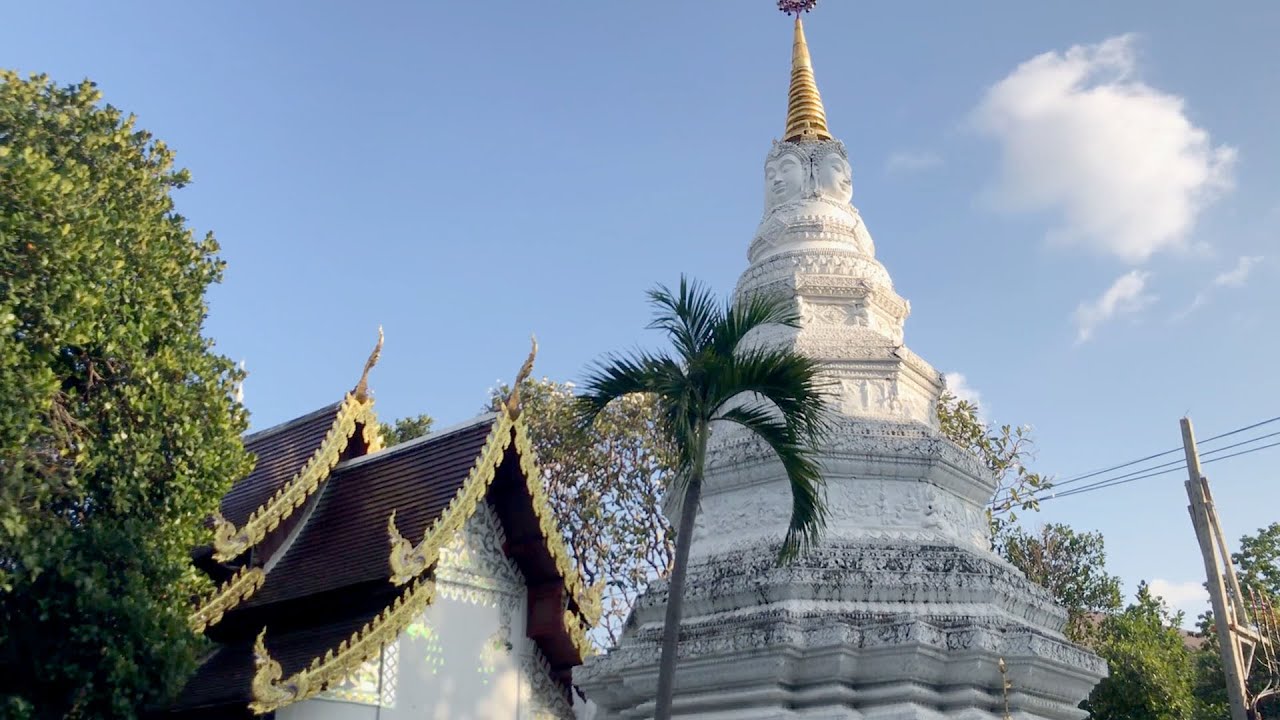
 Click to Access the Navigation Map GPS
Wat Phan Waen Map
Recommend

 Muang Chiang Mai(121)Chom Thong(47)Mae Chaem(25)Chiang Dao(33)Doi Saket(68)Mae Taeng(85)Mae Rim(69)Samoeng(29)Fang(71)Mae Ai(62)Phrao(70)San Pa Tong(105)San Kamphaeng(66)San Sai(73)Hang Dong(74)Hot(32)Doi Tao(22)Omkoi(11)Saraphi(74)Wiang Haeng(15)Chai Prakan(28)Mae Wang(32)Mae On(22)Doi Lo(34)Galyani Vadhana(1)


