
lovethailand home >North Travel Attractions >Chiang Mai Travel Attractions >Muang Chiang Mai >Mae He Ya > Wat Ubosot
TL;DR: Wat Ubosot is located at Ban Bo, Moo 2, Mae Hia Subdistrict, Mueang Chiang Mai District, Chiang Mai Province, open Daily, hours 08.00 – 17.00.
Wat Ubosot
Open Days: Daily
Opening Hours: 08.00 – 17.00
Wat Ubosot in Chiang Mai is a community Buddhist temple located at 67 Ban Bo, Moo 2, Mae Hia Subdistrict, Mueang Chiang Mai District, Chiang Mai Province. It is one of the old neighborhood temples of Mae Hia and is especially significant because of its historic role as an ordination and monastic assembly site, its old wooden ubosot, a northern Thai inscription dated 1847, a Lanna-style chedi with Sukhothai influence, a Phra Chao Than Chai viharn, and a newer viharn built on the site of an earlier hall. For travelers who want to explore temples beyond Chiang Mai’s old city moat, Wat Ubosot offers a quiet and meaningful view of Mae Hia’s religious, artistic, and community history.
Wat Ubosot is not a large tourist temple, but it has a strong cultural identity. Its name directly reflects the original religious function of the site. Before the present temple community developed, this area was remembered as a quiet wooded place with an old ordination hall used for monastic ceremonies. As houses gradually expanded closer to the site, the community developed around the hall and the temple came to be known as Wat Ubosot. The name therefore preserves the temple’s original role as a sacred space for Sangha rites.
The surrounding village is known as Ban Bo, a name connected with the many wells that once characterized the area. These wells were part of the older landscape of Mae Hia before modern urban expansion changed the community. Visiting Wat Ubosot therefore allows travelers to read the older geography of the area through place names: the temple name recalls the ordination hall, while the village name recalls water sources and settlement memory. This makes Wat Ubosot a useful site for understanding how Lanna temples grew from local landscape, water, forest, and community life.
According to the temple’s history, Wat Ubosot was founded in 1592 and received its consecrated boundary in 1667. The boundary measures 10 meters wide and 14 meters long. In Buddhist practice, a consecrated boundary is essential because it defines the formal area for monastic acts, especially ordination and Sangha assemblies. This gives Wat Ubosot a clear religious importance beyond its modest size. It was not only a local worship site but also a formal ritual space for monks in Mae Hia.
One of the most important historical roles of the temple was its use as a shared ubosot for monks from nearby temples in Mae Hia. Local accounts record that monks from Wat Tamnak Suan Khwan, Wat Ton Pin, Wat Tha Kham, Wat Pa Chi, and Wat Ubosot came together here for formal monastic observances. This shows that Wat Ubosot once functioned as a religious center for a network of temples in the area. It also reveals how older Mae Hia temples were connected through shared Buddhist practice rather than existing in isolation.
The temple compound covers about 5 rai. Important structures and areas include the ubosot, funeral pavilion, chedi, Phra Chao Than Chai viharn, and the new viharn built on the former site of an older hall. These features show that Wat Ubosot remains a living community temple. It serves worshippers, supports merit-making, preserves old religious architecture, and continues to provide space for community and Buddhist activities in Ban Bo and Mae Hia.
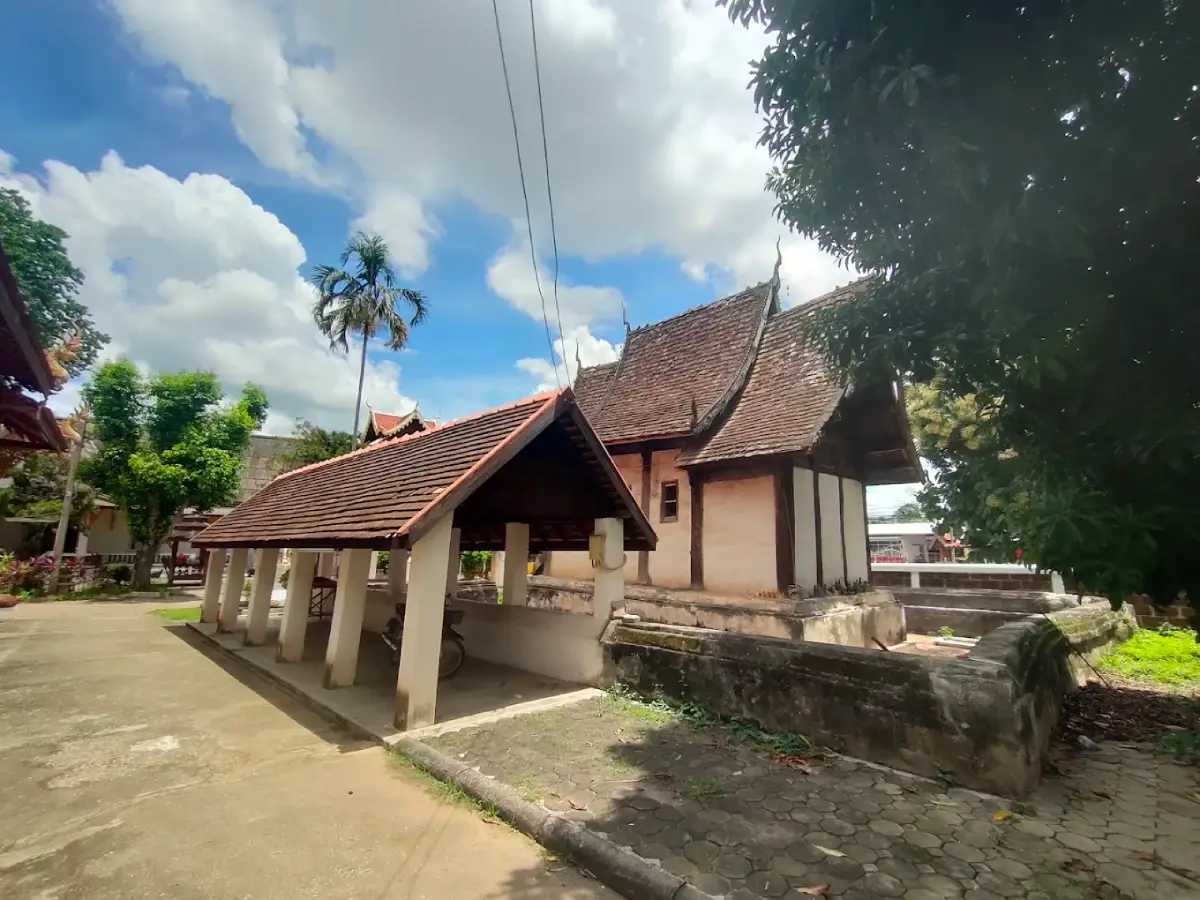
The most important feature of the temple is the old wooden ubosot. It is more than 150 years old and is built as a half-masonry, half-wooden structure with a two-tiered roof. Its gable is decorated with stucco foliate patterns and jewel-like Angwa glass ornamentation. Two guardian celestial figures stand along the stairway. This ubosot is valuable because it connects the temple’s name, its monastic function, old Lanna craftsmanship, and local memory in one structure.
Inside the ubosot is a wooden inscription panel about one cubit wide, coated with fired brick material and inscribed in old northern Thai script on two sides. The inscription records the auspicious date connected with the construction of this ubosot in 1847. It refers to Khruba Pothi of Wat Pa Chi, local patrons, community leaders, and devotees who helped build the ordination hall to support Buddhism. This makes the inscription one of the temple’s most important historical objects.
The Ban Bo Wat Ubosot inscription is highly valuable for understanding local Lanna religious history. It shows that the construction of the ubosot was a collective act of faith involving monks, villagers, and local leaders. The inscription is not only a religious record; it is also a social and historical document. It preserves the names, values, and intentions of people who worked together to maintain Buddhism in Mae Hia.
The old ubosot also has boundary markers that define the formal sacred area. These markers are associated with the consecrated space used for monastic acts. For visitors, this is an important point to understand: an ubosot is not simply an old building or a beautiful hall. It is a legally and ritually defined Buddhist space where monks perform essential ceremonies. Wat Ubosot’s old ordination hall therefore carries both architectural and doctrinal importance.
The main chedi behind the viharn is another major feature. It is a Lanna-style chedi with Sukhothai influence, enclosed by a low boundary wall. Decorative umbrellas stand at the corners. The square base is decorated with stucco designs of the 12 zodiac animals. Above the base are indented lotus mouldings, niches containing Buddha images in the Subduing Mara posture, two tiers of octagonal malaitha elements, an inverted bell-shaped body, and a nine-tiered golden umbrella at the top.
The 12 zodiac designs around the chedi base are especially meaningful in northern Thai culture. Zodiac symbolism is connected with birth years, merit-making, pilgrimage traditions, and auspicious belief. When placed around the chedi, these motifs combine Buddhist devotion with Lanna cultural cosmology. Visitors should walk around the chedi respectfully and observe the base, niches, bell body, and upper structure without touching or climbing the monument.
The Buddha images in the Subduing Mara posture placed in the niches of the chedi express one of the central meanings of Buddhist art: the Buddha’s victory over defilement and temptation. Their presence around the chedi makes the monument a devotional space on all sides. The chedi is therefore not only an architectural object; it is a sacred center that brings together Buddha images, zodiac symbolism, Lanna religious design, and community faith.
The viharn is built in the Lanna style, with a two-tiered roof. The gable includes carved wooden foliate patterns and monkey figures. The stairway has makara-and-naga balustrades. Near the entrance, exterior wall paintings depict the Buddha’s teaching of the Ovada Patimokkha. Inside, the principal Buddha image is in the Subduing Mara posture, while murals on the walls tell stories from the Buddha’s life and the Ten Birth Stories. The viharn therefore works as a space of worship, craftsmanship, and visual Buddhist teaching.
The carved foliate and monkey designs on the viharn gable give the building a distinctive local character. Foliate designs symbolize growth, fertility, auspiciousness, and natural abundance, while animal imagery brings movement and vitality to sacred architecture. These details show that Lanna craftsmen often integrated plants, animals, and Buddhist symbolism into temple buildings in a balanced and lively way.
The makara-and-naga stairway is also important. In Lanna Buddhist architecture, nagas are associated with protection, water, fertility, and the guardianship of Buddhism. The makara is a mythic creature often used in sacred thresholds. Together, they mark the transition from ordinary space into a sacred hall. Walking up the viharn stairway is therefore symbolically different from entering an ordinary building.
The Ovada Patimokkha mural near the entrance is significant because the teaching summarizes the core Buddhist principles of avoiding evil, cultivating good, and purifying the mind. Placing this subject near the entrance works as a moral reminder before visitors enter the worship space. The mural is not merely decoration; it is a teaching device that communicates Buddhist ethics through image and place.
The murals inside the viharn tell the Buddha’s life and the Ten Birth Stories. In Lanna temple culture, murals have long served as visual lessons for local communities. They explain moral conduct, generosity, patience, effort, compassion, wisdom, and spiritual cultivation. At Wat Ubosot, the murals help visitors understand the temple as a place of learning as well as a place of worship.
The Phra Chao Than Chai viharn adds another devotional layer to the temple. In northern Thai Buddhist culture, Phra Chao Than Chai is associated with sincere prayer, focused intention, and the belief in swift fulfillment through faith and merit. Visitors can pay respect here quietly while observing standard temple etiquette. This area makes Wat Ubosot more than a historical site; it remains a place where local people come to pray and make merit.
Wat Ubosot is also known for the phenomenon of an inverted chedi shadow. This is a feature associated with certain northern Thai temples and reflects the relationship between temple architecture, light, openings, and visual perception. For visitors, it adds an experiential dimension to the temple: beyond buildings, inscriptions, and murals, the site also offers a subtle optical phenomenon connected with the sacred landscape.
The funeral pavilion reflects another important role of the temple in Thai community life. Temples are not only places for worship and sightseeing. They also support families during merit-making ceremonies, memorial events, and community gatherings. Wat Ubosot’s funeral and merit-making spaces show that the temple continues to serve people through important moments of life, remembrance, and religious practice.
Wat Ubosot remains active in contemporary Mae Hia. The temple and nearby community spaces have been used for local activities such as the Poy Mai Mueang or Songkran-related community tradition and ceremonies for paying respect to elders. This continuing use confirms that the temple is not an abandoned historical site. It remains a religious and social space for Ban Bo and the wider Mae Hia community.
Getting to Wat Ubosot is straightforward from central Chiang Mai. From Ton Payom Market, follow the irrigation canal road south toward Mae Hia and continue toward the Ban Bo area. Visitors can also approach from Chiang Mai–Hang Dong Road or the 700-Year Chiang Mai Road. Because there are several temples with similar names in Chiang Mai Province, it is best to use the full destination name: “Wat Ubosot, Ban Bo, Moo 2, Mae Hia.”
The temple fits well into a southern Chiang Mai and Mae Hia itinerary. Nearby cultural and leisure destinations include Wat Pa Chi, Wat Tamnak Suan Khwan Sirimangkhalachan, Wat Tha Kham, Wat Ton Pin, Wat Suan Phrik, Wat Phra That Doi Kham, Royal Park Rajapruek, Chiang Mai Night Safari, Wat Ton Kwen, and Baan Kang Wat. This makes Wat Ubosot a useful stop for travelers who want to combine local temples, old communities, parks, family attractions, and Doi Kham’s religious landscape.
Visitors can reach the temple by private car, motorcycle, red songthaew, tuk-tuk, or taxi-app service. When using local transport, state the destination clearly as “Wat Ubosot, Ban Bo, Mae Hia” to avoid confusion. From Chiang Mai International Airport, Nimmanhaemin, Suan Dok Gate, or Chiang Mai University, the irrigation canal road provides a convenient connection toward Mae Hia.
The best time to visit is in the morning or late afternoon. Morning is suitable for worship and quiet observation, while late afternoon works well for viewing architectural details in softer light. Visitors interested in the inverted chedi shadow or interior areas should stay within spaces open to the public and respect the temple’s religious use, as some areas may be used by monks or the local community.
Standard Thai temple etiquette should be followed. Dress modestly, remove shoes before entering sacred buildings, keep voices low, and avoid touching Buddha images, inscriptions, murals, woodwork, stucco, or old architectural elements. Do not climb the chedi base. If monks, local worshippers, or community ceremonies are present, visitors should step aside and allow religious activity to take priority.
For cultural photography, Wat Ubosot offers several meaningful subjects: the old wooden ubosot, stucco gable, Angwa glass decoration, guardian celestial figures, northern Thai inscription, Lanna-Sukhothai-influenced chedi, 12 zodiac base designs, Buddha-image niches, Lanna viharn, carved wooden gable, makara-and-naga stairway, and Ovada Patimokkha mural. Photography should be done respectfully, without flash near murals or inscriptions and without disturbing worshippers.
The strength of Wat Ubosot lies in its specific Mae Hia identity. It preserves the story of an old ordination hall, the Ban Bo well landscape, a shared monastic assembly site for five nearby temples, an 1847 northern Thai inscription, an old wooden ubosot, a Lanna-Sukhothai-influenced chedi, zodiac stucco motifs, Phra Chao Than Chai devotion, and the inverted chedi shadow. These details make the temple culturally rich even though it remains modest in scale.
Overall, Wat Ubosot is a worthwhile temple for travelers exploring the southern side of Chiang Mai and Mae Hia. Founded in 1592 and formally granted a consecrated boundary in 1667, it preserves an old monastic function, local inscription evidence, Lanna religious architecture, community faith, and an active role in present-day Mae Hia. Travelers who want a quiet temple near the city with deeper local meaning should include Wat Ubosot in a Mae Hia cultural route.
| Name | Wat Ubosot |
| Location | Ban Bo, Moo 2, Mae Hia Subdistrict, Mueang Chiang Mai District, Chiang Mai Province |
| Address | 67 Ban Bo, Moo 2, Mae Hia Subdistrict, Mueang Chiang Mai District, Chiang Mai Province, Thailand |
| Temple Type | Community Buddhist Temple Under The Mahanikaya Order |
| Temple Area | 5 rai |
| History | Founded in 1592. The site originally functioned as an ordination and monastic assembly area for monks in Mae Hia before the surrounding community developed into the present temple area. |
| Consecrated Boundary | Granted in 1667. The boundary measures 10 meters wide and 14 meters long. |
| Name Origin | The name comes from the old ubosot that served as a formal monastic assembly hall. Ban Bo refers to the old village landscape with many wells. |
| Highlights | Old wooden ubosot, 1847 northern Thai inscription, Lanna chedi with Sukhothai influence, 12 zodiac stucco motifs, Phra Chao Than Chai viharn, Lanna viharn, and inverted chedi shadow |
| Old Ubosot | Half-masonry, half-wooden building with a two-tiered roof, stucco foliate gable, Angwa glass decoration, and two guardian celestial figures along the stairway |
| Important Inscription | A two-sided old northern Thai inscription on a wooden panel coated with fired brick material, recording the construction of the ubosot in 1847 |
| Chedi | Lanna-style chedi with Sukhothai influence behind the viharn, enclosed by a boundary wall, with a square base, 12 zodiac stucco motifs, Buddha-image niches, inverted bell body, and nine-tiered golden umbrella |
| Viharn | Lanna-style hall with a two-tiered roof, carved wooden gable with foliate and monkey motifs, makara-and-naga stairway, Ovada Patimokkha mural, Buddha-life murals, and Ten Birth Stories |
| Sacred Objects / Key Features | Old ubosot, principal Buddha image in the Subduing Mara posture, chedi, Phra Chao Than Chai viharn, northern Thai inscription, and inverted chedi shadow |
| Current Status | Open for worship, merit-making, temple visits, and community activities in Ban Bo and Mae Hia |
| Open Days | Daily |
| Opening Hours | 08.00 – 17.00 |
| Main Contact Number | 053-111-031 |
| Facilities | Ubosot, Phra Chao Than Chai viharn, new viharn, chedi, funeral pavilion, merit-making area, walking area, and community activity spaces |
| Main Areas / Zones | Old ubosot, new viharn, Phra Chao Than Chai viharn, chedi, temple courtyard, funeral pavilion, inscription area, and inverted chedi shadow area |
| Travel Information | Accessible from Ton Payom Market by following the irrigation canal road south toward Mae Hia, or from Chiang Mai–Hang Dong Road and the 700-Year Chiang Mai Road. Use “Wat Ubosot, Ban Bo, Moo 2, Mae Hia” as the destination. |
| Visitor Guidelines | Dress modestly, remove shoes before entering sacred buildings, do not touch inscriptions, Buddha images, murals, woodwork, stucco, or old architectural elements, do not climb the chedi base, and respect monks and community activities. |
| Nearby Tourist Attractions | 1. Wat Pa Chi, About 1 km 2. Wat Tamnak Suan Khwan Sirimangkhalachan, About 2 km 3. Wat Tha Kham Mae Hia, About 3 km 4. Wat Ton Pin, About 4 km 5. Wat Phra That Doi Kham, About 4 km 6. Royal Park Rajapruek, About 5 km 7. Chiang Mai Night Safari, About 5 km 8. Wat Intharawat Or Wat Ton Kwen, About 6 km 9. Baan Kang Wat, About 7 km |
| Nearby Restaurants | 1. Basil? Mae Hia, About 0.2 km, Tel. 082-696-4932 2. Huen Burapha Mae Hia, About 0.5 km, Tel. 091-780-1767, 085-569-0953 3. Munchies Cafe, About 0.7 km, Tel. 081-764-3446 4. Num Mae Hia Hoi Tian Lao, About 1.5 km, Tel. 053-271-643, 087-173-3875 5. COCO Burrito Box Mae Hia, About 2 km, Tel. 093-132-0966 6. Phuket Pork Leg Rice Hia Meng, About 0.5 km |
| Nearby Accommodations | 1. Pool Suite Chiang Mai, About 4 km, Tel. 099-236-3222 2. Vdara Pool Resort Spa Chiang Mai, About 3 km, Tel. 061-270-5888 3. Pimlada Hotel, About 4 km, Tel. 099-269-4256 4. Donpin 8 / Timeless House Chiang Mai, About 5 km 5. B2 Premier Hotel & Resort, About 6 km, Tel. 052-009-564 6. Mountain Creek Wellness Resort Chiang Mai, About 6 km |
Frequently Asked Questions (FAQ)
Q: Where is Wat Ubosot located?
A: Wat Ubosot is located at 67 Ban Bo, Moo 2, Mae Hia Subdistrict, Mueang Chiang Mai District, Chiang Mai Province, in the Ban Bo community near the irrigation canal road and Mae Hia area.
Q: What are the opening hours of Wat Ubosot?
A: Wat Ubosot is open daily from 08.00 to 17.00.
Q: What is the history of Wat Ubosot?
A: Wat Ubosot was founded in 1592. The site originally functioned as an ubosot for formal monastic ceremonies in Mae Hia. It later became a community temple and received its consecrated boundary in 1667.
Q: Why is the temple called Wat Ubosot?
A: The name comes from the old ordination hall that served as a formal monastic assembly space for monks in Mae Hia. The temple’s name directly preserves this original religious function.
Q: What should visitors see inside Wat Ubosot?
A: Important features include the old wooden ubosot, the 1847 northern Thai inscription, the Lanna-Sukhothai-influenced chedi, the Phra Chao Than Chai viharn, the new viharn, the principal Buddha image, Buddha-life murals, Ten Birth Stories, and the inverted chedi shadow.
Q: Why is the Wat Ubosot Ban Bo inscription important?
A: The inscription is an old northern Thai text on a wooden panel coated with fired brick material. It records the construction of the ubosot in 1847 by Khruba Pothi of Wat Pa Chi and local devotees, making it an important record of Mae Hia’s religious and community history.
Q: How can travelers get to Wat Ubosot?
A: Travelers can reach the temple from Ton Payom Market by following the irrigation canal road south toward Mae Hia, or by entering from Chiang Mai–Hang Dong Road and the 700-Year Chiang Mai Road. Use “Wat Ubosot, Ban Bo, Moo 2, Mae Hia” as the destination.
Q: What nearby places can be visited with Wat Ubosot?
A: Nearby places include Wat Pa Chi, Wat Tamnak Suan Khwan Sirimangkhalachan, Wat Tha Kham, Wat Ton Pin, Wat Phra That Doi Kham, Royal Park Rajapruek, Chiang Mai Night Safari, Wat Ton Kwen, and Baan Kang Wat.
 Category: ●Places of Worship
 Group: ●Temple
Last Update : 3 WeekAgo
 Last Update : 3 WeekAgo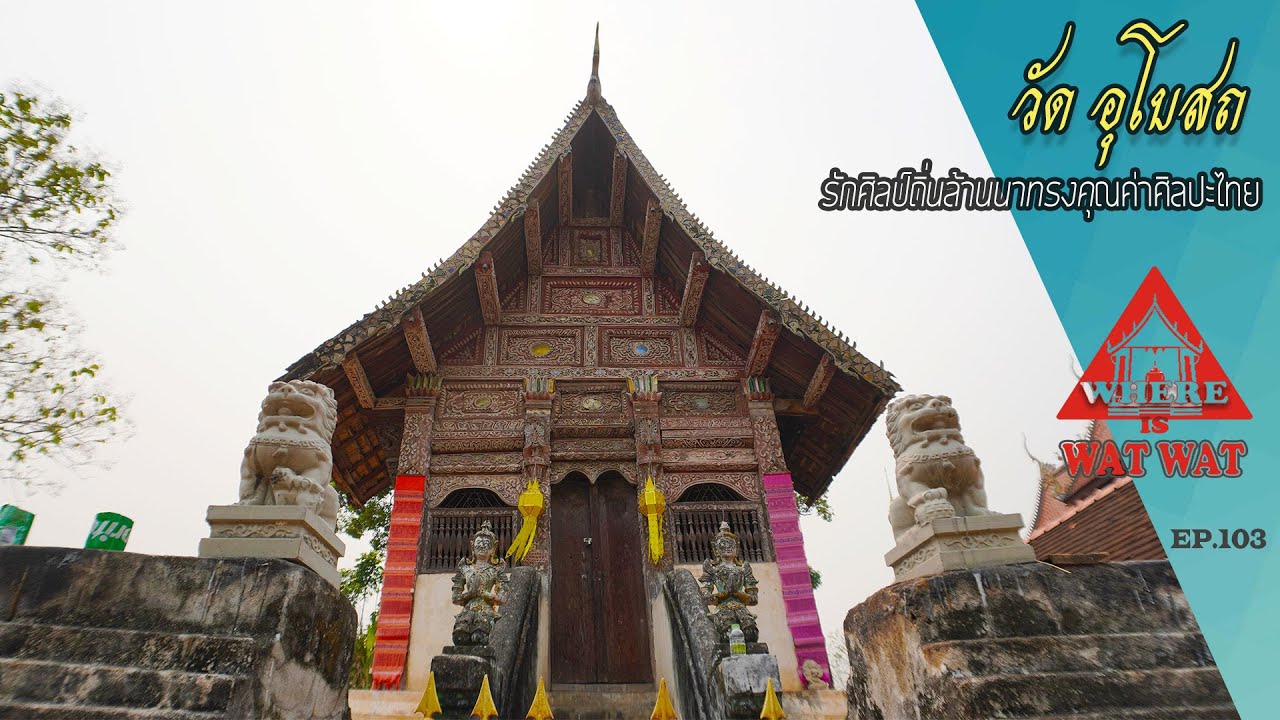
 Click to Access the Navigation Map GPS
Wat Ubosot Map
Recommend

 Muang Chiang Mai(121)Chom Thong(47)Mae Chaem(25)Chiang Dao(33)Doi Saket(68)Mae Taeng(85)Mae Rim(69)Samoeng(29)Fang(71)Mae Ai(59)Phrao(70)San Pa Tong(103)San Kamphaeng(66)San Sai(73)Hang Dong(73)Hot(32)Doi Tao(22)Omkoi(11)Saraphi(74)Wiang Haeng(15)Chai Prakan(28)Mae Wang(32)Mae On(22)Doi Lo(33)Galyani Vadhana(1)


