
lovethailand home >North Travel Attractions >Chiang Mai Travel Attractions >Muang Chiang Mai >Mae He Ya > Wat Pa Ji (Wat Pa Chi)
TL;DR: Wat Pa Ji (Wat Pa Chi) is located at Moo 3, Mae Hia Subdistrict, Mueang Chiang Mai District, Chiang Mai Province, open Daily, hours 08.00 – 17.00.

Wat Pa Ji (Wat Pa Chi)
Open Days: Daily
Opening Hours: 08.00 – 17.00
Wat Pa Chi, also known locally as Wat Pa Ji or Wat Pa Chi, is a community Buddhist temple under the Mahanikaya order in Moo 3, Mae Hia Subdistrict, Mueang Chiang Mai District, Chiang Mai Province. It is one of Mae Hia’s most culturally significant old temples, valued for its Buddhist role, Lanna architecture, historic viharn, Lanna-Sukhothai-influenced chedi, and its direct connection with the annual Liang Dong ritual of Pu Sae and Ya Sae. This makes Wat Pa Chi more than a local temple for worship. It is a living cultural landmark where Buddhism, ancestral belief, forest guardianship, water sources, and community identity meet.
Wat Pa Chi is suitable for travelers who want to understand Chiang Mai beyond the most visited temples inside the old city moat. The temple stands in Mae Hia, near the irrigation canal road, the route to Wat Phra That Doi Kham, Royal Park Rajapruek, Chiang Mai Night Safari, and Wat Ton Kwen. A visit to Wat Pa Chi therefore fits naturally into a southern Chiang Mai cultural route. Its main strengths are its foundation tradition dating to 1582, its historic Lanna viharn, detailed stucco decoration, a carved wooden doorway showing Indra standing on Airavata, a slender gilded changko-covered chedi, and the preservation of the phra bot cloth used in Mae Hia’s annual Liang Dong ceremony.
The temple’s name appears in several forms. Official temple lists commonly use Wat Pa Chi, while local usage may refer to it as Wat Pa Ji or Wat Pa Chi with a local pronunciation. The name is connected with Ban Pa Chi and the older landscape of Mae Hia, an area historically associated with forest, irrigation channels, water systems, and the foothills of Doi Suthep and Doi Kham. The name therefore preserves a memory of the original local environment. It reminds visitors that the temple grew from the relationship between village life, forest, water, and Buddhist devotion rather than from an isolated religious site.
Wat Pa Chi is recorded as having been founded in 1582, making it an old temple of Mae Hia with more than 400 years of local history. It received its consecrated boundary on 3 July 1989. The boundary measures 30 meters wide and 40 meters long. In Buddhist practice, a consecrated boundary is important because it marks the formal area for Sangha acts, especially ordination and other monastic ceremonies. Wat Pa Chi is therefore both an old community temple and a formally recognized Buddhist religious site still active in the present.
The temple compound covers 4 rai, 1 ngan, and 60 square wa under land title deed number 97. The temple’s land is closely related to old irrigation channels and the water system of Mae Hia. This relationship is important because many older Lanna temples were not separated from their surrounding landscape. They were connected with paths, canals, fields, forests, and community ritual spaces. Wat Pa Chi should therefore be understood together with the broader cultural geography of Mae Hia, especially Doi Kham, forest guardianship, water sources, and the Liang Dong ceremonial ground.
The atmosphere of Wat Pa Chi is relatively open and spacious compared with some shaded temples in central Chiang Mai. The compound has fewer large trees than mountain forest temples, but its artistic value is immediately visible through the historic viharn and other old structures. The viharn stands on a raised base of about half a meter. Its façade, stucco decoration, colorful glass, naga stairway, and carved wooden door give the temple a strong historic character. Wat Pa Chi is not impressive because of monumental size; it is impressive because of the density of Lanna craftsmanship within a compact community temple.
The historic viharn is the main architectural feature. It is a Lanna-style hall set on a raised base. The stairway balustrades are formed as nagas with orange and green scales, while the heads are decorated with green and blue glass. The chofa and nak sadung roof elements are also decorated with colored glass, making the hall stand out when natural light touches the surfaces. In Lanna Buddhist art, the naga is not merely ornament. It represents protection, water, fertility, and the guarded passage into sacred space.
The front of the viharn is densely decorated with stucco work. The gable is divided into sections according to the ma tang mai roof structure, a characteristic Lanna architectural form. The decoration includes foliate patterns, animals, and detailed ornamental motifs. This divided gable system allows the structure and decoration to be read together. Each panel contributes to the overall rhythm of the building. Visitors interested in Lanna craftsmanship should take time to observe the balance of lines, motifs, and spatial divisions on the façade.
The viharn doorway is especially valuable. It is carved in wood with the image of Indra standing on Airavata, the celestial elephant. In Buddhist and Lanna symbolism, Indra is associated with heavenly guardianship and support of Buddhism, while Airavata gives the composition dignity and power. Placing this image at the entrance to the viharn transforms the doorway into a symbolic threshold. Visitors should view the carving carefully and avoid touching the old wooden surface so that the craftsmanship can be preserved.
Behind the viharn is the ubosot, a Lanna-style ordination hall. The ubosot is important because it is connected with the temple’s formal monastic acts and consecrated boundary. Although it is not placed as the most visible front structure, its position within the compound creates a clear sequence of sacred spaces. Visitors can move from the viharn toward the ubosot and chedi, gradually understanding the temple’s layout as a working community monastery.
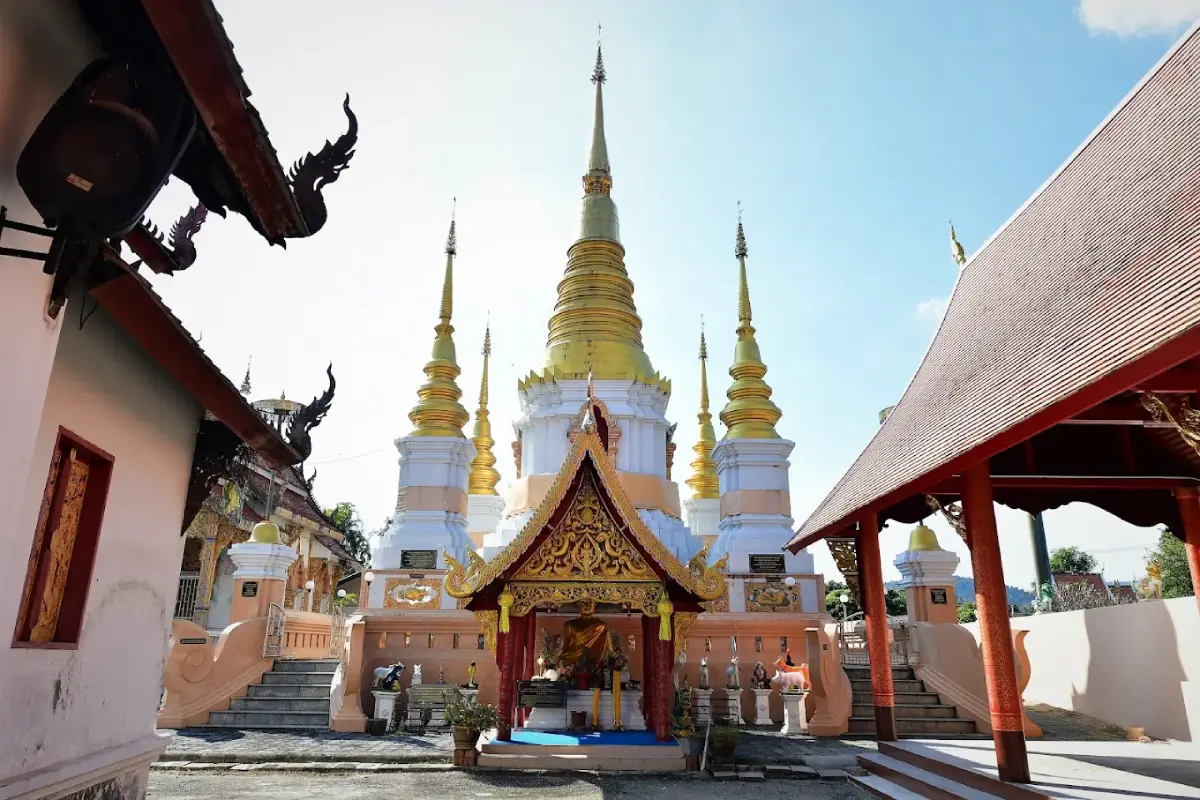
The chedi at Wat Pa Chi combines Lanna and Sukhothai artistic elements. It stands on a raised square platform about 1 meter high. Each corner has a small subsidiary chedi. The lower base is an indented square form, followed by a raised base with niches containing blessing Buddha images on all 4 sides. Above this rises a slender overturned-bell body covered with changko metal sheeting, crowned by a golden umbrella finial. The chedi is one of the most important features to observe because it combines sacred symbolism, regional artistic mixture, and refined proportion.
The 4 Buddha images in the niches around the chedi strengthen its symbolic meaning. The blessing posture suggests kindness, protection, and auspiciousness for worshippers. Placing these images in all 4 directions makes the chedi a sacred center that radiates blessing in every direction. Visitors can walk around the chedi quietly and observe the base, corner chedis, niches, bell-shaped body, changko surface, and golden finial without climbing or touching any old elements.
In front of the chedi is the Phra Chao Than Chai pavilion. Phra Chao Than Chai is a devotional tradition found in many parts of northern Thailand and is associated with sincere prayer, focused merit-making, and the hope that good aspirations will be fulfilled quickly. This pavilion adds a living devotional layer to Wat Pa Chi. Visitors do not only come to view old architecture; they can also participate respectfully in local Buddhist worship.
Other important monastic structures include the ubosot, sermon hall, ho trai-viharn, and monks’ residences. These features show that Wat Pa Chi functions as a full community temple. It supports worship, merit-making, monastic residence, community gatherings, and the preservation of Buddhist teachings. In Lanna temple culture, structures connected with scripture and teaching are especially important because they preserve the Dhamma and transmit knowledge across generations.
The feature that gives Wat Pa Chi exceptional cultural importance is its role as the place where the phra bot cloth is preserved. A phra bot is a cloth painting of the Buddha used as an object of veneration in Buddhist ritual. The term bot is derived from the Pali word pata, meaning cloth or woven fabric. At Wat Pa Chi, the phra bot is a key ritual object in the Liang Dong ceremony of Pu Sae and Ya Sae. It serves as a symbol of the Buddha within a ritual system that brings together indigenous spirit belief and Buddhism.
The phra bot has deep ritual significance in Liang Dong. In local belief, the image of the Buddha represented on the cloth helps restrain and bring forest spirits and ancestral powers within a moral Buddhist frame. The procession of the phra bot from Wat Pa Chi to the ritual ground is therefore not just ceremonial display. It is one of the central acts that gives the ritual balance between older spirit belief and Buddhist teaching.
Liang Dong is a major tradition of Mae Hia, held once a year around May to June, or during the northern Thai ninth lunar month. The ritual is dedicated to Pu Sae and Ya Sae, guardian spirits associated with the forest, water sources, and the Doi Kham area. The ceremony includes worship at the Pu Sae–Ya Sae shrine, offerings, a procession of the phra bot from Wat Pa Chi, and the Liang Dong ritual at the ceremonial ground near Doi Suthep–Pui National Park Unit 4 in Mae Hia.
The ritual includes spirit-mediumship and offerings according to old local belief. It should be understood within its cultural context rather than treated as a tourist performance. Liang Dong is connected with the protection of the forest, the fertility of land, seasonal rain, community well-being, and respect for ancestral powers. The continuing practice of the ceremony shows how strongly Mae Hia residents preserve local memory and the relationship between people and nature.
The legend of Pu Sae and Ya Sae tells of powerful beings associated with the Doi Kham landscape. According to local tradition, the Buddha subdued and taught them with compassion. The spirits accepted the teaching but retained a ritual relationship with the local people through annual offerings. This story explains why Liang Dong is not simply a spirit ritual outside Buddhism. It is a blended ritual in which the phra bot represents the Buddha’s presence and moral authority.
Wat Pa Chi is therefore a symbolic starting point of the Liang Dong ceremony. The phra bot kept at the temple is carried to the ritual ground, turning the route between temple, community, forest, and shrine into an annual sacred path. Villagers participate in the procession, offerings, ceremonial preparation, dance, and ritual order. The importance of Wat Pa Chi extends beyond the temple compound into the wider cultural system of Mae Hia.
From a conservation perspective, Liang Dong is also a local mechanism for reinforcing forest protection. Mae Hia residents understand Pu Sae and Ya Sae as guardians of the forest and water sources. If the forest is harmed, the well-being of the community is also affected. The ritual therefore functions as a cultural reminder that human life depends on ecological balance. This gives Wat Pa Chi contemporary relevance beyond heritage tourism because it is linked with environmental memory and community responsibility.
Visitors should approach Wat Pa Chi respectfully as both a Buddhist temple and a cultural heritage site. On ordinary days, they can worship, view the historic viharn, ubosot, chedi, Than Chai Buddha pavilion, and temple atmosphere. During the Liang Dong season, visitors should be especially careful. The ceremony is a living community ritual, not a staged show. Visitors should stay in appropriate areas, avoid disturbing the procession or ceremonial space, and respect elders, monks, ritual leaders, and local participants.
Getting to Wat Pa Chi is convenient from central Chiang Mai. From Ton Payom Market, follow the irrigation canal road south for about 6 kilometers. At the Ubosot Waree Prathan intersection, continue for about 300 meters, then turn right across the bridge and enter the lane for about 200 meters to reach the temple. This route is suitable for private cars, motorcycles, and taxi-app services because the temple is located inside the Mae Hia community but still close to main connecting roads.
From Chiang Mai International Airport or the Nimmanhaemin area, visitors can use Suthep Road or the irrigation canal road south toward Mae Hia. From Tha Phae Gate or the old city, travelers can connect through Suthep Road, the canal road, or Chiang Mai–Hang Dong Road. When using a hired vehicle, give the destination as “Wat Pa Chi, Moo 3, Mae Hia, near the irrigation canal road and Ubosot Waree Prathan” to avoid confusion with similarly named temples in other districts.
The best time to visit Wat Pa Chi is in the morning or late afternoon. Morning is suitable for worship and quiet observation. Late afternoon is better for viewing the viharn façade, stucco work, naga stairway, colored glass, and changko-covered chedi in softer light. Midday can be hot because the temple compound is relatively open. A careful visit usually takes 30–60 minutes, especially for those who want to observe the viharn, carved door, ubosot, chedi, and Than Chai pavilion.
Standard Thai temple etiquette should be followed. Dress modestly, remove shoes before entering sacred buildings, keep voices low, and avoid touching Buddha images, stucco decoration, carved wood, colored glass, or old architectural elements. Do not climb the chedi base. During ceremonies or merit-making events, give priority to monks and local residents. Photography should be respectful, especially during Liang Dong, because the ritual carries strong cultural and spiritual meaning for the Mae Hia community.
Wat Pa Chi is suitable for cultural photography. Key subjects include the historic Lanna viharn, raised base, orange-green naga stairway, green and blue glass decoration, colorful roof ornaments, dense stucco façade, ma tang mai gable structure, carved wooden doorway of Indra on Airavata, changko-covered chedi, and Phra Chao Than Chai pavilion. Good photography should capture the temple’s art and community setting without interrupting worship or ritual activity.
For itinerary planning, Wat Pa Chi combines well with important sites in Mae Hia and the Doi Kham area. A practical route can begin at Wat Pa Chi, continue to Wat Ubosot or Ubosot Waree Prathan, Wat Phra That Doi Kham, Royal Park Rajapruek, Chiang Mai Night Safari, Wat Ton Kwen, and Baan Kang Wat. This route shows southern Chiang Mai through temples, local tradition, forest foothills, family attractions, public gardens, and creative communities.
The strength of Wat Pa Chi is its direct relationship with Liang Dong. It preserves the phra bot used in the ceremony, contains a historic Lanna viharn, a Lanna-Sukhothai-influenced chedi, and stands in Mae Hia, the cultural heartland of the Pu Sae–Ya Sae tradition. These details make the temple more than a small local monastery. It helps explain the deep relationship between Buddhism, spirit belief, forest guardianship, environmental respect, and Chiang Mai community life.
Overall, Wat Pa Chi or Wat Pa Ji is an important old temple in Mae Hia that should be included in a route around Doi Kham, Rajapruek, and the irrigation canal area. Founded in 1582, it preserves a historic Lanna viharn, a changko-covered chedi, a Than Chai Buddha pavilion, and the phra bot used in the annual Liang Dong ritual of Pu Sae and Ya Sae. Visitors who want to understand Chiang Mai beyond famous central temples will find Wat Pa Chi especially meaningful because it reveals how Buddhism, local belief, forest, water, and community memory remain connected in contemporary northern Thai life.
| Name | Wat Pa Chi |
| Other Names | Wat Pa Ji, Wat Pa Chi |
| Location | Moo 3, Mae Hia Subdistrict, Mueang Chiang Mai District, Chiang Mai Province |
| Address | Moo 3, Mae Hia Subdistrict, Mueang Chiang Mai District, Chiang Mai 50100, Thailand |
| Coordinates | 18.745572, 98.936792 |
| Temple Type | Community Buddhist Temple Under The Mahanikaya Order |
| Temple Area | 4 rai, 1 ngan, and 60 square wa |
| History | Founded in 1582 as an old temple of Mae Hia and closely connected with the Liang Dong ritual of Pu Sae and Ya Sae |
| Consecrated Boundary | Granted on 3 July 1989. The boundary measures 30 meters wide and 40 meters long. |
| Highlights | Historic Lanna viharn, stucco façade, carved wooden door of Indra on Airavata, changko-covered chedi, Phra Chao Than Chai pavilion, and the phra bot used in the Liang Dong ritual |
| Viharn Features | Historic Lanna viharn on a raised base of about half a meter, with orange-green naga stairway, green and blue glass decoration, and colorful roof ornaments |
| Chedi Features | Lanna-Sukhothai-influenced chedi on a raised square platform, with 4 corner chedis, indented base, niches containing blessing Buddha images on all 4 sides, a slender changko-covered bell body, and golden umbrella finial |
| Important Tradition | Liang Dong ritual of Pu Sae and Ya Sae, held once a year around May to June or during the northern Thai ninth lunar month |
| Ritual Significance | Wat Pa Chi preserves the phra bot cloth used as a symbol of the Buddha in the Liang Dong ritual. The cloth is carried from the temple to the ceremonial ground. |
| Current Abbot / Caretaker | Phra Kritsana Khunakaro |
| Main Contact Number | 081-366-4929 |
| Open Days | Daily |
| Opening Hours | 08.00 – 17.00 |
| Current Status | Open for worship, merit-making, temple visits, and still culturally important in Mae Hia’s Liang Dong tradition |
| Facilities | Ubosot, sermon hall, ho trai-viharn, monks’ residences, historic viharn, chedi, Phra Chao Than Chai pavilion, and community merit-making areas |
| Main Areas / Zones | Historic viharn, ubosot, chedi, Phra Chao Than Chai pavilion, sermon hall, ho trai-viharn, monks’ residences, phra bot storage area, and temple courtyard |
| Travel Information | From Ton Payom Market, follow the irrigation canal road south for about 6 km. At Ubosot Waree Prathan intersection, continue about 300 meters, turn right across the bridge, then enter the lane for about 200 meters to reach the temple. |
| Visitor Guidelines | Dress modestly, remove shoes before entering sacred buildings, do not touch stucco work, carved wood, colored glass, Buddha images, or old architectural elements, do not climb the chedi base, and respect community rituals. |
| Nearby Tourist Attractions | 1. Wat Ubosot Or Ubosot Waree Prathan, About 1 km 2. Royal Park Rajapruek, About 2 km 3. Chiang Mai Night Safari, About 2 km 4. Wat Intharawat Or Wat Ton Kwen, About 2 km 5. Wat Phra That Doi Kham, About 3 km 6. Baan Kang Wat, About 5 km 7. Wat Umong Suan Phutthatham, About 5 km 8. Central Chiang Mai Airport, About 6 km |
| Nearby Restaurants | 1. Chamcha At Doi Kham, About 2 km, Tel. 083-473-9494 2. Saenkham Terrace, About 3 km, Tel. 053-838-990 3. Chom Cafe & Restaurant, About 3 km, Tel. 053-271-749 4. Khaomao-Khaofang Chiang Mai, About 4 km, Tel. 053-838-444, 063-665-5838 5. The Good View Village, About 4 km, Tel. 053-904-406 6. Khaomao-Khaofang Chiang Mai, About 4 km, Tel. 053-838-444 |
| Nearby Accommodations | 1. Mountain Creek Wellness Resort Chiang Mai, About 1 km, Tel. 053-111-424 2. Vdara Resort and Spa, About 3 km, Tel. 061-270-5888 3. Pool Suite Chiang Mai, About 4 km, Tel. 099-236-3222 4. Sukruethai Hotel Chiang Mai, About 5 km, Tel. 081-137-0949 5. Chiang Mai Marriott Hotel, About 8 km, Tel. 053-253-666 6. Meliá Chiang Mai, About 8 km, Tel. 052-090-699 |
Frequently Asked Questions (FAQ)
Q: Where is Wat Pa Chi located?
A: Wat Pa Chi, also known as Wat Pa Ji, is located in Moo 3, Mae Hia Subdistrict, Mueang Chiang Mai District, Chiang Mai Province. It is near the irrigation canal road, Ubosot Waree Prathan, Wat Phra That Doi Kham, Royal Park Rajapruek, and Chiang Mai Night Safari.
Q: What are the opening hours of Wat Pa Chi?
A: Wat Pa Chi is open daily from 08.00 to 17.00. Visitors can come for worship, merit-making, and to view the historic viharn, chedi, Phra Chao Than Chai pavilion, and local temple atmosphere.
Q: What is the history of Wat Pa Chi?
A: Wat Pa Chi was founded in 1582 and is an old community temple of Mae Hia. The temple covers 4 rai, 1 ngan, and 60 square wa, and received its consecrated boundary on 3 July 1989. The boundary measures 30 meters wide and 40 meters long.
Q: What should visitors see inside Wat Pa Chi?
A: Important features include the historic Lanna viharn, colored-glass naga stairway, stucco façade, carved wooden door of Indra on Airavata, ubosot, Lanna-Sukhothai-influenced chedi, Phra Chao Than Chai pavilion, ho trai-viharn, and the phra bot storage area.
Q: How is Wat Pa Chi connected with the Liang Dong ritual?
A: Wat Pa Chi preserves the phra bot cloth used as a symbol of the Buddha in the Liang Dong ritual of Pu Sae and Ya Sae. During the ceremony, the cloth is carried from the temple to the ritual ground near Doi Suthep–Pui National Park Unit 4 in Mae Hia.
Q: When is the Liang Dong ritual held?
A: Liang Dong is held once a year around May to June, or during the northern Thai ninth lunar month. It is an old Mae Hia ritual connected with Pu Sae and Ya Sae, forest guardianship, water sources, and community well-being.
Q: How can travelers get to Wat Pa Chi?
A: From Ton Payom Market, follow the irrigation canal road south for about 6 kilometers. At Ubosot Waree Prathan intersection, continue about 300 meters, turn right across the bridge, and enter the lane for about 200 meters to reach the temple.
Q: What nearby places can be visited with Wat Pa Chi?
A: Nearby places include Wat Ubosot, Wat Phra That Doi Kham, Royal Park Rajapruek, Chiang Mai Night Safari, Wat Intharawat or Wat Ton Kwen, Baan Kang Wat, Wat Umong Suan Phutthatham, and Central Chiang Mai Airport.
 Category: ●Places of Worship
 Group: ●Temple
Last Update : 2 DayAgo
 Last Update : 2 DayAgo
 Click to Access the Navigation Map GPS
Wat Pa Ji (Wat Pa Chi) Map
Recommend

 Muang Chiang Mai(121)Chom Thong(47)Mae Chaem(25)Chiang Dao(33)Doi Saket(68)Mae Taeng(85)Mae Rim(69)Samoeng(29)Fang(71)Mae Ai(62)Phrao(70)San Pa Tong(105)San Kamphaeng(66)San Sai(73)Hang Dong(74)Hot(32)Doi Tao(22)Omkoi(11)Saraphi(74)Wiang Haeng(15)Chai Prakan(28)Mae Wang(32)Mae On(22)Doi Lo(34)Galyani Vadhana(1)


