
lovethailand home >North Travel Attractions >Chiang Mai Travel Attractions >Muang Chiang Mai >Chang Phueak > Wat Khuang Sing
TL;DR: Wat Khuang Sing is located at Ban Khuang Sing, Moo 3, Chotana Road, Chang Phueak Subdistrict, Mueang Chiang Mai District, Chiang Mai Province, open Daily, hours 08.00 – 17.00.
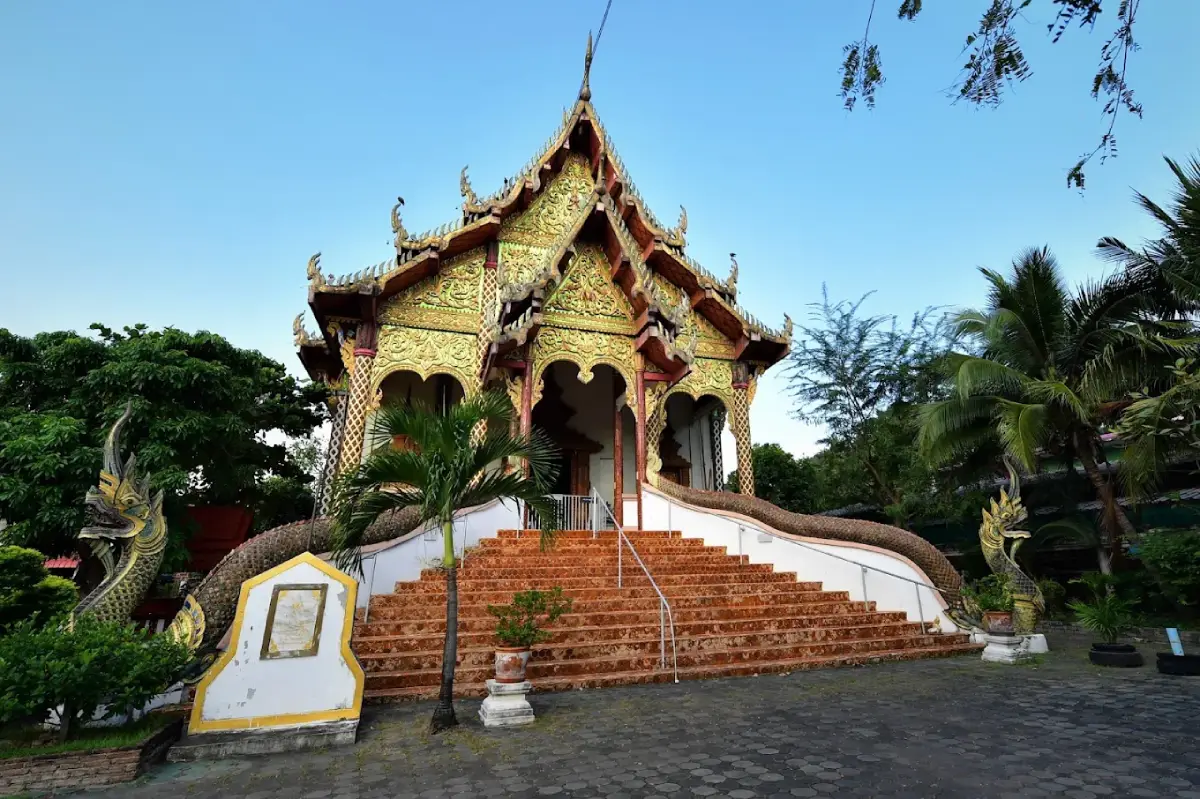
Wat Khuang Sing
Open Days: Daily
Opening Hours: 08.00 – 17.00
Wat Khuang Sing in Chiang Mai is a historic community temple located at Ban Khuang Sing, Moo 3, Chotana Road, Chang Phueak Subdistrict, Mueang Chiang Mai District. It is a Buddhist temple under the Mahanikaya order and is closely connected with the northern side of Chiang Mai city, the old Khuang Sing area, the auspicious symbolism of lions, and the restoration of religious life during the time of King Kawila. The temple is especially meaningful for travelers who want to understand Chiang Mai beyond the better-known temples inside the old city walls.
Wat Khuang Sing is suitable for visitors looking for a quiet, local, and historically layered temple in Chiang Mai. It is located near Chotana Road, the Chiang Mai-Lampang Superhighway, Chiang Mai National Museum, Wat Chet Yot, and the northern urban communities of Chiang Mai. This makes it easy to combine with nearby museums, old temples, local restaurants, and accommodation in the Chang Phueak area. The temple remains open for worship, merit-making, and cultural sightseeing during its daily operating hours.
The name “Khuang Sing” carries strong meaning in the Lanna cultural context. “Khuang” refers to an open ground or public field, while “Sing” means lion, an auspicious creature associated with power, protection, courage, and royal authority. The old Khuang Sing area was remembered as an open ground north of Chiang Mai where troops gathered, formed ranks, and performed auspicious rituals before military expeditions. The temple’s name therefore preserves both sacred and civic memory.
Wat Khuang Sing was formerly known as Wat Khuang Sing Chai Mongkhon. The name reflects the idea of victory, blessing, and auspicious protection. The temple was built under King Kawila, the ruler of Chiang Mai, and is commonly dated to around 1804. Its wider historical background is linked with the year 1801, when King Kawila ordered a pair of lion figures to be built in a broad open area north of the city. One lion faced east and the other faced north, with walls and a pond surrounding the sacred area.
After the lion figures were completed, rituals were performed to invite guardian spirits and sacred powers to reside there. The purpose was to create a protective and auspicious site for the city. When military forces were preparing to fight enemies or expand authority, they would stop at the Khuang Sing area to perform ceremonies before departure. This makes the site important not only as a Buddhist temple but also as a place tied to city protection, military rites, and Lanna political memory.
During the time of Chao Inthawichayanon, the temple was restored and improved. The longer name Wat Khuang Sing Chai Mongkhon gradually became shortened in common speech to Wat Khuang Sing, matching the name of the surrounding village and locality. This process is common in old Thai and Lanna temples, where the name used by the local community becomes the name remembered across generations.
The temple’s compound is closely connected with the surrounding community. To the north, it adjoins the village entrance and Khum Sing. To the south, it adjoins the Superhighway. To the east, it adjoins Wat Khuang Sing School and the village, while the west adjoins an irrigation canal embankment and community land. The temple also has 2 plots of monastic land totaling 10 rai and 72 square wa. These details show how the temple belongs to a living neighborhood made up of roads, schools, homes, water systems, and religious space.
The presence of Wat Khuang Sing School nearby reinforces the temple’s role as a community center. Like many Thai temples, Wat Khuang Sing has been connected not only with worship but also with education, local organization, and public life. The relationship between temple, school, and community is one of the clearest ways to understand how Buddhist temples continue to shape everyday life in Chiang Mai.
Wat Khuang Sing received its consecrated boundary for Buddhist ordination purposes on 10 July 1984. This consecrated boundary confirms the temple’s formal religious role, especially for monastic rites such as ordination. The temple therefore remains an active Buddhist institution, not merely a historical landmark.
One of the most important structures inside Wat Khuang Sing is the ubosot, or ordination hall. It is a 2-storey building, with the upper floor used as a scripture hall, or ho trai. Inside are mural paintings depicting the 13 chapters of the Mahachat, the story of Prince Vessantara. This structure is notable because it combines two important religious functions: the ubosot as a ceremonial space for monks, and the ho trai as a place associated with Buddhist scriptures and learning.
The Mahachat murals are among the temple’s most meaningful artistic features. The Mahachat, or Vessantara Jataka, teaches generosity, patience, sacrifice, and moral perfection. In a temple setting, murals help communicate Buddhist teachings visually to the community. Visitors should take time to observe these paintings because they show how art, storytelling, and Buddhist doctrine are brought together inside a local Lanna temple.
The viharn at Wat Khuang Sing is also a 2-storey brick-and-plaster building. Like the ubosot, it contains mural paintings of the 13 Mahachat chapters. The viharn is a public devotional space where laypeople can pay respect, make merit, listen to sermons, and take part in temple activities. For travelers, the viharn is one of the best places to understand the temple’s living religious function.
The temple also includes a sermon hall, known in Thai as sala kan parian. In Thai Buddhist communities, this hall is often used for merit-making, sermons, meetings, and community events. Because Wat Khuang Sing stands inside an active residential area, the sermon hall supports the temple’s role as a shared civic and religious space.
The monks’ residences are built in a half-concrete, half-wood style. This architectural character reflects the gradual adaptation of older temple buildings in Chiang Mai. Wood preserves the feeling of traditional northern architecture, while concrete and masonry provide durability for continued use. The result is a practical local temple environment that has evolved with the city.
Wat Khuang Sing also has a 2-storey multipurpose hall, as well as the Anonthawilat Samakkhi Memorial multipurpose hall. These buildings support temple ceremonies, community gatherings, and public activities. Their presence shows that the temple continues to serve local people in everyday life, not only during major Buddhist festivals.
The temple bell tower is another element that contributes to the atmosphere of Wat Khuang Sing. A bell tower in a Thai temple is both functional and symbolic. The sound of the bell marks time, calls attention to temple activities, and creates a sense of sacred order within the compound. Visitors should see the bell tower together with the ubosot, viharn, and chedi to understand the temple layout as a whole.
The prasat-style chedi is another distinctive feature of Wat Khuang Sing. In Lanna Buddhist tradition, a chedi is a focus of devotion and continuity. It represents the Buddhist faith across generations and often marks the spiritual center of a temple compound. At Wat Khuang Sing, the chedi adds architectural depth to a site already rich in civic, military, and religious memory.
A major event connected with the Khuang Sing community took place in 1926, when King Prajadhipok, Rama 7, visited Chiang Mai and came to this village area to receive a white elephant offered by the province. This event gave further significance to the Khuang Sing area, linking the community with a wider chapter of Chiang Mai and Thai royal history.
The recorded abbots of Wat Khuang Sing include Phra Khruba In, Phra Khruba Phrom, Phra Khruba Bom Uttamo, Phra Athikan Kham Ban, Phra Khruba Chan Kaew, Phra Athikan Di, Phra Athikan Chan Kham, Phra Athikan Un Ruean, Phra Athikan Chuea Sukkhawathumno, and Phra Khru Phisit Phiphitthakan. This lineage shows the continuity of monastic leadership that has helped maintain the temple across generations.
Phra Khru Phisit Phiphitthakan, also known as Khruba Bunpan Chaiyaphrom, is especially associated with the temple’s more recent history. He was born in Lamphun Province, ordained as a novice at 16, and became a monk at 21. After studying Buddhist discipline and northern Thai language, he was invited to serve as abbot of Wat Khuang Sing. His role is linked with religious education, temple care, and the continuation of Buddhist practice in the Khuang Sing community.
Wat Khuang Sing also has an educational role. A Buddhist Dhamma school was opened at the temple in 1972, and the temple has also served as a local public training center. This educational function is important because it shows how the temple supports moral learning, community development, and Buddhist instruction for monks, novices, and laypeople.
A good visit to Wat Khuang Sing should begin with paying respect inside the main religious buildings. After that, visitors can observe the 2-storey ubosot, the upper scripture hall, the Mahachat murals, the 2-storey viharn, the sermon hall, the monks’ residences, the multipurpose halls, the bell tower, and the prasat-style chedi. Seeing the temple in this order helps visitors understand the compound as a complete religious and community space.
The atmosphere of Wat Khuang Sing is that of a local northern urban temple. Around the temple are Chotana Road, Wat Khuang Sing School, village houses, shops, markets, and major traffic routes. This setting shows how an old temple continues to exist within a modern city. For travelers, this is one of the temple’s strengths: it offers a realistic view of Buddhist life in Chiang Mai rather than a staged tourist experience.
Getting to Wat Khuang Sing is straightforward. From central Chiang Mai, use Chotana Road toward Khuang Sing Intersection and the Chiang Mai-Lampang Superhighway. The temple is in Ban Khuang Sing, Moo 3, Chang Phueak Subdistrict. Visitors can travel by private car, red songthaew, tuk-tuk, taxi app, or by using local transport to the Chang Phueak area and continuing with a short ride to the temple.
For a half-day itinerary, Wat Khuang Sing pairs well with Chiang Mai National Museum, Wat Chet Yot, the Highland People Discovery Museum, Lanna Rama 9 Park, Maya Lifestyle Shopping Center, Nimmanhaemin Road, Wat Lok Moli, and Chang Phueak Gate. This route gives visitors a balanced view of historic temples, local museums, northern communities, and modern Chiang Mai.
The best time to visit is in the morning or late afternoon. Morning is suitable for worship and quiet temple photography, while late afternoon is convenient for combining the visit with nearby restaurants or museum stops. Visitors should dress modestly, remove shoes before entering sacred buildings, keep voices low, and avoid touching Buddha images, murals, old objects, or restricted areas.
Wat Khuang Sing is also suitable for cultural photography. Interesting subjects include the temple buildings, bell tower, prasat-style chedi, the 2-storey ubosot and viharn, and the Mahachat murals. Photography should be done respectfully and should not disturb monks, worshippers, or ongoing ceremonies. Flash should be avoided near murals and older objects.
Overall, Wat Khuang Sing is a meaningful temple for travelers who want to see Chiang Mai through local history, Lanna symbolism, Buddhist art, and community life. Its story brings together King Kawila, the auspicious lion ground north of the city, military rituals, temple restoration, the 1926 royal visit, Buddhist education, and the continuing role of a neighborhood temple. For visitors who enjoy quieter temples with strong historical context, Wat Khuang Sing is a worthwhile stop in the Chang Phueak area.
| Name | Wat Khuang Sing |
| Location | Ban Khuang Sing, Moo 3, Chotana Road, Chang Phueak Subdistrict, Mueang Chiang Mai District, Chiang Mai Province |
| Address | 15 Chotana Road, Chang Phueak Subdistrict, Mueang Chiang Mai District, Chiang Mai 50300, Thailand |
| Coordinates | 18.812796, 98.982763 |
| Highlights | Historic temple in the Khuang Sing area, linked with King Kawila, auspicious lion symbolism, old military gathering grounds, a 2-storey ubosot, scripture hall, Mahachat murals, 2-storey viharn, and prasat-style chedi |
| History | Built around 1804, formerly known as Wat Khuang Sing Chai Mongkhon, and associated with King Kawila of Chiang Mai. The temple received its consecrated boundary on 10 July 1984. |
| Name Origin | Khuang means an open ground, while Sing means lion. The name refers to an auspicious northern ground connected with troop gatherings, pre-battle rituals, and the lion pair built by King Kawila. |
| Distinctive Features | 2-storey ubosot with an upper scripture hall, 2-storey brick-and-plaster viharn, Mahachat murals of 13 chapters, sermon hall, half-concrete half-wood monks’ residences, multipurpose halls, bell tower, and prasat-style chedi |
| Temple Boundary And Monastic Land | The temple adjoins the village entrance and Khum Sing to the north, the Superhighway to the south, Wat Khuang Sing School and the village to the east, and an irrigation canal embankment and village area to the west. It has 2 plots of monastic land totaling 10 rai and 72 square wa. |
| Travel Information | Accessible from central Chiang Mai via Chotana Road toward Khuang Sing Intersection and the Chiang Mai-Lampang Superhighway. Visitors can use a private car, red songthaew, tuk-tuk, taxi app, or local transport through the Chang Phueak area. |
| Current Status | Open for worship, merit-making, and temple sightseeing during operating hours |
| Open Days | Daily |
| Opening Hours | 08.00 – 17.00 |
| Facilities | Viharn, ubosot, sermon hall, monks’ residences, multipurpose halls, bell tower, merit-making areas, walking areas, and a convenient community setting |
| Main Areas / Zones | 2-storey ubosot, scripture hall, 2-storey viharn, Mahachat murals, sermon hall, monks’ residences, Anonthawilat Samakkhi Memorial multipurpose hall, bell tower, and prasat-style chedi |
| Abbot / Caretaker | Phra Khru Phisit Phiphitthakan |
| Main Contact Number | 053-220-973 |
| Nearby Tourist Attractions | 1. Chiang Mai National Museum, About 1 km 2. Wat Chet Yot, About 1 km 3. Highland People Discovery Museum, About 1 km 4. Lanna Rama 9 Park, About 1 km 5. Maya Lifestyle Shopping Center, About 3 km 6. Nimmanhaemin Road, About 3 km 7. Wat Lok Moli, About 3 km 8. Chang Phueak Gate, About 3 km |
| Nearby Restaurants | 1. Lapin Cafe Khuang Sing, About 1 km, Tel. 098-750-9815 2. Khuang Sing Chicken Noodles, About 1 km, Tel. 095-373-4718 3. Khuang Sing Champion Meatball Noodles, About 1 km, Tel. 090-331-6274 4. Chokdee Suki Haeng Khuang Sing, About 1 km, Tel. 097-939-7726 5. Made-To-Order Food Khuang Sing, About 1 km, Tel. 062-884-5655 6. Rad Na Khuang Sing, About 1 km, Tel. 063-971-6421 |
| Nearby Accommodations | 1. Khuang Singh Residence & Hotel Chiangmai, About 1 km, Tel. 053-223-000 2. Wintree City Resort Chiang Mai, About 1 km, Tel. 052-081-377, 093-689-1955 3. B2 Mountain Pano Residence Chiang Mai, About 2 km, Tel. 052-009-161 4. ibis Styles Chiang Mai, About 3 km, Tel. 053-908-888 5. Chiang Mai Phucome Hotel, About 3 km, Tel. 053-211-026 6. The Core St. by Stay Now, About 4 km, Tel. 053-218-163 |
Frequently Asked Questions (FAQ)
Q: Where is Wat Khuang Sing located?
A: Wat Khuang Sing is located at Ban Khuang Sing, Moo 3, Chotana Road, Chang Phueak Subdistrict, Mueang Chiang Mai District, Chiang Mai Province, near Khuang Sing Intersection and the Chiang Mai-Lampang Superhighway.
Q: What are the opening hours of Wat Khuang Sing?
A: Wat Khuang Sing is open daily from 08.00 to 17.00.
Q: Why is Wat Khuang Sing historically important?
A: Wat Khuang Sing was formerly known as Wat Khuang Sing Chai Mongkhon and is linked with King Kawila, the old northern ceremonial ground of Chiang Mai, auspicious lion symbolism, and military rites before campaigns.
Q: What does the name Khuang Sing mean?
A: Khuang means an open ground, while Sing means lion. The name refers to an auspicious open area connected with troop gatherings and protective lion symbolism in Lanna culture.
Q: What should visitors see inside Wat Khuang Sing?
A: Key features include the 2-storey ubosot, scripture hall, 2-storey viharn, Mahachat murals of 13 chapters, sermon hall, monks’ residences, multipurpose halls, bell tower, and prasat-style chedi.
Q: How can travelers get to Wat Khuang Sing?
A: Travelers can reach the temple via Chotana Road from central Chiang Mai. Private cars, red songthaews, tuk-tuks, taxi apps, and local transport through the Chang Phueak area are convenient options.
Q: Who is Wat Khuang Sing best suited for?
A: Wat Khuang Sing is suitable for travelers interested in old Chiang Mai temples, Lanna history, community temples, Mahachat mural paintings, and cultural sites outside the old city wall.
Q: What nearby places can be visited with Wat Khuang Sing?
A: Nearby places include Chiang Mai National Museum, Wat Chet Yot, Highland People Discovery Museum, Lanna Rama 9 Park, Maya Lifestyle Shopping Center, Nimmanhaemin Road, Wat Lok Moli, and Chang Phueak Gate.
 Category: ●Places of Worship
 Group: ●Temple
Last Update : 1 WeekAgo
 Last Update : 1 WeekAgo
 Click to Access the Navigation Map GPS
Wat Khuang Sing Map
Recommend

 Muang Chiang Mai(121)Chom Thong(47)Mae Chaem(25)Chiang Dao(33)Doi Saket(68)Mae Taeng(85)Mae Rim(69)Samoeng(29)Fang(71)Mae Ai(59)Phrao(70)San Pa Tong(105)San Kamphaeng(66)San Sai(73)Hang Dong(74)Hot(32)Doi Tao(22)Omkoi(11)Saraphi(74)Wiang Haeng(15)Chai Prakan(28)Mae Wang(32)Mae On(22)Doi Lo(34)Galyani Vadhana(1)


