

 Home
Home Chiang Mai(




Rating: 3.8/5 (4 votes)
 |
|  Map
Map 
 Have Map
  No Map
Phranakhon Si Ayutthaya attractions
Attractions in Thailand
Open Days: Daily
Opening Hours: 08.00 – 17.00
Koh Pak Chan (Ban Koh Pak Chan) is a place that reminds many people that Ayutthaya attractions are not limited to ancient temples and ruins on the historic island. In another part of Phra Nakhon Si Ayutthaya Province, there is a community area that is deeply connected to waterways and nature, and it still preserves a distinctly local rhythm of life in a way that makes you feel you are walking through a real, lived-in neighborhood—not a scene staged purely for photos. Koh Pak Chan is located in Ban Koh, Moo 1, Pak Chan Subdistrict, Nakhon Luang District, Phra Nakhon Si Ayutthaya. The area is commonly described as having originally been an island surrounded by rivers and forest. Most residents traditionally work in rice farming, grow home-garden vegetables, and make Mon-style bricks (it-mon), which form the core of the community’s identity. This strong sense of place makes it a compelling destination for travelers who want to get to know Ayutthaya through a more community-focused lens—unhurried, grounded, and far from the crowds that often gather at the province’s most popular tourist spots.
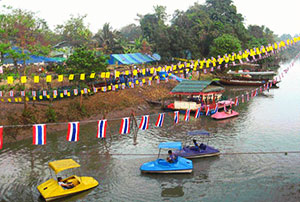
The word “island” in the context of Koh Pak Chan does not point to a faraway sea island that requires a long boat ride. Here, it refers to land encircled by canals and waterways within the wetland landscape typical of Thailand’s central plains. As you approach, what you often feel first is openness and a wash of green from the tree lines that frame the community. When the wind moves through, the water and surrounding vegetation soften the atmosphere naturally, inviting you to slow down without effort. This is where many visitors begin to understand why Koh Pak Chan suits a more intentional style of travel. It is not a place you rush through for a quick check-in before the next stop. Its charm lies in the continuity of everyday stories—the traces of local occupations, the relationship with water, and the local effort to restore balance to the environment over time.
From a traveler’s perspective, Koh Pak Chan offers an “off-the-beaten-path Ayutthaya” experience that contrasts strongly with the familiar imagery of tall chedis and old brick walls. Instead of walking among historic ruins under harsh sun and heavy crowds, you are brought into community roads where you can see fields, forest, and water coexisting at eye level. The simplicity of the setting makes real rest possible—whether you come to sit quietly, watch the water, listen to the wind, or take a slow walk until your thoughts settle. For people who work hard or live in cities full of constant stimulation, Koh Pak Chan can feel like a reset. It also shows that Ayutthaya still holds communities living close to nature, not only tourist zones shaped solely as products for visitors.
The story of Koh Pak Chan becomes even clearer through the lens of livelihoods. Most residents farm rice and grow household vegetables, which is a familiar picture of rural life in Thailand’s central region. What gives this community a more specific narrative, however, is “Mon-style brickmaking.” Brick production requires clay, and over time, the extraction of soil from the island for brickmaking in large quantities is said to have created environmental impacts within the community. These impacts are not only visual. They connect to the balance of wetland ecosystems, changes in the land itself, and the way residents feel about their home as the familiar landscape shifts. When the environment changes beyond what a community recognizes as normal, people naturally begin looking for ways to manage and restore livability. This is why “restoration” has become a central theme in how Koh Pak Chan is understood today.
The role of the Pak Chan Subdistrict Administrative Organization (SAO Pak Chan) is often mentioned as part of this restoration effort. One commonly cited approach is the construction of a road loop around the island to strengthen infrastructure and support a direction toward community-based tourism. In development terms, a road around the island is more than a transportation route. It becomes a structural backbone that helps the community manage access, circulation, and visitor distribution more systematically. With clearer, safer routes, the community can more easily plan welcoming formats, storytelling points, and areas that require special care. Most importantly, this kind of restoration signals an attempt to return to balance between daily life and welcoming visitors, rather than fast-tracking development in a way that disconnects the place from its original way of life.
Beyond environmental and infrastructure dimensions, Koh Pak Chan is also described as an area with historical importance dating back to the Ayutthaya period. In the broader geography of Ayutthaya, we can see how it has long been a “water city.” Waterways and wetlands played major roles in transportation, settlement patterns, and local economies. Riverside communities often held significance in one way or another within the city’s wider network. When Koh Pak Chan is spoken of as historically important since earlier times, visiting today can carry meaning beyond simply enjoying nature. You are walking through a place shaped by time and by generations of everyday life. At the same time, the community still maintains a distinct lifestyle and cultural identity of its own, which is the heart of community-based tourism. If you come ready to listen and observe, the place will tell its story through homes, the breath of the river, and the small, unforced details of daily life.
Community-based tourism does not mean turning a community into a stage. It means letting the community own the direction and pace of tourism. Residents decide what stories to share, how many visitors the area can reasonably host, which points need careful management, and how benefits should be distributed fairly. When you consider Koh Pak Chan’s context, it is easy to see why this approach fits. The community has livelihoods, narratives, cultural identity, and an ongoing environmental restoration challenge. Tourism is therefore not the final goal, but a tool that can create incentives and resources for caring for the community’s home more effectively. At the same time, travelers gain an experience that feels sincere and meaningful, because they are not only consuming a service—they are learning, respecting, and participating in a place that is gradually restoring itself.
If you ask what kind of traveler Koh Pak Chan suits, the clearest answer is those who want to see Ayutthaya through a community-and-nature lens. It fits people who enjoy open, calming scenery and who prefer not to stay in crowded areas all day. It also appeals to those interested in local development and community management, because the area carries stories of restoration after environmental impacts and of preparing for participatory community tourism. If you visit with intention, you begin to see that travel is not only movement. It can be an effort to understand the relationship between people and local resources in real places. That understanding naturally leads to more responsible travel, because you recognize that every place carries costs, scars, and hopes within it.
The best times to visit Koh Pak Chan are usually morning or late afternoon, when the weather in the central plains is less intense. Morning light is soft and clean, ideal for relaxed community walks and photographing nature and everyday life. In the evening, the light turns warmer and more atmospheric. Shadows across trees and water add depth, and breezes off the waterways often feel more soothing than midday heat. If you plan to spend time outdoors, it helps to bring drinking water, a hat, and sun protection. Even though greenery and riverside air can ease the heat, Ayutthaya’s open landscapes still require practical preparation for a comfortable trip.
One important point to understand from the start is that Koh Pak Chan is a living community before it is an attraction. Courtesy in how you use the space matters more than you might expect. Park in a way that does not block entrances, homes, or local routes. Keep noise at a reasonable level, especially in the morning and evening when residents rest. Be mindful of privacy when taking photos, and ask permission if you want to photograph individuals. Not littering is basic, but in wetland and waterway settings, cleanliness matters even more because small waste can easily spread and accumulate, affecting the ecosystem. Traveling with this kind of respect not only helps residents feel comfortable with visitors, it also helps Koh Pak Chan keep its charm as a real place over the long term.
Getting There Koh Pak Chan is straightforward to plan if you are traveling by private car. The idea is to head to Nakhon Luang District in Phra Nakhon Si Ayutthaya Province, then enter Pak Chan Subdistrict and set your destination to Ban Koh, Moo 1. As you get closer, using navigation and searching for “Koh Pak Chan” or “Ban Koh Pak Chan” helps you arrive accurately and reduces confusion on local roads with multiple small junctions. Once you reach the area, drive carefully and choose parking that does not disrupt the community, so your walk through the neighborhood feels comfortable both for visitors and for local residents.
For those without a private vehicle, a practical approach is to start by traveling to central Ayutthaya or a main transport hub in the province, then continue to Nakhon Luang District and use local transport or connecting rides into Pak Chan Subdistrict. It helps to specify the destination clearly as “Ban Koh Pak Chan, Moo 1, Pak Chan Subdistrict, Nakhon Luang District,” because local drivers often recognize village and subdistrict names more readily than broad descriptions. Checking the route on a map before departure is also recommended, especially to avoid losing time searching for the final turns of the trip.
If we define the meaning of visiting Koh Pak Chan as clearly as possible, it is a place that shows the relationship between people and water in a way that is still alive today. You can see how one community can hold deep livelihood roots, carry environmental scars from resource use, and still move forward with a steady effort to restore balance—with local agencies and residents advancing together step by step. Koh Pak Chan is therefore not a place you visit just to complete a checklist. It is a place suited to “spending time” and understanding Ayutthaya from another angle. For travelers who want their Ayutthaya trip to include nature and community culture in a more meaningful way, this is a simple choice with real weight and quiet impact.
| Place Name | Koh Pak Chan (Ban Koh Pak Chan) |
| Address | Ban Koh, Moo 1, Pak Chan Subdistrict, Nakhon Luang District, Phra Nakhon Si Ayutthaya 13260 |
| Coordinates (Latitude, Longitude) | 14.829083, 100.285500 (Referenced from coordinates stated in a research document on Ban Koh Pak Chan) |
| Place Summary | An island community in Nakhon Luang District surrounded by waterways and forest, with local livelihoods in rice farming, home-garden vegetables, and Mon-style brickmaking, alongside narratives of environmental restoration and preparation for participatory community-based tourism |
| Key Highlights | Island-and-waterway scenery with green landscapes, suitable for learning local ways of life, with restoration themes and infrastructure development (a road around the island) supporting community-based tourism |
| History / Significance (Brief) | Often described as historically significant since the Ayutthaya era, with a strong living community identity and an approach toward participatory community-based tourism |
| Latest Administrator | Pak Chan Subdistrict Administrative Organization (SAO Pak Chan) |
| Current Status | A community area that can be visited (recommended to check the latest local notices / activities before traveling) |
| Main Contact | SAO Pak Chan Tel. 035 360 951 (Referenced from local agency contact information) |
| Travel | By private car: Nakhon Luang District → Pak Chan Subdistrict → Ban Koh, Moo 1, then navigate to “Koh Pak Chan” / Public transport: travel into Ayutthaya, continue to Nakhon Luang, then local transport into Pak Chan |
| Nearby Attractions (With Distance) | 1) Prasat Nakhon Luang – Approx. 8 km 2) Wat Niwet Thammaprawat Ratchaworawihan (Bang Pa-In) – Approx. 22 km 3) Bang Pa-In Royal Palace – Approx. 22 km 4) Wat Yai Chai Mongkhon – Approx. 32 km 5) Ayutthaya Historical Park (Old City Area) – Approx. 34 km |
| Nearby Restaurants (With Distance + Phone) | 1) Krua Aim Aroy, Nakhon Luang – Approx. 12 km – Tel. 087-080-8765 2) Krua Khun Tao (Nakhon Luang) – Approx. 14 km – Tel. 081-070-9071 3) Baan Suan 89 Ayutthaya – Approx. 18 km – Tel. 065-587-8222 4) Restaurant / Dining at To Bakseng Hotel Ayutthaya – Approx. 10 km – Tel. 098-289-0387 5) Restaurant / Cafe at Sopisa Boutique Hotel Ayutthaya (Nakhon Luang Area) – Approx. 9 km – Tel. 064-626-8636 |
| Nearby Accommodations (With Distance + Phone) | 1) Wari Resort (Nakhon Luang) – Approx. 12 km – Tel. 081-987-1804 2) To Bakseng Hotel Ayutthaya – Approx. 10 km – Tel. 098-289-0387 3) Sopisa Boutique Hotel Ayutthaya – Approx. 9 km – Tel. 064-626-8636 4) Krungsri River Hotel (Ayutthaya City Area) – Approx. 34 km – Tel. 035-244-333 5) Centara Ayutthaya – Approx. 34 km – Tel. 035-243-555 |
Frequently Asked Questions (FAQ)
Q: Where is Koh Pak Chan located in Ayutthaya?
A: It is located in Ban Koh, Moo 1, Pak Chan Subdistrict, Nakhon Luang District, Phra Nakhon Si Ayutthaya, and is a community area on an island-like landscape surrounded by waterways and nature.
Q: What is Koh Pak Chan best known for?
A: It is known for its riverside community atmosphere, local livelihoods (rice farming, home-garden vegetables, and Mon-style brickmaking), and the community’s restoration story as it prepares for participatory community-based tourism.
Q: Why is there an environmental theme associated with Koh Pak Chan?
A: The community narrative notes that large-scale soil extraction on the island for Mon-style brickmaking affected the local environment, leading to restoration ideas and better land-and-resource management.
Q: How do I get to Koh Pak Chan by private car?
A: Drive to Nakhon Luang District in Phra Nakhon Si Ayutthaya, enter Pak Chan Subdistrict and head to Ban Koh, Moo 1, then use navigation to “Koh Pak Chan” to arrive accurately.
Q: Can I visit Koh Pak Chan without a private car?
A: Yes. Travel into Ayutthaya first, continue to Nakhon Luang District, then use local transport into Pak Chan Subdistrict. Clearly specify “Ban Koh Pak Chan, Moo 1” as your destination.
Q: When is the best time to visit for the atmosphere?
A: Morning and late afternoon are usually most comfortable, with softer light and pleasant breezes that suit walking through the community and photographing nature.
Q: What etiquette should visitors follow in the community?
A: Keep the area clean, do not litter, keep noise reasonable, park without blocking residents, and respect privacy—especially when taking photos.
 Koh Pak Chan Map
 Category:
  Group:
  Last Update: 2 DayAgo
Comment
 Nearby Attractions
| Keyword (Advance) |
 Facebook Fanpage
 Region
 Art, Culture and Heritage
 Historical Sites and Monuments(
 Landmarks and Memorials(
 Royal Palace(
 Art, Craft Centres, Tradition(
 Museums(
 Educational Places
 Museum for Study(
 Educational Gardens, Farm(
 Training Center(
 University
 Places of Worship
 Temple(
 Church(
 Mosque(
 Other religious and spiritural sites(
 Research and Development
 Royal Project(
 Suburban Living
 Village, Community(
 Local Market(
 Floating Market(
 Dam, Reservoir, Lake(
 River, Canal(
 Other natural attractions(
 Entertainment and Agricultural
 Animal camps and shows(
 Farm, Parks, Gardens and Ecotourism(
 Travel Articles, Recipes
 Travel Review, Food Review(