

 Home
Home Chiang Mai(




Rating: 3/5 (15 votes)
 |
|  Map
Map 
 Have Map
  No Map
Phranakhon Si Ayutthaya attractions
Attractions in Thailand
Open Days: Daily (except some public holidays)
Opening Hours: 08.00–17.00
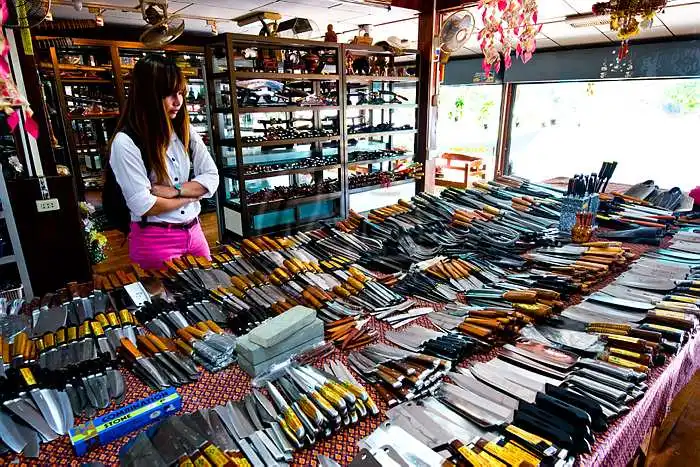
Aranyik Knife Village (Aranyik Knife Village) — Ban Ton Pho–Ban Phai Nong (Ayutthaya) is one of those Ayutthaya trips that doesn’t ask you to admire history from a distance, but instead brings you close to the living heartbeat of Thai craftsmanship. This is not a staged checkpoint designed for quick photos and fast exits. It is a real, densely populated community where families still earn their living through the same craft, handed down across generations. The rhythmic clang of hammer on hot steel, the pulse of heat from the forge, the moment metal shifts under skillful hands, and the calm focus of a craftsman during critical steps all make it instantly clear that “local wisdom” is not just something written in books. It exists in working methods, decision-making, discipline, and responsibility. For travellers, this is Ayutthaya in a completely different dimension from the popular island-of-temples route, yet it completes the picture of the province in a surprisingly satisfying way. A city’s long life is never built only on palaces, wars, and monuments — it is also built on the hands that shape tools, create household essentials, and quietly pass knowledge forward without interruption.
Aranyik Knife Village is located in Moo 6 and Moo 7, Tha Chang Sub-district, Nakhon Luang District, Phra Nakhon Si Ayutthaya Province. The production heart of the area is the paired communities of Ban Ton Pho and Ban Phai Nong. These villages are widely recognised as one of Thailand’s major knife-producing centres, with a reputation that has endured for nearly 200 years. What makes the place special is that it is truly a “craft village” in the literal sense: many households still work in the same trade as part of everyday life. They do not make knives merely to demonstrate for visitors; they make them to sell, to sustain their families, and to protect the standards behind the name that Thai people have long trusted — “Aranyik knives.” The moment you step into the area, you can feel that what is offered here is not only a product but a reputation built on long-term real use. That kind of trust is never created by advertising. It is created by details — how steel is chosen, how fire is controlled, how angles are hammered into form, and how the final edge becomes “sharp but not brittle,” which is the quiet core of a tool meant to live in a household for years.
The community’s background is often told through the story of migration and settlement. Local narratives describe the ancestors of Ban Ton Pho and Ban Phai Nong as a Vientiane group from Laos, who arrived in Thailand during the early Rattanakosin period. Many in this group were skilled artisans, especially goldsmiths and blacksmiths, so it is not surprising that when they found land suitable for metalwork and trade, they chose to settle. The community story paints an old-world picture of craftspeople dividing roles by strength and aptitude: the physically strong would work the forge and hammer iron, while those with steady hands and fine precision would craft gold ornaments. Later, around 1822, the goldsmith trade gradually declined, leaving knife-making as the primary profession. From that point, the village became deeply identified with a single occupation. For visitors, this matters. You are standing in a place where community identity has been forged by one craft for an exceptionally long time — long enough that the work itself became a national reputation.
The suitability of Ban Ton Pho and Ban Phai Nong for settlement is often explained through their earlier landscape. The area used to be thick bamboo forest, with swamps and the Pa Sak River flowing through. In those times, waterways were not just scenery — they were the main arteries for travel, trade, and transport. For a blacksmith community, bamboo was not merely a local plant; it was an industrial resource. Bamboo charcoal produces high heat, making it excellent for forging. Bamboo could also be used for building materials and daily necessities, including handles for hammers and knives — items a forge household needs constantly. When you zoom out, the area was both fertile in resources and rich in the raw materials that supported the craft. This explains why the settlements took names aligned with the land: Ban Phai Nong reflects bamboo and swamps, while Ban Ton Pho is said to have been named after a large sacred Bodhi tree once located at the centre of the village. Over time, the thick bamboo landscape thinned, some areas became farmland, and swamps grew shallower — but the craft remained. That continuity helps visitors see the difference between a story that is only told and a story that is still proven in daily work.
Another thread that gives the village greater historical texture is the community’s recorded prestige over different eras. Local accounts describe how the craft gained wide recognition during the reign of King Rama III, strengthening local stability and prosperity. Accounts also mention a royal visit in the reign of King Rama V, when the blacksmithing and knife-making were demonstrated with care and dignity. While these narratives may be shared through community memory, the key point for travellers is that Aranyik’s reputation is not a modern tourism invention. It is a long-built credibility, earned through quality and acceptance over time. Visiting today can feel like witnessing a continuing chapter of history — not a chapter that ended as soon as it was written down.
When people hear the name “Aranyik knives,” many assume the production must be in Ban Aranyik, Tha Ruea District. But the common explanation found across multiple sources is that, historically, Ban Aranyik (in Tha Ruea) was a lively trading area with shops and markets not far from these production villages. Knife-makers would bring their products there to sell. When buyers used the knives and found them excellent, word-of-mouth spread along with the name of the trading place, and “Aranyik” became the label people remembered. In other words, the name grew from the marketplace rather than the workshop. It is a classic example of an organic, pre-logo “brand” built without marketing campaigns — powered instead by trust and repeated real use. For travellers, the practical takeaway is clear: if you want to see the real making process, you should come to the Ban Ton Pho–Ban Phai Nong area in Nakhon Luang, where production continues actively today.
The best way to visit Aranyik Knife Village is to treat it as a place to “read the craft,” not merely glance at knives. A good knife is not only sharp; it must be sharp in a controlled way, durable without becoming brittle, and balanced enough to handle comfortably over time. In broad strokes, the process begins with preparing the steel and the forge, heating to a suitable temperature, and hammering the metal into form. The difference between handcrafted work and factory work lies in the maker’s control of the material through experience — a blacksmith reads colour, heat, resistance, and timing. Steel heated too far can lose key properties; steel not hot enough becomes difficult to shape and may show defects. Once the blade takes shape, the steps that many visitors do not notice become crucial: managing hardness, grinding, sharpening, and handle assembly. These determine comfort, safety, and long-term usability — the true value of a tool meant to be used, not just displayed.
Bamboo remains an important part of this village’s story, not merely as scenery but as practical technology within local knowledge. Bamboo charcoal produces high heat and helps stable fire control, which supports forging efficiency. Bamboo has also served as a versatile material for tools, household needs, and in earlier times, housing. This “resource–occupation–landscape” relationship makes Aranyik an excellent case study in how people read nature and turn it into long-term livelihood. As you walk around, it is worth noticing why some craftsmen still emphasise traditional fuel and why certain households keep methods that resemble older practices even in the modern world. The most common reason is simple: for people who make knives, quality is not negotiable.
Aranyik knives are often described in functional “families” such as household knives for kitchens, agricultural knives for gardens and farms, weapon-category blades (today more often made for collecting or artistry than everyday use), and other types adapted to specific user needs. What makes this interesting is that even though everything is called a “knife,” design details shift depending on use. Kitchen knives must reduce fatigue; chopping knives must withstand impact; garden blades must handle moisture, soil, and rough contact; and specialised tools require shapes that match real movement patterns. If you plan to buy, talking to the maker about how you will actually use the knife often leads to a better choice than selecting by appearance alone. A knife perfect for one person may be wrong for another if the work differs. This is one of the strongest charms of buying from a craft community: there is room for consultation, not only a quick checkout.
What makes Aranyik Knife Village more than a production centre is the cultural value system that frames the work. One of the community’s most important traditions is the Wai Khru (paying respect to teachers) or Wai Khru Bucha Tao (honouring the forge). This ceremony reflects reverence for teacher-masters, the fire, and the tools that sustain each household. From an outsider’s view, it might look like a normal ritual. But within a blacksmith community, it also functions as a reminder of responsibility: this craft demands discipline and care, because a failure in one knife can affect a user’s safety. In that sense, the ritual is not only belief; it is an ethics system — a community mechanism that keeps standards in focus. If you hear locals speak about it, you tend to understand why knife-making here is not simply “craft” but a relationship between livelihood, belief, and accountability.
To enjoy Aranyik Knife Village fully, you do not need to rush. The best approach is to walk slowly and look deeper. The reward lies in noticing differences between households. Some are especially skilled in forging and shaping, others in sharpening and grinding, others in handle assembly and finishing quality. Many families have their own signature technique developed through years of experience. If you want to understand what you are seeing, look at a knife as a design object: examine whether the edge line is straight and smooth, whether the spine is consistent, how the handle feels in hand, whether the balance suits the intended work, and whether the assembly is clean and durable. When you see the work this way, buying a knife becomes an experience, not just a souvenir. It also helps explain why the village’s reputation has stayed strong for so long.
Getting There If you start from central Ayutthaya, the most convenient way is by private car or hired transport. Take the Asia Highway (Highway 32) and follow signs toward Nakhon Luang District, then continue to Tha Chang Sub-district in the Ban Ton Pho–Ban Phai Nong area, which is the main production zone. There are also local buses on the Ayutthaya–Tha Ruea route, with onward travel into the Nakhon Luang area depending on your plan. If you want to connect with Ayutthaya’s older transportation identity, you can also view travel by water as a cultural experience, since this area has long been tied to the Pa Sak River. In practical terms, however, driving remains the easiest way for most visitors, especially if you intend to combine this visit with other Ayutthaya attractions in the same day.
In the end, Aranyik Knife Village is an Ayutthaya destination that gives the word “souvenir” a serious meaning again. What you buy is not a temporary decoration but a tool with a purpose — a tool that carries responsibility in real use. Seeing the process, understanding the community’s ethnic history, learning why the name “Aranyik” became widely known, and hearing about the Wai Khru Bucha Tao tradition that the village still preserves, all turn a short visit into something deeper. It is Ayutthaya as a city of great history and also close-to-hand history — history made by skilled working people. If you want to leave Ayutthaya with knowledge, feeling, and a practical object with lasting value, Aranyik Knife Village is a remarkably grounded answer.
| Name | Aranyik Knife Village (Aranyik Knife Village) — Ban Ton Pho–Ban Phai Nong |
| Address | Moo 6 and Moo 7, Tha Chang Sub-district, Nakhon Luang District, Phra Nakhon Si Ayutthaya Province, Thailand |
| Summary | A renowned Ayutthaya craft community specialising in real-use knives, passed down for generations. Ideal for travellers interested in Thai wisdom, hands-on craftsmanship, cultural souvenirs, and seeing authentic production in a living village. |
| Highlights | Watch real forging and knife-making, learn settlement and ethnic background, buy trusted quality knives for real use, and explore community culture such as the Wai Khru Bucha Tao ceremony that reflects craft values and standards. |
| Current Steward | Aranyik blacksmith network / local knife-makers in Ban Ton Pho and Ban Phai Nong (community producers) |
| Open Days | Daily (except some public holidays) |
| Opening Hours | 08.00–17.00 |
| Key Tradition | Wai Khru / Wai Khru Bucha Tao (honouring craft masters and the forge for auspiciousness and community craft discipline) |
| Contact Number | 035-715-346 |
| Coordinates | 14.504008, 100.652083 |
| Getting There | From central Ayutthaya, drive or hire transport via Asia Highway (Highway 32), then follow signs into Nakhon Luang District and continue to Tha Chang Sub-district (Ban Ton Pho–Ban Phai Nong). Alternatively, take the Ayutthaya–Tha Ruea bus route and continue into the area as needed. |
| Current Status | Open for visits and contact. Calling ahead is recommended, especially during public holiday periods. |
| Nearby Tourist Attractions With Distance | 1) Ayutthaya Historical Park (approx. 25 km) Tel. 035-242-525 2) Wat Yai Chai Mongkhon (approx. 24 km) Tel. 035-242-640 3) Wat Phanan Choeng Worawihan (approx. 23 km) Tel. 035-259-818 4) Bang Pa-In Royal Palace (approx. 32 km) Tel. 035-261-548 5) Chao Sam Phraya National Museum (approx. 26 km) Tel. 035-241-587 |
| Nearby Restaurants With Distance | 1) Ruay Kung Pao (approx. 26 km) Tel. 086-007-1451 2) Baan Mai Rim Nam Ayutthaya (approx. 25 km) Tel. 035-242-248 3) Baan Pom Phet (approx. 24 km) Tel. 035-242-242 4) The Summer House Ayutthaya (approx. 24 km) Tel. 094-224-2223 5) Malakor Kitchen and Cafe (approx. 23 km) Tel. 091-779-6475 |
| Nearby Accommodations With Distance | 1) Krungsri River Hotel (approx. 25 km) Tel. 035-244-333 2) Classic Kameo Ayutthaya (approx. 25 km) Tel. 035-212-535 3) Kantary Hotel Ayutthaya (approx. 26 km) Tel. 035-337-177 4) sala ayutthaya (approx. 23 km) Tel. 035-242-588 5) Centara Ayutthaya (approx. 26 km) Tel. 035-243-555 |
Frequently Asked Questions (FAQ)
Q: Who is Aranyik Knife Village suitable for?
A: It is ideal for travellers who enjoy Thai craftsmanship and local wisdom, visitors who want to see real production inside a living community, people seeking an Ayutthaya experience beyond the city-island temple route, and anyone who wants a practical souvenir such as a high-quality knife made for real use.
Q: Is this the same as Ban Aranyik in Tha Ruea District?
A: No. The main production area is in Ban Ton Pho and Ban Phai Nong, Tha Chang Sub-district, Nakhon Luang District. The name “Aranyik” became widely used because knives were historically sold and recognised by buyers through the old trading area called Ban Aranyik.
Q: What can you do when you visit?
A: You can walk through the community atmosphere, ask about the knife-making process, observe production steps in households that welcome visitors, and purchase knives or related craft items as souvenirs.
Q: What should you check when buying an Aranyik knife?
A: Look at the straightness and smoothness of the edge line, whether the handle assembly is clean and comfortable, whether the balance matches the work you intend to do, and ask the maker what blade shape best fits your real use.
Q: What is the Wai Khru Bucha Tao ceremony?
A: It is a community tradition honouring craft masters and the forge, asking for auspiciousness and reinforcing respect for the profession and the tools used to create the work.
Q: How long should you plan to spend here?
A: Typically 1–2 hours for a relaxed walk and shopping. If you plan to speak in depth with makers or visit multiple households, it is best to allow more time.
Q: What is the most convenient way to get there?
A: Private car or hired transport from central Ayutthaya is the easiest because it is time-efficient and makes it simple to combine with other attractions. Use Asia Highway (Highway 32) and follow signs into Nakhon Luang District, then continue into Tha Chang Sub-district.
 Aranyik Knife Handicraft Village Map
 Category:
  Group:
  Last Update: 3 DayAgo
Comment
 Nearby Attractions
| Keyword (Advance) |
 Facebook Fanpage
 Region
 Art, Culture and Heritage
 Historical Sites and Monuments(
 Landmarks and Memorials(
 Royal Palace(
 Art, Craft Centres, Tradition(
 Museums(
 Educational Places
 Museum for Study(
 Educational Gardens, Farm(
 Training Center(
 University
 Places of Worship
 Temple(
 Church(
 Mosque(
 Other religious and spiritural sites(
 Research and Development
 Royal Project(
 Local Market(
 Floating Market(
 Nature and Wildlife
 Dam, Reservoir, Lake(
 River, Canal(
 Islands(
 Other natural attractions(
 Entertainment and Agricultural
 Animal camps and shows(
 Farm, Parks, Gardens and Ecotourism(
 Travel Articles, Recipes
 Travel Review, Food Review(