

 Home
Home Chiang Mai(




Rating: 4.5/5 (4 votes)
 |
|  Map
Map 
 Have Map
  No Map
Phranakhon Si Ayutthaya attractions
Attractions in Thailand
Open Days: Daily (except some public holidays)
Opening Hours: 08.00–17.00
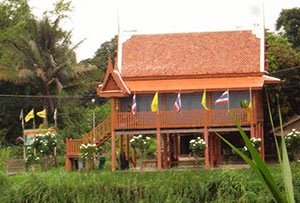
Sarai Village — Ban Sarai Homestay Community (Ayutthaya) is a strong answer for anyone looking for an “Ayutthaya attraction” that feels like a real community where people still live, work, and protect their way of life every day. This is not a place created mainly for photos and quick walk-throughs. It is a medium-sized village in Nakhon Luang District with a calm, genuine rhythm that visitors can sense immediately. Sarai’s charm is not the grandeur of ancient monuments, but the fact that it is a community that can truly make a living — from rice farming, Aranyik knives, agricultural tools, and the crafts made by multiple active women’s groups. When you step into the village, you will see houses with real life in them, steady work happening in the background, and the determination of local people who try to preserve both their occupations and the strength of the community at the same time. This is why Sarai Village suits travelers who want to see Ayutthaya beyond the old-city island area and return home with “experience” rather than just another checklist.
Sarai Village is located in Moo 5, Tha Chang Subdistrict, Nakhon Luang District, Phra Nakhon Si Ayutthaya Province. In the travel map of Ayutthaya, the story is often told through temples, palaces, and historic ruins in the island area. But when you move out toward Nakhon Luang, you begin to see “Ayutthaya through its people” — communities that still live with their occupations and maintain a continuous local identity. Sarai is one of the places that reflects that clearly, because it separated from the Ban Ton Pho–Ban Phai Nong community, which has roots in a Lao migrant group from Vientiane that settled in this area in the early Rattanakosin period. Local narratives explain that these settlers originally had strong artisan backgrounds, especially as gold craftsmen and blacksmiths, before their working life gradually changed and was passed down into what is widely known today as Aranyik knife-making. Once you understand this root, you will see Sarai not merely as a “tourist village,” but as a living piece of social history that is still moving forward.
What makes Sarai Village especially interesting is how naturally it shows the coexistence of “rice fields” and “craftsmanship.” The main occupation here is rice farming, alongside making Aranyik knives and producing tools connected to agriculture, including tableware and everyday items that match daily life. A community like this helps visitors understand the logic of rural Thailand: in a single year, village life rarely relies on only one activity. Instead, work rhythms follow seasons and market needs. One period focuses on caring for rice fields and managing farm tasks; another focuses on artisan work that requires strength, time, and precision. When these two paths move together, households gain more flexible income and can maintain stronger stability. For travelers, this matters because it shows that “local wisdom” is not an abstract idea — it is embedded in real life systems where people must eat, must use tools, and must pass knowledge to the next generation every day.
In terms of historical background, Sarai is connected to narratives about Lao migration from Vientiane into Thailand, followed by the building of a community based on artisan skills carried with them. The earlier livelihood included both gold craftsmanship and iron forging, reflecting a division of roles inside an artisan society that depended on both physical strength and fine detail. People with stronger bodies suited iron work, which demanded heat tolerance and heavy effort, while work requiring delicate hands and high concentration, such as gold, relied on those with careful eyes and steady control. Over time, many artisan livelihoods in different places changed with the economy and market demand: some crafts gradually faded, while another became a long-lasting core because it served real everyday needs — making knives and iron tools that people use in practice. When communities in this area built strong “use-quality standards,” reputation traveled through word of mouth, and eventually formed a common public perception: if you want a knife you can trust, you think of Aranyik. This understanding gives a visit to Sarai deeper meaning, because you are not only buying products — you are seeing the background of a trade that has deep roots and clear reasons for its survival.
That said, Sarai Village does not rely on knives alone when you look at the community economy as a whole. What makes it appealing for “community-style Ayutthaya travel” is the way local women’s groups have organized into multiple activities, creating a small but diverse economic system within the village. In the picture of Sarai, these groups include natural body-scrub herbal products, batik textiles that reflect both taste and patience, traditional Thai massage that connects to health wisdom, and artificial flower crafts that require careful precision and detail-focused eyes. These activities are valuable because they open space for people of different ages to participate in the local economy, and they keep the village from tying its future to only one product type. For travelers, this becomes a “visit with choices” — you can buy practical items, buy meaningful souvenirs, or choose service-based experiences like massage, and everything comes from a real working community.
If you want the best experience in Sarai Village, the key is not rushing to “cover everything,” but taking time to “read the community.” Look at how villagers divide their time between rice farming and artisan work. Notice how locally made agricultural tools differ from mass-produced items in shops. Observe what details in tableware or kitchen tools help people choose them for long-term use. Some items may look simple at first glance, but the true difference often lies in durability, balance, and how they feel in the hand — qualities that handmade work tends to deliver well because makers think from “real use” rather than only high-volume output. If you are interested in women’s group products, try asking about ingredient sources, making steps, or the inspiration behind batik patterns. Those answers give your purchases clearer stories and make supporting the community more meaningful than a simple transaction.
Another major element that gives Sarai Village a distinctive cultural identity is the “Wai Kru Tao” ceremony, also called the “Wai Kru Bucha Tao” ceremony. This is an important ritual passed down since grandparents’ time and is closely tied to the artisan occupation. The community states that every household performs it on the waxing day of the sixth lunar month each year, and importantly, it must fall on a Thursday. This strict requirement is not only about ritual detail; it reflects the community’s commitment to maintaining a shared tradition as one consistent standard. For outsiders, the ceremony may look like a typical ritual, but in an artisan community it also works as a reminder of “craft discipline.” Work involving fire, iron, and tools used by real people must always be done responsibly. A small mistake can create unsafe tools or reduce quality below what the community stands for. In this sense, the Wai Kru Bucha Tao ceremony becomes a quiet promise from makers: we will not be careless, we will respect the masters of the craft, we will respect our tools, and we will protect standards that match the trust of users.
From a traveler’s point of view, the Wai Kru Bucha Tao ceremony adds depth to the visit because it helps explain why certain artisan traditions can last for so long. Communities with shared rituals often have strong “collective mindset,” and that mindset supports both quality and occupational stability. When people hold similar values, the work produced tends to share a common language: intention, meticulousness, and a refusal to lower standards easily, even as the world of production changes. Visiting Sarai is therefore not simply seeing a village; it is seeing how “occupational culture” helps a community survive — and it changes how you look at a single tool or household item, because you recognize both skill and discipline behind it.
If you plan to buy something from Sarai Village, the most satisfying approach is choosing based on how you will truly use it. For knives or agricultural tools, it helps to explain clearly what you will use them for, how often, and who will be the primary user. Those answers make recommendations far more accurate. Good craft work usually does not sell itself with “sharpness” alone, but with suitability: does it feel comfortable in your hand, is the weight balanced, are handle edges smooth or irritating, and how should you maintain it so it lasts. If you are choosing women’s group products, a practical rule is to buy items you will genuinely use in daily life — skincare you will keep using, batik you can actually wear, or massage as a relaxing part of your trip. When a purchase is truly used, you will remember the community again and again, which is the value of strong community-based travel.
Sarai Village is also suitable for travelers who want an Ayutthaya route that avoids backtracking. One useful idea is to start in the island area for the “big picture” of history, then move out to Nakhon Luang for the “close-up picture” of people and working life. If you like a clear rhythm, consider leaving the city early morning or late morning, because walking through the community feels easier before the heat becomes strong and you have enough time to talk, learn, and choose items without rushing. Then you can return toward the city or continue to other stops as you prefer. This kind of trip gives you both “the grandeur of the past” and “the fine details of the present” in one day, and it helps you feel that Ayutthaya is not only what you already expect — it also has communities that build economy, preserve skills, and maintain shared culture in real time.
Getting There to Sarai Village (Ban Sarai Homestay Community) from Ayutthaya city, the most convenient option is using a private car or hired transport, because it is easy to control time and connect to other stops within the same day. A practical route is to leave the city via Asia Highway (Highway 32), then choose an entry route into Nakhon Luang District and continue toward Tha Chang Subdistrict. Once you are in Tha Chang, look for community signage and the route into Sarai Village in Moo 5. If you prefer public transport, you can first travel into Ayutthaya city and then continue toward the Nakhon Luang side using local routes available in the area. In practice, however, for most travelers, a private car or hired transport remains the most flexible choice — especially if you plan to buy souvenirs or visit multiple spots in one day.
In the end, Sarai Village is an “Ayutthaya attraction” that restores community travel to its most meaningful definition. This place does not tell its story through staged scenery; it tells its story through people, occupations, and a shared ritual like the Wai Kru Bucha Tao ceremony that is maintained with real seriousness. You will see why locals still take pride in Aranyik knives and hand-made tools, how women’s groups build income through crafts and services, and how rice farming remains a life foundation that supports the community on another side. If you want to return from Ayutthaya with a deeper understanding that a city is not only about historic monuments, but also about communities that keep the city moving forward, Sarai Village is a destination that answers that desire in a gentle but clear way.
| Place Name | Sarai Village — Ban Sarai Homestay Community |
| Address | Moo 5, Tha Chang Subdistrict, Nakhon Luang District, Phra Nakhon Si Ayutthaya |
| Place Summary | A medium-sized community in Nakhon Luang that combines rice farming, Aranyik knife-related crafts, agricultural tools, and multiple women’s groups. Ideal for travelers who want a real community experience in Ayutthaya with practical, meaningful local products. |
| Highlights | Authentic village life, Aranyik knife and iron-tool culture, women’s groups (herbal scrubs/batik/traditional Thai massage/artificial flowers, etc.), and the Wai Kru Bucha Tao ceremony that reflects artisan values. A strong option beyond the island-area route. |
| Latest Steward | Local community network and occupational groups in Sarai Village, together with the Ban Sarai Homestay community group (activities and visitor support) |
| Open Days | Daily (except some public holidays) |
| Opening Hours | 08.00–17.00 |
| Key Community Tradition | Wai Kru Tao / Wai Kru Bucha Tao ceremony, held by every household on the waxing day of the 6th lunar month each year, and it must fall on a Thursday |
| Contact | 035-730-957, 086-800-2657 |
| Travel | From Ayutthaya city, use a private car or hired transport via Asia Highway (Highway 32), enter Nakhon Luang District, head to Tha Chang Subdistrict, and follow local signage to Sarai Village (Moo 5) |
| Current Status | Open for visits/contact. Calling ahead is recommended, especially around public holidays. |
| Nearby Tourist Attractions With Distance | 1) Wat Phanan Choeng Worawihan (Approx. 23 km) Tel. 035-259-818 2) Wat Yai Chai Mongkhon Worawihan (Approx. 24 km) Tel. 035-242-640 3) Ayutthaya Historical Park (Approx. 25 km) Tel. 035-242-525 4) Chao Sam Phraya National Museum (Approx. 26 km) Tel. 035-241-587 5) Bang Pa-In Royal Palace (Approx. 32 km) Tel. 035-261-548 |
| Popular Restaurants Nearby With Distance | 1) Ruay Kung Phao (Approx. 26 km) Tel. 086-007-1451 2) Baan Mai Rim Nam Ayutthaya (Approx. 25 km) Tel. 035-242-248 3) Baan Pom Phet (Approx. 24 km) Tel. 035-242-242 4) The Summer House Ayutthaya (Approx. 24 km) Tel. 094-224-2223 5) Malakor Kitchen and Cafe (Approx. 23 km) Tel. 091-779-6475 |
| Popular Accommodations Nearby With Distance | 1) Krungsri River Hotel (Approx. 25 km) Tel. 035-244-333 2) Classic Kameo Ayutthaya (Approx. 25 km) Tel. 035-212-535 3) Kantary Hotel Ayutthaya (Approx. 26 km) Tel. 035-337-177 4) sala ayutthaya (Approx. 23 km) Tel. 035-242-588 5) Centara Ayutthaya (Approx. 26 km) Tel. 035-243-555 |
Frequently Asked Questions (FAQ)
Q: Who is Sarai Village suitable for?
A: It is suitable for travelers who want a real community-style Ayutthaya experience, enjoy learning about rice farming and artisan life, are interested in Aranyik knife-related craft and iron tools, or want practical local souvenirs, including products and services from women’s groups.
Q: How is Sarai Village connected to Aranyik knives?
A: Sarai shares roots with artisan communities in Tha Chang Subdistrict and continues blacksmith-related skills that have been passed down and developed into Aranyik knife-making and practical tools for household and agricultural use.
Q: What is the Wai Kru Bucha Tao ceremony?
A: It is an important artisan-community ceremony to honor craft masters and the forge/oven, asking for auspiciousness in work and life. The community performs it in every household on the waxing day of the 6th lunar month each year, and it must fall on a Thursday.
Q: What can visitors do when they come?
A: Visitors can walk through the community atmosphere, talk and learn about local livelihoods, shop for Aranyik knife-related items, agricultural tools, and tableware, and choose women’s-group products such as herbal scrubs, batik, local crafts, or traditional Thai massage services when available.
Q: How long should I plan to spend here?
A: Generally, 1–2 hours is enough for a relaxed walk and shopping. If you plan activities or deeper conversations, allow more time as appropriate.
Q: What is the most convenient way to get there?
A: A private car or hired transport from Ayutthaya city is recommended because it is time-efficient and easy to combine with other stops. Use Asia Highway (Highway 32), enter Nakhon Luang District, and continue to Tha Chang Subdistrict and Sarai Village.
 Sarai Village Map
 Category:
  Group:
  Last Update: 3 DayAgo
Comment
 Nearby Attractions
| Keyword (Advance) |
 Region
|
 Phranakhon Si Ayutthaya(