

 Home
Home Chiang Mai(




Rating: 3.8/5 (6 votes)
 |
|  Map
Map 
 Have Map
  No Map
Phranakhon Si Ayutthaya attractions
Attractions in Thailand
Open Days: Monday–Saturday
Opening Hours: 09.00–16.00
Portuguese Village (Ayutthaya) is one of those “things to do in Ayutthaya” that pulls travelers away from the familiar image of the city as only temples and ancient ruins. This small riverside area on the western bank of the Chao Phraya River in Samphao Lom invites you to see Ayutthaya as an “international port city” where people of many languages once arrived to negotiate, trade, exchange knowledge, and settle side by side. If you are used to visiting Ayutthaya to admire old brickwork and chedis, Portuguese Village adds a new layer to the trip immediately. It opens a window onto the world of foreign communities in Siam, the European age of sea voyages, and the everyday lives of people whose faith, language, and customs differed from ours, yet became closely intertwined with Ayutthaya’s history.
The location of Portuguese Village sits on the western bank of the Chao Phraya River, south of Ayutthaya’s old city center. When you look at the landscape the way Ayutthaya once worked, it becomes clear why the river mattered more than we often assume. In an era when roads were not the main stage, waterways functioned as the highway for people, goods, and news. The river was both a travel route and an economic system that sustained the capital. That is why foreign communities commonly settled along the river: it made shipping, contact with the royal city, and connection to wider trade networks possible in real daily life. Visiting Portuguese Village today feels like stepping back onto Ayutthaya’s “water map,” then slowly understanding how the city once opened itself to the wider world.
In the history of Ayutthaya’s relationship with the West, the Portuguese are recorded as the first European nation to establish trade contact with the kingdom. Accounts often mention an event in 1511 CE (B.E. 2054), when Afonso de Albuquerque, the Portuguese governor in Asia, sent Duarte Fernandes as an envoy to foster relations with King Ramathibodi II of Ayutthaya. This story matters in a broader sense because it reflects a moment when the world was shifting quickly due to seafaring technology, maritime trade routes, and competition for resources and markets across Southeast Asia. For Ayutthaya, Portuguese arrival did not mean being “affected” on one side only. It also meant negotiating and managing relationships with new players in the trade arena, and choosing pathways that allowed the capital’s economy to continue growing.
As contact expanded, some Portuguese settlers established themselves as traders in Ayutthaya, and they were not limited to commerce alone. Sources also describe Portuguese men serving as volunteer soldiers in Ayutthaya’s army. The idea of a “Portuguese community” therefore was not merely a foreign quarter where merchants opened shops. It was a community with multiple roles—economic, security-related, and cultural. One factor that made it a true community was the building of a church, both for religious outreach and as a center for communal life. In a port city where people of many faiths lived together, a sacred place did more than host ceremonies. It provided emotional stability, a support system, and a focal point for kinship and social ties among people living far from home.
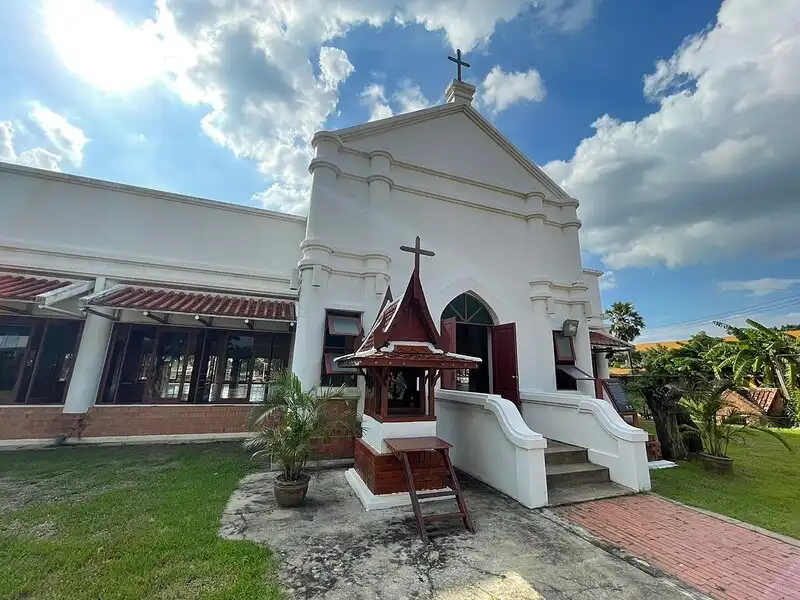
A key trace that turns these narratives into tangible evidence in the Portuguese Village area is the archaeological site of San Pedro, known in the Ayutthaya period as St. Dominic Church and associated with the Dominican order. It is often described as the first church built in Thailand, dated to 1540 CE (B.E. 2083). Although what we see today may be remnants and foundations, walking slowly and “reading” the site plan reveals a meaningful three-part layout. The front section served as a cemetery for Dominican Catholics, the central section functioned as a religious space and burial place for priests, and the rear and side areas were connected to living quarters and everyday life within the community. This arrangement makes it easy to feel that the church was not simply a stand-alone structure. It was the heart of a community, weaving together faith, death, memory, and daily living in one place.
The interest of Portuguese Village lies not only in “building ruins,” but also in what archaeological excavations have revealed about past lives through small objects and buried traces. Accounts mention a wide range of finds, from human skeletal remains and tobacco pipes to coins, ceramics, glass bangles, and religious items such as crosses, devotional medallions, and rosary beads. At first glance, these may look like mere “antiquities.” But to a traveler who wants to understand, they are fragments of real lives. Tobacco pipes hint at lifestyle and habit, coins reflect trade and economic systems, ceramics point to daily eating and living, and religious objects show the faith people carried with them even when they were far from home.
One reason Portuguese Village holds strong historical and archaeological weight is the cemetery area, where reports describe the discovery of as many as 254 skeletons, laid out in an orderly manner yet densely overlapping inside and outside the structure. A “crowded cemetery” is not an easy image, but it makes history more human. It tells us real people lived here, and that there were times of crisis when deaths were so numerous that burials had to overlap. Based on the alignment of the remains, the cemetery has been interpreted as having three zones. The innermost area in the center of the building, at the church base, may have contained priests or clergy. The second area may have been reserved for individuals of higher social standing within the Portuguese camp. The third area, outside the church base line, shows overlapping burials up to three or four bodies deep. Even in death, the pattern suggests social roles and hierarchy within the community.
When connected with historical documents that mention severe epidemics late in King Phetracha’s reign in 1696 CE (B.E. 2239), and another outbreak during King Thai Sa’s reign in 1712 CE (B.E. 2255), it becomes plausible that epidemic-related losses contributed to the cemetery’s expansion beyond its earlier boundaries. Reading Portuguese Village, therefore, is not only reading a story of “prosperity.” It is also reading the “fragility” of a port city in an age when disease, long-distance travel, and risks linked to trade and conflict were part of everyday life. Visiting here reminds us that Ayutthaya’s past is not only the beauty of architecture. It also includes the hardships that remain silent beneath brick remnants and the ground itself.
As a travel experience, Portuguese Village suits visitors who want to “travel to understand” rather than simply “travel to check in.” What the site offers is not a dramatic photo backdrop, but a new framework for seeing Ayutthaya. If you have tended to associate Ayutthaya with royal power, temples, and wars, walking through a Portuguese community site helps you see Ayutthaya as a city of diverse people—a city shaped by labor, expertise, and negotiation in international trade. That is why it is worth giving yourself time to “read” the details: the orientation of the structure toward the river, the cemetery layout, the objects on display that reflect everyday life, and the broader context of a community that once existed at this very spot. As the pieces come together, Ayutthaya starts to feel like a living port city, not a frozen ancient city captured only in photographs.
Another reason Portuguese Village fits well into a full-day itinerary is that it lies on the same riverside route as several major attractions on the western bank of the Chao Phraya. Planning a “river-hugging route” makes the trip smooth and reduces backtracking. For example, start in the old city area or a museum in the historic zone, then cross to the western bank to visit Wat Chaiwatthanaram and Wat Phutthaisawan, before continuing down to Portuguese Village. This creates a natural storyline in your head, moving from “religion and power” toward “port city life and foreign communities.” You can then end the day with riverside dining or grilled river prawns, another Ayutthaya signature closely tied to the river system.
Getting There from central Phra Nakhon Si Ayutthaya, you can drive along the Ayutthaya–Suphanburi road, then turn onto the riverside road that follows the Chao Phraya River and passes key landmarks such as Wat Chaiwatthanaram and Wat Phutthaisawan, before heading onward to Samphao Lom. The distance from the historic zone to the Portuguese Village area along the riverside route is typically only a few kilometers, making it ideal for a half-day to full-day plan combined with western-bank riverside temples. For easier planning, set your map destination to Samphao Lom and adjust your route into a loop, which saves time and prevents unnecessary back-and-forth.
A good way to make Portuguese Village feel “worth it” in terms of content is to view it as both a “community” and “evidence,” not merely a quick stop. Foreign communities in Ayutthaya are not distant stories; they are part of the city’s structure that helped the kingdom become a regional trade hub. Seeing the church remains and cemetery is therefore not just seeing the past of one group, but seeing how the wider world connected to Ayutthaya at a time when the kingdom was fully embedded in maritime trade networks. When you look through that lens, you begin to understand that “Ayutthaya-ness” is not only Thai identity as we commonly imagine it, but also a real international dimension that once lived here and left traces for later generations to learn from—right up to the present.
| Name | Portuguese Village (Ayutthaya) |
| Address | Samphao Lom Subdistrict, Phra Nakhon Si Ayutthaya District, Phra Nakhon Si Ayutthaya Province (western bank of the Chao Phraya River, south of the city center) |
| Summary | A historical learning site about the Portuguese community in the Ayutthaya period, featuring church and cemetery remains, narratives of international trade and volunteer soldiers, and archaeological evidence that helps explain Ayutthaya as an international port city |
| Highlights | San Pedro/St. Dominic Church remains, stories of the first European community in Ayutthaya, archaeological finds and religious objects, and the cemetery/epidemic narrative that reflects real lives in the past |
| Latest Management | Fine Arts Department (per agency/museum database sources) |
| Open Days | Monday–Saturday |
| Opening Hours | 09.00–16.00 |
| Fees | Free admission (please check the latest announcement before visiting) |
| Contact | 035-335-665 |
| Current Status | Open to visitors |
| Nearby Attractions With Distance | 1) Wat Chaiwatthanaram (approx. 2 km) Tel. 035-242-286 2) Wat Phutthaisawan (approx. 2 km) Tel. 035-241-195 3) Ayutthaya Historical Park (approx. 5 km) Tel. 035-242-525 4) Chao Sam Phraya National Museum (approx. 6 km) Tel. 035-241-587 5) Wat Phanan Choeng Worawihan (approx. 6 km) Tel. 035-243-867 |
| Popular Restaurants Nearby With Distance | 1) Baan Mai Rim Nam Ayutthaya (approx. 6 km) Tel. 035-242-248 2) Baan Pom Phet (approx. 7 km) Tel. 035-242-242 3) Malakor Kitchen and Cafe (approx. 8 km) Tel. 091-779-6475 4) Jay Tim 10 Baht Boat Noodles (approx. 15 km) Tel. 092-623-6645 5) Ruay Kung Pao (approx. 15 km) Tel. 086-007-1451 |
| Popular Accommodations Nearby With Distance | 1) Krungsri River Hotel (approx. 7 km) Tel. 035-244-333 2) sala ayutthaya (approx. 6 km) Tel. 035-242-588 3) Classic Kameo Ayutthaya (approx. 8 km) Tel. 035-212-535 4) Kantary Hotel Ayutthaya (approx. 8 km) Tel. 035-337-177 5) Centara Ayutthaya (approx. 9 km) Tel. 035-706-777 |
Frequently Asked Questions (FAQ)
Q: Who is Portuguese Village (Ayutthaya) best for?
A: It’s ideal for visitors interested in Ayutthaya’s international history, archaeology lovers, documentary-style content creators, students/field trips, and anyone who wants to understand Ayutthaya as a port city shaped by trade—not only temples and monuments.
Q: What should I focus on when visiting?
A: Focus on the church and cemetery remains, the narrative of Portuguese settlement, and the riverside context that helps you visualize Ayutthaya as an international port city.
Q: Why is this place important for understanding Ayutthaya?
A: It highlights Ayutthaya as a truly international city with foreign communities, trade, diplomacy, and multilingual coexistence—making the city’s historical picture more complete.
Q: How long should I spend here?
A: Around 1–2 hours for an easy visit. If you want to read and connect the story with western-bank temples, plan it as part of a half-day route.
Q: What’s the most convenient way to get there?
A: Driving is the most convenient. From central Ayutthaya, follow the route along the Chao Phraya riverside road past Wat Chaiwatthanaram and Wat Phutthaisawan, then continue toward Samphao Lom.
Q: What nearby places pair well in the same trip?
A: Many visitors combine it with Wat Chaiwatthanaram, Wat Phutthaisawan, Ayutthaya Historical Park, and Chao Sam Phraya National Museum for a one-day itinerary that blends religion, royal-city history, and Ayutthaya’s international port-city dimension.
Q: Is there an entrance fee?
A: Information indicates free admission, but it’s best to confirm the latest announcement before visiting.
 Portuguese Village Map
 Category:
  Group:
  Last Update: 3 DayAgo
Comment
 Nearby Attractions
| Keyword (Advance) |
 Region
|
 Phranakhon Si Ayutthaya(