

 Home
Home Chiang Mai(




Rating: 4.3/5 (4 votes)
 |
|  Map
Map 
 Have Map
  No Map
Phranakhon Si Ayutthaya attractions
Attractions in Thailand
Open Days: Saturday–Sunday
Opening Hours: 10.00 – 15.00
Lat Chado Market in Phra Nakhon Si Ayutthaya is widely regarded as one of central Thailand’s most genuinely “living” old markets. It was not created as a tourism set, but grew naturally alongside the canal, the community, and everyday trade—so much so that locals often describe it as a market with more than 100 years of history. The appeal here is not only the wooden riverside scenery or a staged retro aesthetic, but the feeling of walking through a real community that still breathes: timber walkways, long rows of wooden shophouses facing one another, and a variety of traditional shops that once formed the true “heart” of a local market. The Lat Chado Canal continues to tell the story of how people and water have long been intertwined. When you come to stroll through Lat Chado Market, you gain far more than shopping. You see layered community history, everyday life, and shared memories made tangible through vendors’ voices, the aroma of food, and the warm, unforced friendliness of local residents who have worked hard to preserve their home as a cultural conservation community without losing its identity.
The roots of Lat Chado Market are often explained as a market that gradually took shape from canal-side trade. In its earliest period, the image most frequently recalled is that of floating raft-houses, especially Chinese merchants who lived and traded on rafts moored along both sides of the canal, exchanging goods with people in nearby settlements. As commerce became livelier, the canal edge began evolving into a wooden riverside market, and later expanded steadily onto land until it became a large complex of almost a hundred shop units. These wooden shophouses face one another in aligned rows, forming broad walkways that function the way a true community market should. For visitors, this may resemble a charming old-fashioned market that photographs beautifully. For local people, however, this structure reflects a community economy built on mutual dependence: one shop sells daily essentials, another is a barbershop, another a tailor, another a photo studio, another a traditional Thai medicine shop. Together they form a small ecosystem that allows the community to continue without having to chase modernity at every turn. This is why Lat Chado Market matters beyond being an “Ayutthaya attraction”—it is a rare place that still tells the story of community life in a way major cities can hardly offer anymore.
Looking back through the lens of local history, the Lat Chado community was once known as “Ban Chakkarat.” It is said to have formed after the Burmese sacked Ayutthaya and withdrew in 1767. In the years that followed, people gradually rebuilt homes and reorganized community life in an area that remained suitable for making a living. Ban Chakkarat had waterways connecting out to the Noi River, making water travel convenient and helping canal-based trade flourish. Even though most visitors now arrive by car, you can still sense a community that continues to “think with the canal”: how houses face the water, how riverside space is used for boats, how traditional canal-side activities take place, and how residents’ memories are shaped by the sound of water and the seasons of the canal. The canal once teemed with freshwater fish, especially snakehead fish (pla chado), which were so abundant that they became the origin of the name “Lat Chado.” This name is more than a place label; it preserves the area’s natural character in language. Once you know the name’s origin, walking through the market gains a deeper layer, because you begin to see that the market did not grow from trade alone—it grew from landscape, water systems, and the richness of a freshwater environment that sustained the community for generations.
What makes Lat Chado Market stand out for cultural travelers is the “completeness” of its community elements. Your experience here is not limited to lines of food stalls or souvenir vendors. The community’s institutions and everyday structures remain in the same area: you can find a temple and a Chinese shrine that serve as spiritual anchors, a school that represents family life, traces of an old rice mill that reflect earlier economic patterns, and, most memorable to many, an old-style cinema or community entertainment space that still appears in local collective memory. When all these pieces come together, Lat Chado is not a market that exists in isolation, but a true “market community” where people actually live. Visitors who enjoy stories will find it rewarding to walk slowly and observe details: old wooden signage, folding window designs, and the way shops display goods without trying to “sell vintage” because age is simply the market’s natural condition.
Another layer of Lat Chado’s significance is the community’s joint effort to conserve its traditional buildings, leading to recognition through an architecture and heritage conservation award (as noted in tourism/community references). This shows that Lat Chado’s age was not left to decay with time, but protected through intention and a deep sense of belonging. This kind of conservation differs from restoring historic monuments because it preserves a place that is still used daily. It must allow residents to live, shops to operate, and visitors to come—without breaking the community’s way of life. Visiting with respect is therefore as important as taking beautiful photos, because every corner is a “lived space,” not merely a backdrop for outsiders. When you walk with attention, you notice subtle community textures: some shops maintain classic service styles, some vendors talk with customers like acquaintances, some families have stories of multi-generation businesses, and at certain hours you can see genuine local routines—organizing goods, cooking, and casual greetings that make the market lively without any need for staged performances.
As you wander deeper, you begin to encounter the “old shops” that give Lat Chado its distinctive flavor of memory: a photo studio that recalls a time when taking pictures was a meaningful family ritual, a tailor that represents careful craft, a barbershop that doubles as a local news hub, a general store that gathers household essentials in one place, and a traditional Thai medicine shop often discussed for its longstanding herbal knowledge. In particular, the Thai medicine shop run by “Mor Charan” is frequently mentioned in community narratives for its inherited traditional formulations. For visitors, the important approach is to view this as cultural heritage rather than a novelty product, because the value lies in the continuity of knowledge and the relationship of trust between the healer and local people. From a learning-travel perspective, you can observe, take notes or photos, and speak politely to understand the role of traditional medicine within a Thai community—without reducing it to sensational storytelling.
One reason Lat Chado can feel like a “living museum” is that there are spaces dedicated to preserving and presenting community stories. One example is the old-house museum associated with the local municipal leader, said to have once been a place that sold Buddhist ceremonial supplies and cloth wreaths—items historically well known in the area—before becoming an exhibition space for photographs and everyday objects from the past. It also includes displays such as freshwater fish specimens, which reinforce how deeply water and livelihood are connected here. This turns a market walk into something beyond “just eating”; it becomes a way to read local history through real objects and real images. You begin to understand how the community grew, why the canal mattered, and why wooden shophouse markets became both economic centers and memory spaces. For those interested in social history, seeing ordinary household items often makes the past easier to imagine than reading signs alone, because authentic objects carry time-worn details that give stories more weight.
At the same time, Lat Chado holds another unexpectedly striking memory: traces of a former community entertainment hall and a classic cinema. Some accounts say part of the area is now linked with a local fishing association, and that films may be screened free of charge on certain occasions. The image of neighbors gathering to watch a movie reflects an era when entertainment was not private or mall-based, but communal—a shared activity for an entire market community. There are also local stories that certain Thai films used Lat Chado as a filming location, adding another cultural dimension as a place where everyday life and parts of Thailand’s entertainment history intersect. Even if you did not live through that era, walking past these buildings and spaces helps you see that a market community is not only a place to buy things, but a place where people build relationships and record the memory of their times through architecture and shared social activities.
Of course, “food” is another major reason people come to Lat Chado, because community markets like this often offer dishes that are difficult to find in the city, and many reflect flavors locals have known for generations. A dish that is frequently highlighted is kaeng bon (taro-stem curry), a classic Thai recipe that is not easy to cook well and requires careful preparation so the taro stem does not cause irritation and the seasoning remains balanced. There are also many freshwater fish dishes that fit the canal setting, such as large pieces of snakehead fish in steamed curry (hor mok) with noni leaves (bai yo), and an old-style sweet-salty braised carp (tom khem pla tapian) that uses natural sweetness from sugarcane and gentle sourness from tamarind and sometimes pineapple. Another local-style item includes fish-based preparations made from small river fish, reflecting traditional knowledge of preservation and transformation. If you enjoy food with a story, these dishes offer an excellent lesson in how canal communities used freshwater resources and adjusted recipes to match local ingredients.
Beyond main dishes, Lat Chado also has noodles and market snacks that suit the rhythm of strolling: kuai chap, remembered by many for its familiar comfort and easy-to-eat character, stewed pork noodles that work well as a simple meal while walking, and classic Thai-market roasted duck and duck in spiced broth (phalo). For dessert lovers, community markets often bring back childhood nostalgia through sweets such as pandan-flavored glutinous rice dumplings (tua paep), herbal rice balls (khanom tom), and Thai custard cake (khanom mo kaeng). The best way to eat your way through Lat Chado is to avoid rushing: taste one item at a time, pause to chat with vendors, and observe cooking methods where possible. The charm of a community market lies in the “process,” not only the final taste. When you give time to those details, eating becomes less of a solo activity and more of a meaningful participation in market life.
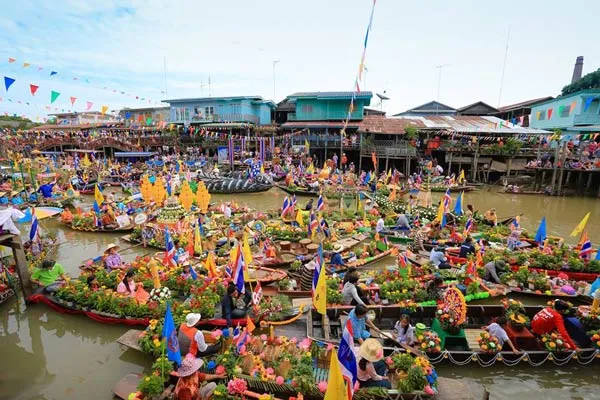
Another reason Lat Chado works well for a half-day to full-day trip is the chance to experience canal life through a boat ride along the Lat Chado Canal. This feels very different from touring major ruins in Ayutthaya city because here the story is told through riverside living. You can see traditional Thai houses by the water, local fishing tools and methods such as lift nets (yok yo) or cast nets (thot hae) in certain moments, and the canal landscape that makes it immediately clear why the community grew with water at its center. The boat ride is not about spectacle; it is about simplicity and authenticity, ideal for those who want to rest their eyes, photograph everyday canal scenes, and understand Thai community life through a freshwater landscape. On a pleasant-weather day, soft light in the morning or late afternoon makes the riverside views look gentle and distinctly central-Thai in mood.
Because Lat Chado is a real community, visitors should approach it with particular respect—especially when photographing vendors or homes. For local residents, this is a home and workplace, not a tourism prop. If you want to photograph people, ask for permission first, and avoid flash or blocking walkways for long periods. Timing also matters. If you want a calm atmosphere that is not overly crowded, arrive in the late morning so you have time to eat, walk, and talk with vendors. If your focus is photographing wooden shophouses and walkways with an airy feel, earlier hours often provide better light and fewer people. Comfortable walking shoes and water are practical essentials, because exploring a community market in detail takes time. The real joy of Lat Chado is reading the place gradually, not rushing to tick off highlights.
Getting There Lat Chado Market is located in Phak Hai District, Phra Nakhon Si Ayutthaya. If you are driving from Bangkok, a practical plan is to enter the broader Ayutthaya area first and then continue toward Phak Hai, using the main roads that connect into Phak Hai and Nong Nam Yai Subdistrict. As you get closer, look for signs directing you to the market or to the Lat Chado Subdistrict Municipality, which is a key local reference point. Near the community zone, you will begin to notice the canal-side atmosphere and the distinctive rows of wooden shophouses—clear signs you are approaching the right area. If you prefer not to drive, a workable approach is to travel to Ayutthaya city or the Phak Hai center first, then continue by local hire car or local transport services. This reduces navigation stress and makes it easier to build a broader day trip. If you want a full-day itinerary, you can also connect onward to temples or palaces in the Bang Pa-In area or Ayutthaya city center, using Lat Chado as a “reset point” that offers a canal-community perspective distinct from monumental ruins.
What makes Lat Chado a strong choice on an “Ayutthaya things to do” list for both Thai visitors and international travelers is its ability to present another side of Ayutthaya—one that is not centered on brick stupas and historic ruins, but on everyday people and community life. Ayutthaya is not only royal history and grand temple architecture; it also holds community history, trade history, and canal systems that sustained generations. Walking a wooden riverside market makes Thai culture tangible: greetings, bargaining manners, how people choose goods, and local foods that reflect inherited knowledge. Visiting Lat Chado therefore suits travelers who want meaning beyond check-ins, because every step contains stories of people and water. When you leave, you often take home not only snacks and small local products, but also photographs and a warmer, more personal understanding of what “Ayutthaya” can feel like.
| Name | Lat Chado Market |
| Address | Nong Nam Yai Subdistrict, Phak Hai District, Phra Nakhon Si Ayutthaya 13280 (Lat Chado Canal community area) |
| Place Summary | A long-established canal-side community market known for wooden shophouses, old local businesses, and traditional foods, offering an authentic canal-life perspective of Ayutthaya. |
| Highlights | Wooden riverside market and large wooden shophouse rows, authentic community atmosphere, heritage shops and local stories, rare traditional dishes (e.g., kaeng bon and freshwater fish menus), canal boat rides showcasing local life. |
| History / Background | Said to have begun with Chinese raft-house trading on both sides of the canal, later developing into a wooden riverside market and expanding onto land into nearly 100 shop units. The community was formerly called “Ban Chakkarat,” formed after 1767, and the name “Lat Chado” comes from the once-abundant snakehead fish in the canal. |
| Open Days | Saturday–Sunday |
| Opening Hours | 10.00 – 15.00 |
| Fees | Admission: Free (generally) / Boat Ride: THB 10 per person or THB 50 per boat charter |
| Latest Administrator | Lat Chado Subdistrict Municipality, Phak Hai District, Phra Nakhon Si Ayutthaya |
| Contact Number | 035-740-263 to 4 (Lat Chado Subdistrict Municipality) |
| Current Status | Open according to operating days (recommended to check the latest updates with the administrator before visiting) |
| Nearby Tourist Attractions (Approx. Distance) | 1) Wat Lat Chado – approx. 2 km – Tel. 035-391-582 2) Bang Pa-In Royal Palace – approx. 45 km – Tel. 035-261-044 3) Wat Niwet Thammaprawat Ratchaworawihan – approx. 46 km – Tel. 035-261-822 4) Wat Phanan Choeng Worawihan – approx. 55 km – Tel. 098-991-4519 5) Wat Yai Chai Mongkhon – approx. 58 km – Tel. 035-242-640 |
| Popular Restaurants Nearby (Approx. Distance) | 1) Krua Rim Khlong (Phak Hai) – approx. 12 km – Tel. 095-946-1584 2) Phak Hai Boat Noodles (Khun Kae) – approx. 15 km – Tel. 064-296-9666 3) Ban Mai Rim Nam (Ayutthaya) – approx. 55 km – Tel. 035-242-248 4) Sala Ayutthaya Eatery and Bar – approx. 56 km – Tel. 035-242-588 5) Krung Kao Boat Noodles (Rim Khlong Makham Riang) – approx. 56 km – Tel. 085-333-9033 |
| Popular Accommodations Nearby (Approx. Distance) | 1) Krungsri River Hotel – approx. 55 km – Tel. 035-244-333 2) Centara Ayutthaya – approx. 55 km – Tel. 035-243-555 3) Classic Kameo Hotel, Ayutthaya – approx. 55 km – Tel. 035-212-535 4) Kantary Hotel, Ayutthaya – approx. 56 km – Tel. 035-337-177 5) Sala Ayutthaya – approx. 56 km – Tel. 035-242-588 |
Frequently Asked Questions (FAQ)
Q: Which days and hours is Lat Chado Market open?
A: Official tourism information generally lists Saturday–Sunday, 10.00 – 15.00. It is recommended to confirm the latest updates with the administrator before your visit.
Q: How old is Lat Chado Market and how did it begin?
A: The market is often described as being more than 100 years old. It is said to have started with Chinese raft-house trading on both sides of the canal, later developing into a wooden riverside market and expanding into a larger shophouse complex over time.
Q: Where does the name “Lat Chado” come from?
A: The name comes from snakehead fish (pla chado), which were once abundant in the Lat Chado Canal and were closely tied to the community’s canal-based way of life.
Q: What should I try eating at Lat Chado Market?
A: The market is known for traditional community dishes and freshwater fish menus such as kaeng bon (taro-stem curry), hor mok pla chon (steamed curry with snakehead fish), tom khem pla tapian (old-style braised carp), as well as kuai chap, stewed pork noodles, and various Thai desserts.
Q: Is there a canal boat ride at Lat Chado?
A: Yes. You can take a boat ride to see canal-side life, including traditional riverside houses and local fishing activities in some moments. Visiting when the sun is not too strong makes both walking the market and the boat ride more comfortable.
Q: Can I visit Lat Chado Market without a private car?
A: Yes. You can travel to Ayutthaya city or the Phak Hai area first, then continue to the market by local hired transport or local services, which helps reduce navigation concerns.
 Tel: 035740263-4
 Lat Chado Market Map
 Category:
  Group:
  Last Update: 3 DayAgo
Comment
 Nearby Attractions
| Keyword (Advance) |
 Region
|
 Phranakhon Si Ayutthaya(