

 Home
Home Chiang Mai(







Rating: 3.4/5 (7 votes)
 |
|  Map
Map 
 Have Map
  No Map
Kanchanaburi attractions
Attractions in Thailand
Open Days: Daily
Opening Hours: Generally open for worship throughout the day (recommended visiting time: 08:00–17:00)
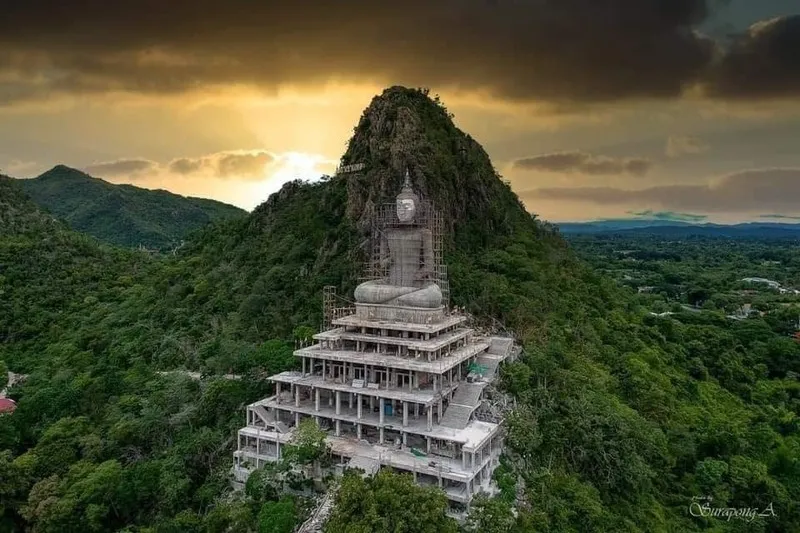
Wat Tham Khao Laem in Kanchanaburi Province is a temple that travelers passing through the entrance to Kanchanaburi town often notice easily, thanks to the large temple sign mounted on the mountain behind it. The sign is highly visible from afar and has become a familiar landmark that sparks curiosity, inviting many to stop by and see for themselves what lies within a temple framed by a mountain backdrop. Wat Tham Khao Laem is not merely a roadside photo stop or a pass-by temple, but a place with stories of caves, sacred Buddha images, and a gradual development that began from a natural cave area, eventually evolving into a religious site marked by tranquility, refined artistic beauty in its ordination hall, and expansive panoramic views from higher ground that encourage visitors to slow down and quietly absorb the atmosphere.
The heart of Wat Tham Khao Laem originates from “Tham Khao Laem,” a small natural cave located on the mountain behind the temple. A stairway leads visitors up to the cave entrance, and upon reaching the top, one is rewarded with a beautiful panoramic view of the surrounding landscape. The appeal of climbing up to this cave is not merely about reaching the destination, but about the rhythm of the journey itself, which gradually shifts the mind from haste to stillness. Many visitors naturally lower their voices without being prompted, as the mountain environment, the quiet forest, and the sense of approaching a sacred space gently organize one’s emotions and state of mind.
A local narrative that gives Tham Khao Laem a deep place in community memory tells of a sacred Buddha image once enshrined inside the cave. This image is described as a Chiang Saen–style Buddha, created in 1908 CE (B.E. 2451). Its exterior was formed of plaster, while the interior is cast in bronze—details that enhance its value both spiritually and artistically. When a place houses a Buddha image revered collectively by the community, it ceases to be merely a “natural cave” and becomes a “cave of meaning,” where reverence and faith are passed down continuously from one generation to the next. Local historical records clearly mention the Buddha image’s Chiang Saen style, its date of creation, and the combination of plaster exterior with bronze core, as well as the emergence of the temple from this very cave.
Later, a wandering monk named “Phra Buntham” came to stay at Tham Khao Laem. Observing that the cave had fresh air, a peaceful atmosphere, and already enshrined a principal Buddha image, he felt content and decided to reside there for several rainy seasons. This period marked a significant turning point, as the presence of a resident monk gave villagers a spiritual center—a place to make merit, listen to teachings, and collectively care for the site. This story illustrates a distinctly Thai relationship: many temples did not begin with grand construction plans, but rather with “monks and community” mutually supporting one another, gradually expanding into a temple as faith and readiness allowed.
As the site’s development became more concrete, an additional monk’s dwelling (kuti) was constructed in 1973 (B.E. 2516). The structure measured 5.10 meters wide and 8.20 meters long, built in a traditional Thai style with a half-concrete, half-wood structure, raised on a single level. Such architectural details are significant, as they reflect the temple’s philosophy of moderation—prioritizing practical use within a mountainous landscape rather than striving for grandeur. Viewed as a whole, Wat Tham Khao Laem is truly a temple “born from a cave,” both physically and narratively, with a developmental timeline that readers can clearly visualize step by step.
What adds another layer of charm to Wat Tham Khao Laem today is the restoration and decoration of the ordination hall situated against the mountain—the origin of the temple’s name. The overall appearance of the hall is graceful and harmonious, using color tones that feel cool and soothing to the eye. Inside, Buddha images in meditation and blessing postures are enshrined, while the walls and ceiling are adorned with painted murals depicting scenes from the life of the Buddha. Entering the ordination hall is therefore not simply an act of paying respect and leaving, but an experience of “seeing” and “reading” stories through art, accompanied by the calm of the surroundings.
Another highlight frequently mentioned by visitors is the naga-shaped balustrade along the ordination hall stairway. Its flowing lines and intricate details enhance the artistic dimension of the temple. Certain angles evoke a sense of contemporary Thai craftsmanship, emphasizing fluidity and refinement familiar from modern temple art. Yet the true charm of Wat Tham Khao Laem does not lie in comparisons with other sites, but in the intention to make the ordination hall a space where visitors feel light, bright, and inclined to remain quietly for a while—an essential quality of a sacred place that requires little explanation.
For those specifically interested in “climbing the cave,” the mountain behind the temple also features a small cave chamber accessible by stairs leading to the cave entrance. Above, there is a viewpoint offering scenic views of the surrounding area, especially impressive on clear days when layers of mountains and nearby communities become distinctly visible. However, some tourism sources note that access to the cave may occasionally be restricted. Therefore, the most complete experience of visiting Wat Tham Khao Laem is to focus on worship in the ordination hall and strolling around the temple grounds first, then proceed to the cave only if it is open and safe. Extra caution is advised during the rainy season due to slippery and damp pathways.
Another special aspect of Wat Tham Khao Laem is its character as an easily accessible “mountain-view temple” close to town, yet offering a markedly different atmosphere from temples in densely populated areas. Visitors seeking a place to pay respects while resting their eyes on mountain scenery often find their breathing feels more relaxed here. Photography enthusiasts will also appreciate the ordination hall’s architecture and naga motifs, which provide elegant and respectful photo opportunities without requiring dramatic poses—simply allowing the light to do its work. Early morning or late afternoon light, in particular, lends a soft, gentle tone to the temple’s colors.
In terms of merit-making activities, Wat Tham Khao Laem invites visitors to contribute donations toward the construction of Buddha images that remain unfinished, as well as toward ongoing restoration efforts. This reflects the temple’s growth through community support and individual faith. Those wishing to make merit are encouraged to do so calmly and without expectation, as the true value of visiting lies in spending time within a space where mountain, cave, art, and faith coexist in balanced harmony.
For visitors interested in the temple’s official administration, publicly available listings have identified “Phra Khru Sutthaworakan” as the abbot of Wat Khao Laem (within the Kanchanaburi context). This information should be regarded as preliminary guidance, and for maximum accuracy, visitors who wish to meet monks or arrange specific activities are advised to contact the temple in advance, as responsibilities and roles within the temple may change over time. Local municipal sources also summarize the history of Wat Tham Khao Laem and its origins from the cave.
Wat Tham Khao Laem is therefore well suited to merit-makers, photographers, and cultural travelers seeking to experience Kanchanaburi from a perspective that is “close to town, yet far in spirit.” While the journey is easy, the atmosphere genuinely draws the mind away from daily bustle. What makes this temple memorable is not merely the mountain sign visible from afar, but the lingering feeling upon leaving—often a sense of lightness, as if some fatigue has been left with the mountain, allowing one to return to daily life with a little more mindfulness.
Getting There Wat Tham Khao Laem can be reached easily from Kanchanaburi town by heading toward Pak Phraek Subdistrict. Its proximity to the urban area makes it convenient to visit by private car or local taxi. When using navigation apps, search for “Wat Tham Khao Laem” and allow extra time for climbing the stairs to the cave or viewpoint. Visitors should dress respectfully and wear shoes with good grip, especially if planning to walk up to the cave area.
| Place Name | Wat Tham Khao Laem |
| Address | 100 Moo 2, Pak Phraek Subdistrict, Mueang Kanchanaburi District, Kanchanaburi Province (please verify the latest map coordinates before traveling) |
| Overview | A mountain-view temple near Kanchanaburi town, originating from a cave, featuring a beautifully decorated ordination hall, scenic viewpoints, and the local legend of a Chiang Saen Buddha image from 1908 CE |
| Highlights | Large mountain sign visible from afar, cave and viewpoint, cool-toned ordination hall, Buddhist murals, graceful naga stair railings |
| History | Originated from Tham Khao Laem cave, formerly housing a Chiang Saen–style Buddha image created in 1908 CE with plaster exterior and bronze core. Later developed when a wandering monk, Phra Buntham, resided there, followed by the construction of additional monastic dwellings in 1973 |
| Abbot (Latest Available) | Phra Khru Sutthaworakan (recommended to confirm with the temple before visiting) |
| Opening Information | Open daily (generally accessible throughout the day; recommended visiting time 08:00–17:00) |
| Admission Fee | Free admission (donations welcome) |
| Facilities | Temple grounds and walkways, stairs leading up the mountain and viewpoint (some sections may be steep or slippery when wet), worship areas inside the ordination hall |
| Access | From Kanchanaburi town to Pak Phraek Subdistrict, accessible by private car or taxi; search for “Wat Tham Khao Laem” on navigation apps and allow time for stair climbing to the cave/viewpoint |
| Current Status | Open for worship and general visits; access to the cave or upper areas may occasionally be restricted for safety—please inquire in advance |
| Contact | 081-178-1223 |
Frequently Asked Questions (FAQ)
Q: Where is Wat Tham Khao Laem located?
A: It is located in Pak Phraek Subdistrict, Mueang Kanchanaburi District, Kanchanaburi Province. Visitors are advised to verify the location on a map before traveling.
Q: Does Wat Tham Khao Laem have a cave open for visitors?
A: Yes, there is a small cave on the mountain behind the temple with stairs leading to the entrance and a viewpoint above. However, access may be restricted at times for safety reasons, so it is advisable to check with the temple in advance.
Q: What are the main highlights of Wat Tham Khao Laem?
A: Key highlights include the large temple sign on the mountain visible from afar, the beautifully decorated ordination hall with Buddhist murals, the graceful naga stair railings, and the scenic viewpoint.
Q: How is Wat Tham Khao Laem connected to the Chiang Saen Buddha image?
A: Local history recounts that the cave once housed a Chiang Saen–style Buddha image created in 1908 CE, with a plaster exterior and bronze interior, revered by the local community.
Q: How should visitors prepare for a visit to Wat Tham Khao Laem?
A: Visitors should dress respectfully, wear shoes with good traction, bring drinking water, and exercise caution when climbing stairs to the cave or viewpoint, especially after rainfall.
Q: Is there an admission fee to visit Wat Tham Khao Laem?
A: There is generally no admission fee. Visitors may make donations according to their faith, and those wishing to contribute to restoration or Buddha image construction can inquire directly at the temple.
 Wat Tham Khao Laem Map
 Category:
  Group:
  Last Update: 15 HourAgo
Comment
 Nearby Attractions
| Keyword (Advance) |
 Region
|
 Muang Kanchanaburi(