

 Home
Home Chiang Mai(










Rating: 3.8/5 (4 votes)
 |
|  Map
Map 
 Have Map
  No Map
Kanchanaburi attractions
Attractions in Thailand
Open Days: Daily
Opening Hours: Approximately 08:00 – 17:00
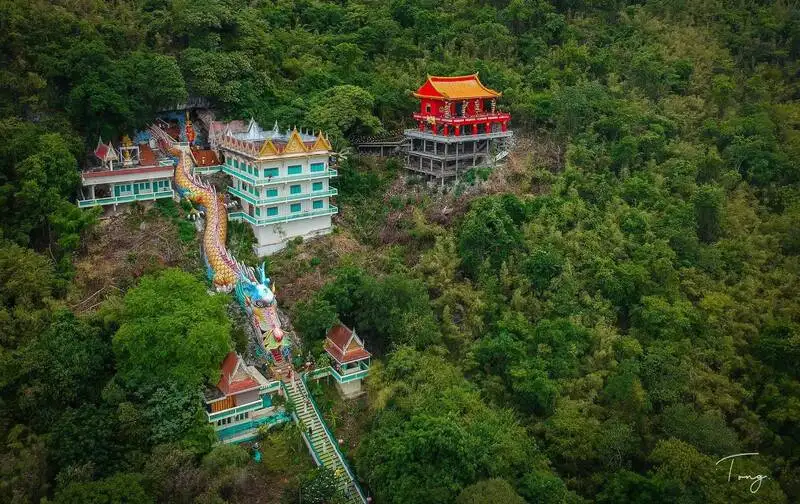
Wat Ban Tham is located in Khao Noi Subdistrict, Tha Muang District, Kanchanaburi Province. It is a cave temple that plays an important role in religious life, local history, and the belief systems of communities along the Mae Klong River basin. The temple is situated about 5 kilometers from Wat Tham Suea toward Kanchanaburi town, accessible via an old riverside road along the Mae Klong River that clearly reflects the landscape and riverside way of life of the local communities.
The distinctive character of Wat Ban Tham comes from its location on a limestone mountain range, a type of terrain commonly found in the lower central region and western Thailand. Over thousands of years, natural geological processes have formed caves, stalactites, and stalagmites throughout these limestone hills. As a result, cave temples such as Wat Ban Tham represent a close integration of “natural space” and “sacred space,” differing from lowland temples that focus primarily on buildings and architectural structures.
When viewed in the broader historical context of cave temples in central Thailand, such temples were traditionally used as places for meditation, monastic retreat, and religious practice. Caves provide tranquility, cool temperatures, and separation from surrounding communities, while also serving as spiritual refuges for local residents seeking sacred places for merit-making, prayer, or ritual activities. Wat Ban Tham can therefore be understood as a product of geography, belief, and the long-standing coexistence between humans and nature.
One of the most striking features for visitors is the cave entrance, accessed by a stairway that leads deep into a massive “dragon’s mouth.” In Thai–Chinese artistic and belief traditions widely present in central Thailand, dragons symbolize power, authority, and protection. Passing through the dragon’s mouth is thus perceived as a symbolic transition from the ordinary world into a realm of faith. Inside the cave, the atmosphere gradually shifts from bright daylight to a cool, calm, and humid environment, creating a distinct sensory experience for visitors.
Inside the cave are numerous stalactites and stalagmites of various forms. The most well-known formation is a stalagmite resembling a woman, believed by local residents and devotees to represent “Nang Bua Khli,” the wife of Khun Phaen from the famous Thai epic Khun Chang Khun Phaen. This association between natural formations and literary characters reflects a Thai cultural approach to interpreting space, where nature is not viewed merely as a physical object but as a place imbued with stories, spirit, and moral meaning.
When the legend of Khun Chang Khun Phaen is examined in relation to physical space, Nang Bua Khli is remembered as a woman of loyalty, patience, and self-sacrifice. The belief that the stalagmite represents her transforms the cave from a natural attraction into a symbolic site where visitors come to pay respect, make wishes, and reflect on moral values embedded in traditional Thai society.
On the mountaintop above Wat Ban Tham, there are several additional caves featuring impressive stalactites and stalagmites, each shaped differently by geological processes over long periods of time. Some of these caves are open to visitors, who must exercise particular caution due to slippery surfaces and high humidity. Visiting these caves should be done with respect for nature, avoiding contact with or damage to formations that have taken thousands of years to develop.
Today, Wat Ban Tham continues to serve as a spiritual center for the communities of Khao Noi Subdistrict and nearby areas. Beyond its religious role, the temple functions as a cultural learning site and a destination for spiritual tourism, connecting visitors with local history, geography, and oral traditions passed down through generations.
Getting There From Kanchanaburi town, travel toward Wat Tham Suea, then continue along the road running parallel to the Mae Klong River into Khao Noi Subdistrict, Tha Muang District. The distance is approximately 5 kilometers. Parking is available near the temple entrance, after which visitors proceed on foot to the cave area. Modest dress and respectful behavior are recommended.
| Summary | A cave temple in Khao Noi Subdistrict, Tha Muang District, Kanchanaburi Province, near the Mae Klong River |
| Highlights | Dragon-mouth staircase, Nang Bua Khli stalagmite, mountaintop cave system |
| Abbot | Phra Khru Wisut Kanchanaphon (commonly referenced local information) |
| Nearby Attractions | 1) Wat Tham Suea ~5 km 2) Wat Tham Khao Noi ~5 km 3) Kanchanaburi Skywalk ~10 km 4) Bridge over the River Kwai ~12 km 5) Don Rak War Cemetery ~13 km |
| Nearby Restaurants | 1) Krua Chuk Don ~4 km Tel. 034-512-345 2) Krua Tham Suea ~5 km Tel. 034-513-222 3) Mae Klong Riverside Restaurant ~5 km Tel. 034-514-678 4) Tha Muang Seafood Restaurant ~6 km Tel. 034-515-999 5) Kanchanaburi Local Cuisine Restaurant ~7 km Tel. 034-516-111 |
| Nearby Accommodations | 1) Mae Klong Riverside Resort ~6 km Tel. 034-520-111 2) Tha Muang Hotel ~7 km Tel. 034-521-222 3) Khao Noi Homestay ~4 km Tel. 034-522-333 4) Accommodation near Wat Tham Suea ~5 km Tel. 034-523-444 5) Hotels in Kanchanaburi Town ~12 km Tel. 034-524-555 |
Frequently Asked Questions (FAQ)
Q: Where is Wat Ban Tham located?
A: It is located in Khao Noi Subdistrict, Tha Muang District, Kanchanaburi Province.
Q: What is the main highlight of Wat Ban Tham?
A: The dragon-mouth cave entrance and the stalagmite associated with Nang Bua Khli from the Khun Chang Khun Phaen legend.
Q: Is it difficult to travel to Wat Ban Tham?
A: The temple is easily accessible by private car via the Mae Klong riverside road.
Q: Are there any precautions when visiting the cave?
A: The floor can be slippery and humid; suitable footwear and caution are recommended.
Q: What attractions can be visited nearby?
A: Wat Tham Suea, Wat Tham Khao Noi, and major attractions in Kanchanaburi town.
 Wat Ban Tham Map
 Category:
  Group:
  Last Update: 14 HourAgo
Comment
 Nearby Attractions
| Keyword (Advance) |
 Region
|
 Muang Kanchanaburi(