

 Home
Home Chiang Mai(







Rating: 3.6/5 (5 votes)
 |
|  Map
Map 
 Have Map
  No Map
Kanchanaburi attractions
Attractions in Thailand
Open Days: Open daily
Opening Hours: Recommended 06:30 – 17:30 (access depends on local conditions and community routes)
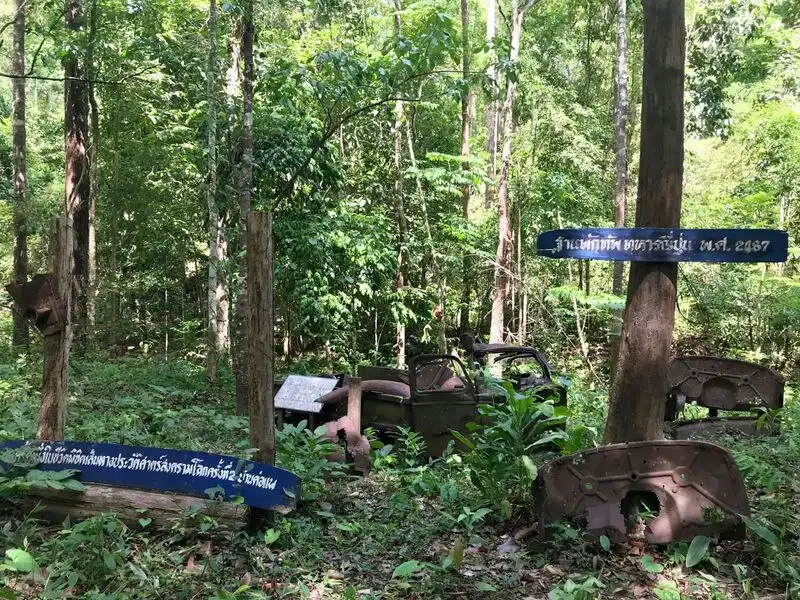
Japanese Troop March Route During World War II (Bong Ti Area) in Moo 1, Bong Ti Subdistrict, Sai Yok District, Kanchanaburi, is a “historical landscape” rather than a curated museum with paved walkways. It is a real area that once played a strategic role as a passage route during World War II. The distinctiveness of this kind of place is that you are not here to look at grand buildings; you come to “read the terrain” and understand why mountain passes, streams, old cart tracks, and ridgelines in Sai Yok once mattered for troop movement in a particular chapter of history. When you arrive in Bong Ti and see the long mountain ranges stretching across the horizon, you begin to understand immediately that the borderland of the Khwae River basin is not merely nature’s backdrop—it is a place where geography shapes the “route,” and routes shape the “fate of people” in wartime.
If your image of Kanchanaburi is defined by the Bridge over the River Kwai, the historic railway, or museums about prisoners of war, this article helps you “complete the picture” through another lens: overland routes that linked the province’s interior to the border. The Bong Ti area, in particular, has been mentioned as one of the corridors used for Japanese troop movement during the early phase of the Greater East Asia War in the region. Understanding such a route does not require a flood of military terminology. Start with a simple question: “Why pass through here?” The answer lies in Sai Yok’s mountainous, valley-and-ridge geography—with limited crossings and practical pathways leading toward the west. When speed became essential in wartime, choosing a suitable corridor was inevitably a priority for any army.
Bong Ti lies within Sai Yok District, an area defined by dense nature: forests, waterways, and community paths connecting villages through a valley landscape. From a tourism perspective, Bong Ti is often described as quiet and restful, suitable for camping-style stays and nature activities. From a historical perspective, however, the name Bong Ti leads many people back to Kanchanaburi’s role in World War II, which was not only the stage for building the Thai–Burma Railway. It was also a region that had “passable routes” and “decision points” for moving forces through mountain corridors toward Burma for certain missions. Visiting Bong Ti today can therefore feel like stepping into a place where past and present overlap—nature in the foreground, and wartime memory in the background that we should listen to with care.
To see this more clearly, it helps to position Bong Ti on Sai Yok’s broader memory map, alongside places such as Wang Pho, Hellfire Pass, and the historic railway corridor—all within the same geographic zone. These places are not significant because they are visually ornate; they are significant because strategy saw them as passable, controllable, and connectable. For this reason, the Bong Ti march route should be understood as part of Kanchanaburi’s wider wartime landscape network rather than as an isolated story. When you connect the narrative this way, visiting Bong Ti is no longer only about novelty; it becomes a way to understand the “regional picture” of that era—how hardship and terrain shaped decisions and outcomes.
Historically, during World War II, Kanchanaburi became a highly significant area in the Southeast Asian theatre, especially as Japan sought routes to move forces and supplies toward Burma. The construction of the Thai–Burma Railway—widely remembered as the “Death Railway”—is a dominant image, and Sai Yok itself contains many traces and learning sites, such as Hellfire Pass, a cutting through the mountains associated with stories of railway construction under brutal conditions. Even so, in the broader context of war, movement was not limited to rail lines. There were also footpaths, supply tracks, and overland corridors used in particular phases and circumstances. “Dan Bong Ti” is one of the names that appears in accounts and writings discussing movement from the Kanchanaburi side toward the border for operations in Burma.
One practical point should be understood plainly: a “troop march route” as a historical travel site often does not have official signage like a museum, and parts of it may overlap with community paths or natural trails used today. Visiting should therefore rest on three principles: safety, respect for community rights, and respect for wartime memory. If you intend to go on-site, it is wise to accept that the goal is not to “prove by sight” that one pinpoint location is the single correct answer with 100% certainty, but rather to view the overall landscape and understand how Bong Ti’s terrain in Sai Yok forms a corridor that is “practically passable”—and why its name is mentioned in wartime narratives that link Kanchanaburi with the border.
The experience of visiting Bong Ti today is therefore better framed as “travel to learn” rather than following a fixed, ready-made itinerary. You may begin with an easier reference point, such as the well-organized learning site at Hellfire Pass to establish a solid historical framework, and then move into Bong Ti to encounter the real terrain. This approach prevents the story from feeling abstract. Hellfire Pass and the historic railway corridor provide clear explanatory context that helps “set the foundation” for general readers. With that foundation, a visit to Bong Ti becomes a way to “complete the puzzle” rather than starting from zero, and you will be able to read the landscape with stronger reasoning.
Another reason this area feels compelling is the contrast between the “silence of nature” and the “weight of the story.” When you are in the mountains—with wind in the treetops, the sound of a stream, or the emptiness of an earthen track—you instinctively sense that moving through such terrain was never easy. Even today, with roads, vehicles, and navigation technology, mountain and border travel still demands planning. In wartime, passing through mountainous corridors inevitably involved fatigue, risk, and strict logistics. In that sense, Bong Ti’s landscape becomes a “teacher” without words—you simply stand there and think honestly about what it implies.
Getting There Reaching the Bong Ti area in Sai Yok is most suitable by private car or a hired vehicle from Kanchanaburi town or the Sai Yok zone, as public transport can be limited in frequency and flexibility due to the mountainous setting. A safe planning method is to set your starting point as “Sai Yok District” and then continue into Bong Ti Subdistrict. Fuel up before entering the area, check the weather—especially in the rainy season when mountain roads can be slippery or affected by flash floods—and allow extra travel time. If you plan to go onto natural trails, inform someone close to you where you are going and when you expect to return. For safety and comfort, bring drinking water, insect repellent, shoes with good grip, and a backup flashlight.
For a richer travel “storyline,” a recommended flow is to start the morning with structured historical learning at a site like Hellfire Pass, then drive into the Bong Ti zone to experience the terrain firsthand. In doing so, you will not see places as disconnected points; you will see Kanchanaburi as a “narrative landscape” that includes rail lines, valleys, border routes, and communities living within the same geography. This planning also helps you use your time efficiently, because Sai Yok offers natural attractions that combine easily with a history-focused trip, such as waterfalls and viewpoints along the Khwae Noi River, making the day feel balanced rather than heavy and exhausting.
The most important caution is: “Do not enter areas without permission.” Some community routes and borderland sections may have safety restrictions or be privately owned. Before taking photos or walking into uncertain areas, ask local residents or landholders whenever possible. If you want deeper exploration, a safe and high-value option is to use a local guide or knowledgeable community member. This helps not only with navigation, but also with community perspectives on how people live with this landscape. Respect for the community makes your experience more “sustainable” and reduces the risk of negative impacts from irresponsible visitation.
In terms of etiquette for war-related heritage travel, aim to keep a calm, respectful tone, avoid turning wartime memory into entertainment, and do not collect items from nature or any area that might carry historical significance. Even though Bong Ti is not an official museum with displayed artifacts, respectful conduct is the core of the visit. It is also wise to avoid posting highly detailed coordinates publicly if the spot is sensitive or within a community area, to prevent overcrowding beyond local capacity and to reduce safety risks.
Finally, if you truly want this trip to be meaningful, consider asking yourself as you travel: What does a route like this help me understand about Kanchanaburi? Some visitors gain insight into terrain and strategy. Others reflect on how wartime memory still lingers across the region. And some come away with a sharper understanding of responsible travel, because war-related places are not just tourist sites—they are shared human lessons. When you leave Bong Ti, what you take home does not have to be only photos, but a deeper understanding of how much a single landscape can hold—and how we should travel without harming either nature or the memories embedded within it.
| Place Name | Japanese Troop March Route During World War II (Bong Ti Area) |
| Location | Moo 1, Bong Ti Subdistrict, Sai Yok District, Kanchanaburi |
| Address | Bong Ti Subdistrict, Sai Yok District, Kanchanaburi |
| Place Summary | A historical landscape in a mountainous area and community-route setting, referenced in the context of overland movement during World War II, linking the Sai Yok zone toward the border. Best visited as a learning-focused journey through real terrain. |
| Highlights | Reading a real borderland landscape that functions as a passable corridor, completing the broader World War II story of Kanchanaburi, quiet natural atmosphere suited to responsible learning-based travel |
| Open Days | Open daily |
| Opening Hours | Recommended 06:30 – 17:30 (access depends on local conditions and community routes) |
| Current Status | A natural/community-route area within Sai Yok’s terrain. Travel with caution and respect any local restrictions. |
| Nearby Tourist Attractions (With Distance) | 1) Hellfire Pass Interpretive Centre (approx. 55 km) Tel. 034-919-605 2) Sai Yok National Park (approx. 45 km) Tel. 034-686-024 3) Sai Yok Noi Waterfall (park ranger unit) (approx. 35 km) Tel. 034-686-024 4) Mallika R.S.124 (approx. 25 km) Tel. 034-540-884 5) Erawan National Park (approx. 105 km) Tel. 034-574-222 |
| Nearby Restaurants (With Distance + Phone) | 1) Krua Phak Wan Baan Rai Naropadin (approx. 30 km) Tel. 086-384-1450 2) Krua Asa (wild cuisine) (approx. 25 km) Tel. 092-775-1978 3) Baan Kafae (approx. 25 km) Tel. 081-763-7792 4) ImmSook SteakHouse (FM Cafe / ImmSook SteakHouse) (approx. 28 km) Tel. 098-437-4700 5) Bambooglamping Cafe&Camping (approx. 32 km) Tel. 090-899-6424 |
| Nearby Accommodations (With Distance + Phone) | 1) Yoko River Kwai Resort (approx. 38 km) Tel. 081-880-1002 2) River Kwai Resotel (approx. 60 km) Tel. 081-734-5238 3) The FloatHouse River Kwai (approx. 60 km) Tel. 084-725-8686 4) Hintok River Camp at Hellfire Pass (approx. 55 km) Tel. 081-754-3898 5) Home Phutoey River Kwai Resort (approx. 62 km) Tel. 081-817-5182 |
Frequently Asked Questions (FAQ)
Q: When is the best time to visit the Bong Ti route for safety and comfortable walking?
A: Morning or late afternoon is recommended—especially 06:30–10:30 or 15:30–17:30—because it is cooler and there is still enough natural light for mountain terrain travel.
Q: Is this route suitable for children or older visitors?
A: If you are visiting to observe the landscape and learn the context without going deep into forest trails, it can be suitable. Bring drinking water, a hat, and insect repellent, avoid slippery or steep areas, and do not return after dark.
Q: If I want an easy-to-understand historical context, where should I combine nearby in Sai Yok?
A: Hellfire Pass is recommended for a clear overview of the war context and the Thai–Burma Railway. After that, looking at Bong Ti’s terrain will make the meaning of a “mountain corridor route” easier to understand.
Q: What should I be especially careful about if I plan to explore?
A: Avoid entering private land or sensitive community areas. Ask locals before proceeding, do not litter, keep noise low, and avoid going deep alone—especially in the rainy season when trails can be slippery and flash floods may occur.
Q: How should I plan a worthwhile one-day itinerary?
A: A balanced plan is to learn in the morning at Hellfire Pass, then spend the afternoon in the Bong Ti zone to experience the terrain, and finish with nearby nature spots in Sai Yok—such as the national park area or waterfall zones—for a mix of learning and relaxation.
 Japanese Troop March Route During World War II (Bong Ti Area) Map
 Category:
  Group:
  Last Update: 1 DayAgo
Comment
 Nearby Attractions
| Keyword (Advance) |
 Facebook Fanpage
 Region
 Landmarks and Memorials(
 Art, Craft Centres, Tradition(
 Museums(
 Art Gallery(
 University
 Places of Worship
 Temple(
 Church(
 Other religious and spiritural sites(
 Research and Development
 Royal Project(
 Suburban Living
 Village, Community(
 Local Market(
 Nature and Wildlife
 National Parks and Marine Reserves(
 Mountain (Doi)(
 Dam, Reservoir, Lake(
 Waterfalls(
 Hot Springs(
 Caves(
 River, Canal(
 Other natural attractions(
 Entertainment and Agricultural
 Zoos and Aquariums(
 Animal camps and shows(
 Farm, Parks, Gardens and Ecotourism(
 Cinema(
 Outdoor and Adventure Activities(
 Travel Articles, Recipes
 Travel Review, Food Review(