

 Home
Home Chiang Mai(










Rating: 3/5 (25 votes)
 |
|  Map
Map 
 Have Map
  No Map
Kanchanaburi attractions
Attractions in Thailand
Open Days: Daily
Opening Hours: 06:00 – 18:00
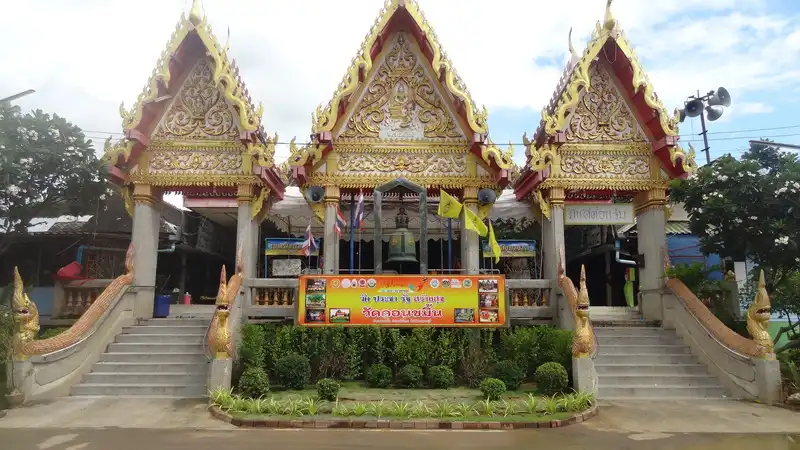
Wat Don Khamin (Don Khamin Subdistrict, Tha Maka District, Kanchanaburi Province) is a community temple with historical roots reaching back to the period when it functioned as a monastic retreat rather than a legally established monastery. Over many decades, it has steadily grown through the faith, cooperation, and continued support of local residents. In brief, the temple stands out as a place that began as “Pho Thong Monastic Retreat”, was later formally recognized under Thai law in the early 20th century (B.E. 2472 / 1929), and remains lively today with morning merit-making routines, alongside an ongoing role in education, religious life, and cultural support sustained by the abbot and the community.
The temple’s historical narrative is closely connected to “Pho Thong Monastic Retreat”, its former name prior to becoming an officially established temple. The retreat was founded around B.E. 2470 (1927) on a site originally covering about 10 rai. Its establishment was made possible through land donations, building materials, and practical support offered by devoted families in the Don Khamin area. This collective effort reflects a familiar pattern of rural Thai society: a temple often emerges not only from centralized planning, but from shared determination within the community—creating a sacred place to serve as a spiritual anchor, a refuge for the mind, and a source of stability during times when daily life can be shaped by economic uncertainty and social change.
A key turning point in shaping the retreat into a structured religious center was the invitation of Phra Ajarn Yim Thammachoto from Chaloem Arn Temple in Photharam District, Ratchaburi Province, to serve as the retreat’s spiritual leader. As the head of the monastic retreat, Phra Ajarn Yim became a focal point of local faith and helped organize religious routines in a clearer, more systematic way—daily chanting, prayer, instruction in Dhamma, and support for essential community ceremonies. These included annual merit-making events, house blessings, dedication of merit to the deceased, and other practices deeply woven into local life and social bonds.
The origin of the name “Pho Thong Monastic Retreat” is meaningful because it was not chosen merely for its pleasing sound, but for its connection to the actual landscape. Local accounts say that a senior ecclesiastical authority in Ratchaburi Province named the retreat after noticing that many bodhi trees grew in the surrounding area. In Buddhist tradition, the bodhi tree is strongly associated with enlightenment and spiritual refuge, making it a fitting symbol for a place of practice. Once the retreat’s identity became tied to an environment filled with bodhi trees, the name functioned both as a geographic marker and as an invitation to a calm, reflective state of mind.
As the community expanded, the need to elevate the retreat into a temple recognized under Thai law became increasingly important. Legal recognition strengthens governance, property management, and long-term development of religious buildings and community programs. Records state that Pho Thong Monastic Retreat was officially established as a temple under the legal framework in early January B.E. 2472 (1929). This moment can be seen as a milestone that allowed Wat Don Khamin to move from a modest retreat-based beginning into a fully functioning temple serving the Don Khamin community.
Once its legal status became secure, the temple naturally developed in both structure and social role. Many rural Thai temples serve far beyond religious ritual alone: they become learning spaces for children and youth, gathering places for elders, informal community meeting points, and cultural stages for local traditions. Wat Don Khamin followed this path. Over time, it became a shared community space where people of different ages and backgrounds could come together for simple yet meaningful reasons—making merit in the morning, offering alms and necessities, listening to sermons, or volunteering during important temple occasions.
The clearest reflection of Wat Don Khamin’s living presence today can be seen in the early morning atmosphere, when local worshippers regularly visit to make merit. In a community temple, merit-making is not only a religious expression; it also represents mutual care among local people. The temple plays a dual role—supporting spiritual well-being and reinforcing social connection. The continued steady flow of worshippers suggests that the temple remains a trusted refuge and an important rhythm within everyday life, offering calm and meaning in a world that often moves too fast.
In terms of leadership and development, public information indicates that the current abbot is Phra Khru Suphatthanakanchanakit, who has played a notable role in building the temple’s recognition both within Don Khamin Subdistrict and more broadly. His approach emphasizes consistent support for education, religious activities, and cultural continuity. This direction is particularly significant for community temples, because it helps connect younger generations to local spiritual roots in a natural way—through tangible programs that align with real community life rather than abstract ideals.
From the perspective of cultural travel, Wat Don Khamin may not be a large, iconic temple known primarily for grand architecture, like certain headline destinations. Its appeal lies instead in the authenticity of community life. Visitors can experience a local temple that operates quietly and sincerely, witness everyday merit-making that is not staged for tourism, and observe the close relationship between temple and community in small, genuine details—greetings among worshippers, preparation of offerings, shared maintenance of spaces, and temple activities carried out without hurry or spectacle.
For those who wish to visit for worship and merit-making, morning is the most suitable time. The air is cooler, the temple is less crowded, and this is when the temple’s true daily rhythm is most visible. Simple offerings such as drinking water, practical necessities, or a modest set of alms can be made without complex planning, yet the experience can feel deeply grounding—a quiet way to return attention to one’s mind and intentions.
If traveling with children or elderly family members, it helps to focus on comfort and safety: choose appropriate footwear for temple grounds, bring drinking water and a hat for sun protection, and maintain an unhurried pace. Community temples typically offer places to rest, and locals are often friendly and helpful, making a temple visit feel relaxed and warmly human, rather than stressful or overcrowded.
Appropriate dress and respectful conduct are equally important at Wat Don Khamin as at any Thai temple. Visitors should dress modestly—shirts with sleeves and long trousers or long skirts—avoid loud voices in sacred areas, and be considerate when taking photos, especially during active ceremonies or chanting. If taking pictures as a personal memory, it is best to choose angles that do not disturb worshippers and to respect shared space, helping the temple remain a calm refuge for its community.
Getting There Wat Don Khamin is most convenient to reach by private car. From Bangkok, drive toward Kanchanaburi Province, then enter Tha Maka District and follow local signs to Don Khamin Subdistrict. Because the temple is located within a community area, drivers should proceed carefully, especially in the morning when motorcycles and pedestrians are more common near the temple. For a well-rounded short trip, visitors can plan a half-day or full-day route: make merit at the temple in the morning, then stop at a local market or restaurant in Tha Maka, before continuing to major Kanchanaburi attractions in the afternoon.
Overall, Wat Don Khamin represents a community temple that grew from a modest retreat-based beginning into a place with clear social value. Its significance is not only in the year it was founded or its legal status, but in its lived presence in people’s daily lives. It remains a morning destination for merit-making, a space that strengthens family and community ties, and a simple place where many people can rest their minds—especially on days when the outside world feels overwhelmingly fast.
| Name | Wat Don Khamin |
| Location | Don Khamin Subdistrict, Tha Maka District, Kanchanaburi Province |
| Summary | A community temple in Tha Maka District with roots as Pho Thong Monastic Retreat, later legally established and active in local religious and cultural life |
| Highlights | Historical origin as Pho Thong Monastic Retreat, authentic community atmosphere, best experienced during morning merit-making |
| Period / Brief History | Founded around B.E. 2470 (1927) as Pho Thong Monastic Retreat; legally established as a temple in early January B.E. 2472 (1929) |
| Key Evidence | Publicly shared historical accounts of the retreat’s founding, the invitation of Phra Ajarn Yim Thammachoto, and the legal establishment as a temple |
| Name Origin | Originally called Pho Thong Monastic Retreat, reportedly named due to the abundance of bodhi trees around the site; later recognized as the temple of Don Khamin area |
| Abbot (Latest) | Phra Khru Suphatthanakanchanakit |
| Open Days | Daily |
| Opening Hours | 06:00 – 18:00 |
| Travel | Private car recommended: Bangkok → Kanchanaburi → Tha Maka → Don Khamin (follow local signs) |
| Current Status | Open for worship and merit-making as usual |
| Nearby Tourist Attractions (Approx. Distance) | 1) Tha Ruea Market (Tha Maka) – 14 km 2) Wat Phra Thaen Dong Rang Worawihan – 18 km 3) Wat Tham Suea (Tha Muang) – 28 km 4) Mueang Mallika R.S.124 – 42 km 5) Bridge Over the River Kwai (Kanchanaburi City) – 40 km |
| Popular Restaurants Nearby (Approx. Distance + Phone) | 1) Kob Tod Restaurant (Tha Maka) – 12 km Tel. 087-811-8482 2) Ko Khiw (Fried Frog Specialist) (Tha Maka) – 13 km Tel. 062-395-8222 3) Pad Thai Je Tum (Tha Maka) – 14 km Tel. 089-837-3085 4) The Connection 78 (Tha Maka) – 16 km Tel. 061-452-7136 5) Krua Tai Rim Thang (Kanchanaburi) – 18 km Tel. 080-992-1199 |
| Popular Accommodations Nearby (Approx. Distance + Phone) | 1) The Bridge Residence Hotel Kanchanaburi – 40 km Tel. 080-0888-454 2) U Inchantree Kanchanaburi – 42 km Tel. 034-521-584 3) Felix River Kwai Resort – 45 km Tel. 034-551-000 4) Mida Resort Kanchanaburi – 55 km Tel. 034-600-300 5) River Kwai Resotel – 75 km Tel. 034-681-030 |
Frequently Asked Questions (FAQ)
Q: Where is Wat Don Khamin located?
A: Wat Don Khamin is in Don Khamin Subdistrict, Tha Maka District, Kanchanaburi Province, and it is easy to access from the district area.
Q: How did Wat Don Khamin begin?
A: It began as a monastic retreat called “Pho Thong Monastic Retreat” around B.E. 2470 (1927) before being legally established as a temple in early January B.E. 2472 (1929).
Q: Why was it formerly called Pho Thong Monastic Retreat?
A: Local accounts say it was named because many bodhi trees grew around the site, reflecting a landscape closely associated with Buddhist symbolism.
Q: Who is the current abbot of Wat Don Khamin?
A: Public information indicates the abbot is Phra Khru Suphatthanakanchanakit.
Q: When is the best time to visit Wat Don Khamin?
A: Morning is recommended, as the weather is cooler and this is when locals most actively come to make merit, creating the temple’s most authentic daily atmosphere.
 Tel: 034566202, 034566888
 Fax: 034566888
 Wat Don Khamin Map
 Category:
  Group:
  Last Update: 16 HourAgo
Comment
 Nearby Attractions
| Keyword (Advance) |
 Region
|
 Muang Kanchanaburi(