

 Home
Home Chiang Mai(










Rating: 4.2/5 (5 votes)
 |
|  Map
Map 
 Have Map
  No Map
Kanchanaburi attractions
Attractions in Thailand
Open Days: Monday–Saturday
Opening Hours: 08:00–17:00 (Mon–Fri), 08:00–12:00 (Sat)
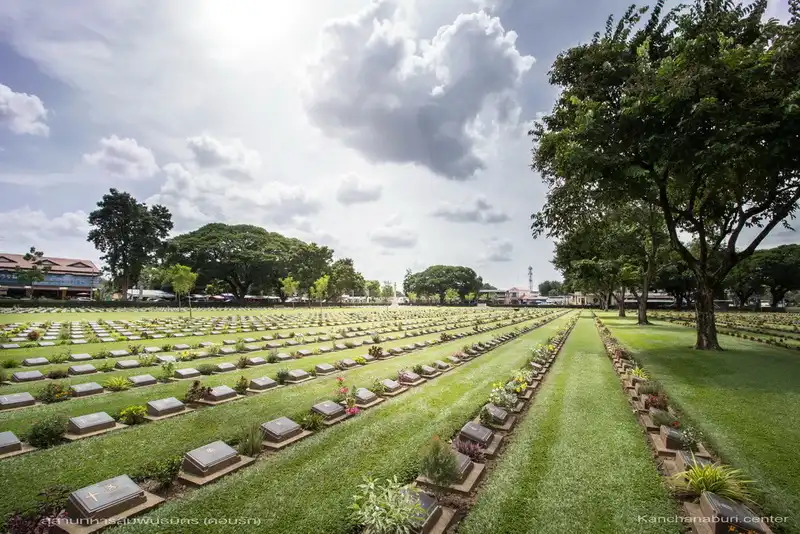
Kanchanaburi War Cemetery (Don Rak) If you have come to know Kanchanaburi through images of the Bridge Over the River Kwai, the slow grind of train wheels on the Death Railway, or the calm riverside atmosphere that seems almost too peaceful for a place once shaped by wartime suffering, Kanchanaburi War Cemetery—often called Don Rak—is the site that brings those stories back into sharp, tangible focus. This is not a place that tells history through spectacle. It speaks through silence, order, and respect—woven into every square meter of carefully kept lawn, every row of headstones aligned with quiet precision, and every name etched one by one. Visiting Don Rak today is therefore not merely a stop for a checklist. It is a deliberate pause that helps you understand Kanchanaburi as a city of global historical weight, and it naturally reframes travel here as an experience with responsibility toward the past rather than a quick pass-through for photos.
Kanchanaburi War Cemetery (Don Rak) sits along Saengchuto Road, part of Highway 323, in Mueang Kanchanaburi. Compared with many other World War II heritage points on the same route, its location is exceptionally accessible and close to multiple learning sites in the city area. That convenience makes Don Rak an ideal “starting point” for travelers who want to understand the Death Railway story properly. You can begin with a calm moment of remembrance, then continue to nearby museums, the Bridge Over the River Kwai, and sections of the railway that still operate today—all within a single day without forcing the journey into a rushed sequence of quick stops.
After World War II ended in this region, remembrance did not remain scattered or informal. Over time, commemorative sites and war cemeteries across Asia were organized and maintained with consistent standards that emphasize dignity and equal respect for those who died. In multiple Asian countries that served as major theaters of war, memorials and cemeteries were established to care for the graves of Allied servicemen and prisoners of war who died not only from combat, but also from the brutal conditions of captivity and forced labor. When you place Don Rak on this wider map, it becomes clear that this is not a small, local monument. It is part of a transnational memory network, and a reminder that Kanchanaburi’s history is deeply connected to the world in ways many visitors do not fully realize before arriving.
What gives Kanchanaburi its special status in the global memory of World War II is the “Death Railway,” formally known as the Thailand–Burma Railway. It was built under intense wartime pressure to serve Japanese strategic logistics. Constructing a railway through tropical forest, mountains, cliffs, and multiple rivers was difficult from an engineering perspective—but far more devastating from a human one. The project was driven by limited time and a demand for rapid results, leading to the mass use of forced labor, including Allied prisoners of war and Asian laborers. The combination of tropical disease, food shortages, limited tools, and harsh punishment created conditions in which many deaths occurred not only through battle, but through exhaustion, illness, and deprivation without adequate care. As the scale of loss became overwhelming, the world came to remember the line by a name that reflected its reality: the Death Railway.
Don Rak is one of the places where the phrase “human cost” ceases to be a sentence in a book and becomes something you can see with your own eyes. The cemetery contains the graves of many Allied servicemen who died during the railway’s construction period and while held as prisoners of war. The graves are arranged in orderly rows across a lawn maintained with meticulous care, creating an atmosphere that is calm, restrained, and almost automatically slows your pace. As you look at names, ages, units, and inscriptions, you begin to understand that the “numbers” of history are made of real lives, one by one—each with a family, aspirations, and a future cut short. This is why many war cemeteries around the world choose simplicity as their language: simplicity prevents distraction and brings you face-to-face with loss in the most direct, respectful way.
The quietness of Don Rak is not emptiness. It is power. Silence creates space for thought. Walking past long, continuous rows of headstones, you grasp the scale of loss without narration. The more you understand Kanchanaburi’s wartime context, the more this place feels like a central anchor for World War II learning in the city. It helps set the emotional frame for the rest of your itinerary. Before you see the Bridge Over the River Kwai as a world-famous landmark, or ride a scenic train along the river on the historic line, you first acknowledge a difficult truth: behind the beauty is pain that truly happened. That acknowledgment naturally makes what you experience afterward feel deeper and more responsible.
Seen through a learning lens, Don Rak teaches history through spatial design rather than lengthy explanation. The disciplined alignment of graves communicates an effort to honor the dead with equality. The carefully tended grounds convey that memory has not been neglected. Many elements of such cemeteries are arranged to support remembrance: places to leave flowers, areas that invite quiet standing, and paths that encourage slow, mindful walking. As a result, many visitors find themselves shifting, almost unconsciously, from the mindset of a “tourist” to that of a “visitor” who is willing to listen to what the silence is saying.
It is also important to understand that Don Rak does not commemorate only those who died in direct combat. It also reflects deaths caused by hunger, disease, and inhumane conditions in prisoner-of-war camps and forced-labor work sites connected to the railway project. When you imagine laborers working in tropical forest with inadequate food, scarce medicine, and little rest, you see why Kanchanaburi is repeatedly cited in World War II narratives of Southeast Asia. You also see why visiting places like this should be done with respect, rather than treating them as scenic backdrops.
To gain real value from a visit to Don Rak, you do not need deep prior knowledge—but you do need the right approach. Give yourself time to walk slowly, notice the order of the grounds, and read details on a few graves with intention. You do not need to read every stone. Even pausing at a handful of names and ages can transform the story from something distant into something real. If you are traveling with friends or family, especially with young children, it helps to offer a simple, age-appropriate context before entering so the experience remains respectful and meaningful rather than unintentionally noisy.
Photography is a common question. In general, visitors may take photos, but it should be done with dignity. Avoid inappropriate poses, avoid disturbing others, and do not touch graves or arrangements unnecessarily. If you want documentary-style images that convey meaning, focus on the atmosphere: the lines of the paths, the repeating rhythm of the headstones, and the light and shadow that amplify the sense of calm. The core principle here is respect—and it is precisely that respect that separates serious heritage travel from ordinary sightseeing.
For timing, Don Rak is best experienced with at least 45 minutes. If you want to read more inscriptions and truly let the place work on your thoughts, 60–90 minutes is more appropriate. Weekday mornings are often quieter and cooler, making them ideal for a slow walk. Afternoon visits can reveal details clearly, though the sun may be stronger, so carrying water and dressing comfortably yet modestly will help. Most importantly, keep an eye on closing time. Rushing near the end of the day undermines the calm that gives this place its meaning.
If your goal is to build a “serious” route that can stand alongside long-form Top 10 travel content and keep readers engaged on your page, a logical itinerary is the strongest foundation. Start at Don Rak to establish the meaning of remembrance. Then continue to a nearby learning center or museum that explains the Thailand–Burma Railway with photographs, maps, and survivor narratives. After that, go to the Bridge Over the River Kwai to see the most iconic physical evidence of the railway story. In three stops you gain a complete arc: remembrance, understanding, and tangible proof. If you have extra time, continue to Tham Krasae / Wampo Viaduct or Nam Tok Station to experience the line on the ground. This structure avoids jumping around and creates a coherent narrative flow that many ordinary articles fail to achieve.
Getting There Kanchanaburi War Cemetery (Don Rak) is located along Saengchuto Road (Highway 323) in Mueang Kanchanaburi. From Bangkok, you can travel to Kanchanaburi town by private car or public transport and then connect locally to the cemetery, which sits in an easy-to-reach city zone near several World War II learning sites. If arriving by train, you can get off at Kanchanaburi Railway Station and take a local taxi or hired car to Saengchuto Road. For travelers without a private vehicle, local taxis and on-demand car services (subject to availability in the area) are practical options, and you should plan your schedule around the official opening hours—especially if you intend to continue the same day to the Bridge Over the River Kwai or other museums.
Ultimately, Don Rak is the place that prevents “Kanchanaburi” from being reduced to scenery and leisure alone. It changes how you see the landscape. After leaving the cemetery, the Bridge Over the River Kwai and the Death Railway no longer feel like simple landmarks. You recognize that behind them are real people, real names, and real loss. And you begin to understand that the best heritage travel is not about collecting places, but about returning home with a deeper perspective—one grounded in respect for the past and for human dignity.
| Name | Kanchanaburi War Cemetery (Don Rak) |
| Address (Main Reference Point) | Saengchuto Road (Highway 323), Mueang Kanchanaburi, Kanchanaburi |
| Place Summary | A war cemetery commemorating Allied servicemen and prisoners of war who died during World War II and under the brutal conditions linked to the Thailand–Burma “Death Railway,” serving as a key starting point for historical learning in Kanchanaburi town. |
| Highlights | A calm, orderly atmosphere suited to remembrance and learning, an easy-to-reach city location, and strong connectivity to major Death Railway heritage sites. |
| Period | World War II And Post-War Commemoration |
| Key Evidence | The cemetery grounds and aligned graves, individual headstones with names and inscriptions, and spatial links to World War II learning sites and the Death Railway narrative in Kanchanaburi. |
| Name Origin | “Don Rak” refers to the local area name in Kanchanaburi town where this war cemetery is located along Saengchuto Road. |
| Travel | Road: Reach Kanchanaburi town, then follow Saengchuto Road (Highway 323) / Rail: Arrive at Kanchanaburi Railway Station, then take a local taxi to Saengchuto Road. |
| Current Status | Open to visitors during official hours; a remembrance site that should be visited with quiet, respectful behavior. |
| Contact Number | 034 511 500 |
| Nearby Tourist Attractions (With Distance) | 1) Thailand–Burma Railway Centre – 0.2 km 2) Kanchanaburi Railway Station – 1 km 3) World War II Museum – 4 km 4) Bridge Over The River Kwai – 4 km 5) Wat Thewa Sangkharam – 3 km |
| Popular Restaurants Nearby (With Distance + Phone) | 1) Zab Zab Restaurant – 0.2 km – 089 545 4575 2) Sahachai Crab Wonton Noodles – 0.7 km – 081 724 1257 3) Nuea Nuan Hotpot – 0.3 km – 092 651 6625 4) The Sky Garden Cafe And Brasserie – 3.1 km – 087 475 3366 5) Keeree Tara Riverside Restaurant – 4 km – 034 513 855 |
| Popular Accommodations Nearby (With Distance + Phone) | 1) Natee The Riverfront Hotel – 2 km – 099 713 3187 2) Good Times Resort – 4 km – 087 162 4949 3) U Inchantree Kanchanaburi – 4 km – 034 521 584 4) Felix River Kwai Resort – 4 km – 034 551 000 5) The Bridge Residence Hotel – 4 km – 080 088 8454 |
| Facilities | Internal walkways, on-site parking (subject to local conditions), and a shaded, quiet environment suitable for slow, respectful visits. |
Frequently Asked Questions (FAQ)
Q: What is Kanchanaburi War Cemetery (Don Rak), and why is it important?
A: It is a war cemetery commemorating Allied servicemen and prisoners of war who died during World War II, closely linked to the history of the Thailand–Burma “Death Railway,” and it forms a core historical learning point in Kanchanaburi town.
Q: How is Don Rak different from Chungkai War Cemetery?
A: Don Rak is in the town area and is the main, easy-to-access cemetery most visitors see first, while Chungkai is often experienced as quieter and more secluded, with a riverside atmosphere.
Q: How much time should I plan for a visit?
A: At least 45 minutes is recommended, and 60–90 minutes is ideal if you want to read inscriptions and experience the atmosphere without rushing.
Q: Is photography allowed, and what etiquette should I follow?
A: Photography is generally permitted, but visitors should dress modestly, keep voices low, avoid inappropriate posing, and be mindful not to disturb others or touch graves and arrangements.
Q: Where should I go next to understand the Death Railway story more deeply?
A: A strong sequence is Thailand–Burma Railway Centre for structured context, then the Bridge Over the River Kwai for iconic physical evidence, and if time allows, Tham Krasae / Wampo Viaduct or Nam Tok Station to experience the route on the ground.
Q: Is it convenient to visit without a private car?
A: Yes. Because the cemetery is in the town zone near main roads, you can use local taxis/hired cars, connect from Kanchanaburi Railway Station, or use on-demand services depending on availability.
 Kanchanaburi War Cemetery (Don Rak) Map
 Category:
  Group:
  Last Update: 2 DayAgo
Comment
 Nearby Attractions
| Keyword (Advance) |
 Facebook Fanpage
 Region
 Landmarks and Memorials(
 Art, Craft Centres, Tradition(
 Museums(
 Art Gallery(
 University
 Places of Worship
 Temple(
 Church(
 Other religious and spiritural sites(
 Research and Development
 Royal Project(
 Suburban Living
 Village, Community(
 Local Market(
 Nature and Wildlife
 National Parks and Marine Reserves(
 Mountain (Doi)(
 Dam, Reservoir, Lake(
 Waterfalls(
 Hot Springs(
 Caves(
 River, Canal(
 Other natural attractions(
 Entertainment and Agricultural
 Zoos and Aquariums(
 Animal camps and shows(
 Farm, Parks, Gardens and Ecotourism(
 Cinema(
 Outdoor and Adventure Activities(
 Travel Articles, Recipes
 Travel Review, Food Review(