

 Home
Home Chiang Mai(










Rating: 4.2/5 (6 votes)
 |
|  Map
Map 
 Have Map
  No Map
Kanchanaburi attractions
Attractions in Thailand
Open Days: Daily
Opening Hours: 08:00 – 17:00
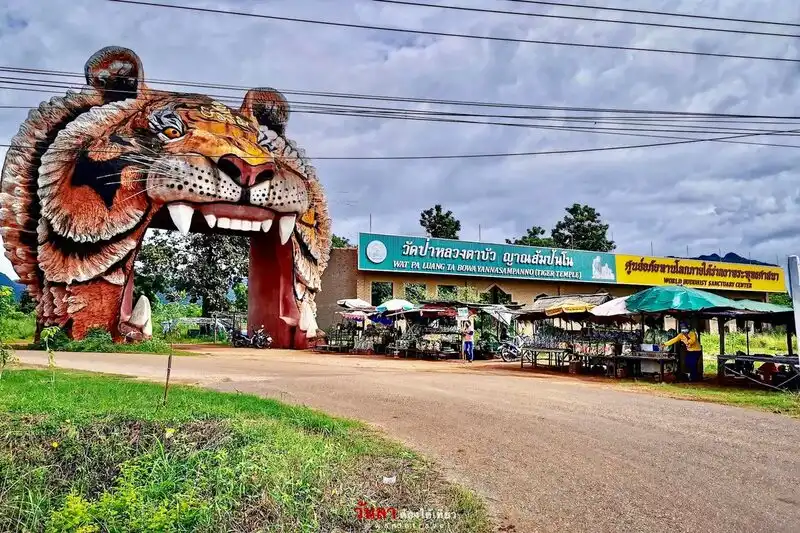
Wat Pa Luang Ta Bua Yan Sampanno is located in Sai Yok District, Kanchanaburi Province. The temple is widely known in both Thailand and abroad as the “Tiger Temple” and has been frequently cited as a place that reflects the concept of peaceful coexistence between humans and wild animals, grounded in Buddhist principles—particularly compassion, loving-kindness, and non-harm.
Wat Pa Luang Ta Bua Yan Sampanno was established in 1994. Its origins did not stem from plans to create a tourist attraction or a wildlife conservation center, but rather from a small incident that reflected human compassion toward animals. Local villagers rescued a tiger cub whose mother had been killed by poachers. With no place to turn, the cub was brought to the temple for help.
At that time, no organization or individual was willing or able to care for the orphaned tiger cub. The abbot of the temple therefore decided to take it in, fully aware that tigers are dangerous wild animals. Guided by compassion and faith in the power of kindness, the abbot and resident monks cared for the cub closely, treating it as if it were their own child. This event became the starting point of Wat Pa Luang Ta Bua as a sanctuary for orphaned wild animals.
From a single orphaned tiger cub, Wat Pa Luang Ta Bua gradually became a place where villagers and local people brought injured or parentless wild animals. The temple was intended to serve as a final refuge for animals with nowhere else to go. Its guiding philosophy has been to raise and care for these animals according to Buddhist principles, emphasizing calmness, familiarity, and non-violence in behavior management.
The care of tigers at Wat Pa Luang Ta Bua differs notably from that of conventional animal care facilities. The monks who look after the tigers use simple, non-violent methods. When a tiger displays inappropriate behavior or growls threateningly, the monks may splash water from a plastic bottle or temporarily cover the tiger’s eyes, especially when other animals such as cows or goats pass nearby. These practices reflect an approach based on calm control rather than punishment.
The tigers living at Wat Pa Luang Ta Bua are Indochinese tigers, scientifically known as Panthera tigris corbetti. This subspecies is native to Thailand, Laos, Myanmar, Cambodia, Vietnam, Malaysia, and southern China. According to data from December 2005, the temple housed a total of 17 Indochinese tigers—seven rescued from the wild and ten born within the temple from tigers already under its care.
Wat Pa Luang Ta Bua attracted significant international attention, particularly when Time magazine, in its issue dated May 22, 2006, praised the temple as an outstanding example of peaceful coexistence. This recognition referred to the temple’s ability to allow humans to live alongside animals as dangerous as tigers without causing serious harm, a case study considered rare on a global scale.
The role of the abbot and the monastic community at Wat Pa Luang Ta Bua has been critically important. Beyond their function as spiritual leaders, they have been responsible for decisions regarding wildlife care, maintaining a balance between human safety and animal welfare, and preserving the image of the temple as a religious institution rather than a zoo or entertainment venue.
Wat Pa Luang Ta Bua thus represents a space that raises profound ethical and social questions about the relationship between humans and nature. While some view the temple as an example of compassion and peaceful coexistence, others question the appropriateness of keeping wild animals within a temple. Nevertheless, Wat Pa Luang Ta Bua remains an important case study that encourages society to examine these issues from multiple perspectives.
Getting There From Bangkok, take Highway No. 4 (Phetkasem Road) through Nakhon Pathom Province, then continue toward Kanchanaburi Province and follow Highway No. 323. Drive straight to the Kaeng Sian intersection and head toward Sai Yok District. Wat Pa Luang Ta Bua is located approximately 38 kilometers from Kanchanaburi town. Look for signs pointing to Muang Sing Historical Park, then turn into the access road and continue for about 6 kilometers to reach the temple entrance.
| Summary | A forest temple founded on the principle of compassion, providing refuge for orphaned wild animals, especially Indochinese tigers. |
| Highlights | Human–tiger coexistence, recognition by Time magazine, and the philosophy of Buddhist compassion. |
| Abbot / Administrator | Phra Wisutthisanathera (Phusit Khantithero) |
| Nearby Attractions | 1) Muang Sing Historical Park – 6 km 2) Muang Sing Historical Site – 6 km 3) Hellfire Pass – 25 km 4) Bridge over the River Kwai – 38 km 5) Thai–Burma Railway Museum – 39 km |
| Nearby Restaurants | 1) Sai Yok Restaurant – 10 km, Tel. 034-555-123 2) River Kwai Riverside Restaurant – 20 km, Tel. 081-234-5678 3) Krua Muang Sing – 7 km, Tel. 089-345-6789 4) Kaeng Sian Local Eatery – 30 km, Tel. 086-456-7890 5) Kanchanaburi Restaurant – 38 km, Tel. 082-567-8901 |
| Nearby Accommodations | 1) Sai Yok Resort – 15 km, Tel. 034-222-333 2) River Kwai Riverside Lodge – 20 km, Tel. 081-333-4444 3) Muang Sing Resort – 7 km, Tel. 034-444-555 4) Muang Kanchanaburi Hotel – 38 km, Tel. 034-555-666 5) River Kwai Floating Raft – 25 km, Tel. 082-666-7777 |
Frequently Asked Questions (FAQ)
Q: How was Wat Pa Luang Ta Bua established?
A: It began with the rescue of an orphaned tiger cub whose mother had been killed by poachers and had no caretaker.
Q: Why does the temple keep tigers?
A: To provide refuge for orphaned and injured wild animals based on the principle of Buddhist compassion.
Q: What species are the tigers at the temple?
A: They are Indochinese tigers, Panthera tigris corbetti.
Q: How has Wat Pa Luang Ta Bua been recognized internationally?
A: It was praised by Time magazine as an example of peaceful coexistence between humans and wild animals.
Q: Who would find Wat Pa Luang Ta Bua interesting to visit?
A: Those interested in history, religion, and the relationship between humans and wildlife.
 Tel: 034531557
 Fax: 034531558
 Wat Pa Luang Ta Bua Yan Sampanno Map
 Category:
  Group:
  Last Update: 7 HourAgo
Comment
 Nearby Attractions
| Keyword (Advance) |
 Region
|
 Muang Kanchanaburi(