

 Home
Home Chiang Mai(







Rating: 4/5 (5 votes)
 |
|  Map
Map 
 Have Map
  No Map
Kanchanaburi attractions
Attractions in Thailand
Open Days: Daily
Opening Hours: Generally 08:00–17:00
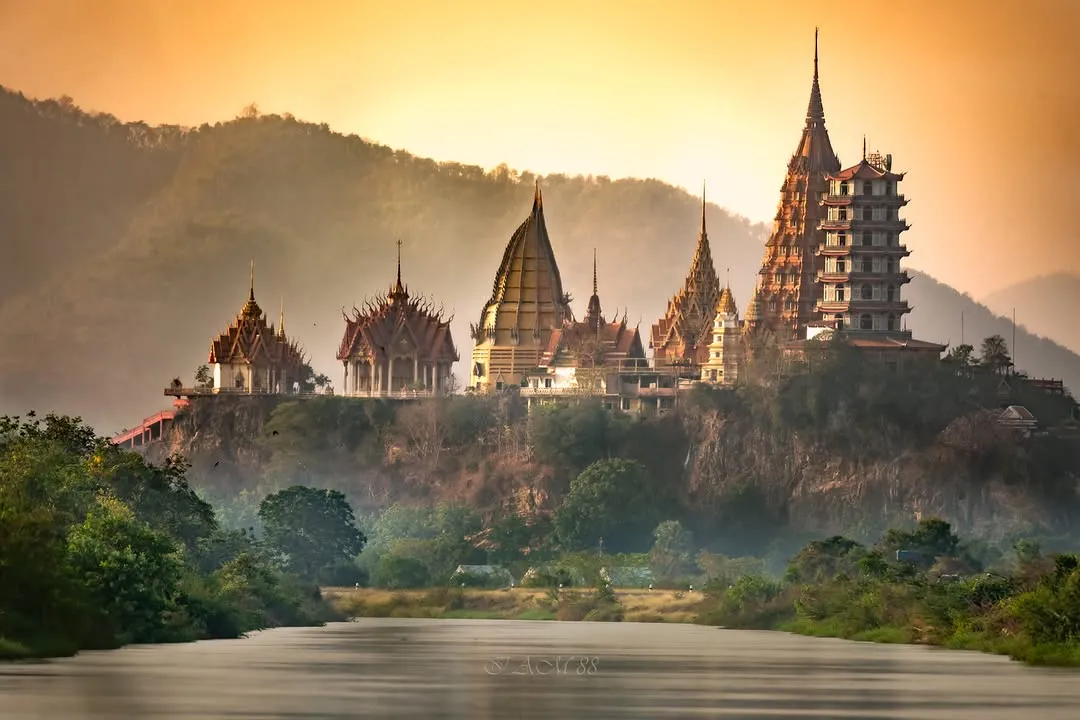
Wat Tham Khao Noi is widely regarded as one of Kanchanaburi’s most distinctive Anamnikaya (Vietnamese Mahayana) temples for travelers who want spiritual calm, cultural depth, and a panoramic mood of “town, fields, and water” in one visit. The temple is located in Muang Chum Subdistrict, Tha Muang District, Kanchanaburi, and is easy to reach from main roads by car. Many visitors also pair it with nearby Wat Tham Suea, making this area a popular faith-and-culture route that offers more than a quick stop for merit. Here, you can experience Chinese–Vietnamese architectural aesthetics, multiple shrine halls to explore, and viewpoints with a rare dual character—one side looking toward the Mae Klong River, the other opening to lush green rice fields that naturally slow your pace and quiet the mind.
The temple’s identity begins with its Anamnikaya affiliation, a Mahayana Buddhist tradition shaped by Vietnamese and Chinese cultural roots, expressed through rituals, craftsmanship, and the spatial arrangement of sacred images. Visitors who are familiar mainly with Theravada Thai temples may immediately sense that the atmosphere feels “different”—from worship corners and iconic figures to the ornate, layered architectural elements. Yet this difference does not create distance. Instead, it opens a wider perspective: Kanchanaburi has long carried multiple layers of belief and community histories, and Wat Tham Khao Noi stands as a tangible, walkable testament to that diversity.
To understand the broader context, Kanchanaburi has historically been tied to both the movement of peoples and western frontier strategy. During the early to mid-Rattanakosin period, the kingdom had to organize defenses along the western border, and the region’s river and land routes supported many communities over time—including Vietnamese groups who settled in Thailand in different waves and were differentiated by religion and roles assigned by the state. In this historical development, Anamnikaya temples did not appear by chance. They emerged from settlement patterns, faith, and a community’s need for spiritual anchors, eventually forming a cultural-religious landscape with its own distinct narrative in Kanchanaburi.
For Wat Tham Khao Noi, it is commonly presented that the temple was founded in 1883 (B.E. 2426). Luang Pu Haeng (Kak Ngen) was said to be the first Chinese monk to reside here, followed by two additional Chinese monks who continued overseeing the temple. Later, Phra Ajarn Tiap Tho—a Mahayana monk of the Anamnikaya tradition—is credited in local accounts with restoring and developing the temple until it gradually became prosperous, visually refined, and increasingly aligned with Mahayana cultural expression. This storyline places the temple in the category of a “century-plus” heritage site, especially compelling for visitors who appreciate places with continuity and lived religious practice, not simply photogenic landmarks.
The most rewarding way to visit Wat Tham Khao Noi is to treat it as a temple designed for sequential exploration rather than a single-stop attraction. Highlights are distributed across several zones, from lower shrine halls up to higher areas along the hillside. The more you walk, the more the atmosphere shifts—from intimate worship spaces that feel welcoming, to grand Mahayana vistas, to quiet overlooks where wide-open views naturally settle the mind. Morning visits tend to be cooler with softer light, ideal for unhurried walking, while late afternoon can add depth to the rice-field scenery and the surrounding community’s contours. Either way, it is worth budgeting more time than you expect, because many visitors arrive intending a brief stop and end up lingering.
One of the temple’s most memorable images is a symbolic bodhisattva figure with a plump form, a bright smile, and recognizable attributes. In the stories passed down, this figure is described as perpetually cheerful and at ease, often traveling with a large shoulder bag filled with toys for children. This is why the figure is popularly nicknamed “Luang Por Yam Yai” (the “Big Bag” monk). The presence of this icon gives Wat Tham Khao Noi a distinct emotional tone: sacredness here is not conveyed only through solemnity, but also through warmth, generosity, and an approachable happiness embodied in the image of the “big bag” and the smile that gently encourages visitors to set down their worries for a moment.
Near Luang Por Yam Yai, many visitors slow down to study the details of the “18 Arhats” statues, positioned on both sides within the same area. Each arhat has a different posture and personality, often explained as representing Dharma riddles or moral-philosophical themes drawn from Anamnikaya and older Chinese traditions. For those who enjoy craftsmanship and photography, this zone is rewarding both visually and intellectually. Even without knowing every legend, you can feel the artist’s intention to make visitors “pause” and “observe”—skills closely aligned with mindful attention in Buddhist practice. The result is not a glance-and-go experience, but a respectful, attentive way of seeing.
Another major spiritual centerpiece is the central hall enshrining “Guanyin Bodhisattva” (Avalokiteshvara in one form). In Mahayana belief, Guanyin is revered as the compassionate one who listens to the suffering of all beings and helps relieve it. The presence of Guanyin gives the hall a particularly gentle atmosphere, and many people come here to pray for compassion, safety, family well-being, health, and the strength to move through difficult phases of life. If you intend to worship here, it is best to take your time, keep your voice low, and avoid blocking others, as this is a consistently visited area throughout the day.
Continuing behind the central hall, you will find Mahayana elements that make many visitors feel as though they are reading an entire belief system in one place. There is a hall dedicated to the Five Buddhas in Mahayana tradition, followed by a replica of the Buddha’s footprint, a spot where many worshippers pay respects for auspiciousness. This layout creates a smooth internal route: from the bright, benevolent mood of Luang Por Yam Yai, to Guanyin’s compassion, and onward into symbols of Buddhahood and awakening. The visit feels less like hopping between unrelated points and more like being guided, step by step, toward greater quietness.
The highlight that many people deliberately come to see, even if it requires further climbing, is the “Kiri Borommathat Pagoda,” also known as “Buang Huk Tha,” commonly described as the “Ten-Thousand Buddhas Pagoda.” Its height and presence make it both an iconic religious structure and a major viewpoint. From the front, you often look out across the Mae Klong River, while the rear opens to green rice fields that change tones with the seasons. The beauty of this panorama is how complete it feels—not just one signature angle, but both water and farmland, the living landscape of Muang Chum and Tha Muang. Standing here, you can sense how the town and its communities grow and endure through the environment that still breathes around them.
For visitors drawn to religious significance, one frequently mentioned point is reaching the seventh level of the pagoda, where it is said that sacred relics are enshrined. Paying respects here is regarded as a great blessing. Practically, the best approach at the highest level is heightened composure, as visitors may be chanting softly or meditating in silence. Photography can be done, but it should remain modest, without inappropriate poses, and without loud conversation, because calmness is one of the defining charms that sets Wat Tham Khao Noi apart from an ordinary scenic lookout.
As a cultural destination, Wat Tham Khao Noi’s greatest strength is its distinctive craftsmanship reflecting Chinese–Vietnamese aesthetics within a Mahayana Buddhist framework, combined with a spatial design that encourages a narrative-style walk through the temple. You are not pushed into one photo spot and out again. Instead, you are invited to keep moving, keep seeing, and keep understanding—while remaining within the boundaries of a living religious site. A good visit therefore means honoring the place: do not touch sacred objects, do not climb restricted areas, and do not litter. The temple’s beauty endures through order, respect, and shared responsibility among visitors.
Atmospherically, Wat Tham Khao Noi can feel noticeably different by season. During the rainy season and just after rainfall, skies often clear in intervals, making the rice fields especially vivid and the waterlight softer, though you should watch for slippery paths in some areas. In the hot season, the sky can be wide and clear with long-distance visibility, but the sun is stronger, so it helps to bring water and visit in the morning or late afternoon for comfort. On certain winter days, the weather is so pleasant that climbing to higher points becomes genuinely enjoyable rather than tiring. These seasonal shifts make the temple a place you can return to and still experience differently each time.
In trip planning terms, Wat Tham Khao Noi fits smoothly into a day route in the Tha Muang area and can connect easily onward to Kanchanaburi town, because it is not far from main routes and sits near several popular attractions. Pairing it with Wat Tham Suea is especially common, offering a rich combination of Mahayana grandeur and varied devotional spaces. After finishing this zone, if time allows, you can continue into town to explore the River Kwai area and museums without losing time to backtracking.
Temple etiquette always matters, especially at a site with steady daily worship. Dress modestly, avoid revealing clothing, keep voices low inside halls and prayer areas, and take photos respectfully without poses that are inappropriate for a sacred place. If you are traveling with elders or small children, walk slowly and take care on stairs and uneven levels, as this is a hillside temple with sections that require ascending and descending. Being cautious helps the visit stay smooth and supports a respectful coexistence with the space.
Getting There Wat Tham Khao Noi is most easily reached by private car. Start from Saeng Chuto Road and head toward the Tha Muang area, then use navigation to search for “Wat Tham Khao Noi” or “Wat Tham Khao Noi (Kanchanaburi).” Along the final approach there are directional signs at intervals and the road is generally convenient. If you plan to visit together with Wat Tham Suea, you can arrange the order freely since they are in the same vicinity. It is also wise to set aside enough time to walk through the temple properly, because there are multiple points best enjoyed slowly for the fullest experience.
Altogether, Wat Tham Khao Noi offers a complete, quietly powerful experience for travelers who want worship, calmness, Mahayana artistry, and a panorama that reveals local life in a wide frame. If you are looking for a Kanchanaburi temple that is not only beautiful but also storied, sequentially walkable, and genuinely capable of slowing the mind, Wat Tham Khao Noi deserves at least half a day. Many people return even after a first visit, precisely because the temple continues to reveal new details and new moods over time.
| Place Name | Wat Tham Khao Noi (Wat Tham Khao Noi) |
| Address | Muang Chum Subdistrict, Tha Muang District, Kanchanaburi |
| Place Summary | A hillside Anamnikaya (Vietnamese Mahayana) temple in Tha Muang, known for Chinese–Vietnamese shrine halls, Luang Por Yam Yai, Guanyin, the 18 Arhats, and the Kiri Borommathat Pagoda (“Buang Huk Tha” or Ten-Thousand Buddhas Pagoda), with panoramic views of the Mae Klong River and surrounding rice fields. |
| Key Highlights | Anamnikaya/Mahayana identity, Luang Por Yam Yai, 18 Arhats, Guanyin Hall, Hall of the Five Buddhas, replica Buddha footprint, Kiri Borommathat Pagoda (“Buang Huk Tha”), Mae Klong River viewpoint and rice-field panorama. |
| History / Background | Commonly presented as founded in 1883 (B.E. 2426), with Luang Pu Haeng (Kak Ngen) as the first Chinese monk resident. Later, additional monks continued the oversight, and Phra Ajarn Tiap Tho (Mahayana/Anamnikaya) is cited in local accounts for restoring and developing the temple until it became prosperous and visually refined over time. |
| Sect / Tradition | Anamnikaya (Mahayana) |
| Abbot / Current Caretaker | Phra Palat Wichian Thian-I, Ph.D. |
| Open Days & Hours | Daily (generally 08:00–17:00) |
| Admission Fee | No admission fee (donations welcome) |
| Facilities | Multiple shrine halls, hillside walkways to higher points, viewpoints, parking areas arranged by the temple (watch for uneven levels and slippery surfaces in rainy conditions). |
| Travel | Use navigation to search “Wat Tham Khao Noi” or “Wat Tham Khao Noi (Kanchanaburi).” Access is convenient from main roads in the Tha Muang area, with signage along the final approach. |
| Current Status | Open for worship and visits as usual |
| Contact Number | 034-655-233 |
| Nearby Tourist Attractions (Approx. Distance + Phone) | 1) Wat Devasangharam (Wat Nuea) ~18 กม. โทร 034-511-216 2) Kanchanaburi Skywalk ~18 กม. โทร 098-952-0628 3) Bridge Over the River Kwai ~19 กม. โทร 034-512-979 4) Thailand–Burma Railway Centre ~20 กม. โทร 034-512-721 5) JEATH War Museum ~20 กม. โทร 034-515-203 |
| Nearby Restaurants (Approx. Distance + Phone) | 1) Keeree Tara Restaurant ~19 กม. โทร 034-513-855 2) Keeree Mantra Restaurant ~19 กม. โทร 034-540-889 3) Bell’s Pizzeria ~19 กม. โทร 081-010-6614 4) Jolly Frog Restaurant ~19 กม. โทร 034-512-028 5) By de River ~19 กม. โทร 034-624-477 |
| Nearby Accommodations (Approx. Distance + Phone) | 1) U Inchantree Kanchanaburi ~19 กม. โทร 034-521-584 2) Felix River Kwai Resort ~19 กม. โทร 034-551-000 3) Dheva Mantra Resort ~20 กม. โทร 034-615-999 4) Good Times Resort Kanchanaburi ~20 กม. โทร 034-513-888 5) Mida Resort Kanchanaburi ~35 กม. โทร 034-919-606 |
Frequently Asked Questions (FAQ)
Q: Where is Wat Tham Khao Noi located?
A: It is in Muang Chum Subdistrict, Tha Muang District, Kanchanaburi. The temple is easy to reach by car and is commonly visited together with nearby Wat Tham Suea.
Q: What Buddhist tradition does Wat Tham Khao Noi follow?
A: It is an Anamnikaya (Mahayana) temple, so many architectural features and worship points reflect Chinese–Vietnamese Mahayana culture, including Guanyin and the Mahayana-style arrangement of sacred images.
Q: Where should I start when visiting the temple?
A: Start at the lower halls to settle your pace and pay respects, then continue to Luang Por Yam Yai and the 18 Arhats, visit the Guanyin Hall, and finally walk up to the Kiri Borommathat Pagoda area to enjoy the panoramic viewpoints.
Q: What are the must-see highlights at Wat Tham Khao Noi?
A: Luang Por Yam Yai, the 18 Arhats, Guanyin Hall, the Hall of the Five Buddhas, the replica Buddha footprint, and the Kiri Borommathat Pagoda (“Buang Huk Tha”) with views of the Mae Klong River and surrounding rice fields.
Q: When is the best time to visit for comfortable walking and good photos?
A: Morning or late afternoon is more comfortable and offers softer light for shrine halls and viewpoints. If you plan to climb to higher points, it is best to avoid midday heat.
Q: What etiquette should I follow when visiting the temple?
A: Dress modestly, keep voices low in worship areas, take photos respectfully without inappropriate poses, do not climb restricted areas or touch sacred objects, and be careful on stairs and uneven paths, especially when surfaces are damp after rain.
 Wat Tham Khao Noi Map
 Category:
  Group:
  Last Update: 16 HourAgo
Comment
 Nearby Attractions
| Keyword (Advance) |
 Region
|
 Muang Kanchanaburi(