

 Home
Home Chiang Mai(










Rating: 4/5 (6 votes)
 |
|  Map
Map 
 Have Map
  No Map
Kanchanaburi attractions
Attractions in Thailand
Open Days: Daily
Opening Hours: Accessible all day (24 hours)
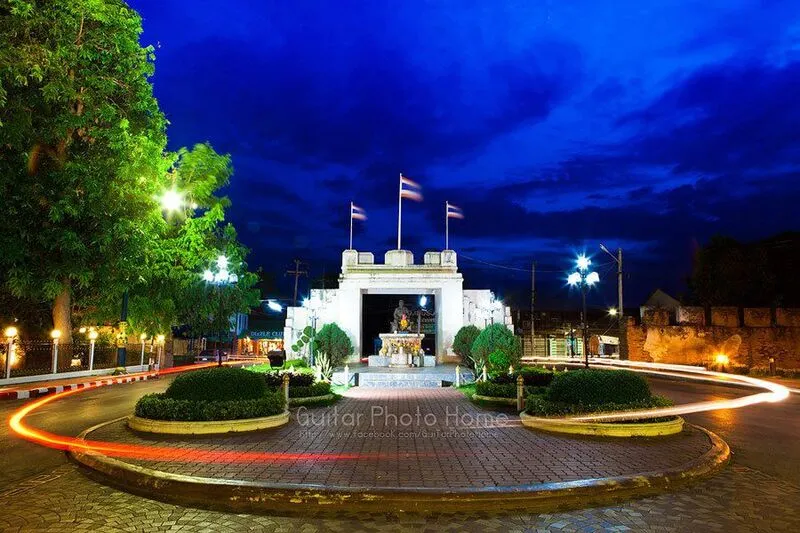
Kanchanaburi City Gate (Pak Prak Road) is located on Pak Prak Road, Ban Nuea Subdistrict, Mueang Kanchanaburi District, Kanchanaburi Province. It is one of the most tangible pieces of evidence that clearly tells the story of a crucial turning point of a “frontier city” in the early Rattanakosin period. This is not merely a brick-and-mortar city gate that still stands proudly near the Khwae Yai River, but rather the “starting point of a new city,” established when the old city of Kanchanaburi (in the Lat Ya area) was relocated to the Pak Prak neighborhood in 1831 (B.E. 2374) during the reign of King Nangklao (Rama III), in response to major strategic and economic changes.
When we stand before the “front city gate” facing the Khwae Yai River, what we see often leads many people to think of it simply as a beautiful photo spot in downtown Kanchanaburi. Yet from the perspective of military history, a city gate is a control point for entry and exit that is inseparable from the city wall, bastions, and the overall city layout. It functions as a “security mechanism” responsible for surveillance, screening, controlling transportation routes, and designating muster points during critical situations—especially at a time when Kanchanaburi was an important borderland city connecting routes to the west, where the state closely monitored external movements.
Key information to understand before exploring the deeper narrative is that the new city of Kanchanaburi in the reign of Rama III was planned with brick-and-mortar city walls topped with bai sema (boundary markers). The city’s layout formed a rectangular plan, approximately 210 meters wide and 480 meters long, with four corner forts and additional smaller forts along the wall. The city also originally had a total of eight gates, including six main city gates and two smaller “chong kut” gates. Over time, however, most of the walls and gates deteriorated and were largely ruined. Today, the most visibly preserved remains are the front city gate and a section of the adjoining wall. These were restored in 2006 (B.E. 2549), and behind the gate stands a royal monument of King Nangklao (Rama III), reinforcing the meaning of this place as a “city that was relocated and rebuilt” under the royal initiative of this monarch.
Looking back to understand why the city was moved from Lat Ya to Pak Prak, the primary factor was the changing strategy of defending against enemies. The old site may not have met the needs of territorial control and defense as effectively as required. In contrast, Pak Prak offered a more suitable defensive position and also provided better connectivity for trade with other cities through networks of waterways and overland routes. As a result, the new city played a dual role in both security and the economy. In other words, it was designed to “withstand warfare” and “drive commerce” at the same time.
A military analysis of Kanchanaburi’s early Rattanakosin city plan should begin with what seems simplest: the “rectangular layout.” This shape makes it easier to define and control the defensive perimeter, reduces blind spots, and allows corner forts to function effectively in creating crossfire coverage. If an attack approached from one direction, the corner forts served as primary firing points controlling two sides of the wall simultaneously. Meanwhile, additional forts along the front and rear sections of the wall strengthened long-range surveillance, reduced the chance of enemies approaching undetected, and increased defensive density in particularly vulnerable areas.
Another dimension often overlooked is the “number of gates,” which was as many as eight. Multiple gates may appear to increase risk, but in the context of a frontier city, they helped distribute movement routes and supply lines, reduced bottlenecks in troop deployment, and increased operational flexibility—especially when the city needed to communicate with surrounding areas by both land and water. Gates were not merely passages, but “nodes in a network” linking the city to agricultural settlements, trade communities, river piers, and strategic routes. Even so, gate design and entry approaches were typically not left as long, straight open corridors; rather, they were arranged to enable effective inspection and control of people and goods entering and exiting the city.
The front gate that remains today therefore serves as an “entry point for reading the city plan,” helping us visualize the former defense system—especially its relationship with the Khwae Yai River. Strategically, the river served two roles at once: as a “natural moat” that impeded opposing forces, and as a “logistics route” enabling the state to send troops, supplies, information, and goods more efficiently than overland routes during certain seasons. A city oriented toward the river was, in effect, positioned to align geography with both security and prosperity.
Shifting from the military system to people’s lives, the importance of the city gate becomes even clearer. The gate did not function only in wartime; it also became a “symbol of the city” and a point that shaped the rhythm of the local economy. Traders entering the city, travelers arriving via the pier and main road, and people coming to contact official authorities all passed through this node. The city gate was therefore a place where “state governance” and “everyday economic life” overlapped closely.
The Pak Prak area where the city gate stands holds special meaning as an old community of Kanchanaburi. It grew as a riverside commercial district linked to shipping and the movement of goods. Over time, Pak Prak became a major road of the city, bringing together shops, residences, old shophouses, and the cultural practices of people from diverse backgrounds. This community carries not only stories of soldiers and defense, but also stories of merchants, craftsmen, boatmen, market life, and families whose daily routines were tied to the river’s flow and the steady arrival of people from many places.
Local elders in the Pak Prak community often recall the atmosphere of a bustling “riverside town” from early morning. Cargo boats and passenger boats docked at the pier, and people moved constantly because the road and riverfront were the heart of activity. Homes near the pier were surrounded by general stores, local eateries, tool shops, fabric sellers, and informal spaces where news was exchanged. In the past, “going to the pier” was not merely travel—it was meeting people, trading goods, listening to stories of the city, and witnessing changes brought by those who passed through this frontier district.
In the memory of many Pak Prak residents, the city gate was like the “pillar of the district,” serving as a familiar meeting point. Some families recall that when relatives arrived from other districts, they would often say, “Meet at the city gate,” before heading together to the market or the pier. In this way, the gate performed a social function as a symbol, marking the beginning of getting to know the city and signaling that one had truly entered the urban center.
Another commonly shared story is Pak Prak’s transition from a riverside trading zone to a modern commercial road. As overland transport became more convenient, people began using cars more than boats. Shops shifted from catering primarily to boat passengers to serving customers passing by on the road. Pak Prak Road gradually became the city’s main artery in a new form. Yet even as the economy changed, what continues to give the area its distinct identity is its “layers of time,” visible in old buildings, restoration traces, remnants of older shop signs, and memories of residents who still recall when this space was once a lively pierfront.
The restoration of the city gate and portions of the wall in 2006 (B.E. 2549) helped revive the area’s role as a tangible historical attraction. Increasing numbers of visitors began coming to Pak Prak Road to take photos, absorb the old-town atmosphere, and then continue to other historical sites in Kanchanaburi—such as the Bridge on the River Kwai, the Don Rak Allied War Cemetery, the Thailand–Burma Railway Centre, and various war museums. This supports modern storytelling of Kanchanaburi with a strong “core” that connects multiple eras—from the relocation and rebuilding of the city under Rama III, to World War II history, and onward to contemporary tourism.
To understand the city gate more deeply, looking only at the architecture is not enough, because the gate was the result of state-level political and strategic decisions. The reign of Rama III was a period when Siam faced regional pressures, including relations with neighboring states, concerns over troop movements along border areas, and the need to reorganize frontier cities to strengthen governance. As a western borderland, Kanchanaburi had to be “re-formed” into a more secure city. Building walls, forts, and gates was not accidental; it was a way of asserting state authority through the urban landscape.
From an engineering and defense standpoint, the brick-and-mortar wall topped with bai sema reflects a clear concept of defining the city boundary. In this context, bai sema did not carry only religious symbolism; it also created a distinct “crest line” on the wall, making the upper boundary more visible, increasing climbing difficulty, and potentially serving as a modest cover line for sentries in earlier times. Meanwhile, corner forts and mid-wall forts meant that surveillance was not limited to sightlines alone, but was supported by prepared positions for counteraction if enemies approached.
Positioning the gate toward the Khwae Yai River also demonstrates the connection between the “city system” and the “water system.” The river was both a trade route and a strategic route. The front gate thus became a gateway to the outside world via the waterway. In some periods, travelers may have arrived primarily from the pier before moving up to Pak Prak Road. Having the gate near the river made controlling waterborne entry and exit practical, enabling the state to regulate both economic activities and security simultaneously.
On another level, the city gate reflects Kanchanaburi’s “shared memory.” This is a city with multiple layers of history—from the rebuilding in Rama III’s era, to its crucial role in World War II, to the growth of tourism after the war. Many travelers come to Kanchanaburi hoping to see the Bridge on the River Kwai or war-related museums, but when they enter Pak Prak Road and encounter the city gate, they often realize that “Kanchanaburi is not only about World War II.” It also has a much longer history of city management and border defense that predates that period by far.
Touring the city gate therefore suits visitors who want to “begin the story of Kanchanaburi” from the old city core and then expand into different eras according to their interests. Photography lovers will appreciate the gate and wall lines as strong visual composition elements. History enthusiasts can see spatial evidence of the city’s relocation under Rama III. Those interested in community life can continue walking along Pak Prak Road to observe old houses, historic shops, and traces of a riverside community that still remain.
If you want to “read the city” in detail, notice how standing at the gate reveals the city’s orientation. In front is the Khwae Yai River, a crucial geographical feature. Behind is Pak Prak Road, functioning like the commercial axis of the community. Nearby is the monument of Rama III, reinforcing the state’s role in the city-building process. Bringing these elements together in one space makes the city gate not merely an architectural object, but a “stage” that holds the state, the city, and the community in a single frame.
Getting There is relatively easy because the city gate is located in the urban area on Pak Prak Road. Visitors can drive and park in nearby areas before walking to explore, or use local public transport within the city to reach Pak Prak Road. From here, it is also convenient to continue to other major attractions in town, since many are located within a short distance. Planning a “historic old-town route – wartime history route” works particularly well: start at the city gate and Pak Prak Road, then continue to museums and memorial sites across central Kanchanaburi.
Although this is an open-air site accessible all day, the most pleasant times to visit are usually morning or late afternoon. The softer light adds depth to the surface details of plaster and brick, and the weather is more comfortable for walking onward along Pak Prak Road to explore the old community area, or to stop for a meal in town before heading to the Bridge on the River Kwai and other attractions.
One more important point is visiting with respect for a historic place. The city gate is cultural heritage of the community. Photography is generally fine, but keeping the area tidy, avoiding climbing, not damaging plaster or brick surfaces, and not disturbing local residents will help preserve the site for the long term and support quality tourism in Kanchanaburi overall.
When we connect the gate’s story to the Pak Prak community, it becomes clear that “the city,” in the Kanchanaburi sense, has never been static. The city has been relocated, rebuilt, restored, and retold across eras. Yet the city gate continues to serve as a starting point for understanding Kanchanaburi, because it stands at the intersection of royal-state history and community history, of defense strategy and commerce, and of local memory and visitor experience.
For these reasons, if you are looking for a place to visit in Kanchanaburi town that offers beautiful visuals, deeper meaning, and the ability to branch into multiple sightseeing routes, the Kanchanaburi City Gate is an ideal beginning. Simply walking through this archway can feel like “walking through time,” from the early Rattanakosin period into a living contemporary city—while stories continue to unfold layer by layer alongside the people of Pak Prak and the Khwae Yai River flowing through Kanchanaburi to this day.
| Category | Details |
| Place Name | Kanchanaburi City Gate |
| Address | Pak Prak Road, Ban Nuea Subdistrict, Mueang Kanchanaburi District, Kanchanaburi Province |
| Place Summary | A brick-and-mortar city gate from the early Rattanakosin period, built during the reign of Rama III in 1831 (B.E. 2374). It represents the relocation of Kanchanaburi from Lat Ya to the Pak Prak area, and is the most prominent surviving element of the original city-wall system. |
| Highlights | Rama III-era city-gate architecture, remaining sections of the historic city wall, orientation toward the Khwae Yai River, and direct connection to Pak Prak Old Community—ideal for a walking route focused on local history in downtown Kanchanaburi. |
| Period | Early Rattanakosin (Reign of Rama III) |
| Key Evidence | The front city gate (best-preserved remain), portions of the city wall, the original rectangular city plan (approx. 210 m × 480 m), and records of the 1831 (B.E. 2374) city relocation. |
| Name Origin | “City Gate” refers to the main gate of the relocated Kanchanaburi city wall system established in the Pak Prak area, serving as a controlled entry–exit point and a symbol of the city boundary. |
| Travel | Travel into central Kanchanaburi town and head to Pak Prak Road (Pak Prak community area). You can drive and park nearby before walking around, or take local public transport to the Pak Prak area. From here, it is easy to continue to other key attractions in the city. |
| Current Status | Historic landmark in the old-town area, open for visitors daily |
| Nearby Tourist Attractions | 1) Pak Prak Old Community & Pak Prak Road – 0.01 km 2) Don Rak Allied War Cemetery – 1.4 km 3) Thailand–Burma Railway Centre – 1.6 km 4) Skywalk Kanchanaburi – 2.0 km 5) Bridge on the River Kwai – 3.7 km |
| Nearby Restaurants | 1) Keeree Tara – 3.8 km – 034-513-855 2) Loft Restaurant & Bar – 3.8 km – 034-513-000 3) Mangosteen Cafe – 4.2 km – 034-511-814 4) Bell’s Pizzeria – 4.1 km – 087-170-5263 5) On’s Thai Issan Vegetarian Restaurant – 4.6 km – 087-364-2264 |
| Nearby Accommodations | 1) Felix River Kwai Resort – 4.2 km – 034-551-000 2) U Inchantree Kanchanaburi – 4.0 km – 034-521-584 3) Good Times Resort Kanchanaburi – 5.1 km – 087-162-4949 4) Natee The Riverfront Hotel Kanchanaburi – 5.5 km – 034-518-777 5) Dheva Mantra Resort – 6.7 km – 034-615-999 |
Frequently Asked Questions (FAQ)
Q: When was the Kanchanaburi City Gate built?
A: It was built during the reign of King Nangklao (Rama III) in 1831 (B.E. 2374), as part of the relocation of Kanchanaburi from Lat Ya to the Pak Prak area.
Q: Why was Kanchanaburi relocated to the Pak Prak area?
A: The relocation aimed to meet changing defense strategies and to improve trade and transportation convenience, taking advantage of a stronger riverside position and more effective routes than the former location.
Q: What was the original Kanchanaburi city wall like?
A: The wall was built of brick and mortar and topped with bai sema. The city plan was rectangular, approximately 210 meters wide and 480 meters long, with four corner forts and a total of eight gates. Most of it has deteriorated, and today the front gate and parts of the wall are the most clearly visible remains.
Q: What time can visitors see the city gate?
A: In general, it can be visited at any time (24 hours) since it is an open-air historic landmark within the town area.
Q: How far is the city gate from the Bridge on the River Kwai?
A: The approximate distance is about 3.7 km. It is easy to travel by car within the city, and it can be included in a connected route with museums and memorial sites around central Kanchanaburi.
Q: After visiting the city gate, where should visitors go next for a fuller historical route?
A: Recommended stops include the Pak Prak Old Community (walkable), Don Rak Allied War Cemetery, the Thailand–Burma Railway Centre, Skywalk Kanchanaburi, and the Bridge on the River Kwai—linking the story from the era of Rama III to World War II history and modern-day Kanchanaburi.
 Kanchanaburi City Gate Map
 Category:
  Group:
  Last Update: 2 DayAgo
Comment
 Nearby Attractions
| Keyword (Advance) |
 Region
|
 Muang Kanchanaburi(