
 Home
Home North(
 Chiang Mai(


Rating: 4.4/5 (5 votes)
 |
|  Map
Map 
 Have Map
  No Map
Chiang Mai attractions
Attractions in Thailand
Open Days: Advance contact/appointment is recommended before visiting (this is an active Royal Initiative project area with ongoing field operations)
Opening Hours: Recommended during daytime, 08.30–16.30 (hours may change depending on field missions or season; please verify before traveling)
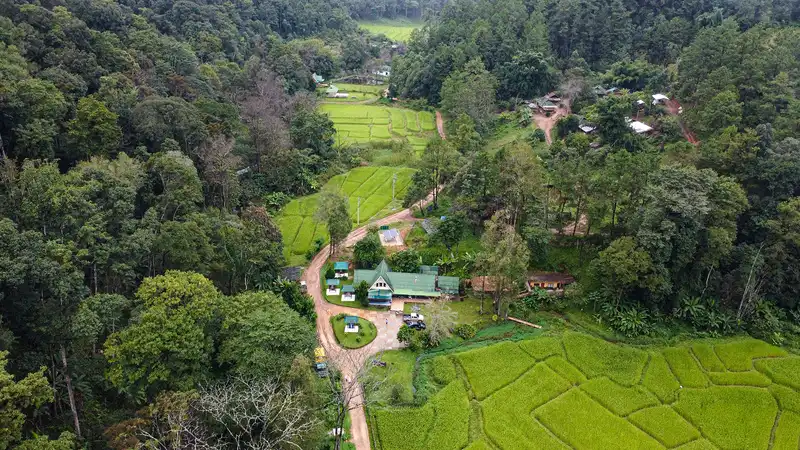
Small House in the Big Forest Project, Doi Kham is a destination that gives the phrase “a place to relax in Chiang Mai” a very different meaning from café hopping or scenic viewpoints. The core of this place is not about sightseeing, but about understanding a development and conservation system designed to allow people to truly live with the forest—without destroying it and without forcing poverty to push communities back toward choices that repeatedly damage watershed forests.
The project is located in Mueang Haeng Subdistrict, Wiang Haeng District, Chiang Mai Province, within the conservation context of Huai Nam Dang National Park. The area falls under watershed quality classes 1 and 2, making it highly ecologically sensitive. This means that any development must proceed with extreme caution. A single misstep does not only affect forest cover, but also water sources, forest moisture, and long-term water security for downstream communities.
The origin of the project can be clearly traced to the royal visit on 21 January 2002 at 16.20, when Her Majesty Queen Sirikit, the Queen Mother, visited the Doi Dam area in Mueang Haeng Subdistrict, Wiang Haeng District. She graciously expressed the Royal Initiative to establish the “Small House in the Big Forest” project, assigning local residents the role of restoring and caring for nearby forest areas while also serving as guardians of the border and partners in preventing drug-related problems in this frontier region. This reflects a concept of national security interwoven with ecological stability—something that becomes truly clear only when standing in the actual landscape.
Because the project area lies within a national park and high-quality watershed zone, strict legal and regulatory limitations apply. As a result, implementation had to take the form of an academic pilot project for national park conservation purposes, carried out in cooperation with relevant government agencies. This is why many Royal Initiative sites are not operated as conventional tourist attractions, and why advance coordination is essential—it ensures safety, proper land management, and prevents disruption to the ongoing fieldwork of officials and community members.
The guiding principle of the Small House in the Big Forest Project is summarized in the “Three A’s”: Sufficiency (A-im), Security (A-un), and Ideals (A-udomkan). Translated into everyday terms, this means ensuring households have enough food and income to live sustainably, enjoy safety and stability in daily life, and develop a long-term commitment to protecting the forest rather than exploiting it. The real challenge is not explaining these ideas beautifully, but making all three happen simultaneously in the daily lives of real families—and sustaining them as a community-wide system rather than a short-term program.
A distinctive feature of the project is its careful selection of participating households. The project targets landless, low-income families who are hardworking and free from involvement with drugs, drawn from four ethnic groups—Akha, Lisu, Lahu (Muser), and Karen—five families from each group, totaling twenty families. Because these participants live and work in the area full-time, development efforts must address real-life needs: food security, income, children’s education, safety, and relationships with state authorities and conservation frameworks.
An often-overlooked aspect is the community’s role as stewards of the land. Participants are entrusted with monitoring forest areas, guarding border zones, and helping prevent drug trafficking. This elevates the project beyond agriculture into a social structure that restores dignity, responsibility, and a sense of national contribution. When dignity is restored, life choices often change with it.
From a visitor’s perspective, the project reveals a clear system: forests, water, agriculture, and livelihoods are inseparably linked. Healthy forests sustain water sources; stable water enables viable agriculture; viable agriculture secures household income; and secure income reduces pressure to encroach further into forest land. This cycle is what the Small House in the Big Forest Project aims to stabilize—not through prohibitions alone, but by making forest protection a shared benefit for both communities and watersheds.
Agricultural practices here emphasize small-scale, forest-compatible cultivation rather than high-volume monoculture. Because the area is mountainous and ecologically fragile, crops that thrive under forest canopy—such as coffee and fermented tea leaves (cha miang)—are promoted, alongside household vegetable gardens for daily consumption. This approach aligns naturally with the Sufficiency Economy philosophy and supports long-term forest coexistence.
Royal guidance within the project also includes livelihood diversification, such as expanding fish farming and identifying cold-climate fish species that are both suitable for local conditions and nutritious. This demonstrates that the project goes beyond crop cultivation to address protein intake, income diversification, and household food security.
For travelers seeking a different kind of retreat in Chiang Mai, this project offers unmanufactured tranquility. Wiang Haeng and Mueang Haeng move at a slower rhythm than urban Chiang Mai. The quiet here creates space for reflection, making it ideal for those who enjoy scenic drives, mountain landscapes, local narratives, and real-world development contexts rather than tightly scheduled tourist activities.
Because this is a working conservation area, respect and moderation are essential. Advance contact, staying within permitted zones, minimizing noise, managing personal waste responsibly, and avoiding expectations of commercial tourism services are basic courtesies. Visitors who come to learn rather than consume often leave with deeper insight—and without disrupting the daily work of the community and officials.
When traveling by private vehicle, allow extra time. Mountain roads include steep sections and curves, and conditions may change during the rainy season. Carry sufficient drinking water, personal medication, rain or wind protection, and ensure communication readiness, especially when traveling in small groups.
For those seeking meaningful travel in Northern Thailand, the Small House in the Big Forest Project at Doi Kham offers more than scenery. It brings visitors face-to-face with a fundamental question: how can people and forests coexist sustainably? Here, the answer lies in strengthening livelihoods so survival does not come at the expense of the forest, while cultivating a shared responsibility for protecting land, water, and future generations.
Getting There From Chiang Mai city, travel toward the Chiang Dao area, then continue to Wiang Haeng District and Mueang Haeng Subdistrict. Allow ample travel time due to mountainous terrain. If you intend to enter the project area, advance contact is recommended to receive up-to-date route guidance, meeting points, and conservation-area protocols.
| Name | Small House in the Big Forest Project, Doi Kham |
| Location | Mueang Haeng Subdistrict, Wiang Haeng District, Chiang Mai Province (within the conservation context of Huai Nam Dang National Park) |
| Key Characteristics | A Royal Initiative project based on the “Small House in the Big Forest” concept, aiming to enable sustainable coexistence between people and forests, restore watershed ecosystems, and enhance community livelihoods and border security through the Three A’s principle |
| Period | Initiated following the Royal Initiative on 21 January 2002 |
| Key Information | Located within Huai Nam Dang National Park and watershed classes 1–2, the project operates under strict legal constraints as an academic pilot conservation initiative. It involves 20 households from four ethnic groups tasked with restoring watershed forests, monitoring border areas, and supporting drug prevention efforts. |
| Name Origin | Derived from the Royal Initiative concept “Small House in the Big Forest,” using the local designation “Doi Kham” |
| Getting There | Chiang Mai → Chiang Dao area → Wiang Haeng District → Mueang Haeng Subdistrict (allow extra time for mountainous roads; advance coordination recommended) |
| Current Status | Active Royal Initiative project within a conservation area; advance contact recommended before visiting |
| Contact | Chiang Mai Highland Agriculture Promotion and Development Center, Tel. +66 53 282 823 |
| Facilities | Field-based learning areas (subject to permission), agricultural and forest restoration demonstration plots (depending on schedule), basic community facilities; visitors should prepare personal necessities |
| Nearby Attractions (Approximate Distance) | Piang Luang Village — approx. 30–45 km Phra That Saen Hai (Wiang Haeng) — approx. 15–35 km Public ponds/parks in Wiang Haeng area — approx. 10–30 km Chiang Dao mountain viewpoints / Highway 1322 corridor — approx. 50–85 km Huai Nam Dang National Park — distance varies by route |
| Popular Nearby Restaurants | Khon Mueang Haeng Restaurant — approx. 10–30 km — Tel. +66 97 967 8431 Mon Lan Chang (Wiang Haeng) — approx. 10–30 km — Tel. +66 97 918 0175 Lab Khan Thep (Piang Luang area) — approx. 30–45 km — Tel. +66 87 176 7657 FoodFactory Canteen (Wiang Haeng) — approx. 10–30 km — Tel. +66 63 228 2202 Coffee Town Wiang Haeng — approx. 10–30 km — Tel. +66 90 891 8392 |
| Popular Nearby Accommodations | Mueang Haeng Resort & Spa — approx. 10–30 km — Tel. +66 53 477 185 Chiang Tung Guesthouse (Wiang Haeng) — approx. 10–30 km — Tel. +66 53 477 251 Chiang Tung Guesthouse (alternate) — approx. 10–30 km — Tel. +66 89 835 4932 Khum Wiang Haeng — approx. 10–30 km — Tel. +66 53 477 177 Benjaporn Guesthouse — approx. 10–30 km — Tel. +66 8 9855 4275 |
Frequently Asked Questions (FAQ)
Q: Who is the Small House in the Big Forest Project at Doi Kham suitable for?
A: It is ideal for travelers seeking meaningful experiences in Northern Thailand and those interested in Royal Initiative projects that integrate forests, water resources, livelihoods, and community security rather than conventional sightseeing.
Q: Why is advance contact required before visiting?
A: Because the area is an active conservation and fieldwork site, advance coordination ensures updated route guidance, meeting points, safety protocols, and minimizes disruption to officials and community operations.
Q: What do the Three A’s (Sufficiency, Security, Ideals) mean?
A: They represent the principles of ensuring adequate livelihoods, stable and safe living conditions, and cultivating a long-term commitment to forest stewardship and community responsibility.
Q: When is the best time to visit?
A: Late rainy season to winter is generally the most comfortable for travel, but visitors should always check weather and road conditions, as mountain routes can change seasonally.
Q: Where can I get more information?
A: Contact the Chiang Mai Highland Agriculture Promotion and Development Center at +66 53 282 823 and inquire about the Small House in the Big Forest Project in the Wiang Haeng / Mueang Haeng area.
 Tel: 053216203
 Fax: 053216820
 The Little House In The Big Forest Doicome Projects Map
 Category:
  Group:
  Last Update: 3 MonthAgo
Comment
 Nearby Attractions
| Keyword (Advance) |
 Facebook Fanpage
 Region
 Art, Culture and Heritage
 Historical Sites and Monuments(
 Landmarks and Memorials(
 Royal Palace(
 Art, Craft Centres, Tradition(
 Museums(
 Educational Places
 Museum for Study(
 Educational Gardens, Farm(
 Training Center(
 University
 Places of Worship
 Temple(
 Mosque(
 Other religious and spiritural sites(
 Suburban Living
 Village, Community(
 Local Market(
 Nature and Wildlife
 National Parks and Marine Reserves(
 Mountain (Doi)(
 Dam, Reservoir, Lake(
 Waterfalls(
 Hot Springs(
 Caves(
 River, Canal(
 Other natural attractions(
 Entertainment and Agricultural
 Zoos and Aquariums(
 Animal camps and shows(
 Stadium(
 Farm, Parks, Gardens and Ecotourism(
 Waterpark(
 Theater(
 Outdoor and Adventure Activities(
 Shopping
 Shopping and Night Market(
 Restaurant
 Michelin Star(
 Michelin Guide(
 Call Customer Service in Tourism
 Call Customer Service in Tourism(
 Travel Articles, Recipes
 Travel Review, Food Review(
 Food Menu, North Recipes(
 Thai Desserts, North Recipes(