

 Home
Home Chiang Mai(










Rating: 3.7/5 (7 votes)
 |
|  Map
Map 
 Have Map
  No Map
Chiang Mai attractions
Attractions in Thailand
Open Days: Generally daily (recommended to visit during daylight hours and avoid heavy rain or right after rain, as the ground can be slippery and more prone to subsidence)
Opening Hours: Generally 08:00 – 17:00 (hours may vary depending on site management and season; checking before you go is recommended)
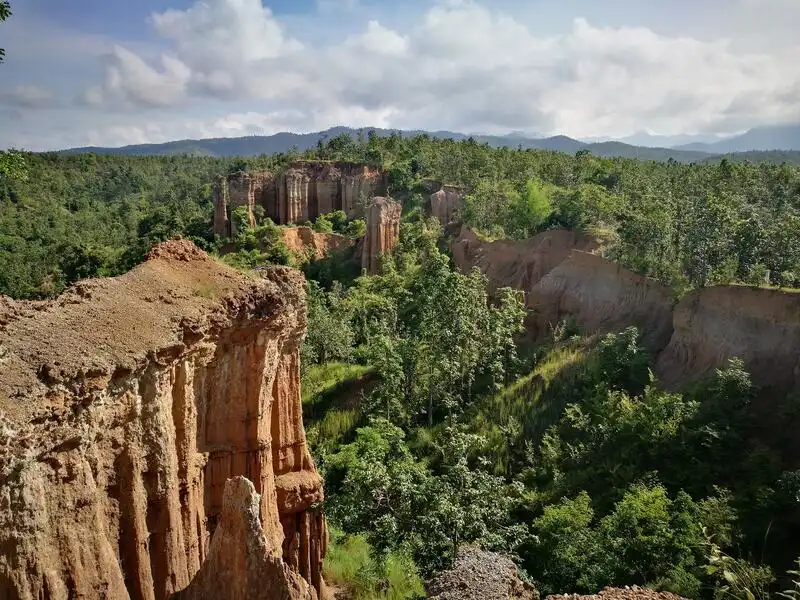
Pha Sing Liao is a natural, geology-focused attraction in Hot District, Chiang Mai. Most visitors remember it first as a place of “high cliffs and earth pillars” standing in layered formations that look like a stone city from a daydream. From certain angles, one section resembles a lion turning its head to look sideways, which is how the name “Pha Sing Liao” is commonly explained. The fun here is not about loud activities, but about slowing down and letting the lines of sediment and the shadows across the cliff face trigger your imagination—as if you were standing before an “ancient wall” or a vast “garden of earth pillars” inside a dry dipterocarp forest.
The location is often described as being within Ban Mai Phana, Ban Tan Subdistrict, Hot District, and another set of local references places it in the broader Ban Tan Nuea area. In practical terms, it is a rural zone that is not difficult to reach by car. What makes this landscape different from typical mountain viewpoints is the “character of the soil” itself—eroded and subsided into earthen walls, cliff faces, and pillars stacked in striking layers. The atmosphere can feel reminiscent of places like Phae Mueang Phi (Phrae), because it is ultimately sculpted by time, rainwater, and wind, gradually carving away softer parts until unusual forms remain. Hot, however, has its own mood: the surrounding dry dipterocarp woodland frames the reddish soil so the colors contrast sharply, and the scene becomes even more dramatic when the forest begins to change color.
In simple terms, many of the pillars at Pha Sing Liao are lateritic soil mixed with gravel and small stones, with certain sections “held together” by clay layers. When rain falls, runoff slowly undercuts weaker parts, creating gullies and hollows, until the tougher sections remain as tall, column-like shapes. No two pillars look exactly the same. Some stand slender and isolated, while others stretch as long earthen walls that people like to jokingly compare to Roman city ramparts. That is why a visit is not just “take a photo and leave”—it is about walking around to notice sediment lines, textures, and how the shadows change the landscape as the sun moves.
A favorite highlight is the “lion-like cliff angle,” which is really a natural form interpreted through our viewpoint. If you go in the morning or late afternoon, the slanting light brings out the relief of each layer, making the shapes feel more alive than under harsh midday sun. For the most flattering photos, many people look for a perspective where the pillars step down in layers against the dry dipterocarp forest backdrop, letting the sediment lines naturally guide the eye. On clear days, the soil often reads as a warm tone, which pairs beautifully with greens—or with golden leaves when the forest shifts color.
The time that many consider “most beautiful” is when the dry dipterocarp forest begins to change color (often said to be around January), because you get warm-toned foliage and the lateritic soil in the same frame. In the rainy season, the site can be beautiful in a different way: the soil darkens, colors look richer, and erosion patterns may appear more sharply defined. The trade-off is that surfaces can become slippery and the risk of small ground shifts increases, so it is wise to dial back the excitement a little—walk slowly, choose stable footing, and avoid chasing risky angles too close to cliff edges.
Safety matters here more than many people expect. Earth pillars and earthen walls are formed by erosion, which means they are beautiful because they are fragile—and they stay fragile because erosion continues. A few simple rules go a long way: do not climb the pillars, do not lean on crumbly faces, do not walk right along cliff edges, and avoid moving deep into narrow gullies right after fresh rain. The ground can be looser than it looks. If you are traveling with children or older visitors, keep to safer lines of walking and take photos from controlled distances rather than forcing a dramatic shot.
Just as important is visiting in a way that does not harm the landforms. Once an earth pillar collapses, it is not something that can be repaired like a fence or a footpath. Scratching names into the soil, planting flags, digging soil to take home, or climbing for content all accelerate damage that cannot be reversed. The best approach is light and respectful: pack out every piece of trash, avoid cigarette litter, keep noise down, and follow any posted rules without negotiation. This is how the landscape stays intact for both the community and future visitors.
Pha Sing Liao fits nicely into a half-day to a full-day trip. If you enjoy photography, it helps to leave extra time to explore multiple angles because the formations change character quickly as you shift your viewpoint. One section can feel like a “pillar garden,” another like an “earthen wall,” and another like a sculpted cliff with deep contours. To make the day feel fuller, you can pair it with other natural sights in the Hot area—for example, a stop at Ob Luang National Park for its gorge and bridge, then a simple meal in Hot town before heading back. That way, you get geology, forest, and dramatic canyon scenery in distinctly different moods—all in one day.
Getting There
Pha Sing Liao is in Hot District. Based on the information provided, it is convenient to reach by car via Highway 1103 (the Hot – Doi Tao road), about 18 km from Hot town, with roadside signs along the way. A practical driving tip is to budget a bit more time than you think you need—especially if you want soft morning or late-afternoon light. Arriving early lets you walk around and choose safe standing points without rushing. Daytime driving is generally safer, and during the rainy season you should be extra cautious because some rural road stretches can collect sand or muddy runoff across the surface.
Before you step away from the car, it helps to bring drinking water, shoes with good grip, a hat, and a small trash bag. Places like this often do not have the same convenience services you find at city attractions. In dry weather, the sun can be strong and reflections off the soil can feel harsh. On windy days, dust may lift at times—sunglasses can help. Most importantly, do not underestimate how much walking you may do. The formations can spread across a broad area, and a relaxed loop for multiple viewpoints often takes longer than expected.
In plain terms, Pha Sing Liao rewards patience. The slower you walk, the more detail you notice, and the more respectful you are, the richer your photos and memories will be. If you like unusual landscapes and layered sediment textures—and you want something that feels different from the usual “popular mountain and sea-of-mist” stops—this is one of Hot’s worthwhile places. Just do not rush, and do not gamble with cliff edges. The beauty is never worth a single careless step.
| Place Name | Pha Sing Liao |
| Location (Summary) | Ban Mai Phana / Ban Tan Nuea area, Ban Tan Subdistrict, Hot District, Chiang Mai (based on the information provided) |
| Key Features | Cliffs and earth pillars formed by subsidence and erosion; striking sediment layers; varied natural shapes; often compared in feel to Phae Mueang Phi landscapes |
| Best Photo Moments | Morning and late-afternoon light enhances depth and layer relief; forest color change (often around January) creates strong contrast with the soil tones |
| Travel (Summary) | Drive from Hot town via Highway 1103 (Hot – Doi Tao) about 18 km; signage appears along the route (daytime travel recommended) |
| Safety Notes | Soil can be loose and may subside, especially after rain; avoid cliff edges; do not climb pillars; do not scratch or disturb the formations |
| Nearby Attractions (Approx. Distance) | Ob Luang National Park (gorge/bridge) — 35 km — Tel. 081-602-1290 Mae Ping National Park (visitor info/service area) — 75 km — Tel. 052-030-480, 052-030-380 Kaeng Kor (Mae Ping National Park) — 95 km — Tel. 052-030-480, 052-030-380 Thung Kik (Mae Ping National Park) — 95 km — Tel. 052-030-480, 052-030-380 Ob Luang National Park (conditions/information) — 35 km — Tel. 081-602-1290 |
| Nearby Restaurants (Approx. Distance) | Local restaurants/cafes in Hot town — 18 km Small eateries around Ob Luang area (near park entrance zone) — 35 km Roadside/local restaurants along the Hang Dong – Hot route (main road areas) — 25 km Local eateries around Hot (varies by season and each shop’s hours) — 18 km Roadside food options on Highway 1103 (depends on time/day) — 18 km |
| Nearby Accommodations (Approx. Distance) | Accommodations in Hot town (Hod Hotel / Star Home Hod) — 18 km — Tel. 053-461-348, 089-955-3534 Accommodations along Hang Dong – Hot zone (Hot-area stay listings) — 25 km — Tel. 085-030-7356 Ob Luang National Park lodging (book via park office) — 35 km — Tel. 081-602-1290 Huen Hak Hod The Resort (Hot-area stay) — 18 km Accommodation around Ob Luang/Hot zone (season-dependent) — 35 km |
Frequently Asked Questions (FAQ)
Q: What is Pha Sing Liao, and what is it best known for?
A: It is a geology-focused landscape of cliffs and earth pillars created by subsidence and erosion, forming beautiful sediment layers and many natural shapes—including an angle that people interpret as a lion turning its head.
Q: Which month is best for visiting?
A: Many people love the period when the dry dipterocarp forest changes color (often around January) because the foliage and soil tones contrast beautifully. In the rainy season the colors can be rich too, but the ground becomes slippery and more fragile.
Q: What safety precautions should I keep in mind?
A: Avoid cliff edges, do not climb the pillars, and stay away from crumbly or loose sections—especially after rainfall. Walk slowly because some surfaces can be slick or unstable.
Q: Is it difficult to drive there, and which route should I take?
A: It is generally accessible by car. Use Highway 1103 (Hot – Doi Tao) from Hot town for about 18 km, following roadside signs. Daytime travel is recommended.
Q: What should I prepare before visiting?
A: Bring drinking water, grippy shoes, a hat and sunglasses, a light rain layer in wet weather, and a small trash bag to pack out your waste.
 Pha Sing Liao Map
 Category:
  Group:
  Last Update: 2 HourAgo
Comment
 Nearby Attractions
| Keyword (Advance) |
 Facebook Fanpage
 Region
 Art, Culture and Heritage
 Historical Sites and Monuments(
 Landmarks and Memorials(
 Royal Palace(
 Art, Craft Centres, Tradition(
 Museums(
 Educational Places
 Museum for Study(
 Educational Gardens, Farm(
 Training Center(
 University
 Places of Worship
 Temple(
 Mosque(
 Other religious and spiritural sites(
 Research and Development
 Royal Project(
 Suburban Living
 Village, Community(
 Local Market(
 National Parks and Marine Reserves(
 Dam, Reservoir, Lake(
 Waterfalls(
 Hot Springs(
 Caves(
 River, Canal(
 Other natural attractions(
 Entertainment and Agricultural
 Zoos and Aquariums(
 Animal camps and shows(
 Stadium(
 Farm, Parks, Gardens and Ecotourism(
 Waterpark(
 Theater(
 Outdoor and Adventure Activities(
 Shopping
 Shopping and Night Market(
 Restaurant
 Michelin Star(
 Michelin Guide(
 Call Customer Service in Tourism
 Call Customer Service in Tourism(
 Travel Articles, Recipes
 Travel Review, Food Review(
 Food Menu, North Recipes(
 Thai Desserts, North Recipes(