

 Home
Home Chiang Mai(










Rating: 3.6/5 (8 votes)
 |
|  Map
Map 
 Have Map
  No Map
Chiang Mai attractions
Attractions in Thailand
Open Days: Please contact in advance (community-based museum and local craft center)
Opening Hours: By appointment (recommended to visit 09.00–16.00)
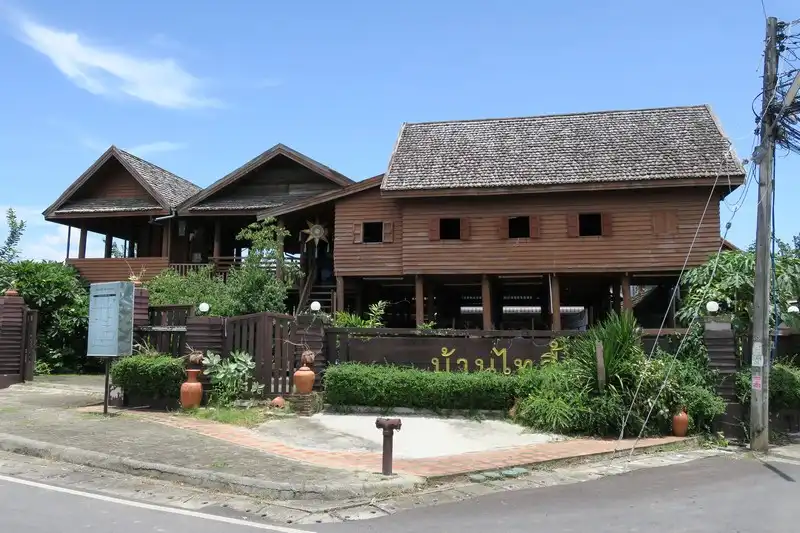
Ban Tai Lue (Ban Luang Tai) in Doi Saket District, Chiang Mai, is home to the Tai Lue Museum – a small but meaningful community space that gathers the story of the Tai Lue people in this area and showcases the local identity through everyday objects, traditional attire, and especially the famous Tai Lue handwoven textiles that many visitors come specifically to see. The setting is in Village No. 8, Ban Luang Tai, Choeng Doi Subdistrict, and the museum sits in front of Wat Rangsi Sutthawat (Wat Mueang Luang Tai), which makes the visit feel naturally connected to the temple community and the rhythm of local life rather than a stand-alone tourist attraction.
To appreciate what makes this place special, it helps to understand who the Tai Lue are. The Tai Lue are a Tai-language ethnic group found across several parts of mainland Southeast Asia, including northern Thailand, parts of Shan State in Myanmar, southwestern China, and northern Laos. Historically, Tai Lue communities in Sipsongpanna (Xishuangbanna) shared close relationships with Lanna (Tai Yuan) in periods when the Lanna realm had influence across trade routes and river systems. Over time, major population movements occurred, including forced relocations into Lanna, which brought many Tai Lue groups into the northern Thai region. In most communities, Tai Lue people have practiced Buddhism and maintained Buddhist customs that blend seamlessly into the broader northern Thai cultural landscape.
Older narratives of origin describe early Tai Lue settlement around areas sometimes referred to as Muang Lue Luang, with later movement toward the region known as Muang Nong Sae (today often associated with Kunming), then down toward the Mekong basin and Sipsongpanna around the 12th century. In this historical frame, a legendary Tai Lue hero named Chao Cheuang Han is remembered for unifying various towns in Sipsongpanna and establishing the kingdom often referenced as the Chelue (Chiang Rung/Jinghong) polity, with an administrative center at Ho Kham Chiang Rung for centuries. Later accounts mention a ruler named Chao In Muang, with a period dated to around 1579–1583 CE, describing the formal division of Sipsongpanna into twelve administrative towns, each associated with agricultural capacity and rice production. This helps explain how the idea of “twelve panna” became a lasting identity marker of the region.
Traditionally, Sipsongpanna was described as a cluster of towns on both sides of the Mekong River, with groups of settlements on the western bank and on the eastern bank, with Chiang Rung (Jinghong) as a central node. Accounts commonly list western towns such as Muang Chae, Muang Luang, Muang Hun, Muang Hai, and Muang Mang, and eastern towns such as Muang La, Muang Ngat, Muang U Nuea, Muang Hing, Muang Phong, and Muang Chiang Thong. Historical memory also includes periods of expansion and warfare involving neighboring regions such as Muang Thaen (today often linked to Dien Bien Phu), Kengtung, Chiang Saen, and Lan Xang. Whether read as legend, chronicle memory, or blended oral history, these narratives still shape how Tai Lue identity is told and retold through community storytelling today.
In visual culture, one of the most recognizable Tai Lue symbols is the peacock, frequently appearing in textile motifs and decorative crafts. Alongside the peacock, ceremonial cloth banners (tung) and woven patterns may depict elephants, horses, cattle, and buffalo, motifs often connected to local Buddhist storytelling traditions, including episodes related to the Vessantara Jataka. In community life, these motifs are not just decoration – they are a living archive of shared memory, faith, and craftsmanship.
It is also helpful to know that, in many local classifications, groups such as Lue, Yong, and Khun/Khoen are discussed in the broader family of Tai-speaking peoples across borders. In simplified terms used in many community explanations: “Lue” commonly refers to Tai Lue with roots in Sipsongpanna in southern China; “Yong” often refers to Tai Lue-related groups historically associated with Muang Yong near Kengtung in Shan State; and “Khun/Khoen” can refer to Tai-speaking groups distributed across Myanmar, China, Thailand, and Laos, with notable settlement along the Khun River basin near Kengtung. These labels can be complex in real life, but for visitors, they help explain why Tai Lue culture in northern Thailand feels both familiar within Lanna and distinct in its own details.
Getting There Ban Tai Lue (Ban Luang Tai) is around 12 km from Doi Saket District center, on the Chiang Mai–Chiang Rai route (often referenced with Highway 118). The museum area is close to Wat Rangsi Sutthawat (Wat Mueang Luang Tai). If you are coming from Chiang Mai city, the drive is straightforward and commonly takes under an hour depending on traffic. Because the museum operates as a community-based site, it is best to call ahead so someone can welcome you, open the exhibition space, and guide you to the weaving products and learning areas without rushing.
| Name | Ban Tai Lue (Tai Lue Museum), Ban Luang Tai, Choeng Doi, Doi Saket, Chiang Mai |
| Highlights | Community museum about Tai Lue heritage in Doi Saket, handwoven Tai Lue textiles, local attire and household culture, easy to pair with a temple-community visit |
| Location Summary | Village No. 8, Ban Luang Tai, Choeng Doi Subdistrict, Doi Saket District, Chiang Mai (in front of Wat Rangsi Sutthawat / Wat Mueang Luang Tai) |
| Open Days | Please contact in advance |
| Opening Hours | By appointment (recommended 09.00–16.00) |
| Fees | No admission fee (community site) |
| Contact Number | 083-570-8066 (Mr. Sombun Sompho) / 087-658-3689 (Village Headman Mr. Somsak Khueanlom) |
| Nearby Attractions (single-number distance) | Wat Rangsi Sutthawat (Wat Mueang Luang Tai) – 1 km Tao Garden Health Spa & Resort (Doi Saket) – 7 km – Tel. 084-028-0230 (mobile), 053-921-200 (landline) Doi Saket District (Choeng Doi area / services) – 12 km Chiang Mai city area (approx.) – 25 km Chiang Mai Old City (approx.) – 30 km |
| Popular Restaurants Nearby (single-number distance) | Arbusto Italian House & Thai Kitchen (Luang Nuea, Doi Saket) – 7 km – Tel. 089-758-4197 Doi Saket Steakhouse (Choeng Doi / Doi Saket) – 12 km – Tel. 095-391-9457 Doi Saket District local dining zone (Choeng Doi) – 12 km Chiang Mai city dining zone (approx.) – 25 km Old City dining zone (approx.) – 30 km |
| Popular Accommodations Nearby (single-number distance) | Srida Resort Lanna & Cafe Chiang Mai (Luang Nuea, Doi Saket) – 8 km – Tel. 087-886-0721, 094-431-1431 Tao Garden Health Spa & Resort (Doi Saket) – 7 km – Tel. 084-028-0230 (mobile), 053-921-200 (landline) Doi Saket District accommodation zone (Choeng Doi) – 12 km Chiang Mai city accommodation zone (approx.) – 25 km Old City accommodation zone (approx.) – 30 km |
| Facilities | Community museum space, textile/craft learning context, nearby temple area; best experience when arranged in advance for guidance and access |
Frequently Asked Questions (FAQ)
Q: Where is Ban Tai Lue (Ban Luang Tai) located?
A: It is in Village No. 8, Ban Luang Tai, Choeng Doi Subdistrict, Doi Saket District, Chiang Mai, in front of Wat Rangsi Sutthawat (Wat Mueang Luang Tai).
Q: Do I need to book ahead to visit the museum?
A: Yes. The museum is community-run and the official guidance is to contact in advance so someone can open the space and support your visit.
Q: What can I see at the Tai Lue Museum?
A: You can learn about Tai Lue history in the area, see traditional items and attire, and explore or purchase renowned Tai Lue handwoven textiles made by local groups.
Q: Who are the Tai Lue?
A: The Tai Lue are a Tai-language ethnic group with communities across northern Thailand, parts of Myanmar (Shan State), southwestern China, and northern Laos, with deep historical roots connected to the Sipsongpanna region.
Q: What is a well-mannered way to visit a community museum like this?
A: Call ahead, arrive on time, dress respectfully (especially near the temple), ask before photographing people or private spaces, and support the community respectfully if you buy textiles or local products.
 Ban Tai Lue Map
 Category:
  Group:
  Last Update: 12 HourAgo
Comment
 Nearby Attractions
| Keyword (Advance) |
 Facebook Fanpage
 Region
 Art, Culture and Heritage
 Historical Sites and Monuments(
 Landmarks and Memorials(
 Royal Palace(
 Art, Craft Centres, Tradition(
 Museums(
 Educational Places
 Museum for Study(
 Educational Gardens, Farm(
 Training Center(
 University
 Places of Worship
 Temple(
 Mosque(
 Other religious and spiritural sites(
 Research and Development
 Royal Project(
 Local Market(
 Nature and Wildlife
 National Parks and Marine Reserves(
 Mountain (Doi)(
 Dam, Reservoir, Lake(
 Waterfalls(
 Hot Springs(
 Caves(
 River, Canal(
 Other natural attractions(
 Entertainment and Agricultural
 Zoos and Aquariums(
 Animal camps and shows(
 Stadium(
 Farm, Parks, Gardens and Ecotourism(
 Waterpark(
 Theater(
 Outdoor and Adventure Activities(
 Shopping
 Shopping and Night Market(
 Restaurant
 Michelin Star(
 Michelin Guide(
 Call Customer Service in Tourism
 Call Customer Service in Tourism(
 Travel Articles, Recipes
 Travel Review, Food Review(
 Food Menu, North Recipes(
 Thai Desserts, North Recipes(