

 Home
Home Chiang Mai(










Rating: 5/5 (1 votes)
 |
|  Map
Map 
 Have Map
  No Map
Chiang Mai attractions
Attractions in Thailand
Open Days: Daily
Opening Hours: 06.00 – 18.00
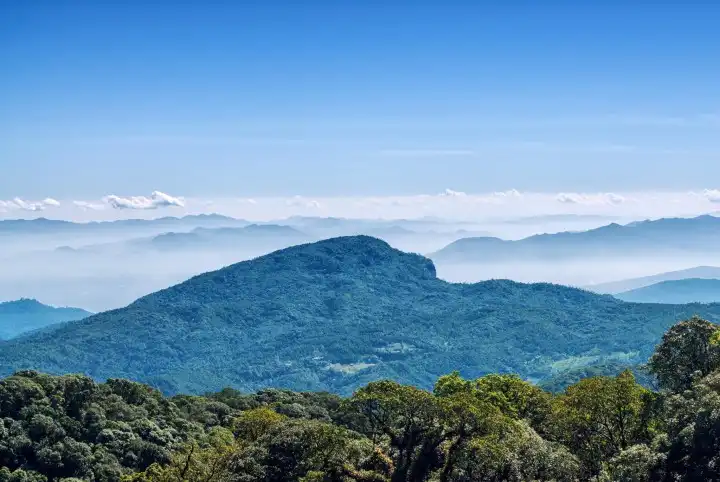
Doi Hua Suea is located in Chiang Mai Province and has become a beloved destination for many travelers thanks to its beautiful natural scenery and distinctive local culture. It is an ideal place for anyone who wants to step away from city noise and experience the quiet calm of nature in a truly genuine way.
Doi Hua Suea is in Ban Luang Subdistrict, Chom Thong District, Chiang Mai. It lies to the southeast of the headquarters of Doi Inthanon National Park, at an elevation of approximately 1,881 meters above sea level, making it the 4th highest peak within the park. The ridge and summit area resemble a tiger’s snout, which is where the name “Doi Hua Suea” comes from. The area remains ecologically rich, with forests characterized by pine woodland alternating with montane evergreen forest. Certain local plant species are more likely to be seen in specific seasons, especially during the early rainy season.
The journey toward the summit is lined with dense vegetation and large trees, some of which are remarkably old. One of the most memorable sights is what many people call “trees wearing coats” or an “ancient forest” look—where trunks are wrapped in lush green growth. Because of the altitude and humidity, lichens, mosses, and ferns thrive in abundance, creating a textured forest surface that looks like a natural green carpet draped along the route.
There are several viewpoints on Doi Hua Suea. The first viewpoint allows you to look up toward the section known as the “tiger snout,” which is a grassy clearing with large boulders that make a good resting spot. From there, you can continue upward to the peak. Near the summit, you may also find the “mysterious soil pit,” a bunker-like hollow about 4–6 meters wide, with trees growing up from below. If you are not paying attention, it can be easy to miss.
This is a relatively long trekking route with frequent ups and downs. The early part involves climbing and then following along a ridgeline. However, the diversity of forest types along the way makes the walk engaging, with many interesting natural features to observe and learn from. It suits hikers who enjoy getting a “story” along with the views.
Doi Hua Suea is also connected to highland ethnic communities, such as the Pga K’nyau (Karen). Visitors can learn about a simple way of life, taste local foods, and see finely made handicrafts. Travelers should prioritize respectful etiquette, honor local spaces, and minimize any impact on community life.
Popular activities include nature trekking, camping in suitable areas for stargazing at night, and photography that captures both landscapes and community life. Visitors should prepare clothing suitable for cold weather, especially toward the end of the year, carry basic first-aid items and enough drinking water, and follow responsible travel practices—do not litter, and comply with guidance from people in the area.
Getting There From Chiang Mai city, travel time is approximately 2 hours. Most travelers drive to the Chom Thong area and the Doi Inthanon access routes, then plan the onward trekking route based on weather conditions and the readiness of the group. If you want clearer, up-to-date route guidance, it is recommended to coordinate with community networks or local area stewards around Ban Luang or Ban Mae Klang Luang before setting out.
| Place Name | Doi Hua Suea |
| Location | Ban Luang Subdistrict, Chom Thong District, Chiang Mai (Doi Inthanon National Park zone) |
| Key Highlights | Peak elevation about 1,881 m; pine forest alternating with montane evergreen forest; “trees wearing coats” (lichen/moss/fern cover); “tiger snout” viewpoint; and the “mysterious soil pit” |
| Name Origin | The ridge/summit area resembles a “tiger snout,” hence the name “Doi Hua Suea” |
| Current Status | A trekking/nature destination best suited for visitors with good physical readiness and advance route planning |
| Fees | Follow the national park/related area entry conditions (check official notices for updates before traveling) |
| Facilities | Depends on the starting point and nearby communities; prepare drinking water, trekking gear, and rain/cold-weather protection |
| Nearby Attractions with Distance | Doi Inthanon Summit (approx. 15 km) Kew Mae Pan (approx. 18 km) Wachirathan Waterfall (approx. 20 km) Mae Ya Waterfall (approx. 22 km) Naphamethinidon – Naphaphonphumisiri Pagodas (approx. 19 km) Ang Ka Nature Trail (approx. 16 km) Hmong Market (Kad Muea) at Doi Inthanon (approx. 18 km) |
| Nearby Restaurants with Distance and Phone Number | For hikers (quick and convenient): Royal Project Inthanon Welfare Restaurant (approx. 18 km) Tel. 065-238-8142 Royal Project Doi Inthanon (food zone) (approx. 18 km) Tel. 053-286-728, 053-286-777 Krua Fueang Fa (Chom Thong) (approx. 14 km) Tel. 053-341-274, 086-182-5031 Rim Nam Thaen Kham (Chom Thong) (approx. 14 km) Tel. 053-826-154, 089-430-1889 Mae Klang Luang Rim Than (restaurant/café) (approx. 18 km) Tel. 083-469-8948, 061-457-4735 Kham Tom Niyom Chom Thong (approx. 14 km) Tel. 062-956-8924 Pha Khwan Pu Khai Chom Thong (approx. 14 km) Tel. 065-696-5855 |
| Nearby Accommodations with Distance and Phone Number | For hikers (easy drive, near the Inthanon route): Touch Star Resort (approx. 20 km) Tel. 092-419-4142, 053-033-595 Baan Phak Mae Klang Luang View (approx. 18 km) Tel. 086-189-4075 Mae Klang Luang Villa (approx. 18 km) Tel. 082-946-6651, 080-500-5233 Rang Bon Doi (approx. 18 km) Tel. 081-168-0382 Baan Phak Chi Le Pu Homestay (approx. 18 km) Tel. 061-312-2757 Baan Kheang Na Mae Klang Luang (approx. 18 km) Tel. 093-048-8570 Baan Ton Khao (Mae Klang Luang) (approx. 18 km) Tel. 093-261-7239 |
| Community Contact (for booking activities/homestays in Mae Klang Luang) | Mae Klang Luang Community Tourism Enterprise Tel. 082-892-7934, 083-508-1282 |
Frequently Asked Questions (FAQ)
Q: How high is Doi Hua Suea, and why is it called Doi Hua Suea?
A: It is about 1,881 meters high, and the name comes from the ridge/viewpoint that resembles a “tiger snout.”
Q: Is the Doi Hua Suea trail difficult?
A: The route is fairly long with frequent ups and downs. It is best to prepare physically and allow enough time for the hike.
Q: When is the best time to visit and take photos?
A: Late in the year tends to be cooler with clearer visibility for mountain views. Early in the rainy season brings lush greenery and a better chance of seeing some seasonal plants.
Q: If I want to stay at a homestay near rice terraces, where should I stay?
A: The Mae Klang Luang/Ban Luang area is recommended because it is close to the Inthanon route and offers a strong community atmosphere.
 Doi Hua Suea Map
 Category:
  Group:
  Last Update: 15 HourAgo
Comment
 Nearby Attractions
| Keyword (Advance) |
 Region
|
 Muang Chiang Mai(