

 Home
Home Chiang Mai(











Rating: 4/5 (6 votes)
 |
|  Map
Map 
 Have Map
  No Map
Bangkok attractions
Attractions in Thailand
Open Days: Daily
Opening Hours: Open all day (viewpoints as public space / transport infrastructure)
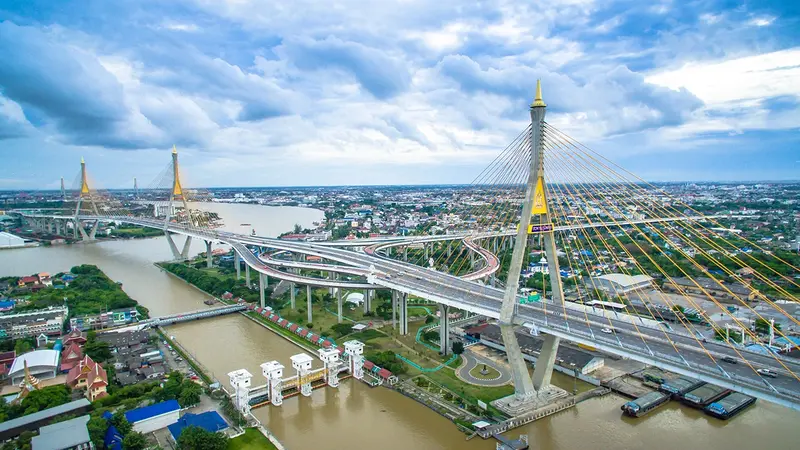
Rama IX Bridge is one of those Bangkok bridges people “use so often they stop noticing.” But if you pause and really look, it’s a piece of engineering that can tell the city’s story in full—how expressway networks expanded, how the Chao Phraya riverside economy evolved, and how Bangkok grew into a car-dependent metropolis. Many locals casually call it a “suspension bridge,” which makes it sound like a simple symbol on the skyline. In reality, it is a cable-stayed bridge that uses large cables to carry the deck’s load—and it has become a major crossing point over the Chao Phraya on the city’s expressway system to this day.
Structurally, Rama IX Bridge is often described as a Single Plane Fan Type Cable-Stayed Bridge. “Single plane” refers to the cables being arranged primarily in one plane, which creates a sharp, clean visual signature. From a distance, the language of engineering is obvious: a tall pylon as the main anchor, and the cables acting as force lines that distribute loads into the structure. The bridge looks light, but it does heavy work every day.
In terms of its role in the city, Rama IX Bridge forms part of the Chalerm Maha Nakhon Expressway, on the Dao Khanong–Tha Ruea section, serving as the span that crosses the Chao Phraya River. This is the core meaning of modern bridges in Bangkok—not simply “crossing water,” but connecting work, logistics, and urban growth so that the city can function continuously at everyday speed.
One layer that gives the bridge its stronger historical identity is its construction timeline and opening ceremony. Construction began on October 1, 1984, and the bridge opened to traffic on December 5, 1987. There was also a “sky marathon” event at 06:00 on the official opening day—a moment that turned the bridge from engineering into a kind of city ritual, using a new structure to announce Bangkok’s modern tempo in that era.
Another important layer is the bridge’s name. “Rama IX Bridge” is a royal name bestowed by His Majesty the King as an auspicious blessing in celebration of the 60th Birthday Anniversary in 1987. That places the bridge not only within transport history, but also within the symbolic atmosphere of a period when the state and the city were accelerating expressway development to support Bangkok’s rapidly growing movement and scale.
If you read Rama IX Bridge through the lens of “riverside economy,” you’ll see how closely it relates to Bangkok’s identity as a port city. Nearby areas have long included industrial zones, ports, and warehouse corridors in certain periods, later shifting toward a modern service city with riverside hotels, restaurants, malls, and mixed-use developments along Rama III and Charoen Krung. This is Bangkok’s reality: roads are crucial, but the river remains a living spine, and bridges are the negotiation points where both worlds must coexist in a workable system.
As a travel experience, the best way to treat Rama IX Bridge as a “place to visit” is to come for the structure-and-river atmosphere rather than trying to “walk the bridge” itself. Early morning or late afternoon brings softer light, making the pylon and cables stand out in crisp lines, while the Chao Phraya’s surface adds depth to the city’s visual layers. Most importantly, choose a safe viewpoint that does not interfere with traffic, because the bridge is part of an expressway network and nearby roads often have fast-moving vehicles.
Getting There Rama IX Bridge is most practical to visit by private car, taxi, or ride-hailing services, since it sits on an expressway corridor and major road network. If you are coming specifically for photography or content creation, plan your timing to avoid rush hours and use accessible, safe viewpoints from nearby public spaces or parallel roads rather than attempting to “stop and look” on the expressway itself, which is neither appropriate nor safe.
For a more complete day out, Rama IX Bridge works best as a “connector” to the Rama III–Charoen Krung–Chao Phraya riverside zone. This area offers riverside walks, shopping and dining destinations, and river-view hotels that help you see Bangkok as a contemporary port city. In simple terms, the bridge may not be a destination where you stand for a long time, but it is a window that shows what kind of infrastructure the whole city is moving on.
| Name | Rama IX Bridge |
| Location | Chao Phraya River crossing on the Chalerm Maha Nakhon Expressway (Dao Khanong–Tha Ruea section), Bangkok |
| Key Features | Single-plane fan type cable-stayed bridge; iconic pylon-and-cable silhouette |
| Period / Context | A key structure from Bangkok’s expressway-expansion era, linking Chao Phraya riverside economy with the Rama III zone |
| Travel | Private car / taxi / ride-hailing (avoid rush hours; choose safe viewpoints from nearby public areas or parallel roads) |
| Current Status | Actively used as a major expressway crossing; best appreciated from nearby viewpoints for bridge-and-river scenery |
| Nearby Attractions | Terminal 21 Rama 3 (approx. 4 km) Tel. 02-483-3555 Asiatique The Riverfront Destination (approx. 6 km) Tel. 092-246-0812 Central Rama 3 (approx. 5 km) Tel. 02-673-5555 Wat Yannawa (approx. 7 km) Tel. 02-672-3216 ICONSIAM (approx. 10 km) Tel. 1338 |
| Nearby Restaurants | Baan Khanitha by the River (approx. 6 km) Tel. 02-108-4910 Baan Somtum, Rama 3 Branch (approx. 5 km) Tel. 02-291-3527 The Never Ending Summer (The Jam Factory) (approx. 8 km) Tel. 061-641-6952 Riverside Terrace (Anantara Riverside) (approx. 9 km) Tel. 02-476-0022 The Terrace@72 (Ramada Plaza Bangkok Menam Riverside) (approx. 8 km) Tel. 02-688-1000 |
| Nearby Accommodations | Montien Riverside Hotel Bangkok (approx. 7 km) Tel. 02-292-2999 Ramada Plaza by Wyndham Bangkok Menam Riverside (approx. 8 km) Tel. 02-688-1000 Chatrium Hotel Riverside Bangkok (approx. 8 km) Tel. 02-307-8888 Anantara Riverside Bangkok Resort (approx. 9 km) Tel. 02-476-0022 Avani+ Riverside Bangkok Hotel (approx. 10 km) Tel. 02-431-9100 |
Frequently Asked Questions (FAQ)
Q: What type of bridge is Rama IX Bridge?
A: It is a single-plane cable-stayed bridge. Large cables support the bridge deck, giving it a clean, open look with a distinctive silhouette.
Q: Which expressway is Rama IX Bridge part of?
A: It serves as the Chao Phraya River crossing on the Chalerm Maha Nakhon Expressway, along the Dao Khanong–Tha Ruea section.
Q: When is the best time to photograph Rama IX Bridge?
A: Early morning or late afternoon is best. Softer light makes the pylon and cables stand out more clearly, and the sky-and-river tones look richer.
Q: Can I walk onto the bridge to view it?
A: The bridge is part of an expressway corridor and nearby roads can have fast-moving traffic, so it’s safer to view it from nearby public areas or parallel roads instead.
Q: Where can I go next after seeing Rama IX Bridge?
A: The Rama III–Charoen Krung riverside zone is a great continuation—Terminal 21 Rama 3, Central Rama 3, Asiatique, or Wat Yannawa all pair well with the bridge’s riverside story.
 Rama IX Bridge Map
 Category:
  Group:
  Last Update: 12 HourAgo
Comment

Photo Gellery(3) 
 Thank you photo(3) from: Auttapon