

 Home
Home Chiang Mai(













Rating: 2.7/5 (15 votes)
 |
|  Map
Map 
 Have Map
  No Map
Bangkok attractions
Attractions in Thailand
Open Days: Generally not open for regular interior visits (government office / high-security area). It may open only for “special events” such as National Children’s Day (depending on the annual announcement)
Opening Hours: No fixed hours for interior visits (if there is a special event, please follow the official schedule announced for that year)
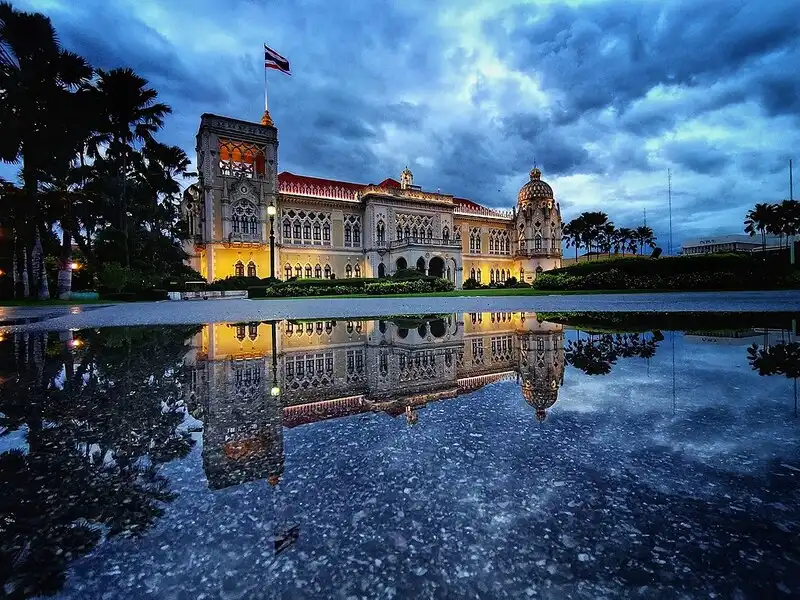
Government House of Thailand (Thai Khu Fa Building) within Thailand’s Government House is a place where, even if you are only standing outside the fence, you can still feel the modern Thai state’s intention to project dignity, international presence, and order. Government House is not an ordinary tourist site; it is a real working area of the executive branch, a venue for receiving state guests, and a ceremonial symbol of the country. That is why the significance of Thai Khu Fa is not only its beauty, but its role as a real backdrop to Thai politics and governance—an image many people recognize through major news and historic moments across multiple eras
If we trace the origin, today’s Government House is rooted in “Ban Norsingh,” originally a large residence built in the reign of King Rama VI as a royal gift to its first owner. Over time, the house became part of the state’s equation: the owner considered it too large for the household’s means and costly to maintain, so it was offered for sale to the government. In the era of Field Marshal Plaek Phibunsongkram, the state decided to purchase it to serve as a venue for receiving foreign guests and began using it as Government House from around September 1941, with the property later fully transferred to the government in subsequent years. This is why the site feels more “alive” than the label of an old building—it transformed from a private residence into a national administrative space
When the story reaches the Thai Khu Fa Building itself, the ambition of the design becomes clear through its architectural language: Late Gothic rooted in Venice, often described as Neo Venetian Gothic, layered with Byzantine influence. The result is a personality that feels luxurious, intricate, and naturally ceremonial. The inspiration is often associated with the Doge’s Palace in Venice in the 14th–15th centuries, but what matters is the idea of “adapting key elements to create a new building” rather than copying an entire structure. That is why Thai Khu Fa looks Western in form, yet remains deeply Thai in its purpose and the ceremonial culture it supports within
The craftsmanship story is also compelling. It is often said that, in the early phase, the construction used an Italian team associated with major national projects of the same period, but the work did not continue seamlessly through later transitions. Eventually, during the administration of Field Marshal Plaek Phibunsongkram, Professor Silpa Bhirasri (Corrado Feroci), who served at the Fine Arts Department, was assigned to lead art and craft students from Silpakorn to continue improvements, additions, and decorative work until completion in the form we recognize today. For art lovers, this reflects a clear “transfer of knowledge” from foreign craftsmen to a new generation of Thai artisans
To keep the picture of Government House complete—not limited to one building—this complex also includes other notable structures that explain how the state uses the space, such as Naree Samakhom Hall, historically connected to women’s activities in one era before shifting into government office use, and Santi Maitree Building, arranged around a fountain courtyard and used for receptions, banquets, and official meetings across different periods. Taken together, the complex was designed like a “small city” for ceremony, administration, and hospitality
The key point for visitors is that Government House and the Thai Khu Fa Building are not places where the public can normally walk in and tour the interior, due to national security. So practical planning usually has 2 approaches. The first is to come for an exterior visit: absorb the Dusit atmosphere, photograph architectural angles respectfully, and connect the trip to nearby temples or museums. The second is to visit during a “special event” such as National Children’s Day, when some years may allow children to experience parts of the interior atmosphere and sometimes see areas connected to Thai Khu Fa. In all cases, visitors should follow the year’s announcement and on-site rules, because conditions can change depending on the situation
Getting There You can reach the Government House area by multiple bus routes that pass through Dusit (e.g., 10, 16, 23, 99, 201, 23 air-conditioned, 505, 509, 515, 521), or by taxi/ride-hailing services if you want to combine several stops within a half-day. If driving, allow extra time for traffic and local area controls, use only permitted parking for that day, and avoid blocking any access points—the area is managed with strict enforcement
A small photo tip for exterior viewing: morning light is sharper and makes architectural details look crisp, while late afternoon light is softer and shadows can enhance the depth of arches and building proportions. No matter the time, the main rule is to dress respectfully, follow signs and restricted boundaries, avoid interfering with official operations, and do not insist on filming or photographing in areas where you are asked not to, because this is a place that is both “beautiful” and “serious” at the same time
| Place Name | Thai Khu Fa Building (Government House) |
| Location | Phitsanulok Road, Dusit District, Bangkok 10300 |
| Characteristics | Signature building of Government House; Neo Venetian Gothic architecture with Byzantine influence; known for its dignified form and outstanding decorative arts |
| Period | The site began serving as Government House around 1941 (based on the state’s purchase and usage history) |
| Key Evidence / Significance | Symbolic building within Government House; supports executive functions and state ceremonies; the area is connected to national-level security |
| Name Origin | “Thai Khu Fa” is widely used as the name of a key Government House building and carries symbolic meaning associated with the state and official ceremony |
| Travel | Buses: 10, 16, 23, 99, 201, 23 (air-conditioned), 505, 509, 515, 521 or taxi/ride-hailing (recommended to check traffic and area regulations before traveling) |
| Current Status | Generally not open for regular interior visits; may open only for special events such as National Children’s Day (follow annual announcements and security measures) |
| Contact Number | 02-283-4000 |
| Nearby Tourist Attractions with Distance | Wat Benchamabophit Dusitvanaram (approx. 2 km) Tel. 02-282-2667 National Museum Bangkok (approx. 4 km) Tel. 02-224-1402 Museum Siam (approx. 5 km) Tel. 02-225-2777 National Library of Thailand (approx. 3 km) Tel. 02-280-9828 Wat Bowonniwet Vihara (approx. 5 km) Tel. 02-281-1236 |
| Popular Restaurants Nearby with Distance | Krua Apsorn (Samsen Branch) (approx. 3 km) Tel. 02-668-8788 Steve Cafe & Cuisine (Thewet) (approx. 3 km) Tel. 02-281-0915 Thipsamai Pad Thai (Pratu Phi) (approx. 5 km) Tel. 02-226-6667 P’Aor Tom Yum Kung Noodle (approx. 5 km) Tel. 02-611-3176 Jay Fai (approx. 6 km) Tel. 02-223-9384 |
| Popular Accommodations Nearby with Distance | The Raweekanlaya Bangkok (approx. 3 km) Tel. 02-628-5999 Royal Princess Larn Luang (approx. 3 km) Tel. 02-281-3088 Centara Life Hotel Bangkok Phra Nakhon (approx. 4 km) Tel. 02-022-6336 The Siam Hotel (approx. 5 km) Tel. 02-206-6999 Pullman Bangkok King Power (approx. 4 km) Tel. 02-680-9999 |
| Facilities | Government area (access/services/restrooms depend on the areas opened during special events and on-site rules) |
| Fees | Exterior viewing is generally free (if opened for special events, please follow official announcements) |
Frequently Asked Questions (FAQ)
Q: Is the Thai Khu Fa Building open every day?
A: Generally no. It is not open for regular interior visits because it is a government facility connected to national security, and it may open only for special events as officially announced.
Q: If I want a chance to see the interior, when should I go?
A: In some years, National Children’s Day activities may allow children to visit certain areas. It is recommended to follow the annual announcement before traveling.
Q: If I cannot enter, is it still worth visiting?
A: Yes for architecture lovers and for anyone who wants the atmosphere of Dusit. You can view the exterior respectfully and combine the trip with nearby temples or museums within a half-day itinerary.
Q: What is the most convenient way to get there?
A: Use bus routes that pass through Dusit or take a taxi/ride-hailing service, especially if you plan multiple stops in one trip. Please allow extra time for traffic.
Q: Are there any special rules I should follow?
A: Dress respectfully, follow boundaries and instruction signs, do not take photos in prohibited areas, and strictly follow on-site rules because this is a government facility.
 Website: www.thaigov.go.th
 Tel: 022812240
 Fax: 022828147
 Government House of Thailand Map
 Category:
  Group:
  Last Update: 2 HourAgo
Comment

Photo Gellery(3) 
 Thank you photo(3) from: Ratchata