

 Home
Home Chiang Mai(




Rating: 2.3/5 (91 votes)
 |
|  Map
Map 
 Have Map
  No Map
Phetchaburi attractions
Attractions in Thailand
Open Days: Daily
Opening Hours: 08:00 – 17:00
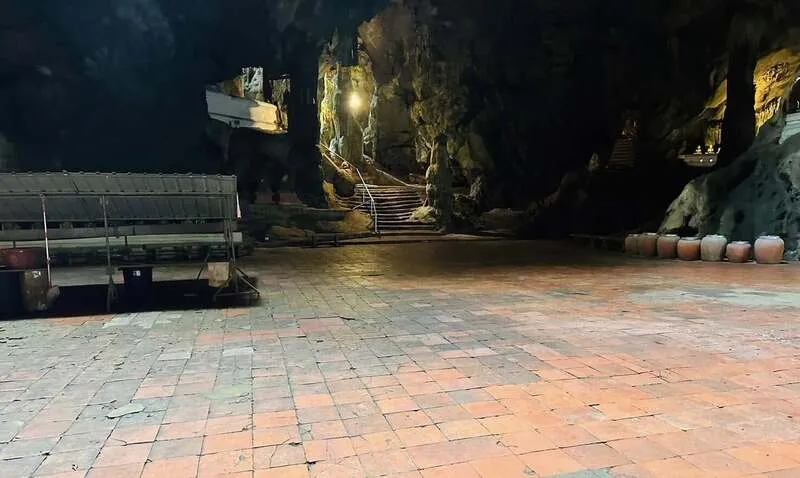
Tham Klaep is a small cave within Wat Boonthawee at the southern foot of Khao Luang in Phetchaburi City District. Its highlight is not grand limestone chambers, but local legends—especially the “mysterious rice husks” and the “Hidden City (Mueang Laplae)” tale about truthfulness, community rules, and unseen worlds.
The cave area has been adapted into small chambers and walkways used for worship and meditation, making this a place to visit quietly and thoughtfully.
Tham Klaep (Wat Boonthawee – Southern Foot of Khao Luang, Phetchaburi City District, Phetchaburi) is a cultural stop that invites you to slow down and read meaning into place. What you see is a modest cave at ground level, a rocky recess with small niches, but what gives Tham Klaep its weight is the layered memory of the community and a legend repeated across generations. This site was long associated with the name “Wat Tham Klaep” before the temple became known as “Wat Boonthawee,” and the two names still appear together in searches and local usage. That continuity matters, because it signals that the Khao Luang landscape is not only about famous large caves, but also about small spaces that function like a living notebook of belief and storytelling in Phetchaburi.
Today, Tham Klaep clearly reflects how a natural formation can be transformed into a functional spiritual space. Natural niches of varying depths were adapted into room-like chambers with doors. Shallower recesses were arranged as small worship points with Buddha images. Higher sections along the rock face were reinforced with concrete beams and platforms, while brick-and-mortar walkways and partitions were added to support safe movement and practical use. The result is a cave with visible human intervention rather than an untouched cavern. This brings a key observation for cultural travel: when a space is actively used for meditation and devotion, order, safety, and usability can take precedence over preserving the original natural texture.
Even so, the lasting charm of Tham Klaep is not stalactites, dramatic chambers, or light shafts—it is the legend that clings to the name. The best-known story says that each morning a pile of rice husks (klaep) appeared at the cave entrance. People would sweep it away, only to find it piled again the next morning. Over time, the repeated “appearance” became an explanation: perhaps there were beings or people deeper inside, living in a hidden world and leaving husks behind. In Thai cultural logic, this is a familiar mechanism of place-making: a name becomes alive when a story is told often enough that it turns into shared explanation.
From there, the husk legend expands into a larger cosmology—the Hidden City (Mueang Laplae), sometimes described as a women-only world or a city with its own strict rules. In the Tham Klaep version, a man witnesses a group carrying goods out from the cave. They hide a certain object near the entrance, then vanish. He returns the next day, sees the same pattern, and investigates the hidden item—only to find a leaf. Thinking it worthless, he tosses it away. Later the group returns; everyone disappears again, except a young woman who weeps because she cannot find the leaf. He retrieves it and returns it to her. She explains that without this leaf she cannot go home. He asks to follow her into the hidden city, and they become husband and wife, eventually having a child together.
The story’s turning point is not romance but a taboo: lying. One day, while the wife is away, the child cries for the mother. The man tries to soothe the child by saying the mother has already returned. The mother-in-law overhears and declares that he has spoken falsehood—an unforgivable offense in Mueang Laplae, where truthfulness is the highest rule. He is forced to leave the hidden city. Before he goes, his wife gives him a large bundle of turmeric. As he walks, the bundle feels heavier and heavier, so he throws pieces away until only one rhizome remains. When he reaches his ordinary world, the remaining turmeric transforms into pure gold. He regrets what he discarded, but it is too late.
Read culturally, “Mueang Laplae” operates as an imagined society built around an extreme value: truth as absolute law. Even a lie meant to comfort a child is treated as contamination. This mirrors the moral economy of traditional communities where speech is a core unit of trust. A village-level society depends on reliability; therefore, “words” become social capital, and falsehood becomes a crack that could spread through the entire system. The tale teaches ethics through narrative by placing truth above affection, parental care, and good intention.
At the same time, the “women-only city / widow city” motif often reflects anxiety within patriarchal imagination about spaces where women hold rule-making power. In this version, the mother-in-law functions as moral authority and enforcer. The daughter may love her husband, but the city’s rule overrides personal desire. That structure highlights power relations inside the family and inside closed communities: outsiders may marry in, but they still must prove compatibility with local norms. The story becomes a social script for boundary-maintenance as much as a moral lesson.
The leaf and the act of “vanishing” are also symbolic. The leaf functions like a passage token—a small object that appears meaningless to an outsider but is essential within the hidden world’s logic. The man’s mistake—judging the leaf by his own standard—is a classic warning in regional folklore: do not evaluate other worlds with your own measuring stick. When he returns the leaf, he does more than help; he gains proximity to the boundary between worlds. This is how many Thai and Southeast Asian tales structure “crossing”: access is granted through respect, accidental kindness, or the recognition of an object’s hidden significance.
The taboo against lying also exposes tension between “truth” and “compassion.” In everyday life, childcare often relies on soothing speech and gentle fabrication to create emotional safety. The hidden city rejects this gray zone entirely. That rejection raises a deeper cultural question: is the punishment aimed at the act of lying itself, or is it a mechanism to keep outsiders from blending into the closed world? In this reading, Mueang Laplae resembles a protected society that fears change, using morality as a wall to keep its borders intact.
The turmeric that grows heavier before turning into gold carries another lesson: do not judge value only by the burden you feel in the present. Turmeric is ordinary and domestic—used in food and healing—yet it transforms into wealth after crossing worlds. The bundle becomes a test of endurance and patience. If he had carried it all, he would have received far more. Because he discards it as “too heavy,” he keeps only a fragment and inherits regret. The story teaches restraint, persistence, and the long-term value of gifts born from relationships and from moral worlds you do not fully understand.
Back at Tham Klaep, the hidden city legend is not only fantasy. It is a cultural tool that explains the mystery of the Khao Luang landscape and, at the same time, delivers social instruction. The cave becomes a moral medium. By attaching the story to a real place, the community makes the lesson memorable and embodied: step into this space, and you are reminded to speak carefully, to respect unseen rules, and to behave with restraint because you cannot fully know what lies beyond the rock face.
As travel, Tham Klaep works best as part of a multi-layered Khao Luang route. After visiting the grand and widely known Tham Khao Luang, a stop at Wat Boonthawee and Tham Klaep adds a “small scale” perspective: royal history and major cave tourism on one side, and community folklore and moral imagination on the other. This pairing turns the trip into more than a checklist. It becomes a walk through how Phetchaburi ties mountain, temple, cave, and ethics into one coherent cultural landscape.
Because Tham Klaep sits inside an active temple environment used for worship and meditation, visitor conduct should follow two principles at once: temple etiquette and respect for a living spiritual space. Dress modestly, keep your voice low, avoid disturbing practitioners, and do not intrude with photography in room-like chambers that may be in use. Do not touch installed objects, do not mark surfaces, and do not litter—these are small spaces that can degrade quickly and are difficult to restore.
Getting There Tham Klaep is located within Wat Boonthawee at the southern foot of Khao Luang, Moo 8, Thong Chai Subdistrict, Phetchaburi City District, Phetchaburi. From Bangkok, take Phetkasem Road (Highway 4) into Phetchaburi town, then follow signs toward “Khao Luang / Tham Khao Luang.” In the Khao Luang foothill area, head to Wat Boonthawee on the southern side; the Tham Klaep area can be visited on foot within the temple grounds. A morning visit is practical for cooler weather and for combining nearby city highlights in one day, such as Phra Nakhon Khiri (Khao Wang), Wat Mahathat Worawihan, and Wat Yai Suwannaram.
If you want a route that captures both the “big picture” and the “small details” of Khao Luang, start with Tham Khao Luang for its major cave chambers and Buddhist art, then end at Wat Boonthawee and Tham Klaep for community legend and cultural reflection. When you leave Tham Klaep, the cave name no longer feels like a label. It becomes a window into how Phetchaburi binds landscape, temple life, folklore, and the ethic of truthfulness into a single, enduring local identity.
| Summary | A small cave within Wat Boonthawee at the southern foot of Khao Luang, best known for local legends—the “mysterious rice husks” and the Hidden City (Mueang Laplae) tale. The cave area has been adapted into chambers and walkways used for worship and meditation. |
| Place Name | Tham Klaep (Wat Boonthawee) |
| Address | 63 Khiri Rat Ya Road, Moo 8, Thong Chai Subdistrict, Phetchaburi City District, Phetchaburi 76000 |
| Highlights | Ground-level cave niches in a rock recess, adapted into small chambers; Buddha images placed in some niches; brick-and-mortar walkways and reinforced sections; strong folklore identity tied to the rice-husk legend and the Mueang Laplae story centered on truthfulness; easy to combine with the Khao Luang route. |
| Period / Cultural Context | A Khao Luang foothill temple landscape where religious practice (worship/meditation) and long-running local folklore (Mueang Laplae) coexist, reinforcing moral values and community boundaries through place-based storytelling. |
| Key Evidence / What To Observe | Room-like niches with doors; worship points with Buddha images; constructed walkways and reinforced platforms indicating adaptation for practice; the spatial feel of a “lived” meditation environment rather than an untouched cave. |
| Name Origin | Local legend says a pile of rice husks appeared repeatedly at the cave entrance each morning even after being swept away, leading people to believe the husks were traces of a hidden world inside the mountain—hence the name “Tham Klaep.” |
| Abbot | Phra Maha Phisut Phisutthidhammo |
| Current Status | Open for visits within temple grounds; maintain quiet conduct and respect meditation areas. |
| Nearby Attractions With Distance | 1) Tham Khao Luang – 2 km 2) Phra Nakhon Khiri (Khao Wang) – 5 km 3) Wat Mahathat Worawihan (Phetchaburi) – 7 km 4) Wat Yai Suwannaram Worawihan – 8 km 5) Wat Khao Bandai It – 11 km |
| Popular Restaurants Nearby | 1) Rabieng Rim Nam (Phetchaburi) – 7 km 2) Khao Chae Mae On (Phetchaburi) – 7 km 3) Je Lang Noodle Shop (Phetchaburi) – 8 km 4) Ow Thung Nai Kee (Phetchaburi) – 8 km 5) Khrua Je Nong Seafood (Bo Kia / Cha-am Zone) – 45 km |
| Popular Accommodations Nearby | 1) Royal Diamond Hotel (Phetchaburi Town) – 8 km 2) Sun Hotel Phetchaburi (Phetchaburi Town) – 9 km 3) Sweet Dreams Guest House (Phetchaburi Town) – 8 km 4) Na Phet Resort (Phetchaburi) – 10 km 5) Fisherman’s Resort (Hat Chao Samran) – 35 km |
Frequently Asked Questions (FAQ)
Q: Where is Tham Klaep located?
A: It is within Wat Boonthawee at the southern foot of Khao Luang in Thong Chai Subdistrict, Phetchaburi City District, Phetchaburi.
Q: Why is it called “Tham Klaep”?
A: A local legend says rice husks repeatedly appeared at the cave entrance each morning even after being swept away, which people linked to a hidden world inside the mountain—hence the name.
Q: What does the Hidden City (Mueang Laplae) legend emphasize?
A: The core value is truthfulness. In the tale, lying—even to comfort a child—breaks the city’s highest rule and leads to exile, reflecting community trust and boundary rules.
Q: Is Tham Klaep a fully natural cave?
A: The cave is made of small niches in a rock recess, but parts have been adapted into chambers and walkways to support worship, meditation, and practical use.
Q: How should visitors behave when visiting?
A: Dress modestly, keep your voice low, avoid disturbing practitioners, do not intrude with photography in active chambers, and do not touch installed objects or damage surfaces.
Q: Can Tham Klaep be combined with nearby stops?
A: Yes. A practical day route is Tham Khao Luang – Wat Boonthawee / Tham Klaep, then city landmarks such as Phra Nakhon Khiri (Khao Wang), Wat Mahathat Worawihan, and Wat Yai Suwannaram.
 Tham Klab Map
 Category:
  Group:
  Last Update: 2 DayAgo
Comment
 Nearby Attractions
| Keyword (Advance) |
 Facebook Fanpage
 Region
 Art, Culture and Heritage
 Historical Sites and Monuments(
 Landmarks and Memorials(
 Royal Palace(
 Art, Craft Centres, Tradition(
 Museums(
 Educational Places
 Educational Gardens, Farm(
 University
 Places of Worship
 Temple(
 Other religious and spiritural sites(
 Research and Development
 Royal Project(
 Suburban Living
 Village, Community(
 Floating Market(
 National Parks and Marine Reserves(
 Mountain (Doi)(
 Dam, Reservoir, Lake(
 Waterfalls(
 Hot Springs(
 River, Canal(
 Bays and Beaches(
 Islands(
 Other natural attractions(
 Entertainment and Agricultural
 Zoos and Aquariums(
 Farm, Parks, Gardens and Ecotourism(
 Waterpark(
 Theater(
 Outdoor and Adventure Activities(
 Travel Articles, Recipes
 Travel Review, Food Review(