

 Home
Home Chiang Mai(




Rating: 3.8/5 (5 votes)
 |
|  Map
Map 
 Have Map
  No Map
Phetchaburi attractions
Attractions in Thailand
Open Days: Daily
Opening Hours: 09:00 – 16:00
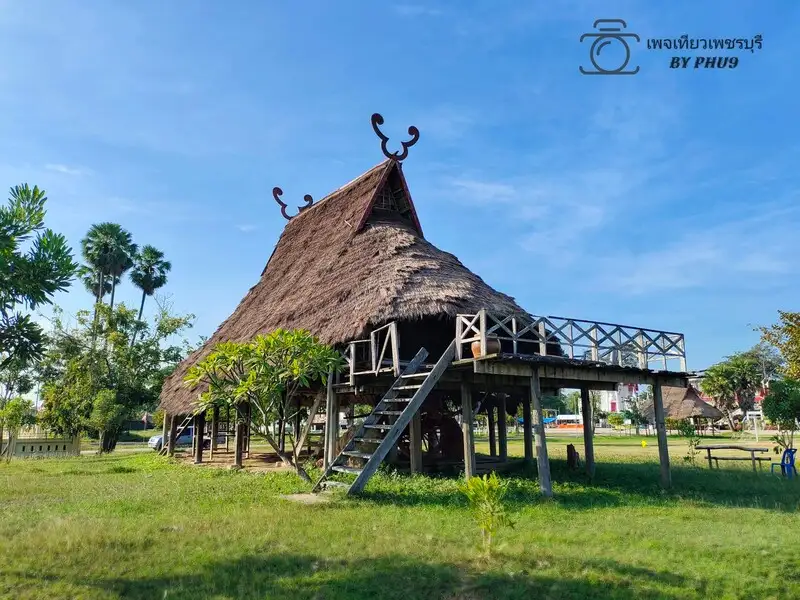
Ban Thai Song Dam (Thai Dam Community, Ban Nong Prong), Khao Yoi District, Phetchaburi is an ethnic-cultural learning space where the idea of a “living culture” feels tangible. This house was built as a memorial in 1993 (B.E. 2536) with a clear purpose: to collect and pass on the history, ways of life, clothing traditions, hairstyles, and key customs of the Thai Song Dam people—also widely known as Lao Song—in a structured, accessible way for younger generations and visitors. It is not merely a replica structure, but a representation of community memory rooted in a place where people still live and sustain their identity in Khao Yoi, Phetchaburi.
The terms Lao Song, Lao Song Dam, and Thai Song Dam refer to an ethnic group whose identity is strongly associated with black clothing. Their original homeland is the Sip Song Chu Tai region (Muang Thaeng) in the northern part of Vietnam. During the early Rattanakosin period, Lao Song groups were relocated into Siam and were granted settlement areas in what is now Khao Yoi District, Phetchaburi. Over time, communities also spread to other provinces in central and western Thailand, especially Ratchaburi and Suphan Buri. Even after more than 200 years, the community’s identity remains clearly visible through language, beliefs, and distinctive house forms.
The core of visiting Ban Thai Song Dam is understanding the “Lao Song house” as a reflection of an entire worldview. The house is built from natural materials and raised on stilts. Posts are made from whole hardwood trunks with natural forks that support beams. Floors are laid with wooden planks or flattened bamboo slats. The roof is thatched with grass, and the front and back curves align with the eaves, sloping down to cover the walls around the house. This low-sloping wall-and-roof form connects to the colder climate of their earlier homeland, helping reduce wind exposure. At the gable peak, a carved wooden ornament shaped like crossed deer antlers—called “Khokut”—stands as a distinct hallmark of Lao Song architecture and a cultural symbol still clearly seen within Thai Song Dam communities.
Interior space use reveals a highly detailed way of life. The area under the house is used for weaving, raising pigs, pounding rice, milling rice, and storing tools for farming and fishing. Stairs typically rise to the front veranda. Inside, there are no permanent partitioned rooms; instead, zones are defined for cooking, eating, and sleeping. A corner by a main post is considered sacred and used for honoring the household spirits on the 5th and 10th days of a ritual cycle, known as “Pad Tong,” with a water bowl and a bowl of rice placed as offerings. This belief in household spirits reflects a worldview where a house is not only shelter, but also the center of relationships between family, ancestors, and the sacred.
An essential structure paired with the house is the rice granary for storing unhusked rice. The granary resembles a small house in shape and stands higher than the main living floor. Sometimes a walkway connects the two, and panels can be opened to move rice in and out. The elevated floor aligns with the belief that rice is associated with Mae Phosop (the Rice Goddess), and should therefore be kept higher than the living area. In this way, the granary is both an economic foundation and a symbol of abundance.
Traditional dress is another highlight. Black clothing is not merely aesthetic, but a shared marker of identity. Tailoring details, textile patterns, and accessories reflect knowledge passed down through women in the household. Weaving is a key activity under the raised house, showing the role of household labor and intergenerational knowledge transfer. Distinctive hairstyles also carry meaning, indicating social status and life stages.
The cultural displays within the memorial house typically cover wedding traditions, Sen Ruean rituals, and annual ceremonial practices, helping visitors understand family structures and the community’s belief system more clearly. The interpretation emphasizes context, so rituals are not presented as distant mysteries but as social systems that explain relationships among people, the home, and ancestors in a coherent way.
Overall, Ban Thai Song Dam is well suited for students, families, and anyone interested in ethnic history and cultural heritage. A typical visit takes about 1–2 hours. For group visits, it is recommended to coordinate in advance to arrange guided explanation or additional learning activities. Visiting here is not simply about viewing a wooden house—it is a way of reading the history of migration, adaptation, and identity preservation that remains alive in Phetchaburi today.
Getting There Ban Thai Song Dam is located in the Thai Dam community of Ban Nong Prong, Khao Yoi District, Phetchaburi. By private car, take Highway 4 (Phet Kasem Road) into Khao Yoi, then continue via local roads into the community following local signs or the coordinates provided by local authorities. By public transport, you can travel to Khao Yoi or Phetchaburi town and then connect with local transport. Coordinating in advance can make the visit smoother, especially for study tours or educational groups.
| Name | Ban Thai Song Dam (Thai Dam Community, Ban Nong Prong), Khao Yoi District, Phetchaburi |
| Address | Khao Yoi Subdistrict, Khao Yoi District, Phetchaburi |
| Highlights | Traditional Lao Song house featuring “Khokut” (a signature gable ornament) + curated displays on Thai Song Dam history, daily life, clothing, and rituals |
| Area Type | Memorial House / Community Ethnic Museum |
| Current Status | Open as a Thai Song Dam cultural learning site |
| Contact Number | 032-561200 |
| Nearby Tourist Attractions | 1) Tham Khao Yoi Cave – 10 km 2) Wat Tham Khao Yoi – 10 km 3) Phra Nakhon Khiri (Khao Wang) – 25 km 4) Wat Mahathat Worawihan – 26 km 5) Cha-am Beach – 40 km |
| Popular Restaurants Nearby | 1) Bai Tarn – 30 km 2) Phuang Phet – 32 km 3) Jek Meng Beef Noodles – 30 km 4) Pa Yan – 35 km 5) Baan Poo Pen 2 (Laem Phak Bia) – 60 km |
| Popular Accommodations Nearby | 1) Royal Diamond Hotel – 30 km 2) Sun Hotel Phetchaburi – 30 km 3) Thanatthichaburi Lake Resort – 55 km 4) C Cha-am Hotel – 45 km 5) Talay Hotel & Villa Cha-am – 47 km |
Frequently Asked Questions (FAQ)
Q: What is Ban Thai Song Dam?
A: It is a memorial house and cultural learning site in Khao Yoi, Phetchaburi, presenting Thai Song Dam history, lifestyle, and community traditions in a structured way.
Q: Where did the Thai Song Dam (Lao Song) people come from?
A: Their original homeland is the Sip Song Chu Tai (Muang Thaeng) region in northern Vietnam, and they were relocated into Siam during the early Rattanakosin period.
Q: What is “Khokut”?
A: It is a carved wooden ornament shaped like crossed deer antlers placed at the gable peak of a Lao Song house, and is a key architectural identity marker of the community.
Q: How long does a visit usually take?
A: Typically around 1–2 hours. For groups, allowing extra time and coordinating in advance is recommended.
Q: What should I wear when visiting?
A: Dress respectfully and follow site guidance, especially around areas linked to ritual explanations or sacred household elements.
Q: Who is this place best suited for?
A: It is ideal for cultural travelers, students, educators, and families who want an authentic introduction to Thai Song Dam heritage and house-based traditions.
 Ban Thai Song Dam Map
 Category:
  Group:
  Last Update: 2 DayAgo
Comment
 Nearby Attractions
| Keyword (Advance) |
 Region
|
 Muang Phetchaburi(