

 Home
Home Chiang Mai(




Rating: 4.3/5 (4 votes)
 |
|  Map
Map 
 Have Map
  No Map
Phetchaburi attractions
Attractions in Thailand
Open Days: Monday – Friday (study visits; please contact in advance for group visits)
Opening Hours: 09:00 – 16:00 (4 rounds: 09:00–10:30, 10:30–12:00, 13:00–14:30, 14:30–16:00)
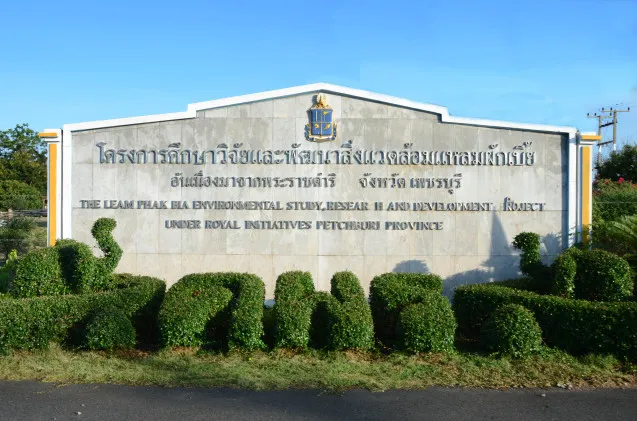
The Laem Phak Bia Environmental Research and Development Project (LERD) in Phetchaburi is widely recognized as a national model for tackling wastewater and solid-waste challenges through the principle of “Nature Helps Nature.” Instead of relying on high-cost, energy-intensive mechanical systems, the project designs treatment processes that mimic real ecosystems, using biological activity, sunlight, sedimentation, aquatic plants, wetland soils, and microbial communities as the main drivers that gradually reduce pollution loads before water is released back to the environment in a safer condition.
Located in Laem Phak Bia Subdistrict, Ban Laem District, the project was developed under a royally initiated approach that treats “wastewater” and “waste” as connected realities of daily life rather than separate problems. In practical terms, household wastewater, organic residues, and municipal waste streams typically appear together and place combined pressure on canals, estuaries, and coastal waters. LERD’s core value is that solving this kind of compound problem requires systems that are simple enough to operate continuously, affordable enough to replicate, and ecologically grounded enough to work with Thailand’s tropical conditions rather than against them.
Downstream communities often experience the consequences most directly. Urban wastewater does not stop at bad odors or local contamination; it flows into waterways that feed rivers, estuaries, and eventually the Gulf of Thailand, affecting fisheries, coastal livelihoods, tourism, and long-term public health. Solid waste presents a parallel challenge: landfilling alone can intensify issues such as leachate, odor, and the steady demand for more disposal space. LERD was developed to demonstrate that effective wastewater and waste management can be achieved with approaches that are “efficient, low-cost, and scalable,” reducing the need for expensive technologies where simpler ecosystem-based solutions can deliver reliable outcomes.
The project’s design logic aligns closely with an ecosystem mindset. Treatment here is not framed as one single “machine” that fixes everything at once, but as a sequence of conditions that allow nature’s processes to do what they already do in wetlands, ponds, and coastal lowlands. This is why the project is known for integrating waste stabilization ponds (WSP) with constructed wetland systems. The ponds provide staged treatment: wastewater moves through successive basins that support settling, microbial degradation, and natural oxygen exchange, progressively lowering organic loads. After that, water is further polished through wetland zones where vegetation and soils help remove remaining nutrients and contaminants.
Waste stabilization ponds are particularly compatible with coastal lowland settings because they trade large footprints for low operational costs. In the tropics, sunlight and warm temperatures enhance biological activity, increasing the effectiveness of natural treatment processes. The ponds also allow retention time that is long enough for organic matter breakdown to occur gradually. As wastewater passes each stage, key indicators such as biochemical oxygen demand (BOD) and chemical oxygen demand (COD) are reduced in a stepwise manner, which helps prevent sudden pollution spikes and improves overall stability before discharge.
Constructed wetlands are the project’s signature element because they resemble the functions of natural wetlands in an engineered, repeatable form. Aquatic and wetland plants act as nutrient sinks, especially for nitrogen and phosphorus that can otherwise drive eutrophication and algal blooms. Meanwhile, microbial communities in wetland soils and around plant roots provide filtration, transformation, and additional decomposition. This combination strengthens the final effluent quality before water is released back to coastal environments.
Equally important is the project’s integrated approach to solid-waste management. LERD does not treat “waste” as something that must be hidden or transferred elsewhere. Instead, it promotes biological decomposition and resource recovery methods such as composting and organic fertilizer production. This reduces landfill dependency and supports a circular perspective where useful outputs can be derived from what was previously considered “pure waste.” In this sense, the project functions not only as an environmental treatment site but also as a practical demonstration of responsible resource use that communities can adapt at different scales.
As environmental conditions improve, the value of the system becomes visible beyond technical measurements. Restored water quality and healthier habitats can support biodiversity recovery, including small aquatic life, insects, and bird populations that thrive around wetland and coastal ecosystems. This makes the site compelling for visitors because the concept of “Nature Helps Nature” is not abstract here; it can be seen in the landscape, observed in the ecological rhythms of the area, and understood through real treatment infrastructure operating in a living environment.
For learning-focused visits, LERD offers strong cross-disciplinary relevance. Environmental science, biology, microbiology, and environmental engineering can all be connected directly to what visitors see on site: pond-based treatment stages, wetland plant zones, nutrient removal mechanisms, and the broader relationship between human waste streams and coastal health. Students can link textbook terms to real systems, while local authorities and organizations can explore how low-energy, low-maintenance treatment concepts can be adapted to schools, communities, or municipal contexts that require continuity rather than complexity.
For general travelers, the experience fits the category of educational and environmental tourism. The surrounding Ban Laem coastal zone is relatively calm, with seaside scenery that often includes salt fields and coastal community life. This provides an added cultural layer to the visit: the trip becomes not just a site inspection, but a journey through a coastal landscape shaped by fisheries, salt production, and livelihoods tied to the sea. In that broader context, LERD acts as a “bridge point” connecting city waste challenges with the real-world consequences for coastal communities and the Gulf of Thailand.
Visitors who want deeper value from the visit should arrive with specific questions. For example, why are treatment ponds staged in multiple levels, how is retention time designed, how are wetland plants maintained to sustain performance, and what monitoring indicators are used across seasons? These questions shift the visit from passive sightseeing to applied learning, and help visitors see how the same principles can be downsized for smaller communities or expanded for larger service areas.
If you are planning your day trip, the site can be paired with nearby coastal attractions such as Chao Samran Beach, Puek Tian Beach, or local seafood experiences in Ban Laem. This pairing helps visitors connect the “upstream management” story (wastewater and waste handling) with the “downstream value” story (cleaner coastal environments that support tourism, fisheries, and community wellbeing). For groups, contacting the project in advance is strongly recommended to align schedules, learning routes, and on-site flow.
Getting There From Phetchaburi city center, the project is commonly approached via routes toward Ban Laem District and Laem Phak Bia Subdistrict. Travel is convenient by private car or group van, and the road network in the coastal zone is generally easy to navigate. For study visits, scheduling in advance helps ensure a smooth visit aligned with the site’s round-based visiting format.
What many visitors take away from LERD is not only the sight of ponds and wetlands, but the clear demonstration that ecosystems can function as practical “technology.” When designed with appropriate space, time, and conditions, natural systems can deliver stable treatment outcomes while remaining affordable and replicable. In that sense, the Laem Phak Bia model is both a working environmental solution and a long-term learning platform that continues to shape how Thailand thinks about sustainable wastewater and waste management.
| Name | The Laem Phak Bia Environmental Research and Development Project (LERD) |
| Address | Laem Phak Bia Subdistrict, Ban Laem District, Phetchaburi 76100, Thailand |
| Key Highlights | National model for wastewater and solid-waste management using ecosystem-based treatment (waste stabilization ponds + constructed wetlands) under the concept “Nature Helps Nature.” |
| Start Period | Initiated from the royal initiative (1990) |
| Key Evidence / Learning Points | Multi-stage natural treatment ponds, constructed wetland zones, organic waste/composting concepts, and coastal ecosystem learning routes. |
| Facilities | Field-learning areas, treatment-system observation points, and nature-walk routes (subject to the site’s visit format). |
| Admission Fees | Free admission (group visits should contact officers in advance). |
| Current Status | A major environmental learning and study-visit site in Thailand, with ongoing demonstrations of nature-based treatment systems. |
| Contact Number | 032-441-264, 032-441-265 |
| Nearby Attractions (Approx. By Road) | 1) Chao Samran Beach – approx. 5 km 2) Laem Luang Beach – approx. 4 km 3) Kanghuntong Salt Spa – approx. 8 km 4) Puek Tian Beach – approx. 11 km 5) Bang Tabun Estuary / Bang Tabun Community – approx. 15 km |
| Popular Restaurants Nearby (Approx. By Road + Phone) | 1) Ban Poo Pen 2 (Laem Phak Bia Branch) – approx. 1 km – 088-194-4172 2) Baan Talay Seafood (Laem Phak Bia) – approx. 2 km – 085-405-2856 3) Sand Beach Club (Chao Samran Beach) – approx. 6 km – 096-098-7980 4) Mae Luk Wan Seafood (Chao Samran Beach) – approx. 6 km – 081-981-9640 5) Pen 1 Seafood (Chao Samran Beach) – approx. 6 km – 086-001-4173 |
| Popular Accommodations Nearby (Approx. By Road + Phone) | 1) i Tara Resort & Spa – approx. 2–3 km – 032-478-301, 088-874-7474 2) Fisherman’s Resort – approx. 5 km – 032-478-020 3) Seaman Resort – approx. 4–5 km – 081-846-1327 4) Chomtalay Resort (Had Chao Samran) – approx. 3 km – 032-478-488 5) Eco Moment Beach Resort – approx. 4 km – 032-770-555 |
Frequently Asked Questions (FAQ)
Q: What is the Laem Phak Bia Environmental Research and Development Project (LERD)?
A: It is a royally initiated project that demonstrates nature-based solutions for wastewater and solid-waste management, using staged ponds and constructed wetlands as core treatment systems.
Q: What days and times are study visits available?
A: Study visits operate in 4 rounds per day: 09:00–10:30, 10:30–12:00, 13:00–14:30, and 14:30–16:00. For group visits, contacting the officers in advance is recommended.
Q: Is there an admission fee?
A: No. Admission is free, but group study visits should coordinate in advance for smoother scheduling and on-site flow.
Q: What makes this project different from typical treatment plants?
A: The project is built around “Nature Helps Nature,” meaning biological and ecosystem processes do most of the work. Treatment is staged through ponds and wetlands to reduce pollution gradually with low energy needs and practical long-term operation.
Q: Is it suitable for students and school learning trips?
A: Yes. It is an excellent field-learning site where students can connect environmental science concepts to real systems, including wastewater indicators, wetland ecology, and sustainable waste management.
Q: How should visitors prepare to get the most value from the visit?
A: Bring practical questions about treatment stages, retention time, wetland maintenance, and monitoring indicators. Also prepare sun protection, water, and comfortable walking shoes for outdoor learning routes.
 Tel: 025792116, 025793473
 Fax: 032441265
 Laem Phak Bia Environmental Research and Development Project (LERD) Map
 Category:
  Group:
  Last Update: 2 DayAgo
Comment
 Nearby Attractions
| Keyword (Advance) |
 Region
|
 Muang Phetchaburi(