

 Home
Home Chiang Mai(




Rating: 3.9/5 (7 votes)
 |
|  Map
Map 
 Have Map
  No Map
Phetchaburi attractions
Attractions in Thailand
Open Days: Daily
Opening Hours: 08:30 – 16:30
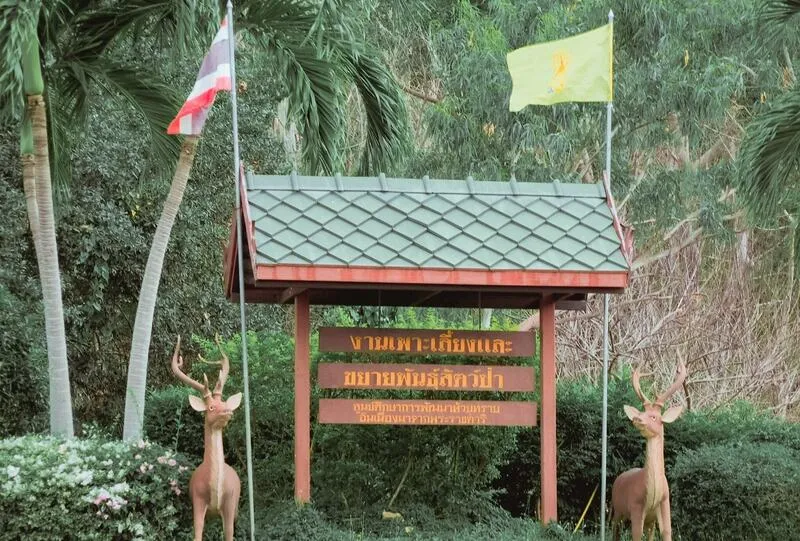
Huai Sai Wildlife Breeding Research Station in Phetchaburi is a royal-initiative unit focused on restoring ecosystems and breeding wildlife—especially the native “sambar deer”—so they can be released back into natural habitats. Its work follows 4 phases, from forest rehabilitation and enclosure construction to breeding and eventual reintroduction. Today, it also serves as an important study-visit site for wildlife conservation and natural resource management in Phetchaburi.
Huai Sai Wildlife Breeding Research Station (Wildlife Breeding and Propagation Unit), Phetchaburi is located around Khao Tao Pun in Sam Phraya Subdistrict, Cha-am District, Phetchaburi. It is one of the key units established under the royal initiatives of King Rama IX for natural resource rehabilitation. Its core mission is to restore degraded forest conditions while conserving and breeding native wildlife so they can sustainably return to the wild.
The development of this area began on 5 April 1983, when His Majesty the King visited the Huai Sai Development Study Centre in Cha-am, Phetchaburi. During the visit, His Majesty observed that this area and its surroundings had once been highly abundant, with streams and waterfalls nourishing the landscape year-round. Over time, however, deforestation and unsuitable land use caused severe degradation. Rainfall decreased and became increasingly irregular, creating conditions that could lead to an arid, desert-like environment.
With a systems-based approach to solving the problem, His Majesty initiated the development of approximately 15,880 rai as the Huai Sai Development Study Centre for agricultural development, emphasizing reforestation to restore the original forest richness. Later, on 26 June 1990, His Majesty further directed that wildlife breeding be accelerated—especially for the “sambar deer,” a native species historically associated with this area—so that animals could ultimately be released back into restored natural forests.
The station covers about 200 rai and is located along Chomphon Road near Khao Tao Pun. The site is planned to align with natural ecosystem conditions, with designated forest zones, grass plots, and animal enclosures that approximate natural habitats. This design supports wildlife adaptation and allows animals to live with greater freedom under staff supervision.
The station’s operations are organized into 4 major phases. Phase 1 focuses on restoring degraded forest by planting various tree species that provide shade and serve as wildlife food sources, such as Muntingia (ta-khop), Indian gooseberry (makham pom), mango, and olive. Grass plots are also planted as natural forage. Soil rehabilitation and moisture restoration are essential foundations before wildlife propagation begins.
Phase 2 involves constructing cages, pens, and semi-natural areas such as an island-style release area for gibbons, designed to allow animals to move more freely and live in conditions as close to nature as possible. Facility design considers the natural behavior of each species to encourage adaptation and reduce stress from captivity.
Phase 3 is the breeding and propagation of multiple wildlife species, using breeding stock supported by government agencies and private partners. Wildlife bred and raised here can be grouped into 3 main categories: (1) mammals such as muntjac, deer, sambar deer, Eld’s deer, gibbons, monkeys, and bears; (2) birds such as peafowl, various pheasant species, moustached parakeets, and parakeets; and (3) reptiles such as elongated tortoises, yellow tortoises, keeled box turtles, and freshwater turtles.
Phase 4 is the release of wildlife back to nature, which is the project’s ultimate goal. On 19 July 1992, Her Royal Highness Princess Maha Chakri Sirindhorn visited and released sambar deer from the breeding pen into a large enclosure around Khao Tao Pun so the animals could acclimate to real outdoor conditions before future releases into natural forests.
In subsequent years, other wildlife species were also released, including Eld’s deer, muntjac, peafowl, and pheasants. These animals adapted well to the environment and continued to reproduce, reflecting the success of an integrated ecosystem rehabilitation approach.
Beyond conservation operations, the station is also open for study visits by school students, university students, government officials, and the general public. Visitors can learn about wildlife conservation processes up close, understand life cycles and management practices, and see how forest restoration directly supports wildlife survival.
From an area once severely degraded, Huai Sai has become a greener landscape with noticeably increased biodiversity. The ecosystem is steadily returning toward balance, offering clear evidence of development grounded in ecological understanding and long-term, consistent work.
Getting There From Cha-am town, take Phetkasem Road (Highway 4) and connect to the bypass/local roads within Sam Phraya Subdistrict toward Khao Tao Pun. Then follow Chomphon Road and local signage to the wildlife breeding and propagation area. Using a navigation app is recommended, and groups should contact staff in advance to ensure smooth entry and coordination.
| Place Name | Huai Sai Wildlife Breeding Research Station (Wildlife Breeding and Propagation Unit) |
| Address | Along Chomphon Road, Khao Tao Pun area, Sam Phraya Subdistrict, Cha-am District, Phetchaburi |
| Contact | 032-593-252, 089-551-3606 |
| Highlights | Breeding and propagating native wildlife (with a focus on sambar deer) for reintroduction, and serving as a conservation study-visit site |
| Area | Approximately 200 rai |
| Current Status | Open as a wildlife conservation study-visit site |
| Nearby Tourist Attractions | 1. Huai Sai Development Study Centre – about 2 km 2. Cha-am Beach (Main Beach Zone) – about 15 km 3. Mrigadayavan Palace – about 25 km 4. Phra Nakhon Khiri (Khao Wang) – about 40 km 5. Kaeng Krachan National Park (HQ/Entrance Area) – about 60 km |
| Popular Restaurants Nearby | 1. Restaurants in the Cha-am Beach area – about 15 km 2. Restaurants near Mrigadayavan Palace – about 25 km 3. Restaurants in Cha-am town – about 15 km 4. Restaurants along Phetkasem Road (Cha-am section) – about 10–20 km 5. Restaurants in Phetchaburi town – about 40 km |
| Popular Accommodations Nearby | 1. Accommodations in Cha-am (Town/Beach) – about 15–20 km 2. Accommodations near Bang Kao Beach / Mrigadayavan area – about 25–30 km 3. Hua Hin accommodations (selected areas) – about 30–40 km 4. Accommodations along the Cha-am–Phetchaburi bypass corridor – about 15–35 km 5. Accommodations in Phetchaburi town – about 40 km |
Frequently Asked Questions (FAQ)
Q: What is the main purpose of Huai Sai Wildlife Breeding Research Station?
A: To breed and propagate native wildlife—especially sambar deer—and prepare them for reintroduction into natural habitats.
Q: How many phases does the station’s work include?
A: 4 phases: forest rehabilitation, enclosure/pen construction, breeding and propagation, and release back to nature.
Q: What types of wildlife are bred and propagated here?
A: A wide range of mammals, birds, and reptiles, such as deer, sambar deer, peafowl, pheasants, and several turtle/tortoise species.
Q: Is it open to the general public?
A: Yes, it is open as a study-visit site. Groups are advised to contact staff in advance for coordination.
Q: Who is this place most suitable for?
A: Students, academics, government agencies, and visitors interested in wildlife conservation and ecosystem restoration.
 Huai Sai Wildlife Breeding Research Station Map
 Category:
  Group:
  Last Update: 3 DayAgo
Comment
 Nearby Attractions
| Keyword (Advance) |
 Region
|
 Muang Phetchaburi(