

 Home
Home Chiang Mai(




Rating: 4/5 (5 votes)
 |
|  Map
Map 
 Have Map
  No Map
Ang Thong attractions
Attractions in Thailand
Open Days: Daily
Opening Hours: 08:00 – 17:00
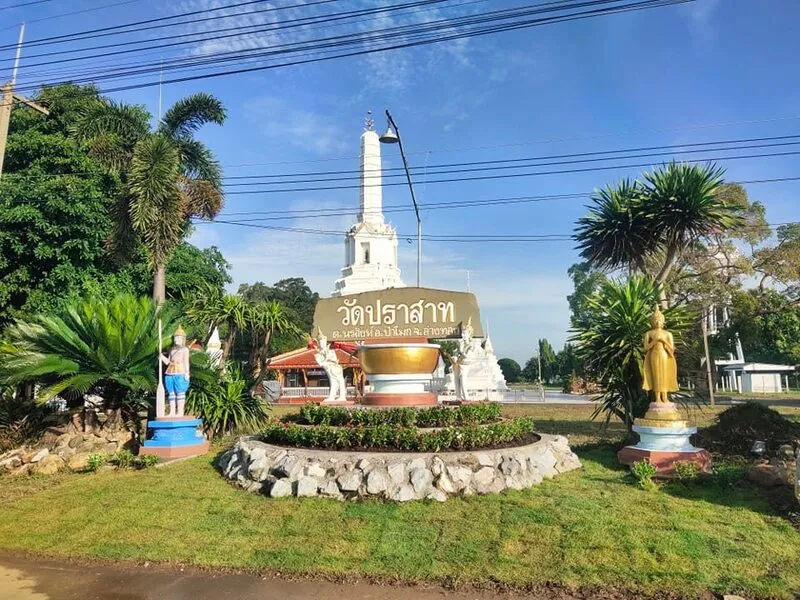
Wat Prasat If you are looking for an “old temple” in Ang Thong that offers tangible traces of history, large-scale architecture, and the living atmosphere of Chao Phraya River communities, Wat Prasat in Narasingh Subdistrict, Pa Mok District is a destination that feels like a step back in time. This is not simply a place for worship; it is a layered cultural landscape where national history, multi-period art, and the rhythms of riverside community life overlap and accumulate. The result is a “storytelling temple” where visitors can read meaning through buildings, murals, and the surrounding landscape without needing to rush.
Wat Prasat (formerly Wat Prasat Thong), Ang Thong Province is located in Narasingh Subdistrict, Pa Mok District, Ang Thong. It is a local Buddhist temple under the Mahanikaya order, with an area of approximately 36 rai 2 ngan 92 square wah. Evidence suggests construction began in the late Ayutthaya period around 2245 B.E., supported by boundary stones (bai sema) and Buddha images enshrined within the temple. The temple was previously known as “Wat Prasat Thong,” a name linked to historical local narratives that it once served as a temporary pavilion site for resting troops during military campaigns. The temple also received its Wisungkhamsima (official ordination boundary) in 2250 B.E., marking a key milestone in establishing the temple’s formal ecclesiastical zone and administrative order.
The location of Pa Mok carries special meaning when viewed through the lens of “Chao Phraya basin history.” This area is part of a long-established riverside settlement corridor that grew alongside water-based transportation and agriculture sustained by fertile alluvial soil. The Chao Phraya is not merely a major river; it is the central lifeline of the Central Plains, a logistics route, a pathway for troop movements, a state artery, and a birthplace of countless riverside temples. Temples in such communities, including Wat Prasat, were never isolated religious spaces. They functioned as public infrastructure: places of learning, community meetings, seasonal merit-making, waypoints for travelers, and ritual centers that shaped the “life calendar” from Visakha Bucha and Magha Bucha to Buddhist Lent, the end of Lent, Kathina, and local merit traditions.
Placed against the backdrop of late Ayutthaya history, Wat Prasat reflects an era when the Central Plains were dynamic with the flow of people, commerce, and political power. River trade, inter-city networks, and political conflicts encouraged extensive temple building and restoration. As a temple with an old ordination hall associated with the period around 2250 B.E., Wat Prasat embodies the “spirit of its time” in how sacred space, boundary-setting, and religious architecture were closely tied to both state systems and community organization. In other words, the temple was not created purely for devotion; it also supported community stability and social order.
What sets Wat Prasat apart from many temples in Ang Thong is its monumental prang (Khmer-style tower), which stands as the temple’s signature landmark. The prang is about 41 meters tall with a base roughly 18 meters wide, a major construction project completed around 2441–2445 B.E. by Phra Upatcha Pool (Luang Pho Thao) during the reign of King Chulalongkorn (Rama V). Its commanding scale gives the temple a powerful architectural identity. Even before reaching the ordination hall, the prang becomes a visual anchor that draws visitors closer, and once you stand before it, the craftsmanship and the community’s ambition in undertaking such a monumental structure become immediately apparent.
At the four corners surrounding the prang are four chedis, arranged to create symmetry and order consistent with sacred architectural principles. These chedis are not only decorative; they help form a “field of devotion,” inviting visitors to walk, observe details, and sense a clear spiritual center. Moving through the temple grounds becomes a journey across layers of meaning, from personal faith to a carefully structured sacred environment.
Another key structure is the old ordination hall (ubosot), with evidence of construction around 2250 B.E., measuring approximately 8.10 meters wide and 15.50 meters long. Inside is a Buddha image in the Maravijaya posture (subduing Mara), with dimensions recorded in traditional measurement terms in the temple’s information. What makes an old ubosot compelling is its “atmosphere of time.” Through walls, light openings, restoration traces, and signs of long-term use, visitors can sense changing eras. Entering the ubosot is therefore not only an act of worship, but also an encounter with a space where generations have made merit, ordained, listened to sermons, and gathered in both ordinary and extraordinary moments of community life.
For art lovers, Wat Prasat is especially rewarding because its murals reflect both late Ayutthaya influences and later Rattanakosin-era sensibilities in linework, color, and composition. The paintings behind the principal Buddha image depicting the Himmapan forest pond and directional mythical creatures show how Buddhist–Brahman cosmology was used to communicate religious meaning through imagery. Meanwhile, paintings of the Buddha standing and depictions of disciples demonstrate meticulous workmanship that emphasizes calmness and an ordered Buddhist worldview. When viewed attentively, these murals reveal that the temple preserves not only “belief,” but also the “language of art” used by earlier generations to teach dhamma and interpret the world.
Another layer of Wat Prasat’s identity is its landscape and ambience. The temple grounds include large yang trees (dipterocarp) that are said to be around a century old, creating deep shade and a naturally cool, peaceful atmosphere. This kind of greenery is ideal for visitors who prefer a quiet, reflective visit, because the presence of mature trees naturally slows your pace. As you slow down, you notice more: the craft details, the textures of plaster surfaces, the prang’s proportions, and the surrounding community’s traditional houses and orchards that continue to frame the temple’s setting. The lush landscape is not just beauty; it functions as a “tool of place,” helping visitors enter a state that is more receptive to the temple’s meanings.
Wat Prasat therefore suits both worshippers and those interested in history. If you come to pay respects, you can worship in the ubosot and spend time in a truly tranquil sacred space. If you come for historical context, you can see how multiple eras overlap: late Ayutthaya foundations expressed through structures and artistic concepts, and large-scale construction from the era of King Rama V embodied by the towering prang. If you enjoy architectural photography, the prang, corner chedis, and tree-lined perspectives create striking compositions and a “grand temple in a garden” mood that is not easy to find.
In local historical memory, the former name “Wat Prasat Thong” is often connected to stories of troop movements and the establishment of a temporary royal pavilion during military campaigns, especially narratives mentioning King Prasat Thong of Ayutthaya, known for both political influence and extensive religious construction. While details differ by storyteller, the essential point remains that the community remembers this temple as a place tied to “the movement of power” and “resting during campaigns,” which aligns with Central Plains geography where river networks served both transportation and strategic purposes. In this sense, Wat Prasat functions like a historical marker on the landscape, helping visitors imagine the past of the Chao Phraya basin without needing a museum setting.
If you want to experience Wat Prasat “fully” without rushing, a good approach is to begin by paying respects in the ubosot to settle the mind and place worship at the heart of the visit. Then walk to the prang area and circle the tower slowly to study its proportions and details, connecting your view to the four corner chedis that create rhythm and balance in the space. Afterward, continue to other structures such as the sermon hall (sala kan parian), a single-storey traditional Thai wooden building constructed around 2491 B.E., the chanting hall, and the orderly rows of monks’ quarters. This sequence helps you see the “relationship of space” within the temple, designed to support ritual practice, devotion, and everyday monastic and community life at the same time.
Community temples like Wat Prasat come alive throughout the year through Buddhist observances and local merit traditions. The rhythm generally follows the Central Thai temple calendar: Buddhist Lent and the end of Lent with merit-making and communal care of the grounds, major holy days such as Magha Bucha, Visakha Bucha, and Asalha Bucha when people come to make merit and participate in ceremonies, and the Kathina season after the end of Lent, often the community’s largest merit event. Local participation is the heart of the temple, because it keeps the temple integrated with real life rather than separated from it. Visitors who arrive at the right time may see residents preparing the site, cleaning, arranging offerings, and welcoming participants, which is part of the charm of a temple that truly remains “of the community.”
Beyond history and art, Wat Prasat is also a practical stop for travelers because it is easy to plan additional visits nearby. Pa Mok and adjacent areas include significant riverside temples, community craft centers, and older markets. This makes the route ideal for a relaxed one-day trip that combines worship and cultural learning, without long drives or hurried check-ins that dilute the meaning of travel.
Getting There If traveling by private car from Bangkok, take Highway 32 (Asia Road) toward Ang Thong Province, then connect to routes leading to Pa Mok District and Narasingh Subdistrict using navigation. Wat Prasat is located in a community zone with convenient access via local roads. If traveling by public transport, take a bus or minivan from Mochit Bus Terminal to Ang Thong or Pa Mok, then continue by local songthaew or motorcycle taxi to the temple. Using online maps and searching “Wat Prasat Pa Mok Ang Thong” will help you reach the destination accurately and save time, especially if you plan to continue to nearby attractions within the same day.
In essence, Wat Prasat shows that temples in the Central Plains are more than places to pray. They are living spaces where the state, community, art, and belief have shaped shared languages and memories over a long period. Standing before the towering prang and then looking back toward the shade of old trees and historic buildings, you can feel the continuity of time. This is why many “old temples” are not old in the sense of being static, but old in the sense of holding accumulated stories—ready for each new generation to read again in its own way.
| Place Name | Wat Prasat (Formerly Wat Prasat Thong) |
| Address | Narasingh Subdistrict, Pa Mok District, Ang Thong Province, Thailand |
| Place Summary | A historic riverside-area temple in Ang Thong, notable for its monumental prang, multi-period architecture, and mural traditions—ideal for worship and cultural–historical exploration in the Chao Phraya basin. |
| Highlights | Monumental prang (about 41 m tall, base about 18 m), four corner chedis, old ubosot with Maravijaya Buddha image, murals (Himmapan/Directional creatures and Rattanakosin-style works), shaded grounds with century-old trees |
| Brief History | Construction evidence around 2245 B.E. (late Ayutthaya). Formerly known as Wat Prasat Thong. Received Wisungkhamsima in 2250 B.E. Major prang construction around 2441–2445 B.E. |
| Abbot / Current Steward | Phra Khru Prasut Silakhun (Parinya Asapho) |
| Getting There | By Car: Highway 32 (Asia Road) → Ang Thong → Pa Mok → Narasingh → follow navigation to the temple | Public Transport: Bus/minivan from Mochit to Ang Thong or Pa Mok, then local transport to the temple |
| Current Status | Open for worship and visits |
| Contact Number | 035-662-335 |
| Facilities | Parking area, shaded walkways, main worship points within key buildings |
| Fees | No on-site ticket fee information (typically free entry for temple visits) |
| Nearby Tourist Attractions (With Distance + Phone) | 1) Wat Pa Mok Worawihan – approx. 7 km – Tel. 035-661-286 2) Ban Bang Sadet Royal Court Doll Center – approx. 10 km – Tel. 035-661-157 3) Wat Khun Inthapramun – approx. 22 km – Tel. 035-691-406 4) Wat Muang (Wiset Chai Chan) – approx. 30 km – Tel. 035-631-556 5) Wat Chaiyo Worawihan – approx. 28 km – Tel. 035-862-669-70 |
| Nearby Restaurants (With Distance + Phone) | 1) Suan Ahan (Floating Raft Restaurant), Pa Mok – approx. 8 km – Tel. 062-936-2249 2) Pinto Restaurant, Pa Mok – approx. 9 km – Tel. 035-662-589 3) Krua Khun Kung (Floating Raft Restaurant), Pa Mok – approx. 9 km – Tel. 083-039-1999 4) Lamoonnee (Bang Sadet) – approx. 12 km – Tel. 081-241-6699 5) Krua Kai Chon, Pa Mok – approx. 9 km – Tel. 035-662-576 |
| Nearby Accommodations (With Distance + Phone) | 1) Bualuang Hotel, Ang Thong – approx. 20 km – Tel. 035-611-116 2) Bualuang Boutique Resort, Ang Thong – approx. 20 km – Tel. 081-495-8884 3) Thanara Resort (Ang Thong) – approx. 19 km – Tel. 092-940-9104 4) Thinee Me Dee Resort (Ang Thong) – approx. 21 km – Tel. 094-131-8081 5) Khlong Suan Phlu Resort (Ayutthaya) – approx. 28 km – Tel. 092-789-2395 |
Frequently Asked Questions (FAQ)
Q: Where is Wat Prasat located?
A: Wat Prasat is in Narasingh Subdistrict, Pa Mok District, Ang Thong Province. You can travel by private car or take public transport to Ang Thong/Pa Mok and continue by local transport to the temple.
Q: What is the top highlight of Wat Prasat?
A: The most iconic highlight is the monumental prang, along with the surrounding architectural complex, the old ubosot, and murals reflecting multiple artistic periods.
Q: How far back does Wat Prasat’s history go?
A: Evidence suggests the temple’s establishment dates to the late Ayutthaya period around 2245 B.E., and it received its official ordination boundary (Wisungkhamsima) in 2250 B.E.
Q: If I want a complete visit, where should I start?
A: Begin by paying respects in the ubosot, then walk to the prang and circle the tower and corner chedis, before continuing to other important buildings within the temple grounds.
Q: What type of trip is Wat Prasat best for?
A: It is ideal for a calm temple visit combined with cultural and historical exploration, thanks to its striking architecture and peaceful, shaded atmosphere.
Q: What nearby places can I visit after Wat Prasat?
A: You can continue to Wat Pa Mok Worawihan, the Ban Bang Sadet Royal Court Doll Center, Wat Khun Inthapramun, Wat Muang, or Wat Chaiyo Worawihan in a single day depending on your schedule.
 Wat Prasat Map
 Category:
  Group:
  Last Update: 6 HourAgo
Comment
 Nearby Attractions
| Keyword (Advance) |
 Region
|
 Muang Ang Thong(