
 Home
Home North(
 Chiang Mai(


Rating: 3.3/5 (6 votes)
 |
|  Map
Map 
 Have Map
  No Map
Kanchanaburi attractions
Attractions in Thailand
Open Days: Daily
Opening Hours: Mon–Fri 08:00 – 16:30; Sat–Sun 08:30 – 16:30
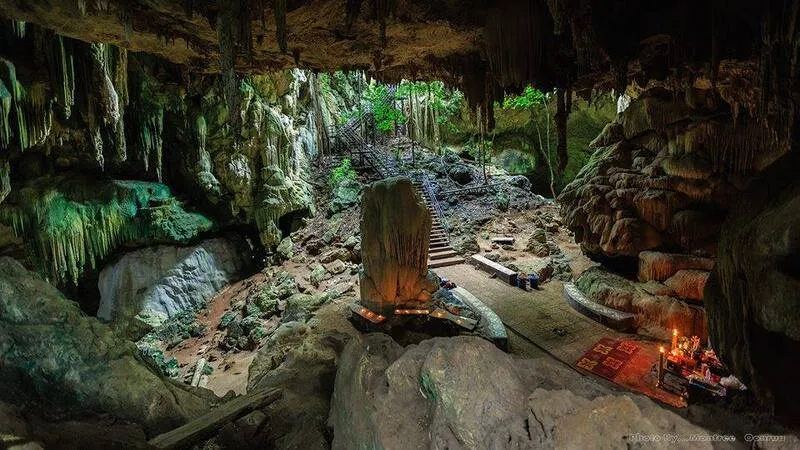
Tham Chaloei in Sai Yok District, Kanchanaburi, is one of those places that makes the idea of “traveling in Kanchanaburi” mean more than just scenic viewpoints and photo stops. The cave is not so large that exploring it feels exhausting, yet it carries a distinctive sense of place because it sits in the same landscape corridor as the historic railway commonly known as the Death Railway and lies close to major nearby attractions such as Krasae Cave and the wooden cliffside viaduct. From the moment visitors arrive, it is easy to feel that this is not simply a “pretty cave,” but a point where nature and history overlap in the same frame: limestone walls, the cool damp air of a cave interior, and stories linked to World War II that are deeply embedded in the wider Sai Yok area.
The charm of Tham Chaloei begins with its location in Lum Sum Subdistrict, Sai Yok District, only a short distance before the Krasae Cave area and the Death Railway viewpoint zone. That proximity makes it convenient to include as a stop within a one-day itinerary, but that convenience is also exactly why the cave deserves a fuller telling rather than being treated as a quick “drop-in.” This region is closely connected to the construction of the Thai–Burma Railway during World War II, a period when large numbers of Allied prisoners of war and forced laborers were used under extremely harsh conditions, with heavy loss of life. Several sources recount that caves in this vicinity were used as refuge during air raids on or near the railway line, which means that a “cave” here is not only a natural landform but also, in certain narratives, a shelter that helped people survive a real wartime situation.
That said, telling wartime history along the Khwae Noi River corridor should be done carefully. The goal is not to make the story feel frightening or sensational, but to help readers understand why a small place like Tham Chaloei is remembered as a site of memory and why visiting it today benefits from a respectful attitude toward those who lived through that era. Visiting the cave in the present can be seen as walking through a “real setting” that once carried meaning in wartime, while we arrive as visitors in peacetime who should act responsibly toward what remains—both the natural features and the historical significance that the broader community continues to preserve.
From a natural-science perspective, Tham Chaloei is a limestone cave, meaning its beauty is the result of an extremely slow process. Rainwater seeps through limestone layers and gradually dissolves calcium carbonate into a mineral-rich solution. When these droplets fall from the ceiling or flow along cave walls, carbon dioxide is released and calcite precipitates in thin layers, slowly forming stalactites above and stalagmites below. The process is so slow that it is almost impossible to perceive within a single human lifetime, which is why cave formations should be treated as fragile natural artworks and appreciated with care rather than curiosity that leads to touching.
Many visitors talk about Tham Chaloei’s formations because some shapes feel unusual and invite imagination. In certain spots, people compare a formation to the figure of “Guan Yin,” based on proportions that resemble a draped shoulder and a calm standing posture. Another frequently mentioned highlight is a section sometimes described as a “sparkling curtain waterfall,” where parts of the calcite surface catch light and glitter when illuminated from an angle. The most rewarding way to experience a cave like this is not rushing through to “cover everything,” but letting your eyes adjust to the dimness and then using a modest beam of light so shadows can reveal depth. Soft shadows make it easier to see texture, layered mineral buildup, and the subtle traces of past water flow preserved on the cave walls.
If you want to enjoy Tham Chaloei properly, a simple rule helps: “learn to see, rather than trying to feel by touch.” Even a single touch can leave skin oils that may discolor the surface or interfere with mineral deposition over time. When many visitors repeat the same behavior, small damage accumulates into permanent marks that cannot be undone. A good cave visit is therefore unhurried and considerate: keep some distance from walls and protruding formations, use light sensibly without shining it too close, and avoid frequent flash photography, especially when others are still adjusting to the darkness.
Another reason Tham Chaloei feels different from a typical “stop-by cave” is the strong context outside the cave that connects directly to the Death Railway landscape. The railway line runs nearby, and close to it is the wooden cliffside section often referred to as the Tham Krasae Viaduct, where travelers carefully walk for views of the Khwae Noi River below. The combined image of limestone cliffs, the river, and a railway cut into mountainous terrain helps visitors understand why Sai Yok is remembered in wartime history: the geography was challenging, and construction in that era demanded immense human effort and, tragically, significant loss.
When you look at Tham Chaloei through the lens of heritage travel, what adds value is the ability to “read the place” with awareness. Stepping into the cave is not only about admiring formations; it is also, in some accounts, standing in a setting associated with survival during wartime raids, within a corridor shaped by the Thai–Burma Railway story. That awareness naturally leads to a more respectful style of travel: no climbing, no damaging surfaces, no excessive noise, and no treating a site of memory as merely a photo prop.
In terms of access and safety, Tham Chaloei is often considered an easy add-on compared with caves that require long hikes, but “easy” does not mean risk-free. Natural caves commonly have uneven ground, damp slippery sections, and limited light. The safest approach is straightforward: take short steps, walk slowly, and aim your light at the ground before each step. If traveling with children or older visitors, keep a steady pace, avoid rushing, and choose a visiting time that is not too close to closing hours, so you do not feel pressured to hurry out of the cave near the end.
Tham Chaloei also fits travelers who want a “Sai Yok history route” because you can continue to Krasae Cave, the Death Railway viewpoints, Wang Pho Station, and river scenery nearby. With good timing, you can start in the morning with the railway and viaduct in gentle light, then shift mood by entering Tham Chaloei, and later have lunch around the Wang Pho area or along Highway 323. After that, you can add a nature stop such as Sai Yok Noi Waterfall or a learning-oriented site in the district. A plan like this keeps Tham Chaloei from feeling isolated; instead, it becomes a meaningful piece in a broader narrative of Sai Yok as a landscape shaped by both nature and history.
Getting There From Kanchanaburi town, drive along Highway 323 toward Sai Yok District. Tham Chaloei is in Lum Sum Subdistrict and sits close to key attractions such as Krasae Cave and the historic railway corridor. As you approach the Sai Yok area on Route 323, look for signs pointing to Krasae Cave / Wang Pho Station and the nearby railway-related stops. Park at an appropriate designated area in the vicinity and walk in via the local access path to the cave. If you travel by train, you can get off at Tham Krasae Station or Wang Pho Station and then walk or use local transport services depending on your preference. Plan to visit in the morning or early afternoon to explore without rushing, and avoid spending time close to the tracks unless necessary for safety reasons.
For preparation, shoes with solid traction are recommended to reduce slipping risk. A flashlight or headlamp can be helpful if interior light is limited. Bring a reasonable amount of drinking water because the Sai Yok area can feel warm before you enter the cave, while the cave itself is cool and humid and can make your body feel the temperature change quickly. Wear clothing that allows easy movement and avoid long, dangling bags that may hit cave walls or formations unintentionally. In the rainy season, consider a lightweight rain layer because outdoor paths and some sections near the cave may be wetter and more slippery than usual.
Ultimately, Tham Chaloei offers both visual wonder and something to reflect on. It is easy to be impressed by formations shaped patiently by nature, and it is equally natural to think more deeply when you recognize that this landscape sits within a World War II heritage corridor in Kanchanaburi. Visiting is not only about “seeing something beautiful,” but about “understanding a place” through both geology and memory. If you walk slowly, stay mindful, and treat the site with respect, Tham Chaloei can remain valuable for today’s travelers and for future generations.
| Place Name | Tham Chaloei (Captive Cave / Prisoner of War Cave) |
| Address / Location | Lum Sum, Sai Yok, Kanchanaburi 71150, Thailand Plus Code: 35VH+RCH |
| Place Summary | A limestone cave near the Death Railway corridor in the Krasae Cave–Wang Pho zone, known for imaginative stalactite and stalagmite shapes and for its broader World War II heritage context in Sai Yok. |
| Key Highlights | Close to Krasae Cave and the Death Railway viewpoints; associated in some accounts with wartime refuge narratives; distinctive formations compared by visitors to Guan Yin and a “sparkling curtain” effect; easy to combine with a one-day Sai Yok itinerary. |
| Open Days | Daily |
| Opening Hours | Mon–Fri 08:00 – 16:30; Sat–Sun 08:30 – 16:30 (hours may vary) |
| Fees | Reported as free entry (please confirm on-site) |
| Facilities | Parking and visitor services are generally available in the nearby railway attraction zone; bring traction shoes and a flashlight if needed; expect uneven and damp surfaces in parts of the cave. |
| Contact (Verified) | Lum Sum Subdistrict Administrative Organization: 034-591-201 |
| Nearby Tourist Attractions (Approx. Distance) | 1) Krasae Cave – 1 km 2) Tham Krasae Viaduct – 1 km 3) Tham Krasae Railway Station – 2 km 4) Wang Pho Railway Station – 6 km 5) Sai Yok Noi Waterfall – 20 km |
| Popular Restaurants Nearby (Approx. Distance + Phone) | 1) View Rim Khwae by Nueng Wang Pho – 7 km – 081-007-1449 2) Krua Phak Wan Baan Rai – 10 km – 083-241-6561 3) Suan Ahan Wang Pho – 8 km – 087-152-4654 4) Luck Aroi Kitchen (Sai Yok area) – 18 km – 084-507-7745 5) Ray Nu Restaurant (Sai Yok area) – 18 km – 081-880-1987 |
| Popular Accommodations Nearby (Approx. Distance + Phone) | 1) River Kwai Jungle Rafts – 15 km – 081-734-0667 2) River Kwai Resotel – 18 km – 02-642-5497 3) The FloatHouse River Kwai – 20 km – 084-725-8686 4) Hintok River Camp at Hellfire Pass – 45 km – 081-754-3898 5) Saiyok River House – 22 km – 034-696-999 |
Frequently Asked Questions (FAQ)
Q: Where is Tham Chaloei located?
A: It is in Lum Sum Subdistrict, Sai Yok District, Kanchanaburi, close to the Krasae Cave zone and the historic Death Railway corridor, making it easy to combine with nearby railway viewpoints.
Q: How is Tham Chaloei connected to World War II history?
A: Multiple sources describe caves in this railway corridor area as places of refuge during the World War II period, and Sai Yok forms part of the wider Thai–Burma Railway heritage landscape.
Q: What are the opening hours, and is there an entry fee?
A: Reported hours are Mon–Fri 08:00–16:30 and Sat–Sun 08:30–16:30, and entry is reported as free, but it is best to confirm on-site.
Q: What is the main highlight inside the cave?
A: Visitors often mention imaginative rock formations, including shapes compared to Guan Yin and a “sparkling curtain” effect when light is angled across calcite surfaces.
Q: What should I prepare before visiting?
A: Wear shoes with good grip, bring a flashlight or headlamp if the cave is dim, carry some water, and avoid touching any formations to help protect fragile cave features.
Q: What is the most important safety precaution in the Tham Chaloei–Krasae area?
A: Walk slowly on uneven or damp surfaces, aim light at the ground before each step, and be especially careful around the railway corridor—avoid walking on tracks unless necessary and follow local safety guidance.
 Tham Chaloei Cave Map
 Category:
  Group:
  Last Update: 2 MonthAgo
Comment
 Nearby Attractions
| Keyword (Advance) |
 Facebook Fanpage
 Region
 Art, Culture and Heritage
 Historical Sites and Monuments(
 Landmarks and Memorials(
 Art, Craft Centres, Tradition(
 Museums(
 Art Gallery(
 University
 Places of Worship
 Temple(
 Church(
 Other religious and spiritural sites(
 Research and Development
 Royal Project(
 Suburban Living
 Village, Community(
 Local Market(
 National Parks and Marine Reserves(
 Mountain (Doi)(
 Dam, Reservoir, Lake(
 Waterfalls(
 Hot Springs(
 River, Canal(
 Other natural attractions(
 Entertainment and Agricultural
 Zoos and Aquariums(
 Animal camps and shows(
 Farm, Parks, Gardens and Ecotourism(
 Cinema(
 Outdoor and Adventure Activities(
 Travel Articles, Recipes
 Travel Review, Food Review(