
 Home
Home North(
 Chiang Mai(


Rating: 3.8/5 (5 votes)
 |
|  Map
Map 
 Have Map
  No Map
Kanchanaburi attractions
Attractions in Thailand
Open Days: Daily
Opening Hours: 08.00 – 17.00
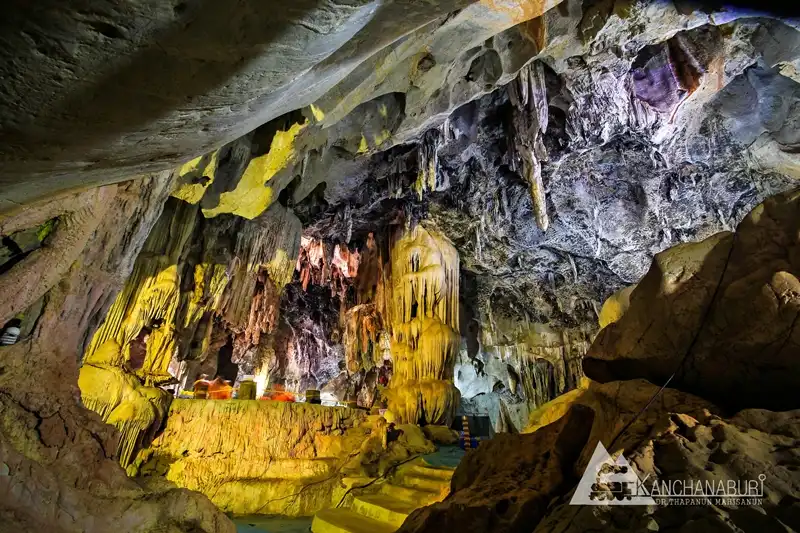
Tham Song Paet (Cave 28) in Ban Tha Maduea, Huai Khayeng Subdistrict, Thong Pha Phum District, Kanchanaburi, is a compact limestone cave with surprisingly “dense” details for anyone who enjoys raw, quiet nature. Inside, you can appreciate limestone textures, abundant stalactites and stalagmites, and cave walls that shimmer subtly with naturally occurring mineral crystals. Because this cave is still relatively unknown to most travelers, it suits those who want to step off the main route and experience a less-talked-about side of Thong Pha Phum away from the usual crowds.
If you want the shortest possible answer, Tham Song Paet is worth visiting for 3 reasons: (1) the beauty of stalactites, stalagmites, and limestone layers formed through long geological processes; (2) the sense of exploration you get from a natural site that has not been heavily “staged” or overdeveloped; and (3) the wider Huai Khayeng context, where multiple eco-tourism resources connect into one route—caves, wetlands, and surrounding forest—so you can plan a satisfying 1–2 day trip without rushing.
Tham Song Paet is located in Huai Khayeng Subdistrict, Thong Pha Phum District, Kanchanaburi. Local information notes that the cave sits within the use area of the Thong Pha Phum Plantation managed by the Forest Industry Organization and is included in the area’s eco-tourism planning. The cave’s name itself reflects a place long recognized and referenced within the local community, rather than a fully promoted attraction like major waterfalls or viewpoint highlights on the popular Thong Pha Phum–Pilok route.
The cave’s key feature is its limestone (limestone cave) interior. Limestone is a sedimentary rock formed by long-term accumulation of marine organism remains and calcium carbonate. Over time, mildly acidic rainwater seeps through rock layers, dissolving some calcium carbonate into solution. This mineral-rich water travels along cracks and drips slowly. Each time a droplet evaporates or releases carbon dioxide, it leaves behind a tiny deposit of calcite. Layer by layer, these deposits build into “stalagmites” rising from the floor and “stalactites” hanging from the ceiling.
The charm of a stalactite-stalagmite cave lies in the seriousness of “time.” What looks like ordinary rock is actually the outcome of countless tiny droplets working continuously over a very long period. Growth is often so slow it cannot be measured within a human lifetime. That means a single careless touch that damages the surface can equal destroying a natural artwork that took immeasurable time to form. This is why cave visits should be based on “looking with your eyes” rather than touching for a sense of closeness.
For visitors who enjoy geological details, Tham Song Paet offers many points of interest—from cave walls where limestone layering can be seen, to varied stalactite and stalagmite forms: slender pillars, thin curtain-like formations resembling limestone drapes, and wave-like or petal-like shapes. These forms often reflect water flow direction and air movement within the cave, along with relatively stable humidity and temperature that influence how calcite crystallizes in different spots.
Another point of interest is cave wildlife. Local information mentions the “Kitti’s hog-nosed bat” (Kitti’s hog-nosed bat), a very small bat species and among the smallest mammals in the world. Finding bats in caves is not unusual, but the essential point is to avoid disturbing their life cycle. If you notice signs of many bats, lower your voice, reduce bright light, and avoid shining strong beams directly at bat clusters for long periods, as stress can cause them to relocate or alter their behavior.
Tham Song Paet also has a section that can be described as a short “walk-through” cave experience. Local information notes a passage that can be walked through for about 100 meters, suggesting interconnected chambers and corridors rather than a single short cavity. Even so, safety should be the priority—especially in the rainy season when humidity is high, surfaces may be slippery, and some sections may have standing or flowing water. If you are not familiar with the terrain, coordinate with locals or the relevant area office before visiting.
Getting There (overview): Tham Song Paet is about 18 kilometers from the Huai Khayeng Subdistrict Administrative Organization (SAO). Part of the route is laterite/dirt road, and at a certain point you will need to continue on foot to reach the cave. A vehicle with sufficient ground clearance is recommended, and at minimum you should check your tires and prepare basic equipment. If you drive a sedan, consider road and seasonal conditions carefully, especially after heavy rain when dirt roads can become soft and slippery. For the walk-in portion, wear shoes with good grip and bring a headlamp as standard gear.
If you start from central Thong Pha Phum (Tha Khanun area / Thong Pha Phum market), main routes connect to Huai Khayeng and several community eco-tourism spots. A practical plan is to depart early and enter the area before noon, so you have enough time to walk in, explore the cave without rushing, and leave dirt-road/forest sections before daylight fades. Driving dirt roads in the dark or in light rain generally increases risk.
The best time to visit depends on your travel style. If you want the greenest scenery and the freshest-looking forest, early to mid rainy season can be beautiful, but you trade that for slippery surfaces and wetter conditions inside the cave and on the approach road. If you prioritize safer, easier walking, late rainy season through early winter and winter is usually more comfortable. Thong Pha Phum weather is generally cooler than lowland towns, making a walking-and-exploring trip less exhausting.
A good cave visit does not have to take long, but you should take time to “look properly.” Caves hide details in darkness and silence. Pause to study wall textures, color differences across rock layers, traces of water flow, and the shapes of stalactites and stalagmites—what do they resemble to you? Some travelers enjoy giving themselves small missions, like finding “limestone curtains” or spotting sparkling crystal patches. Intentional looking makes cave exploration engaging without needing extra activities.
If you plan a serious visit to Tham Song Paet, bring a headlamp (so your hands stay free for balance), thin gloves for grip when holding branches or rocks (but do not use them to touch formations), grippy shoes, sufficient drinking water, a small towel, and a personal trash bag to carry everything back out. In the rainy season, pack a lightweight rain jacket. Avoid bringing an umbrella into the cave, as it is awkward and can accidentally strike walls or low ceilings.
For safety, the most common mistake is underestimating how slippery limestone can be when wet. Some areas may also have a thin algae film, increasing slip risk. Walk with shorter steps, keep a slow pace, and avoid rushing to keep up with others. If visiting in a group, leave enough space between people to prevent collisions if someone slips, and communicate in low voices. Sound echoes strongly in caves and can disturb wildlife more than you might expect.
Beyond human safety, the cave’s safety matters too. Many cave formations are damaged by touching, breaking, or carving names into cave walls—marks that are often irreversible. Photography is fine, but use only necessary light, avoid rapid flash bursts toward bats or animals, and do not bring sprays or chemicals inside. Aerosols can settle on rock surfaces and disrupt the cave’s delicate micro-ecosystems.
If you treat Tham Song Paet as a single “endpoint,” you might visit briefly and leave. But if you see it as one piece of the wider “Huai Khayeng–Thong Pha Phum route,” the trip becomes much more rewarding. Huai Khayeng offers multiple nature attractions—caves, wetlands, and forest viewpoints—that together tell broader ecological stories. A strong itinerary uses the cave as a late-morning or early-afternoon highlight, then continues to a cafe or restaurant in the Tha Khanun area in the evening to rest after walking and end with river views or a small-town atmosphere.
For a 2-day, 1-night plan, staying around Tha Khanun or riverside accommodations in Thong Pha Phum is convenient. The next morning you can continue to major district highlights such as Vajiralongkorn Dam (Khao Laem Dam) or routes toward Ban Rai–Pilok. Overnighting helps you avoid rushing back and increases your chances of experiencing Thong Pha Phum’s cool, peaceful mornings—a charm many visitors remember after they come.
Tham Song Paet is not a cave designed for ultra-easy access where you step from a parking lot straight inside. It is a cave you “intend” to visit. That intention shapes a different experience from typical attractions: you prepare, follow real road conditions, and let nature set the pace. When you arrive and stand in the darkness—not frightening, but calming—you may feel smaller and quieter. You begin to understand why places like this deserve respect, and why eco-tourism matters for fragile resources such as limestone cave systems.
If you enjoy photography, Tham Song Paet is suitable for practicing low-light shooting. A headlamp with adjustable brightness and proper camera settings can reveal beautiful textures and shadows formed by cave shapes. Even with a phone, you can still have fun by using night mode and keeping your hands steady. The key is not to move too close to formations “for a bigger shot,” because it increases the risk of accidental contact. The safest and often most compelling images come from keeping distance and letting the cave’s structure tell the story.
Ultimately, Tham Song Paet suits travelers who want the feeling of having “discovered” something for themselves. It may not be a discovery in the sense that no one has ever been there, but it is a discovery of natural detail in a place that remains relatively undisturbed. If you give the cave enough time, you gain more than photos: you gain a sense of the world’s timescale, nature’s patience, and a small but meaningful responsibility as a traveler—one that helps keep places like this beautiful for the future.
| Place Name | Tham Song Paet (Cave 28) |
| Address / Area | Moo 1, Ban Tha Maduea (Huai Khayeng Subdistrict), Thong Pha Phum District, Kanchanaburi |
| Place Summary | A limestone cave accessed via dirt road and a walk-in section, ideal for nature/exploration travelers seeking a quiet, raw, authentic environment. |
| Highlights | Limestone layers and abundant stalactites/stalagmites, some calcite crystal sparkle on walls, local mention of Kitti’s hog-nosed bat in the area. |
| Open Days | Daily |
| Opening Hours | 08.00 – 17.00 |
| Fees | No clearly verified information (recommended to contact the local office before traveling). |
| Travel (Summary) | About 18 km from Huai Khayeng SAO (dirt road), then walk in to the cave. Bring a headlamp and wear grippy shoes. |
| Current Status | Natural and relatively well-preserved; included within the area’s eco-tourism approach. |
| Verified Contacts | Huai Khayeng Subdistrict Administrative Organization (SAO): 0-3468-5229 Huai Khayeng Plantation Office: 034-685-231 |
| Nearby Tourist Attractions (Approx. Distance) | 1) Huai Khayeng Plantation Area – ~18 km (same zone as the cave route) 2) Nong Pling Swamp – ~35 km 3) Bueng Nam Thip – ~35 km 4) Vajiralongkorn Dam (Khao Laem Dam) – ~55 km 5) Ban I-Tong (Pilok) – ~115 km |
| Nearby Restaurants (Approx. Distance + Phone) | 1) 109 CAFE’ (Thong Pha Phum) – ~55 km – 062-345-4539 2) Krua Siwapa (Thong Pha Phum) – ~55 km – 064-779-8035 3) Chuenjai Cafe (Thong Pha Phum) – ~55 km – 093-052-5297 4) Suan Ahan Bong Tong (Thong Pha Phum) – ~55 km – 034-599-165 / 081-856-5280 / 084-316-4991 5) Thungyai Quality Coffee & Roastery (Thong Pha Phum) – ~55 km – 093-830-8188 |
| Nearby Accommodations (Approx. Distance + Phone) | 1) Thong Pha Phum Place (Tha Khanun) – ~55 km – 093-282-0880 2) Tha Khanun View – ~55 km – 089-810-5630 3) Suan Rim Khwae Resort (Thong Pha Phum) – ~55 km – 063-869-9948 / 081-190-9284 4) Mafai Koo Resort (Thong Pha Phum) – ~55 km – 080-022-0122 5) E-Tong Homestay (Ban I-Tong) – ~115 km – 092-249-1915 |
Frequently Asked Questions (FAQ)
Q: Where is Tham Song Paet, and is it difficult to access?
A: The cave is in Huai Khayeng Subdistrict, Thong Pha Phum District. From Huai Khayeng SAO it is about 18 km via dirt road, and you must walk in to reach the cave. Wear shoes with good traction and bring a headlamp.
Q: What is the most outstanding feature of Tham Song Paet?
A: The highlights are the stalactites, stalagmites, and visible limestone layers. Some wall sections show sparkling calcite crystals, and local information mentions Kitti’s hog-nosed bat in the area.
Q: When is the best and safest time to visit?
A: For easier walking and lower slip risk, late rainy season through early winter and winter are generally best. If you prefer lush greenery, early rainy season can be beautiful, but expect more slippery surfaces and dirt-road conditions.
Q: Do I need a guide or a local escort to enter the cave?
A: If you are not familiar with the route and cave conditions, it is recommended to coordinate with local offices or locals first, since the approach includes dirt road and a walk-in section, and the cave interior can be dark and slippery.
Q: What should I know about bats and conservation?
A: Keep noise low, avoid shining bright light directly at animals for long periods, do not touch or damage formations, and carry all trash out to avoid disturbing the cave ecosystem.
Q: Where should I go next to make the trip more worthwhile?
A: You can continue exploring Thong Pha Phum highlights such as Vajiralongkorn Dam. For a 2-day, 1-night trip, you can extend the route toward Ban Rai–Pilok–Ban I-Tong (check road conditions and seasonality first).
 Tham Song Paet (Cave 28) Map
 Category:
  Group:
  Last Update: 2 MonthAgo
Comment
 Nearby Attractions
| Keyword (Advance) |
 Facebook Fanpage
 Region
 Art, Culture and Heritage
 Historical Sites and Monuments(
 Landmarks and Memorials(
 Art, Craft Centres, Tradition(
 Museums(
 Art Gallery(
 University
 Places of Worship
 Temple(
 Church(
 Other religious and spiritural sites(
 Research and Development
 Royal Project(
 Suburban Living
 Village, Community(
 Local Market(
 National Parks and Marine Reserves(
 Mountain (Doi)(
 Dam, Reservoir, Lake(
 Waterfalls(
 Hot Springs(
 River, Canal(
 Other natural attractions(
 Entertainment and Agricultural
 Zoos and Aquariums(
 Animal camps and shows(
 Farm, Parks, Gardens and Ecotourism(
 Cinema(
 Outdoor and Adventure Activities(
 Travel Articles, Recipes
 Travel Review, Food Review(