
 Home
Home North(
 Chiang Mai(


Rating: 3.8/5 (5 votes)
 |
|  Map
Map 
 Have Map
  No Map
Kanchanaburi attractions
Attractions in Thailand
Open Days: Daily
Opening Hours: 08:30 – 16:30
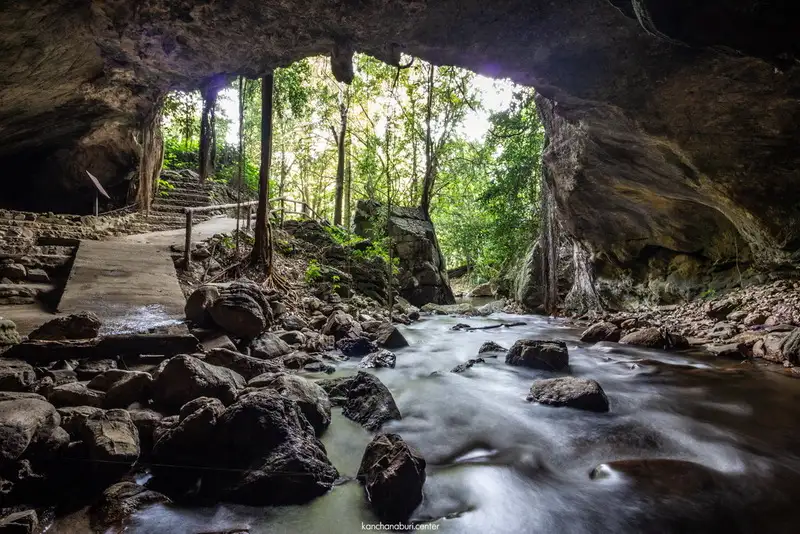
Tham Than Lot Yai Cave in Kanchanaburi is one of those places where just hearing the phrase “a stream running through a cave” immediately brings to mind the cool damp air of limestone chambers, the sound of water tapping pebbles, and shafts of sunlight slowly slipping through openings in the ceiling like nature’s own spotlight. The cave is located in Village No. 5, Khao Chot Subdistrict, Si Sawat District, and sits within Chaloem Rattanakosin National Park. Because of that, the atmosphere here is not merely a “photo spot” but a genuinely lush landscape of forested hills and flowing streams that still feels distinctly natural. Visiting Tham Than Lot Yai is therefore not just about seeing a cave; it is about stepping into a terrain shaped by time—by limestone collapse, the steady carving force of water, and the rhythm of the surrounding forest that gradually embraces the cave mouth until it becomes a massive “natural bridge” that makes you feel small without trying.
Many people who have explored caves in Kanchanaburi are familiar with the dim, mysterious look of stalactites and stalagmites, but Tham Than Lot Yai feels different. Its grandeur comes less from dense formations and more from scale and light. The cave resembles a monumental arch or natural bridge, formed when limestone collapsed and flowing water expanded the opening over a very long period. Thanks to ceiling openings that truly catch daylight, the interior is not pitch-dark like deeper caves; instead, there are moments when sunlight pours in, revealing the texture of rock walls, sandy ground, scattered stones, and even greenery growing inside in a surprisingly vivid way. This is why many visitors describe the cave as a “natural hall”—more spacious, easier to breathe in, and friendlier for those who want an authentic cave experience without having to push far into narrow, demanding passages.
What makes Tham Than Lot Yai stand out as a landscape is how “alive” it feels. The stream is not a background detail; it is the main character. Water flowing through the cave keeps parts of the floor cool and damp throughout the day, making the cave noticeably more comfortable than the outside air. In quieter moments, you can hear the steady cadence of water, a breeze moving through the openings, and your own footsteps softly echoing against limestone. That combination naturally slows the mind down. Tham Than Lot Yai is well-suited for travelers who want to experience nature through their senses rather than through a screen, and who are willing to walk carefully along natural trails in exchange for something deeper than a quick check-in.
From a geology perspective, Tham Than Lot Yai was created by a process that sounds simple but requires immense time. In limestone areas, continuous water erosion gradually forms hollows and channels. When parts of the structure collapse and water keeps enlarging the pathway, an enormous natural-bridge-like opening can emerge. The key factor is water: it not only carves the cave but also continues to flow through it, giving Tham Than Lot Yai its signature feature—a stream running through the cave. Once you understand this, the cave becomes more than a beautiful hollow; it becomes a visible result of time, terrain, and an ecosystem connected from the headwaters in the hills to the point where the stream exits the cave and joins waterways outside.
Another layer that gives Tham Than Lot Yai a strong “evidence-based story” is its historical and archaeological context. Research has noted that the area around Tham Than Lot Yai was once used as an ancient burial site, supported by discoveries of numerous human skeletal remains. There is also historical documentation that connects this region to old military routes, including movements associated with Burmese forces and Japanese troops. This reflects a larger truth about western Kanchanaburi: landscapes of mountain passes and forest corridors were not only scenic backdrops, but also important pathways for people and armies during significant periods. Visiting Tham Than Lot Yai can therefore feel like walking across a place where nature and history overlap quietly. You may not see every trace in a single trip, but knowing the site carries more meaning than beauty alone adds weight and memorability to the experience.
A popular way to explore Tham Than Lot Yai is by “connecting caves” on foot. You can enter from Tham Than Lot Yai and walk out toward Tham Than Lot Lek (the smaller cave) along a natural route. Travel information commonly describes this connecting section as roughly 2–2.5 kilometers, following the stream and forest trail. This distance is manageable for most visitors who wear proper footwear and accept a relaxed pace. The key point is that the route is not simply a path from point A to point B; it gradually delivers the park’s richness in layers—forest edges, stream banks, rocky outcrops, and subtle shifts in terrain and mood as you move. If you enjoy light hiking, the reward here comes more from observation than from exertion, and it keeps your cave visit from ending at a single snapshot at the entrance.
Along the nature trail connecting the caves, many visitors are especially impressed by Thrai Trueng Waterfall, which sits on the walking route and adds variety to the trip. It means you do not just see a cave; you also experience a waterfall and a lively forest stream corridor in the same outing. The commonly described Tham Than Lot Noi – Tham Than Lot Yai route, when done as a round trip, totals around 5 kilometers and takes about 2 hours on average (depending on weather and walking pace). It is ideal for travelers who want an immersive nature activity that does not require a full day, yet still feels like a true escape from the city. Because the site is within a national park, safety guidelines and responsible nature etiquette naturally become part of the experience from start to finish.
In addition to Tham Than Lot Yai, the same area includes Tham Than Lot Noi, a cave known for more visible stalactites and stalagmites, with a stream flowing through it as well. The contrast between the two creates a satisfying “two-mood” trip in one day: Tham Than Lot Yai delivers grand scale and dramatic light, while Tham Than Lot Noi offers a more detail-focused cave atmosphere. Travel sources commonly note that Tham Than Lot Noi is about 2.4 kilometers from Tham Than Lot Yai, and that Tham Than Lot Noi itself is about 300 meters long—an easy, enjoyable distance for close-up observation of cave formations. If you have enough time and energy to visit both, the overall picture of the “Than Lot caves” becomes much clearer, because you experience both the monumental spatial drama and the intricate internal textures within the same cave system.
The park’s abundance is also reflected in the wildlife associated with cave systems and streamside habitats. Various accounts mention cave-dwelling species such as bats, as well as small freshwater fish in the stream. The park is also known in some contexts for “jongkhrong” (otters), which are often cited as a symbolic species of the area. This dimension is why Tham Than Lot Yai should not be viewed purely as a tourist site but as a sensitive ecosystem. Excessive light, loud noise, food scraps, or inappropriate water play can create impacts more easily than people realize. A truly worthwhile visit is not just about seeing something beautiful; it is about seeing it and helping preserve it by staying on designated trails, not touching cave surfaces or formations, carrying out all trash, and maintaining a quiet atmosphere so the area remains a viable habitat for wildlife.
Getting There Tham Than Lot Yai is located in Si Sawat District, Kanchanaburi, within Chaloem Rattanakosin National Park. A commonly used driving approach is to travel from Kanchanaburi town toward the Bo Phloi / Nong Prue area, then continue along routes leading into the park zone. The key is to prepare before entering forested mountain areas: fuel up, carry enough drinking water, and allow extra travel time, as the final portion often involves local roads that require careful driving. Once inside the park, check weather conditions and water levels before starting the walk, especially in the rainy season when trails can be slippery and water levels may change quickly. A morning-to-afternoon plan helps ensure sufficient daylight throughout the hike and reduces risk when walking near the end of the day.
Timing matters for visiting Tham Than Lot Yai because both the caves and the connecting trail rely on light and safety. Even though Tham Than Lot Yai can receive daylight through ceiling openings at certain points, the natural trail between caves still depends on visibility—especially if you plan to connect to Tham Than Lot Lek or Tham Than Lot Noi and return. The most comfortable pace is to start early and walk without rushing, leaving time to pause for water views, light beams, rock textures, and rest points as needed. Good pacing prevents you from hurrying past the details that make cave-and-forest destinations special compared with city-style attractions.
When people talk about the “beauty” of Tham Than Lot Yai, it is often the result of three elements working together: (1) a massive cave hall that feels like standing beneath a natural roof, (2) a stream flowing through the cave that gives the space movement and constant natural sound, and (3) sunlight filtering through ceiling openings to create cinematic atmosphere without any staging. You do not need to be a photographer to feel how the light and shadow shift through the day. With stronger light, rock walls and the cave floor appear crisp and clear; with softer late-afternoon light, the mood becomes gentler and shadows stretch longer—ideal for photos that preserve the place’s natural character.
A smooth and safe visit to Tham Than Lot Yai often starts with small preparations many people overlook. Wear shoes with strong grip, because cave floors and streamside rocks can develop algae and remain damp and slippery. Bring a small flashlight in case you pass through shaded sections or moments when visibility drops. Even though parts of the cave receive natural light, having backup lighting makes movement safer without relying on harsh flash that can disturb other visitors. If you are traveling as a family or with older adults, keeping a consistent pace, not separating, and taking short breaks helps everyone enjoy the same route. The value of the connecting trail is not speed, but observation: noticing how terrain, sound, and the forest-stream environment change as you walk.
What makes Tham Than Lot Yai truly “worth it” for curious travelers is how a single cave can tell multiple stories at once. The first layer is visible nature: the grand cave hall, the natural bridge structure, and the flowing stream. The second layer is time and process: how water and limestone worked together over ages to shape what you see. The third layer is history and archaeology: evidence that the area was once used by people, witnessed events, and served as a passageway in wider historical narratives. Together, these layers make the visit feel like reading a richly illustrated book—beautiful, substantive, and quietly calming from start to finish—very different from a quick stop that leaves only photos but little understanding.
Another reason Tham Than Lot Yai works well as a highlight of a Si Sawat nature trip is how easily it connects with other nearby attractions. You can plan a full-day nature route by starting early with the cave and trail walk, then continuing to water-based viewpoints around the Srinagarind Dam area. If you prefer a softer finish, you can end at a local cafe or meal stop on the way back. Whatever your plan, the core of a good trip here is respecting the national park setting. Tham Than Lot Yai is beautiful precisely because it is fragile and protected. Leaving no trace is what ensures future visitors can see the same scene you enjoy today.
Ultimately, Tham Than Lot Yai is a place that proves grandeur does not need to be man-made. It comes from nature working patiently through time, water, and mountains. If you are looking for a Kanchanaburi experience that feels real—walking for real, seeing for real, and feeling for real—with a meaningful layer of historical and archaeological context, Tham Than Lot Yai is an excellent choice. It is especially fitting for anyone who wants to trade the speed of city life for a slower rhythm: listening to running water and watching sunlight pour through the cave ceiling with intention.
| Place Name | Tham Than Lot Yai Cave (Chaloem Rattanakosin National Park) |
| Address | Village No. 5, Khao Chot Subdistrict, Si Sawat District, Kanchanaburi |
| Coordinates (Approx.) | 14.670662, 99.287961 |
| Place Summary | A national-park cave with a stream running through it, featuring a vast hall shaped like a natural bridge. Notable for light beams from ceiling openings and a lush forest-and-stream setting. |
| Key Highlights | A huge natural-bridge cave formed by limestone collapse and water erosion, with ceiling openings that allow daylight. The site also carries historical–archaeological context and offers a walk connecting to Tham Than Lot Lek / Tham Than Lot Noi. |
| Travel (Quick Guide) | Drive into Si Sawat District and enter Chaloem Rattanakosin National Park, then follow the designated nature trail to the cave (allow extra time and drive carefully on local roads). |
| Current Status | Open during park hours (starting early is recommended to ensure sufficient daylight for the trail). |
| Contact | Chaloem Rattanakosin National Park: 034-547-020, 095-619-8981 |
| Nearby Attractions (Approx. Distance) | 1) Tham Than Lot Noi Cave – approx. 2.4 km 2) Tham Than Lot Lek Cave – approx. 2 km 3) Thrai Trueng Waterfall – approx. 1.5 km 4) Than Ngoen Waterfall – approx. 25 km 5) Than Thong Waterfall – approx. 25 km |
| Nearby Restaurants (Approx. Distance + Phone) | 1) Khrua Wanthanee (Wild Food) – approx. 35 km – 096-359-4792 2) Ruen Thara (Srinagarind Dam Area) – approx. 35 km – 034-574-001 3) Phi Jo Tam Lan Khuen – approx. 38 km – 062-626-2491 4) Saibunang Garden Restaurant & Cafe (Si Sawat) – approx. 35 km – 081-206-9312 5) Je Nee Restaurant (Nong Suea) & T.tiger Bar – approx. 30 km – 034-540-583 |
| Nearby Accommodations (Approx. Distance + Phone) | 1) Rayaburi Resort – approx. 45 km – 034-696-165 2) Z9 Resort – approx. 55 km – 061-360-4959 3) Lake Heaven Resort & Park – approx. 50 km – 061-418-2270 4) Ananta River Hills Resort – approx. 60 km – 034-551-400 5) The Hub Erawan Resort – approx. 65 km – 084-599-4591 |
Frequently Asked Questions (FAQ)
Q: Where is Tham Than Lot Yai Cave located?
A: It is in Village No. 5, Khao Chot Subdistrict, Si Sawat District, Kanchanaburi, within Chaloem Rattanakosin National Park.
Q: What is the main highlight of Tham Than Lot Yai?
A: The cave is known for a stream running through it and a vast hall shaped like a natural bridge, plus dramatic light beams from ceiling openings.
Q: How far is the walk from Tham Than Lot Yai to Tham Than Lot Lek / Tham Than Lot Noi?
A: The connecting section is commonly described as roughly 2–2.5 kilometers, depending on the exact start and end points used on the day.
Q: How long does the Tham Than Lot Noi – Tham Than Lot Yai nature trail take?
A: The round-trip route is commonly described as about 5 kilometers in total and averages around 2 hours, depending on weather and walking pace.
Q: What should I prepare for a safe cave visit and trail walk?
A: Wear non-slip shoes, bring drinking water and a small flashlight, stay on designated trails, avoid touching cave surfaces or formations, and start early to ensure enough daylight.
 Tham Than Lot Yai Cave Map
 Category:
  Group:
  Last Update: 2 MonthAgo
Comment
 Nearby Attractions
| Keyword (Advance) |
 Facebook Fanpage
 Region
 Art, Culture and Heritage
 Historical Sites and Monuments(
 Landmarks and Memorials(
 Art, Craft Centres, Tradition(
 Museums(
 Art Gallery(
 University
 Places of Worship
 Temple(
 Church(
 Other religious and spiritural sites(
 Research and Development
 Royal Project(
 Suburban Living
 Village, Community(
 Local Market(
 National Parks and Marine Reserves(
 Mountain (Doi)(
 Dam, Reservoir, Lake(
 Waterfalls(
 Hot Springs(
 River, Canal(
 Other natural attractions(
 Entertainment and Agricultural
 Zoos and Aquariums(
 Animal camps and shows(
 Farm, Parks, Gardens and Ecotourism(
 Cinema(
 Outdoor and Adventure Activities(
 Travel Articles, Recipes
 Travel Review, Food Review(