
 Home
Home North(
 Chiang Mai(


Rating: 3.9/5 (7 votes)
 |
|  Map
Map 
 Have Map
  No Map
Kanchanaburi attractions
Attractions in Thailand
Open Days: Daily
Opening Hours: 06:00 – 20:00
Ong Ju Cave (Wat Tham Ong Ju) in Kanchanaburi is an ideal destination for travelers who want to step away from the province’s main tourist routes and discover a “large cave on a hillside” that blends the calm of a temple, the mystique of a cave, and distinctive traces of local community art. The cave is located in Si Sawat District, in Na Suan Subdistrict, around Moo 1 in the Ong Ju / Ban Plai Na Suan area. The overall atmosphere feels quiet and rural, surrounded by mountains and forest. As you drive deeper into the area, you can sense the noise and pace of everyday life gradually fading away, leaving only the road that leads into the community and the climb toward a destination that requires more intention than an easy, casual check-in.
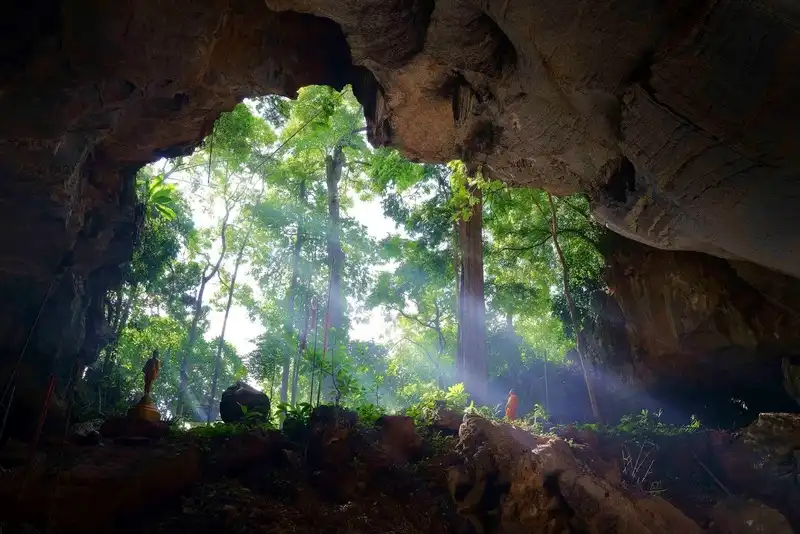
The name “Ong Ju” is explained in local information as meaning “big,” and once you arrive, that meaning becomes immediately clear. The cave opens into a space that feels noticeably wide, with an estimated width of about 20 meters and a length of about 70 meters (as commonly described in the area). This scale makes the interior feel less confined than smaller caves, more like a natural hall that invites you to walk slowly, observe details, and experience the cool humidity typical of limestone caves. Most importantly, inside the cave there is a large Buddha image that local people often call “Luang Pho Yai” (the Great Venerable Father). This is the heart of the experience, because it turns Ong Ju Cave into more than a geological space—it becomes a place of faith where visitors come to pay respects with genuine reverence.
The appeal of Ong Ju Cave lies in the journey and the “rhythm” of the place. Many visitors mention that the final section of the route is quite steep and not suitable for rushed driving. If you are not familiar with mountain roads, it is best to use lower gears and drive carefully, especially during rainy conditions when the surface can become slippery or sandy. As you get closer, some parts of the road may be narrow, requiring patience and good judgment when meeting oncoming vehicles. After parking, there is typically a walking section that continues uphill to reach the cave area. For this reason, Ong Ju Cave tends to suit travelers who come with real intention rather than those who want a quick stop without effort. Non-slip shoes and drinking water are not just “nice to have”—they make the trip significantly safer and more comfortable.
Once inside the cave, the first sensations many people notice are the slightly cooler temperature and the humidity that makes the rock surfaces feel alive. Light inside is limited, so your eyes need a moment to adjust, and then you begin to see the texture of the stone and the dim corners that naturally encourage you to slow down. This is exactly what makes Ong Ju Cave so effective at calming the mind. Unlike crowded attractions filled with noise and constant activity, the quiet here allows you to hear your footsteps, the movement of air, and sometimes even the soft sound of dripping water. These natural sounds create an experience that feels like stepping away from screen-driven life and returning to a more grounded sense of presence.
The large Buddha image inside the cave is a focal point for many visitors who come specifically to pay respect. When a Buddha image appears within a cave space, the feeling is distinctly different from worship in a typical temple hall. The way light filters in at certain angles creates shadows and depth that emphasize a quiet, steady sense of peace. Surrounded by raw stone walls and the natural cave floor, the atmosphere makes reverence feel more “still” and more “deep” almost automatically. This is why many people describe Ong Ju Cave not only as a place to visit, but also as a place to rest the mind and reconnect with a calmer inner pace.
Another element often mentioned as part of Ong Ju Cave’s identity is the presence of “Karen-style sculpture” or artistic features associated with Karen cultural expression. This reflects the broader context of Si Sawat District, where cultural diversity is an important part of local life. When observing such art, it is best to do so respectfully and without rushing to conclusions, because community-based art often emerges from belief, memory, and local transmission rather than being arranged purely for tourism. If you want to learn more deeply, spend time quietly noticing details and then connecting them to the area’s background. That approach transforms the visit from simply “seeing” to genuinely “understanding” how a single cave can hold nature, faith, and community identity together in one place.
In terms of history and stories passed down locally, there are some beliefs or local interpretations suggesting that the large Buddha image or certain traces within the cave may relate to historical periods when Burmese armies advanced into Siamese territory. However, it is safest to treat this as a “place-based narrative” rather than a fully verified fact. What can be stated with confidence is that Kanchanaburi and Thailand’s western routes have long been associated with movement through natural passes and strategic travel corridors, so it is not unusual for places in this region to carry stories tied to conflict periods, journeys, or population movement. A more academically grounded conclusion would require further historical documentation. If, in the future, local records or cultural agencies publish more detailed evidence, the story can be updated and strengthened with clearer references.
One of the most appealing qualities of Ong Ju Cave is that, even with a large Buddha image and worship area, the overall setting still feels natural and not heavily commercialized. That means you should prepare a bit more than you would for a city temple visit: bring drinking water, carry a small flashlight as a backup (especially if parts of the approach are shaded), and be ready for uphill walking that may feel tiring. In many cases, that effort feels worthwhile once you stand at the cave area and see how the surrounding landscape opens wider with elevation.
In Thai temple contexts, caves have long served as places of quiet—used for meditation, retreats, or simply as spaces to step away from noise. Ong Ju Cave offers a similar atmosphere. Even if you do not come specifically for intensive practice, simply walking quietly, speaking softly, and giving yourself time inside the cave often makes the mind feel more organized and settled. This is an important value that Ong Ju Cave offers beyond scenic photos: it provides a sense of “stillness” that many travelers find rare in more mainstream attractions.
Getting There Ong Ju Cave is located in Moo 1, Na Suan Subdistrict, Si Sawat District, Kanchanaburi. A common approach is to drive from Kanchanaburi town toward Si Sawat District and then continue into Na Suan Subdistrict via local roads to the Ong Ju / Ban Plai Na Suan area. The final approach requires extra caution because there are steep sections and some narrow parts of the road. It is best to avoid driving during heavy rain or after dark. If you travel as a group, it helps to agree on rest points and keep communication clear, since mobile signal can be unstable in mountainous areas. Once you reach the temple/parking area, there is typically a walking section that continues uphill to the cave, so sturdy shoes with good grip and sufficient water are strongly recommended.
The best time to visit Ong Ju Cave is from morning to afternoon, when there is enough light for safe driving and walking, and when descending steep paths is less risky than in low-light conditions. For photographers, morning light often makes the surroundings look softer and greener, while late afternoon can produce warmer tones. Even so, it is not recommended to let the visit run too close to evening, especially if you are traveling with several people, because steep routes require strong focus and clear visibility.
Experiencing Ong Ju Cave in a truly worthwhile way is less about staying as long as possible and more about walking slowly, observing carefully, and respecting the site. Both caves and temples are sensitive environments—ecologically and culturally. Basic conduct should be taken seriously: dress modestly, keep your voice low, do not litter, do not scratch or write on cave walls, and avoid touching cave surfaces or artistic elements unnecessarily. If you bring children, it helps to explain in advance that this is not a play area, but a place of faith and nature that everyone should help protect.
Ong Ju Cave is well suited for travelers who enjoy quiet places and are willing to put in a little effort in exchange for a deeper experience. If you are looking for a destination in Kanchanaburi that feels different from the usual popular routes, and you want to experience the atmosphere of a large cave-temple space shaped by community context, this is a place worth keeping on your list—especially if you want to see a side of Kanchanaburi that remains simple, yet memorable in its details.
| Place Name | Ong Ju Cave (Wat Tham Ong Ju) |
| Address | 109 Ban Ong Ju, Moo 1, Na Suan Subdistrict, Si Sawat District, Kanchanaburi |
| Place Summary | A large hillside cave in a temple setting, peaceful and suitable for nature-and-faith travelers. Inside is a large Buddha image along with local artistic elements. |
| Highlights | Estimated cave size of about 20 m wide and 70 m long, a large Buddha image (“Luang Pho Yai”), a calm atmosphere, and mentions of Karen-style sculpture/cultural identity in the area. |
| Abbot / Current Caretaker | Phra Khru Wutthi Kanchanawat (Khamphun) |
| Travel (Brief) | Drive to Si Sawat District and Na Suan Subdistrict. The final approach includes steep sections and, in general, a walking segment uphill to the cave. Daytime travel is recommended, with careful driving. |
| Current Status | Open to visitors under typical hours (morning to afternoon is recommended for safer travel on steep routes). |
| Nearby Tourist Attractions (Approx. Distance) | 1) Srinakarin Dam – approx. 20 km 2) Erawan Waterfall – approx. 40 km 3) Huai Mae Khamin Waterfall – approx. 55 km 4) Wat Tha Kradan – approx. 30 km 5) Rafting / Lake Activities (Tha Kradan Area) – approx. 35 km |
| Popular Restaurants Nearby (Approx. Distance + Phone) | 1) Krua Erawan (Erawan Kitchen) – approx. 40 km – 034-574-098 2) Ruen Thara (Srinakarin Dam Area) – approx. 30 km – 034-574-001 3) Sabai Nang Garden Restaurant & Cafe (Si Sawat) – approx. 30 km – 081-206-9312 4) Krua Wantanee (Wild Food) – approx. 32 km – 096-359-4792 5) Ngern Lai Nong Thong Lai Ma Restaurant – approx. 28 km – 098-496-3599 |
| Popular Accommodations Nearby (Approx. Distance + Phone) | 1) Pufa Engnam Lake Resort – approx. 25 km – 082-221-2118 2) Sweet Home Floating House – approx. 30 km – 094-853-9459 3) Lake Heaven Resort – approx. 35 km – 061-418-2270 4) Z9 Resort – approx. 40 km – 061-360-4959 5) Rayaburi Resort – approx. 45 km – 034-696-165 |
Frequently Asked Questions (FAQ)
Q: Where is Ong Ju Cave located?
A: Ong Ju Cave is in Moo 1, Na Suan Subdistrict, Si Sawat District, Kanchanaburi, in the area of Wat Tham Ong Ju (Ban Ong Ju / Ban Plai Na Suan).
Q: What is the main highlight of Ong Ju Cave?
A: The cave is notably large and contains a large Buddha image (“Luang Pho Yai”), set in a peaceful temple atmosphere suitable for nature-and-faith travelers.
Q: Is it difficult to visit Ong Ju Cave?
A: The final approach is steep and requires careful driving. In general, there is also an uphill walking section to reach the cave, so daytime visits and non-slip shoes are recommended.
Q: What time of day is best for visiting Ong Ju Cave?
A: Morning to afternoon is recommended, as there is better light for safe travel and reduced risk when descending steep routes.
Q: How should visitors behave at Wat Tham Ong Ju?
A: Dress modestly, keep your voice low, do not litter, do not scratch or write on surfaces, and avoid touching cave features or sacred/artistic elements unnecessarily.
 Ong Ju Cave (Wat Tham Ong Ju) Map
 Category:
  Group:
  Last Update: 2 MonthAgo
Comment
 Nearby Attractions
| Keyword (Advance) |
 Facebook Fanpage
 Region
 Art, Culture and Heritage
 Historical Sites and Monuments(
 Landmarks and Memorials(
 Art, Craft Centres, Tradition(
 Museums(
 Art Gallery(
 University
 Places of Worship
 Temple(
 Church(
 Other religious and spiritural sites(
 Research and Development
 Royal Project(
 Suburban Living
 Village, Community(
 Local Market(
 National Parks and Marine Reserves(
 Mountain (Doi)(
 Dam, Reservoir, Lake(
 Waterfalls(
 Hot Springs(
 River, Canal(
 Other natural attractions(
 Entertainment and Agricultural
 Zoos and Aquariums(
 Animal camps and shows(
 Farm, Parks, Gardens and Ecotourism(
 Cinema(
 Outdoor and Adventure Activities(
 Travel Articles, Recipes
 Travel Review, Food Review(