
 Home
Home North(
 Chiang Mai(


Rating: 3.8/5 (5 votes)
 |
|  Map
Map 
 Have Map
  No Map
Kanchanaburi attractions
Attractions in Thailand
Open Days: Open Daily
Opening Hours: 08.00 – 17.00 (Hours may change depending on the monastic community’s management and local conditions)
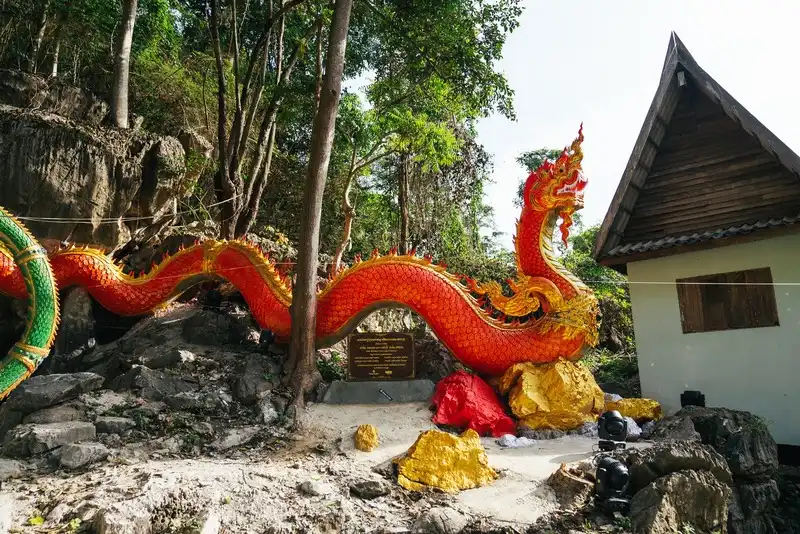
Tham Sattabann Khuha Cave is a destination for travelers who want to experience a kind of “beautiful silence” without having to drive far beyond the province. The cave is located in Lat Ya Subdistrict, Kanchanaburi, with a small access road branching off the main route for about 1 kilometer. The area around the cave is also home to a monastic retreat (samnak song), which naturally sets it apart from many commercially developed cave attractions. The first impression for most visitors is the calmness of the surrounding landscape—hills, forest, and open scenery that makes it easy to breathe deeply and slow down. In the early morning or late afternoon when the sunlight softens, the atmosphere tends to encourage you to move at a gentler pace without even trying.
The name of the cave often sparks curiosity about what “sattabann khuha” might mean. In naming conventions commonly found in caves and spiritual places, “satta” frequently implies “seven,” while “khuha” refers to a cave or cavern. This naturally leads many people to imagine a cave with multiple chambers or sections, or a space remembered for having several distinct caverns. In practice, each visitor may interpret the name differently depending on the route they walk and what they see inside, but the shared feeling is consistent: it is not a noisy place, and it does not feel rushed. That is precisely why it suits travelers who prefer simple, nature-focused experiences without complicated planning.
Because the cave sits within a monastic setting, the overall tone of a visit tends to be especially respectful. Most visitors dress modestly, keep their voices low, and treat the space with more care than they might at a typical tourist attraction. This is part of what makes Tham Sattabann Khuha memorable and worth revisiting. When the usual distractions are absent, the natural beauty around you becomes more vivid: the quiet of the forest, the stillness of the surroundings, and small details like the sound of wind, birds, or leaves brushing together. In that sense, a cave visit here is not only about walking into a rock chamber, but also about resting your mind in an environment where nature remains the main character.
In broad terms, many caves in Kanchanaburi are limestone caves formed through slow geological processes over extremely long periods. Rainwater seeps through soil and rock layers and becomes mildly acidic, gradually dissolving limestone to create tiny voids that expand into chambers and passages. The stalactites and stalagmites that many visitors come to admire are formed by mineral-rich water dripping from the ceiling and depositing calcite little by little. Stalactites develop from above, while stalagmites rise from below. Because this process is so slow, it is important not to touch, grab, or climb on formations. Even natural skin oils can interfere with mineral deposition and disrupt growth that has taken thousands of years.
What makes a monastic-area cave trip appealing is how easily you can control your pace. If you are a nature lover, you can sit quietly for a while before entering. If you are photographing, arriving when the light is beautiful can add depth to the surrounding landscape. No matter your style, the guiding principle should be safety. Cave terrain is often humid, surfaces can be slippery, and some sections may have uneven levels. Shoes with good traction matter more than stylish footwear, and carrying a small bottle of water is wise. Even if the trip feels short on paper, walking on uneven ground can be more tiring than expected.
Getting There to Tham Sattabann Khuha Cave typically begins from Kanchanaburi City, heading toward Lat Ya Subdistrict. Once you enter the Lat Ya area, a commonly shared landmark-based direction is to continue about 1 kilometer from the entrance to the Stone Garden area (Suan Hin). The cave access point is said to be opposite the agricultural college, where you will find a junction leading toward the cave for another approximately 1 kilometer. The final stretch often feels more like a local road, so it is best to drive carefully and keep your speed moderate, especially early in the morning or near sunset when visibility may be lower. If you are unfamiliar with the area, setting your navigation to “Wat/Samnak Song Tham Sattabann Khuha” in advance is recommended, and it can also help to check mobile signal coverage beforehand because some rural sections may have weaker reception than the city.
If you want to add a stronger historical dimension to your trip, consider pairing the cave with the nearby “Old Kanchanaburi City” (Mueang Kanchanaburi Kao) area in Lat Ya. Local historical accounts describe this zone as a frontier outpost that played a role in blocking Burmese troop movements coming through the Three Pagodas Pass, with an often-cited time frame from the early Ayutthaya period to the early Rattanakosin period (approximately 2091 – 2328 BE). Visiting both places in one day can create a richer story that blends natural landscape from the cave with historical landscape from a former border defense settlement.
Old Kanchanaburi City is especially interesting for travelers who enjoy reading places through their remaining structures rather than only taking photos. It is commonly described as still showing traces of an earthen wall forming a rectangular enclosure, roughly 168 x 355 meters, with fortifications at all four corners. This layout reflects the logic of a defensive frontier town in a time when movements through strategic passes had serious implications for regional security. Even though the centuries have passed, the spatial design of defense can still be interpreted through the wall traces and the corner positions of the forts.
Another advantage of exploring Old Kanchanaburi City is that several nearby temples and historic sites are often mentioned in connection with the area, including Wat Khun Phaen, Wat Mae Mai, Wat Pa Le Lai, and Wat Nang Phim. This means your route does not need to be a quick “one stop and back” trip. If you have more time, you can visit the cave in the morning, explore the old city site later in the day, and then stop at nearby temples to add cultural and belief-related context. This kind of itinerary suits travelers who want experiences they can truly narrate, not merely check in.
To keep a cave-and-history day trip comfortable, pacing matters. The cave experience is best enjoyed slowly, paying attention to small details, while the old city site is more about understanding the broader layout and imagining walls, corner forts, and the footprint of the settlement. Plan for breaks, hydration, and shade, especially during the hot season in Kanchanaburi when the sun can be intense. Bringing a hat or umbrella, along with comfortable walking shoes, helps you stay relaxed and reduces risk on uneven ground.
If you are traveling as a family, especially with children or older adults, it helps to assess the ground conditions before going deeper into cave areas. Children should remain close to adults, and older visitors should walk at a comfortable pace without forcing themselves. There is no need to “finish everything” in one go; safety matters more than completeness. For the old city area, choosing cooler hours also improves comfort and ensures everyone has a better overall experience.
Good etiquette is an essential part of visiting a cave within a monastic setting. Dress modestly, avoid loud voices, do not litter, and respect any on-site rules. If you bring food or drinks, take all waste back with you. This is especially important in humid natural environments where leftover food can affect small ecosystems. Keeping the place clean and quiet is what allows destinations like this to remain welcoming and beautiful for future visitors.
From a photography perspective, the cave area and the old city site offer different strengths. The cave environment suits images that focus on texture, light and shadow, and depth, while the old city site is better for compositions that communicate space and historical traces, such as earthen wall lines and open ground that once formed part of a defensive system. If you want natural-looking photos with minimal editing, visiting in the morning or late afternoon helps produce softer light and better shadows—and it also makes walking more comfortable than under midday sun.
Overall, Tham Sattabann Khuha Cave and Old Kanchanaburi City fit travelers who want a trip that feels simple yet meaningful. You do not need a tightly packed plan. Choose comfortable hours, bring water, wear stable shoes, and let the place do what it naturally does best. The quiet of the monastic setting, the calm landscape, and the frontier-town traces gradually reveal that Kanchanaburi is not only about famous highlights, but also about places people visit for peace and a sense of the past—all within a single day.
| Place Name | Tham Sattabann Khuha Cave |
| Location | Lat Ya Subdistrict, Mueang Kanchanaburi District, Kanchanaburi |
| Address | About 1 km from the main road junction leading to the cave in Lat Ya (Recommended: set navigation to “Wat/Samnak Song Tham Sattabann Khuha” before departure) |
| Summary | A cave within a monastic retreat area, known for a quiet atmosphere and scenic surroundings, easily paired with the nearby Old Kanchanaburi City historical site in Lat Ya |
| Highlights | Peaceful monastic setting, scenic and quiet landscape, suitable for slow-paced nature travel, can be combined with Old Kanchanaburi City and nearby historic temples |
| Period | Nearby: Old Kanchanaburi City (frontier outpost) commonly cited around 2091 – 2328 BE (Early Ayutthaya – Early Rattanakosin) |
| Key Evidence & Context | Old Kanchanaburi City is described as having traces of a rectangular earthen wall (about 168 x 355 m) with forts at all four corners; nearby sites include Wat Khun Phaen, Wat Mae Mai, Wat Pa Le Lai, and Wat Nang Phim |
| Monastic Supervisor/Abbot (Latest) | Phra Khru Palat Somsak Dhammarato (Phra Ajarn Tang) (Appointment information reported in 2567 BE) |
| Travel | By Car: Kanchanaburi City → Lat Ya → continue about 1 km from the Stone Garden entrance (opposite the agricultural college) → turn into the junction and drive about 1 km to the cave area |
| Current Status | Open to visitors (Recommended to confirm access rules and site readiness with local caretakers before traveling) |
| Facilities | Monastic-area parking/visitor space depending on on-site management (Details may change) |
| Fees | Typically donation-based (Recommended to check on site) |
| Nearby Accommodations | 1) City-Center Kanchanaburi accommodations (approx. 15 km) 2) River Kwai Bridge area accommodations (approx. 18 km) 3) Wang Pho/Sai Yok area accommodations (approx. 35 km) 4) Lat Ya area accommodations (approx. 8 km) 5) Ban Kao/Mueang Sing area accommodations (approx. 25 km) |
| Nearby Restaurants | 1) Soon Heng (approx. 8 km) Tel. 092-959-3994 2) Prik Kaeng Restaurant (approx. 8 km) Tel. 034-589-185 3) Zab Nua Lat Ya (approx. 8 km) Tel. 092-278-8112 4) Krua Ing Kwae Lam Taphoen (approx. 15 km) Tel. 098-382-2773 5) Nong A Restaurant (approx. 7 km) Tel. 034-589-014 |
| Nearby Attractions | 1) Old Kanchanaburi City (Earthen Wall Ruins) (approx. 6 km) 2) Wat Khun Phaen (approx. 6 km) 3) Wat Mae Mai (approx. 6 km) 4) Wat Pa Le Lai (approx. 6 km) 5) Wat Nang Phim (approx. 6 km) |
Frequently Asked Questions (FAQ)
Q: Where is Tham Sattabann Khuha Cave located?
A: It is in Lat Ya Subdistrict, Kanchanaburi. The cave area is within a monastic retreat setting, with a small junction road leading about 1 kilometer from the main route.
Q: Is it difficult to get there, and what should I prepare?
A: It is manageable if you follow the Lat Ya route and turn into the junction leading to the cave. Wear shoes with good grip, bring drinking water, and dress modestly because it is a monastic area.
Q: Who is this place suitable for?
A: It suits travelers who prefer quiet, slow-paced nature trips and those who want to connect the visit with the nearby Old Kanchanaburi City historical site.
Q: Why is Old Kanchanaburi City historically important?
A: It is described as a frontier outpost site in Lat Ya with traces of a rectangular earthen wall and four corner fort positions, reflecting border-defense context from the early Ayutthaya to early Rattanakosin periods.
Q: What etiquette should I follow when visiting a cave in a monastic setting?
A: Dress modestly, keep noise low, do not litter, and follow any on-site rules. Avoid touching or climbing on cave formations for both safety and conservation.
Q: What is the best time to visit?
A: Morning or late afternoon is usually more comfortable because the sun is less intense, and the softer light is better for walking and photography—especially if you plan to continue to Old Kanchanaburi City on the same day.
 Tham Sattabann Khuha Cave Map
 Category:
  Group:
  Last Update: 2 MonthAgo
Comment
 Nearby Attractions
| Keyword (Advance) |
 Facebook Fanpage
 Region
 Art, Culture and Heritage
 Historical Sites and Monuments(
 Landmarks and Memorials(
 Art, Craft Centres, Tradition(
 Museums(
 Art Gallery(
 University
 Places of Worship
 Temple(
 Church(
 Other religious and spiritural sites(
 Research and Development
 Royal Project(
 Suburban Living
 Village, Community(
 Local Market(
 National Parks and Marine Reserves(
 Mountain (Doi)(
 Dam, Reservoir, Lake(
 Waterfalls(
 Hot Springs(
 River, Canal(
 Other natural attractions(
 Entertainment and Agricultural
 Zoos and Aquariums(
 Animal camps and shows(
 Farm, Parks, Gardens and Ecotourism(
 Cinema(
 Outdoor and Adventure Activities(
 Travel Articles, Recipes
 Travel Review, Food Review(