
 Home
Home North(
 Chiang Mai(


Rating: 4.5/5 (4 votes)
 |
|  Map
Map 
 Have Map
  No Map
Kanchanaburi attractions
Attractions in Thailand
Open Days: Open Daily
Opening Hours: 08:00 – 18:00
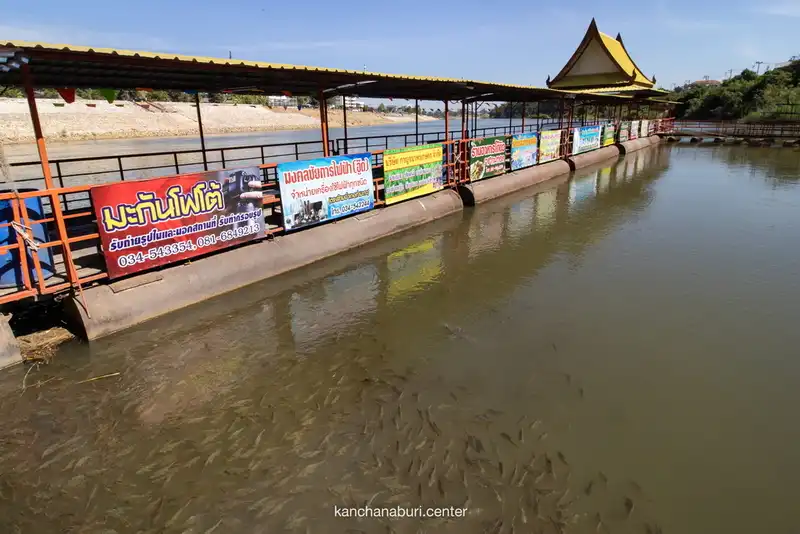
Wang Sangkawas Fish Park, Kanchanaburi is a riverside leisure area along the Mae Klong River in Wai Niao Subdistrict, Tha Maka District. Locals commonly think of it as an easygoing “fish-feeding spot” that doesn’t require much planning, yet still feels genuinely close to the river, the temple, and everyday community life. The simplicity here is the main appeal: families often bring children to feed the fish, working people stop by to rest their eyes and clear their heads, and travelers driving along Highway 323 frequently use it as a convenient break before continuing to other parts of Kanchanaburi.
The park’s charm lies in the “rhythm of riverside life.” The Mae Klong River naturally cools the area, and the river breeze can ease the daytime heat. As the light softens in the late afternoon, the atmosphere becomes noticeably more comfortable and pleasant. That is why many visitors prefer coming close to evening to stroll, breathe in fresh air, and let time slow down a little. Another advantage is the location directly opposite Wat Wai Niao, which means the trip does not have to end with fish feeding. You can easily continue across to the temple to pay respects or visit the local folk museum inside the temple within the same outing.
From a community-based travel perspective, Wang Sangkawas Fish Park functions like a “shared public space” where many groups can spend time without complicated conditions. You can stop briefly to feed the fish and take a few photos before moving on, or you can shape it into a half-day itinerary by adding nearby sites such as Pong Tuek Ancient Site, an important archaeological area in Tha Maka. This combination helps the trip feel more complete, blending nature, local culture, and history along a single route.
The core activity that brings people here on purpose is fish feeding. During the daytime, visitors commonly see large numbers of silver barb fish (pla tapian) swimming up near the riverbank to catch food, which can be especially fun for children as they watch the fish move together in waves. A highlight often mentioned by locals is the “early night” period, when some people say there is a better chance of seeing Sangkawas fish (also called sangkawad or pla yon) come up more clearly. This fish is frequently described as increasingly difficult to spot nowadays, and that sense of rarity is one reason some visitors deliberately come near sunset to observe how the mood of the river and fish behavior changes by time of day.
For visitors unfamiliar with the name “Sangkawas fish,” the term is sometimes used in certain Thai local contexts to refer to catfish-type fish in the general group that people may call sangkawad or sangkawas. To most visitors, it can feel somewhat similar to soft-fleshed river fish in appearance: larger-bodied fish with smooth skin, and when they rise near the surface in softer light, their shape can be more noticeable than smaller fish. The interest, therefore, is not only about feeding fish, but also about informally learning about local river fish and the Mae Klong ecosystem without needing a formal nature museum setting.
That said, to keep fish feeding both enjoyable and responsible, it is best to choose appropriate feed, avoid foods that could pollute the water or harm fish, and avoid throwing large amounts at once, which can cause aggressive competition. This not only reduces the risk of startling children, but also helps prevent long-term behavioral changes in the fish. If you come as a family, it is recommended to stand on stable ground, avoid leaning too far over the river edge, and supervise children closely. Even a calm riverside area can become slippery or uneven, especially after rain or where algae forms along the edge of walkways.
Another strength of Wang Sangkawas Fish Park is how easily it connects with nearby attractions. In just a few minutes, you can visit Wat Wai Niao, an important temple for the local community, and there is also a folk museum inside the temple that is open to visitors (08:00–18:00). This kind of combined trip makes the area’s story feel more complete: you are not only “coming to see fish,” but you also get a clearer sense of how the riverside community uses space and how local culture remains connected to the Mae Klong River.
If you want to add a stronger historical layer to the itinerary, Pong Tuek Ancient Site is an excellent addition. It is recognized as an ancient settlement area with important archaeological evidence in Kanchanaburi, often described in relation to Dvaravati-period art and Indian Gupta influence, roughly dating to around the 11th–12th Buddhist centuries. Visiting Pong Tuek helps illustrate that the “Mae Klong corridor” was never only a natural waterway—it was a route for travel, contact, and settlement for a very long time. When you connect that deep past with today’s riverside life at Wang Sangkawas, you can experience a continuous narrative from history to the present in one day.
For photography, Wang Sangkawas Fish Park is more suited to capturing atmosphere than a monumental landmark. The beauty here comes from water, wind, light, and fish movement. In the morning, the light is softer and comfortable for portraits with the river. In late afternoon toward evening, the tone becomes warmer, with reflections on the water that give photos more depth—especially during fish feeding, which naturally tells a story without requiring a dramatic backdrop.
If you want a relaxed plan that doesn’t feel tiring, a simple approach is to start at Wang Sangkawas Fish Park, spend around 30–60 minutes walking and feeding fish, then cross over to Wat Wai Niao for worship and the folk museum, and finally continue to Pong Tuek to complete the historical side of the trip. If time remains, you can add a cafe or local meal around the Tha Maka–Tha Muang zone, or if you plan to stay overnight, continue into Kanchanaburi town where you will find more riverside accommodations and a broader restaurant selection.
Getting There To reach Wang Sangkawas Fish Park by car from Bangkok, follow Highway No. 323 toward Kanchanaburi. Around kilometer markers 92–93, take the same access route used for Pong Tuek Ancient Site. After crossing Chantrubeksa Bridge (also known as the Celebratory Bridge), turn right and continue along the road that follows the Mae Klong River for approximately 3 kilometers. You will arrive at the park, which sits directly opposite Wat Wai Niao. The driving route is generally straightforward, but it is recommended to maintain a sensible speed because this is a community area with smaller side roads branching off along the way.
For families or travelers with elderly companions, it helps to plan around weather conditions. The riverside is most comfortable in the morning or late afternoon, and carrying drinking water is recommended, especially in the hot season. During the rainy season, the atmosphere can be beautiful, but the ground may be more slippery than usual, so shoes with good grip are advisable, and it is better not to stand close to the river edge for long periods for safety.
| Overview | A Mae Klong River relaxation spot for feeding fish, located opposite Wat Wai Niao, ideal for family outings and easy road-trip stops along Highway 323. |
| Key Highlights | Fish feeding, Mae Klong riverside atmosphere, opposite Wat Wai Niao, near Pong Tuek Ancient Site, suitable for families and atmosphere photography. |
| Address | Wai Niao Subdistrict, Tha Maka District, Kanchanaburi (directly opposite Wat Wai Niao) |
| Coordinates | 13.90617, 99.76221 |
| Open Days | Open Daily |
| Opening Hours | 08:00 – 18:00 |
| Current Status | Open for leisure visits during operating hours. |
| Nearby Attractions | 1) Wat Wai Niao – approx. 0.3 km 2) Pong Tuek Ancient Site – approx. 3 km 3) Chantrubeksa Bridge (Celebratory Bridge) – approx. 3 km 4) Wat Tham Suea (Tha Muang) – approx. 25 km 5) Kanchanaburi Skywalk (town area) – approx. 35 km |
| Popular Restaurants Nearby | 1) Kob Tod Tha Maka – approx. 6 km Tel. 081-178-7849 2) Ban Kong Krua Rim Nam – approx. 5 km Tel. 061-542-9152 3) Lek-Lek Kaeng Pa Tha Maka – approx. 8 km Tel. 096-054-4462 4) Keeree Tara Riverside (Kanchanaburi Town) – approx. 35 km Tel. 034-518-888 5) Loft Restaurant (Kanchanaburi Town) – approx. 35 km Tel. 034-513-000 |
| Popular Accommodations Nearby | 1) U Inchantree Kanchanaburi (Kanchanaburi Town) – approx. 37 km Tel. 034-521-584 2) Natee The Riverfront Hotel (Kanchanaburi Town) – approx. 36 km Tel. 034-518-777 3) Felix River Kwai Resort (Kanchanaburi Town) – approx. 38 km Tel. 034-551-000 4) Dheva Mantra Resort (Kanchanaburi Town) – approx. 40 km Tel. 034-615-999 5) Good Times Resort (Kanchanaburi Town) – approx. 38 km Tel. 034-512-381 |
Frequently Asked Questions (FAQ)
Q: Where is Wang Sangkawas Fish Park located?
A: It is in Wai Niao Subdistrict, Tha Maka District, Kanchanaburi. The park sits directly opposite Wat Wai Niao and uses the same access route as Pong Tuek Ancient Site.
Q: What time of day is best if I want to see a lot of fish?
A: Daytime commonly has many silver barb fish (pla tapian). Some local descriptions mention that near evening there may be a better chance of seeing Sangkawas fish more clearly, so visiting both in the morning and late afternoon can be a good option.
Q: What are the opening hours?
A: Local information commonly states it is open daily from 08:00 – 18:00.
Q: Can I combine this visit with Pong Tuek Ancient Site?
A: Yes. The entrance route is the same and the distance is short, making it suitable for a half-day itinerary combining riverside nature and local history.
Q: Is it safe to bring children for fish feeding?
A: Yes, but children should be supervised closely. Stand on stable ground, avoid staying too close to the river edge, and be mindful of slippery surfaces, especially after rain or where algae may be present.
Q: How much time should I plan if I also want to visit Wat Wai Niao and its folk museum?
A: For a relaxed pace, plan around 2–4 hours for the fish park, the temple, and the folk museum. If you also add Pong Tuek, a half-day trip usually feels comfortable without rushing.
 Wang Sangkawas Fish Park Map
 Category:
  Group:
  Last Update: 2 MonthAgo
Comment
 Nearby Attractions
| Keyword (Advance) |
 Region
|
 Muang Kanchanaburi(