
 Home
Home North(
 Chiang Mai(


Rating: 4.2/5 (5 votes)
 |
|  Map
Map 
 Have Map
  No Map
Kanchanaburi attractions
Attractions in Thailand
Open Days: Open daily
Opening Hours: 09:00 – 17:00 (hours may vary by season/activities; please check before visiting)
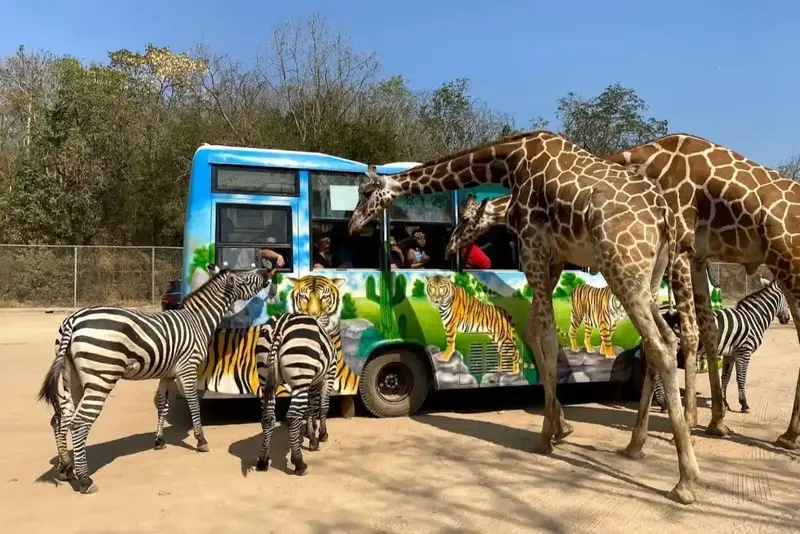
Safari Park Kanchanaburi is an open-range, nature-style zoo and an educational space for zoology, conservation, and responsible tourism in Bo Phloi District, Kanchanaburi. A key highlight is the design that lets visitors experience a “drive-through/ride-through wildlife viewing” atmosphere in the safari zone, along with walkable learning areas and animal shows. As a result, the visit is not simply about “seeing animals,” but about observing animal behavior, understanding basic welfare needs, recognizing the relationship between animals and their habitats, and reflecting on how humans set animal-welfare standards in tourism settings.
From an academic perspective, an open-range zoo differs from conventional cage-based exhibits because its central aim is to reduce animal stress through larger space, encourage more naturalistic behaviors, and support learning through “landscape” and “appropriate interaction,” rather than viewing animals behind bars alone. This approach aligns with core animal-welfare principles, commonly discussed through practical pillars such as adequate food and clean water, suitable shelter, health care and veterinary support, the reduction of fear and suffering, and opportunities for animals to express species-typical behaviors. These are foundational standards that any animal-based visitor attraction should treat as non-negotiable.
This safari park is often described as covering roughly 500 rai, and as being about 28 kilometers from Kanchanaburi city. That distance makes it well-suited for a half-day to full-day trip for families, school groups, university students, and nature-minded visitors—especially those who want learning value rather than entertainment alone. A large footprint also matters for habitat design, because it supports clearer zoning, reduces crowding, and improves the feasibility of hygiene and biosecurity systems such as water management, waste and manure handling, and disease-control protocols—provided that proper staffing and operational standards are in place.
Another frequently mentioned aspect is the site history connected to Bo Phloi’s local economy and its gemstone-mining past. Some accounts describe the land as having been associated with a sapphire/mining area before it was developed into a greener learning-and-tourism space. This kind of land-use transition can serve as a meaningful environmental case study: it reflects ideas of land rehabilitation and land-use change, shifting from an extractive economic landscape toward a service-based model grounded in education and tourism. When managed responsibly, such a transition may reduce certain resource pressures while creating new local opportunities.
For learners in science and natural history, the safari park can function as a training ground for “systematic observation,” across multiple levels. Primary students can practice noticing form and function—basic body features linked to survival, such as hooves, horns, teeth, and tails. Secondary students can connect observations to structure-and-function, feeding behavior, and adaptation, asking questions such as why giraffes have long necks and long tongues, why many hoofed herbivores form herds, or why predators and prey show different vigilance patterns. When students see animals moving through larger spaces, biological questions arise more naturally than when animals are viewed in static displays, opening the door to deeper learning.
At university level, or for visitors with stronger academic interests, the experience can extend to more rigorous themes: ethics of captive wildlife, visitor management that improves learning without increasing animal stress, environmental enrichment to reduce stereotypic behaviors, biosecurity and health management in multi-species facilities, and public communication for conservation. These topics show why an open zoo visit can be more than recreation—it becomes a “real-world problem space” where animal welfare, human safety, financial sustainability, and educational value must be balanced in practice.
Many visitors are drawn to close-up experiences with certain animals—for example giraffes, zebras, deer, or other herbivores—where feeding or photography may be offered at closer range than in typical zoos. However, through an animal-welfare lens, “closeness” should never mean disturbance or chronic stress caused by large crowds. The safest and most appropriate principle is to follow all on-site rules strictly: do not chase, shout, surround animals, touch them without permission, or provide food beyond what staff explicitly allow. Inappropriate food can cause digestive problems or injury, and can also trigger risky behaviors such as competition and pushing, creating safety risks for both animals and people.
For school outings, teachers and parents can design high-quality learning activities that do not rely on physical contact. For example, students can create a simple “field note” journal, recording at least three points per species: natural habitat, primary diet, and one distinctive behavior observed on-site. Students can also compare two herbivores by asking how each avoids predators, or observe eye placement (front-facing in many predators versus side-positioned in many prey species) to connect vision and survival strategies. These activities develop observation and scientific explanation skills without encouraging interactions that may stress animals.
In terms of safety and public health, open zoos must manage multiple risks: animal-related incidents, vehicle routing in safari zones, appropriate distance, restrictions on outside food, and hygiene systems such as handwashing points, waste management, and control of disease vectors. Basic knowledge about zoonoses is relevant as practical guidance: wash hands after activities, avoid touching the face, do not eat while handling railings or public surfaces, and supervise young children closely. These habits support meaningful learning while minimizing health risks for families and students.
One topic that many competing articles mention only superficially is “eco-conservation tourism.” In practice, the concept becomes meaningful only when at least three components align: (1) verifiable animal-care systems (e.g., veterinary support, nutrition planning, health monitoring, enrichment, and stress management); (2) clear visitor education that does not promote risky or disruptive behaviors for the sake of photos; and (3) fair community linkages, such as local employment, income distribution, and responsible environmental management around the site. Using this framework as a personal checklist helps visitors support places that take conservation and welfare seriously, while reducing unintentional support for harmful animal tourism.
From a systems-learning perspective, the safari park also links directly to tourism economics and rural development. Being relatively close to the city encourages related services such as restaurants, accommodations, cafes, fuel stations, and transport—forming a local tourism value chain. Upper-secondary or university learners can turn this into projects, for example analyzing how tourism affects community income, or designing a 1-day/2-day itinerary that reduces unnecessary driving (and emissions) by improving route efficiency and increasing learning-rich activities instead of purely thrill-based stops.
For visitors planning a serious trip, time management matters. Open zoos typically require both travel time and substantial on-site time. If the goal is quality learning, it is better to allow time for observation and rest rather than rushing to “cover everything,” especially when traveling with children or older adults. The most valuable moments often come from calm behavioral observation—herding, communication through posture, responses to stimuli, and feeding—instead of rapid photo-taking across many points.
Another important pre-visit point is understanding entry conditions and activity rules. Some activities may have scheduled rounds, limited capacity, or safety requirements, such as restrictions on certain foods, instructions not to open windows in specific zones, or strict compliance with staff directions—especially in zones with predators or higher-risk species. Following these rules is not only about human safety; it also protects animal welfare by keeping the environment calm and reducing cumulative stress.
If you want to add a stronger “academic dimension,” prepare 5–10 questions in advance and try to answer them from direct observation. For example: Which species are clearly social animals, and what communication signals can you see? Which species are more wary and keep greater distance? Which species use vertical space (climbing) more than ground space, and how does that relate to body structure? Which species show specific daily activity patterns (rest versus movement)? Questions like these turn the visit into practice in “naturalist thinking,” grounded in evidence rather than only signboards or social media.
Regarding access, multiple sources describe the safari park as being in Nong Kum Subdistrict, Bo Phloi District, Kanchanaburi, with an address number 40/2. In general, it is reachable by car from Kanchanaburi city, and route planning is easiest when leaving in the morning to avoid strong midday heat and to allow enough time for activities. Checking the weather is also recommended, because heavy rain can reduce comfort and limit movement in some areas.
Getting There If traveling by private car, set your destination to Safari Park Kanchanaburi (ซาฟารีปาร์ค กาญจนบุรี) in Nong Kum, Bo Phloi, using the coordinates listed in the table below. From Kanchanaburi city, the overall driving distance is commonly described as about 28–34 kilometers (depending on your exact starting point and route). Allow at least 45–60 minutes for a comfortable trip, especially on weekends or holidays when traffic may be heavier along certain segments.
Upon arrival, start by reviewing on-site rules: animal-feeding policies, where exiting vehicles is permitted or prohibited in safari zones, photo etiquette (for example, flash restrictions for some activities), and close supervision of young children. These practices help ensure that “close encounters” do not become disturbances for animals and support responsible tourism overall.
Finally, if your purpose is education, contacting the site in advance can significantly increase learning quality—for example, requesting educational program details, show schedules, or study-visit formats for schools and universities. This also helps align learning structure with age groups, especially for topics where accuracy matters, such as animal nutrition, veterinary care, and conservation or breeding concepts, which should be communicated by staff or official channels whenever possible.
| Place Name | Safari Park Kanchanaburi (สวนสัตว์เปิดซาฟารีปาร์ค กาญจนบุรี) |
| Location | 40/2 Nong Kum Subdistrict, Bo Phloi District, Kanchanaburi |
| Address | 40/2 Moo 5, Nong Kum Subdistrict, Bo Phloi District, Kanchanaburi 71160 |
| Coordinates | 14.25210, 99.50021 |
| Place Summary | A large open-range safari-style zoo designed for nature-based viewing and learning, supporting education in zoology, animal welfare, conservation, and responsible tourism through safari zones and on-site learning activities |
| Key Highlights | 1) Open-range safari concept with wide spaces that support behavioral observation in a more naturalistic setting 2) Suitable for school/university field learning in zoology, environmental topics, and animal welfare 3) Convenient access from Kanchanaburi city for half-day or full-day trips |
| Notable History | Some accounts describe the site as connected to a former gemstone-mining landscape before being developed into a green learning-and-tourism area that supports local livelihoods |
| Fees | Multiple ticket types may apply by visitor category/nationality and activities (please confirm before visiting). Example ranges sometimes cited: adults around 200–300 THB; children around 100–150 THB; foreigner rates may appear in some sources |
| Facilities | Ticketing area, parking, restrooms, shops/drinks, and activity zones depending on the park’s daily program |
| Nearby Tourist Attractions | 1) Kanchanaburi City (Bridge Over the River Kwai area) – approx. 34 km by car 2) Don Rak War Cemetery – Kanchanaburi city area (can be combined in one trip) 3) JEATH War Museum – Kanchanaburi city area (can be combined in one trip) 4) Wat Tham Suea (Tha Muang) – feasible as an additional stop (allow extra travel time) 5) Bo Phloi Town Area – suitable for learning local gemstone-mining context |
| Popular Restaurants Nearby | 1) Krua Tawan Tha Wa – approx. 10–20 km – Tel. 081-870-3911 2) Krua Ban Mai @ Rai Khun Mon – approx. 10–25 km – Tel. 081-894-9959 3) Aura Cafe and The Gang – approx. 10–25 km – Tel. 081-170-6462 4) Keeree Tara Riverside (Kanchanaburi city area) – approx. 30–40 km – Tel. 034-518-888 5) On’s Thai Issan (Kanchanaburi city area) – approx. 30–40 km – Tel. 087-364-2264 |
| Popular Accommodations Nearby | 1) U Inchantree Kanchanaburi – approx. 23 km – Tel. 034-521-584 2) Good Times Resort Kanchanaburi – approx. 24 km – Tel. 034-512-225 3) Natee The Riverfront Hotel Kanchanaburi – approx. 24.3 km – Tel. 034-518-777 4) Mida Resort Kanchanaburi – approx. 27.06 km – Tel. 034-919-606 5) Dheva Mantra Resort – approx. 20–30 km (route/start-point dependent) – Tel. 034-615-999 |
| Contact | Tel. 034-678-225 |
Frequently Asked Questions (FAQ)
Q: What kinds of out-of-class learning is Safari Park Kanchanaburi suitable for?
A: It supports learning in zoology, animal behavior, animal adaptations, animal welfare, safety management in wildlife attractions, and responsible tourism. Field observation and note-taking activities can be designed for multiple age levels.
Q: What should we prepare if we want to bring children for learning?
A: Bring hats, drinking water, closed-toe shoes, insect repellent, and a notebook/pencil. Set group rules such as no loud shouting, no chasing animals, no feeding beyond staff guidance, and washing hands after activities.
Q: How can we visit an open zoo responsibly?
A: Follow staff instructions strictly, keep appropriate distance, do not touch animals without permission, avoid flash where restricted, do not bring food to lure animals, and avoid actions that startle animals. Good close encounters should not increase stress for animals.
Q: If we are interested academically, what should we observe during animal viewing?
A: Observe feeding behavior, herding/grouping, communication through posture, rest-versus-movement patterns, and how body structure relates to function—such as dentition in herbivores versus predators, or eye placement (front versus side) connected to survival strategies—and record evidence from what you actually see.
Q: How far is the park from Kanchanaburi city?
A: Some sources describe it as about 28 kilometers from Kanchanaburi city, while other references mention around 34 kilometers by car. The difference depends on your exact starting point and route. Allow at least 45–60 minutes for a comfortable trip.
Q: What should we check before visiting to avoid missing important details?
A: Confirm the day’s actual opening hours, the latest ticket prices, show/activity schedules, and any safety requirements (such as feeding restrictions or zone-specific rules) via the park’s official contact channels before traveling.
 Website: www.safaripark-kan.com
 Tel: 034531888, 034531999, 034500089
 Mobile: 034500088
 Safari Park Kanchanaburi Map
 Category:
  Group:
  Last Update: 2 MonthAgo
Comment
 Nearby Attractions
| Keyword (Advance) |
 Facebook Fanpage
 Region
 Art, Culture and Heritage
 Historical Sites and Monuments(
 Landmarks and Memorials(
 Art, Craft Centres, Tradition(
 Museums(
 Art Gallery(
 University
 Places of Worship
 Temple(
 Church(
 Other religious and spiritural sites(
 Research and Development
 Royal Project(
 Suburban Living
 Village, Community(
 Local Market(
 Nature and Wildlife
 National Parks and Marine Reserves(
 Mountain (Doi)(
 Dam, Reservoir, Lake(
 Waterfalls(
 Hot Springs(
 Caves(
 River, Canal(
 Other natural attractions(
 Animal camps and shows(
 Farm, Parks, Gardens and Ecotourism(
 Cinema(
 Outdoor and Adventure Activities(
 Travel Articles, Recipes
 Travel Review, Food Review(