
 Home
Home North(
 Chiang Mai(


Rating: 4.4/5 (5 votes)
 |
|  Map
Map 
 Have Map
  No Map
Kanchanaburi attractions
Attractions in Thailand
Open Days: Daily
Opening Hours: 08.00 – 16.30
Lawa Cave is one of the most outstanding large limestone caves in Sai Yok District, Kanchanaburi Province. Nature-focused travelers often describe it as a place you “remember after you go” because the experience is not only about walking into a cave to see stalactites and stalagmites. It is about gradually shifting the atmosphere from the main road to the riverside of the Khwae Noi River, then crossing by boat before reaching an entrance that looks simple from the outside—yet opens into a surprisingly vast and spacious interior. This kind of approach gives Lawa Cave a unique charm: you feel as if you are “moving closer” to nature step by step, rather than merely parking and walking straight in.
The first thing that makes Lawa Cave different from many popular caves is that it feels like a cave that truly belongs to its landscape. It sits within the forested mountains of Sai Yok National Park and is closely connected to the Khwae Noi River. Many visitors remember Lawa Cave through the image of the boat ride and the cool breeze above the water before stepping ashore to begin exploring. Upon arriving at the cave area, people are often surprised that the entrance may not look as wide or grand as expected. But after only a few steps inside, the feeling changes immediately—from bright daylight outside to a cavern space that is open, airy, and full of depth. The broad interior chambers make the visit feel “not cramped,” which suits those who love caves but are uncomfortable with tight spaces, and it also works well for families who want to walk at a relaxed pace.
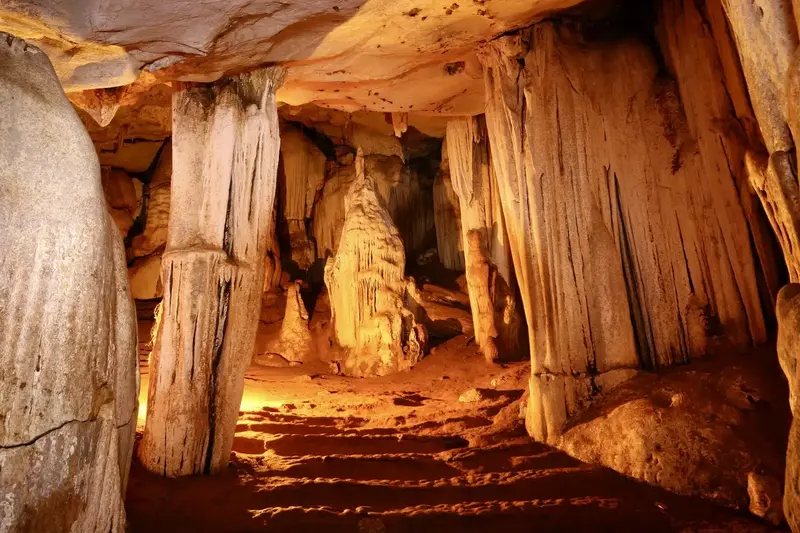
Lawa Cave attracts many visitors who come specifically to see the beauty of stalactites and stalagmites in different moods. Some chambers feel like theater curtains flowing down from the ceiling in soft streaks. Some areas glitter when light strikes at an angle, as if dusted with fine sparkle. In other sections, the shapes encourage architectural imagination—like tall spires or prang-like forms. Lawa Cave’s appeal is not about a single photo spot. It is the pleasure of walking through chamber after chamber and “reading” the rock forms with your eyes, like studying an artwork that nature patiently created with dripping water and time.
In terms of history, Lawa Cave is often referenced with relatively clear information that it was discovered by a named individual and that a year is recorded, giving the site’s story a firm “time anchor” rather than leaving it as a vague legend. When the narrative is placed on a timeline, it becomes easier to understand why caves like this require careful tourism management. What we see inside the cave is the result of natural change over an immense span of time, while damage from careless visitation can happen within minutes. Knowledge of the cave’s history and natural processes is not merely “background information”; it is a framework that encourages more responsible travel.
The beauty of Lawa Cave comes from a simple natural process that takes a very long time. Rainwater seeps through limestone and slowly dissolves minerals into a solution. As droplets fall from the ceiling or seep along the cave walls, the minerals crystallize in thin layers, gradually forming stalactites above and stalagmites below. If you look closely at certain surfaces, you can see flow-like streaks, as if nature left a record of water direction for us to read. And if you shine a flashlight at an angle, without holding it too close, you may notice fine glints where the surface reflects light. This is why many people compare parts of the cave to glitter—although it is actually mineral crystals and water-shaped textures on the stone.
Because stalactites and stalagmites grow through delicate crystallization, it is important to be clear that touching them is not a small matter. Even a single touch can leave skin oils, which may discolor the surface or slow down crystallization over time. A truly rewarding visit to Lawa Cave is therefore not about trying to “touch to feel,” but about learning to “see well”—using light carefully, walking slowly, and letting the details work on your eyes. The calmer you are, the more you notice the difference between dense, smooth surfaces and rippled textures, and the more you understand why nature is often called the most patient artist.
Inside Lawa Cave, the experience is often described through different chambers, which help give the walk a storyline and rhythm. Frequently mentioned chambers include the Throne Hall, the Music Chamber, the Curtain Chamber, and the Prang Chamber. What makes these names interesting is that they reflect feelings and impressions more than technical labels. Nature did not name these chambers for us; people entered, imagined what the formations resembled, and gave names that made sense in human terms. Part of the enjoyment of Lawa Cave lies in walking through each section and seeing whether you imagine the same forms as others—and if you see something different, what you see instead.
The Throne Hall is the chamber many people experience as the “main hall” because it feels wide and dignified, like a grand reception space in architecture. Its openness gives you enough distance to view the overall composition without standing close to walls or formations. That distance matters in cave viewing, because many formations are best appreciated when you can step back and see them as a whole. If you begin with a wide beam, you can read the chamber’s overall shape, then lower the intensity and shift to angled light to study surface details. This approach helps you avoid blasting everything with bright light, which can flatten the scene into simple whiteness, and instead lets you see gentle shadows that create depth and make the rock appear alive.
Deeper inside, the Music Chamber often slows visitors down naturally. In the cave’s darkness and cool air, sound becomes more noticeable—dripping water landing in rhythm, footsteps echoing back, or quiet voices carrying softly across the hall. This is why the “Music Chamber” does not mean musical instruments, but rather the atmosphere of sound the cave creates. It is a good place to pause, breathe deeply, and listen to the cave’s own “tempo.” Those who enjoy calm, reflective experiences often love this chamber because it makes you not only a viewer, but also a listener to nature.
The Curtain Chamber is another place where many visitors linger. Here, some stalactite formations appear as streaks or sheet-like drapes, like curtains flowing from the ceiling. In some spots, it resembles pleated theater curtains. The best way to see this beauty is to use angled flashlight beams rather than shining straight on. Angled light draws out shadow and depth, making the folds and layers more visible. If the light is too strong or too close, the fine lines can disappear into flat whiteness. A simple technique is to step back, reduce the beam slightly, and slowly change the angle until the “curtain” texture becomes clear.
The Prang Chamber is often mentioned as a space with formations that feel “tall and vertical,” resembling a prang-like spire or towering pillars rising into darkness. One interesting aspect here is comparing density and texture: some parts look compact and smooth as if polished, while others show ripples and flow marks left by water. Photography often works well from a slightly low angle to emphasize height, but safety comes first: keep your footing steady, shine light on the ground before each step, and avoid getting too close to protruding formations.
Beyond the well-known chamber names, Lawa Cave also charms visitors through the “transitions between chambers.” As you move from one hall to another, you may notice smaller features that are not officially named but create personal moments of excitement—surfaces that sparkle more intensely, flow marks that resemble waves, or formations arranged like hanging ornaments. If you walk quickly, you may only register general beauty. If you walk slowly and use softer light, you will notice that these details give Lawa Cave a deeper visual richness than many people expect.
An important thing to understand is that caves require attention and caution. Although Lawa Cave is known for its spacious interior, certain sections can be damp and slippery, and darkness makes it easy to misjudge distance. This becomes more likely if lighting is uneven or if visitors rely on only one flashlight. A helpful habit is to aim the light at the ground before every step, follow the designated route, avoid cutting into unclear side areas, and keep a safe distance from walls and formations to prevent accidental contact. If visiting in a group, leave a small gap between people so flashlight beams do not interfere with one another, and keep conversations quieter when crowded so the environment remains safer and more pleasant for everyone.
Getting There From Kanchanaburi town, you can generally follow Highway 323 toward Sai Yok District. There is a section where you need to cross the Khwae Noi River to reach Lawa Cave. A common method is to charter a boat from Pak Saeng Pier to cross to the side where the cave access begins. The boat ride is part of what makes Lawa Cave distinctive, because it offers views of the river and Sai Yok’s forest landscape that feel different from driving on the road. After arriving on the opposite bank, you begin the cave visit along the arranged route. It is recommended to start in the morning or early afternoon so you can explore without rushing and still allow time for the return trip, especially during weekends or peak seasons when more visitors may be present.
Preparation for Lawa Cave should prioritize safety and mobility. Shoes with good traction significantly reduce the risk of slipping, especially in damp areas or where small puddles form. A headlamp is strongly recommended because it keeps your hands free for balance and aligns the light naturally with your line of sight. Bring a reasonable amount of water for travel and for the cave walk. Clothing should be comfortable, breathable, and not restrictive. Avoid bulky items or long-hanging bags, as they may accidentally strike the cave wall or formations, which is risky both for personal safety and for conservation.
Families with children or older visitors can still enjoy Lawa Cave if the pace is slow and breaks are taken as needed. The cave’s spaciousness helps it feel less claustrophobic. However, it is still important to assess balance and walking comfort, especially where the ground is uneven or damp. If someone in the group is uncomfortable in dark environments, it helps to keep them in the middle of the group, ensure they have their own light, and avoid rushing so everyone can walk confidently. A good cave visit accepts slowness as part of the experience: the slower you walk, the more details you see, and the safer the visit becomes.
Lawa Cave also suits travelers who want to plan an efficient “Sai Yok in one day” trip, because it can be combined smoothly with other attractions. For example, you can visit Sai Yok Noi Waterfall or a historic railway viewpoint in the morning, have lunch around the Wang Pho or Sai Yok area, then explore Lawa Cave in the early afternoon before returning to town in the evening. If time allows, you can add a different kind of atmosphere afterward, such as Hin Dad Hot Springs or the Hellfire Pass area, which carries significant historical narratives of Sai Yok. Regardless of the itinerary, the heart of Lawa Cave is allowing enough time to walk calmly, not rush, and not turn the cave experience into a quick pass-through.
Ultimately, Lawa Cave brings two feelings at once: awe at the complex shapes of stalactites and stalagmites, and humility when you realize that this beauty comes from tiny droplets working together with time across scales far beyond a human life. Visiting the cave is not only about “seeing something beautiful,” but about learning nature’s patience and understanding the visitor’s role in protecting the cave so it can remain beautiful for future generations.
| Name | Lawa Cave |
| Address / Coordinates | Sai Yok National Park, Sai Yok District, Kanchanaburi Province Coordinates: N 14.299670, E 98.982751 |
| Overview | A large limestone cave within Sai Yok National Park. The interior is spacious and divided into multiple chambers with varied stalactite formations. Access commonly involves a boat crossing over the Khwae Noi River, making the journey part of the experience. |
| Key Highlights | Spacious, airy cave chambers; delicate stalactites and stalagmites with curtain-like textures and glittering reflections under angled light; often-mentioned chambers include Throne Hall, Music Chamber, Curtain Chamber, and Prang Chamber; access typically includes a boat ride across the Khwae Noi River. |
| Open Days | Daily |
| Opening Hours | 08.00 – 16.30 |
| Fees | Sai Yok National Park entry fee: Thai — Adult 100 THB / Child 50 THB; Foreigners — Adult 300 THB / Child 200 THB |
| Facilities | A headlamp/flashlight, good-grip shoes, and drinking water are recommended. Follow the designated route and watch for damp or slippery areas inside the cave. |
| Getting There (Summary) | From Kanchanaburi town, take Highway 323 toward Sai Yok. Around km 59–60, you need to cross the Khwae Noi River. Many visitors charter a boat from Pak Saeng Pier to cross, then walk into the cave via the arranged route. |
| Boat Crossing (Pak Saeng Pier) | Charter a boat from Pak Saeng Pier (crossing the Khwae Noi River). Approx. 800–1,000 THB per boat, about 10–12 passengers, approx. 45 minutes (price and duration may vary by season and water level). |
| Current Status | A cave attraction within Sai Yok National Park, open to visitors during published hours. Visiting in the morning to early afternoon is recommended for safety and return-trip timing. |
| Contact (Verified) | Sai Yok National Park: 034-686-024 |
| Nearby Attractions (Approx. Distance) | 1) Sai Yok Noi Waterfall – 20 km 2) Wang Pho Railway Station / Tham Krasae – 25 km 3) Sai Yok Yai Waterfall (National Park zone) – 35 km 4) Hin Dad Hot Springs – 45 km 5) Hellfire Pass – 55 km |
| Nearby Restaurants (Approx. Distance + Phone) | 1) Krua Phak Wan Baan Rai (Narbodind) – 25 km – 083-241-6561 2) View Rim Kwae by Nueng Wang Pho – 25 km – 081-007-1449 3) Suan Ahan Wang Pho – 25 km – 087-152-4654 4) Renu Restaurant (Sai Yok area) – 30 km – 081-880-1987 5) Krua Rak Aroi (Sai Yok area) – 30 km – 084-507-7745 |
| Nearby Accommodations (Approx. Distance + Phone) | 1) River Kwai Resotel – 15 km – 02-642-5497 2) The FloatHouse River Kwai – 18 km – 084-725-8686 3) River Kwai Jungle Rafts – 20 km – 081-734-0667 4) Home Phutoey River Kwai – 35 km – 081-817-5182 5) Hintok River Camp at Hellfire Pass – 55 km – 081-754-3898 6) Saiyok River House – 25 km – 034-591-050 |
Frequently Asked Questions (FAQ)
Q: Where is Lawa Cave located?
A: Lawa Cave is within Sai Yok National Park, Sai Yok District, Kanchanaburi Province. Many visitors travel via Highway 323 and then cross the Khwae Noi River to reach the cave area.
Q: Do I need to take a boat to reach Lawa Cave, and where do I board?
A: A commonly used method is to charter a boat from Pak Saeng Pier to cross the Khwae Noi River to the cave-access side. It is recommended to allow extra time and confirm details on-site before departure.
Q: What time is Lawa Cave open?
A: Published information states daily opening hours of 08.00 – 16.30. Visiting in the morning or early afternoon is recommended so you can explore and return without rushing.
Q: What are the standout chambers inside the cave?
A: Frequently mentioned chambers include the Throne Hall, Music Chamber, Curtain Chamber, and Prang Chamber. Each has different stalactite and stalagmite characteristics. Walking slowly and using angled flashlight beams helps reveal depth and texture.
Q: How should I prepare for visiting Lawa Cave?
A: Wear shoes with good traction and comfortable clothing. Bring a flashlight or headlamp and a reasonable amount of water, as some areas can be damp or slippery and lighting is essential for safe walking.
Q: What is the most important safety and conservation advice?
A: Be cautious of darkness and slippery ground: walk slowly and shine your light on the floor before each step. Do not touch stalactites or stalagmites because they are fragile and easily damaged. Always respect barriers and staff guidance.
 Tham Lawa Cave Map
 Category:
  Group:
  Last Update: 2 MonthAgo
Comment
 Nearby Attractions
| Keyword (Advance) |
 Facebook Fanpage
 Region
 Art, Culture and Heritage
 Historical Sites and Monuments(
 Landmarks and Memorials(
 Art, Craft Centres, Tradition(
 Museums(
 Art Gallery(
 University
 Places of Worship
 Temple(
 Church(
 Other religious and spiritural sites(
 Research and Development
 Royal Project(
 Suburban Living
 Village, Community(
 Local Market(
 National Parks and Marine Reserves(
 Mountain (Doi)(
 Dam, Reservoir, Lake(
 Waterfalls(
 Hot Springs(
 River, Canal(
 Other natural attractions(
 Entertainment and Agricultural
 Zoos and Aquariums(
 Animal camps and shows(
 Farm, Parks, Gardens and Ecotourism(
 Cinema(
 Outdoor and Adventure Activities(
 Travel Articles, Recipes
 Travel Review, Food Review(