
lovethailand home >North Travel Attractions >Uttaradit Travel Attractions >Phichai >Ban Dara > Poramin Bridge
TL;DR: Poramin Bridge is located at Ban Dara, Moo 4, Ban Kho Saphan, Ban Dara Subdistrict, Phichai District, Uttaradit Province, open Daily, hours Viewable Throughout The Day From Public And Safe Areas.

Poramin Bridge
Open Days: Daily
Opening Hours: Viewable Throughout The Day From Public And Safe Areas
Poramin Bridge, also known locally as Ban Dara Bridge, is one of the most important railway landmarks in Uttaradit Province. Located at Ban Dara in Phichai District, the bridge carries the Northern Railway across the Nan River before reaching Ban Dara Junction Station. It is not only a functional railway bridge but also a remarkable piece of engineering heritage, a historic symbol of railway expansion, and a scenic landmark for travelers interested in old bridges, trains, riverside landscapes, and the development of northern Thailand.
Poramin Bridge is especially meaningful because it connects several layers of Thai history. It belongs to the period when Siam was developing modern transportation routes under King Chulalongkorn, Rama V. It reflects the ambition to connect the central region with northern towns by rail. It also shows how bridge engineering was used to overcome major natural barriers such as the Nan River. For visitors today, the bridge offers both a visual experience and a historical story that remains closely tied to the identity of Ban Dara and Phichai District.
The bridge is located in the Ban Dara area, a railway community closely associated with Ban Dara Junction Station. This area has long been part of the Northern Railway landscape, where tracks, stations, communities, farmland, and river scenery come together. The bridge is therefore not an isolated structure. It is part of a living railway environment where trains still pass, local people continue their daily routines, and the Nan River remains a defining feature of the landscape.
Construction of Poramin Bridge began around 1906 during the reign of King Chulalongkorn. The bridge was officially opened on 7 December 1909 and received the royal name “Poramin Bridge.” This royal naming reflects its importance as a national infrastructure project rather than a simple local crossing. The bridge helped the Northern Railway continue across the Nan River and played a major role in linking central Siam with the northern region.
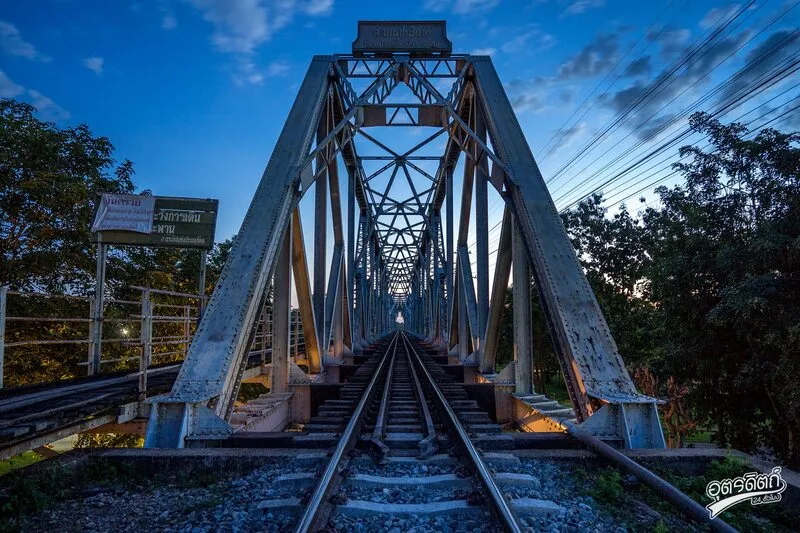
From an engineering perspective, Poramin Bridge is highly distinctive. It is a large steel railway bridge composed of three spans. The two side spans are each about 80.60 meters long, while the central span is about 101.20 meters long, giving the bridge a total length of approximately 262.40 meters. It carries one railway track with standard gauge dimensions. The structure combines cantilever elements with a central suspended span, giving it a strong and elegant appearance.
When viewed from the riverside, Poramin Bridge has a powerful visual presence. Its dark steel framework stretches across the wide Nan River, creating a striking contrast with the water, sky, and rural landscape of Phichai District. When a train crosses the bridge, the scene becomes even more memorable because the bridge is not just a preserved relic. It remains part of the active railway environment, connecting past and present through continuous use.
The Nan River at this point is about 250 meters wide, making it one of the major natural obstacles that the railway had to cross during the construction of the northern line. Building a steel railway bridge across such a river required careful planning, structural knowledge, foundation work, and strong materials. In the early 20th century, this was a significant engineering task, especially in a region where transportation and construction logistics were far more difficult than today.
Local information notes that the bridge has a side walkway, while the railway track runs along the main structure. However, because Poramin Bridge is an active railway bridge, visitors should treat it with caution and respect. It should be viewed from safe public areas rather than by walking on the track or entering railway zones. Railway bridges are not designed as casual pedestrian attractions, and trains may approach faster than expected. Safety should always come before photography.
The bridge also has an important post-war history. After World War II, major railway bridges in Thailand required repair, restoration, or reconstruction due to wartime impact and the need to restore transport networks. Historical information records that the Railway Department carried out major repair work on Poramin Bridge, with a contract dated 7 February 1950 involving Cleveland Bridge and Engineering Company as the main contractor, while Dorman Long of England and Christiani & Nielsen Thai Limited were associated as subcontractors.
The cost of the repair project was recorded as 110,887 pounds sterling plus 7,205,872 baht, totaling 11,091,791 baht. This was a major infrastructure investment for the period and shows the importance of Poramin Bridge to the Northern Railway. Without a reliable bridge across the Nan River at this point, railway movement between central Thailand and the northern region would have been severely affected.
The names of international engineering companies involved in the repair work also reveal the global dimension of bridge engineering in Thailand. Firms such as Cleveland Bridge and Dorman Long were associated with major steel structures, while Christiani & Nielsen became involved in important construction projects in Thailand. The restoration of Poramin Bridge therefore reflects both Thai railway development and the international engineering networks that supported it.
In the history of Thai railways, Poramin Bridge is important because it formed part of the line connecting Siam with Lanna. The Northern Railway was not only a transportation project; it was a national integration project that connected people, goods, administration, trade, and regional economies. Before railway expansion, travel between regions depended heavily on rivers, carts, and difficult overland routes. The arrival of the railway transformed towns such as Uttaradit, Phichai, and Ban Dara into more connected places.
Ban Dara remains closely linked with the bridge. Many local people call it Ban Dara Bridge because of its location near Ban Dara Junction Station and Ban Kho Saphan community. This local name gives the bridge a more intimate identity. It is not only a structure belonging to the State Railway; it is also part of community memory. Generations of local residents have grown up with the sound of trains, the sight of the steel bridge, and the rhythm of railway life beside the Nan River.
For travelers, Poramin Bridge is an excellent photography destination. The best views are usually from safe riverside areas where the full steel structure can be seen crossing the Nan River. Photographers may enjoy capturing the bridge with morning light, evening light, river reflections, passing trains, or the quiet rural scenery around Ban Dara. The bridge is especially attractive to those who appreciate historical railways and classic steel architecture.
The rainy season gives the surrounding landscape a fresh green character, with fuller river scenery and lively farmland. The cool season is comfortable for travel and photography, while the dry season allows visitors to see more of the bridge structure and riverbanks clearly. Morning and late afternoon are generally the best times to visit because the light is softer and the weather is more pleasant.
The most important visitor guideline is safety. Visitors should not stand on the track, walk onto the bridge, place cameras or tripods on the railway, or climb the steel structure. A railway bridge is a working infrastructure, and entering the track area can be dangerous. The best way to enjoy Poramin Bridge is to view it from a safe distance, respect railway boundaries, and allow the bridge to continue functioning as both heritage and transportation infrastructure.
Poramin Bridge can be included in a wider historical route through Phichai District. Nearby places include Ban Dara Junction Station, Wat Ban Dara, Phraya Phichai Dap Hak Monument, Wat Na Phra That, Khao Bandai Ma, Wat Phra Borommathat Thung Yang, and Wat Phra Thaen Sila At. Travelers can plan a half-day or full-day trip that combines railway heritage, local history, temples, and rural scenery.
Getting There is convenient by private car from Uttaradit city. The bridge is about 32 km from the provincial city and can usually be reached in around 30–45 minutes depending on road conditions. Travelers can drive toward Phichai District and Ban Dara Subdistrict, then continue to the Ban Dara Junction area or nearby riverside viewpoints. Those who prefer rail travel can take the Northern Railway to Ban Dara Junction Station and continue to a safe viewing point near the bridge.
Drivers should use safe parking areas and avoid blocking local roads or railway access. Some areas near the bridge are part of local communities or railway-related zones, so visitors should be considerate of residents and follow signs or barriers. If photography is the main goal, it is best to arrive with enough time to find a safe angle before a train passes rather than rushing close to the track.
Architecturally, Poramin Bridge is a beautiful example of functional engineering. Its beauty comes from strength, balance, and structural logic. The steel members, trusses, beams, and spans were not added for decoration alone; each part contributes to carrying loads and stabilizing the bridge. This makes the bridge appealing not only to general travelers but also to those interested in architecture, engineering, and industrial heritage.
Compared with railway bridges in larger cities, Poramin Bridge has a quieter and more rural atmosphere. Its setting beside the Nan River and near Ban Dara community gives it a calm and classic character. The occasional sound of trains crossing the bridge adds movement and emotion to the scene. It is a place where visitors can feel the slow rhythm of a railway town and the endurance of a structure that has stood for more than a century.
As an outdoor learning site, Poramin Bridge can help explain the history of the Northern Railway, the modernization policies of King Rama V, the connection between Siam and Lanna, the use of Western steel bridge technology, and the effects of World War II on Thai infrastructure. For students, railway enthusiasts, and history travelers, the bridge offers a real-world example that makes these subjects easier to understand.
Poramin Bridge is also a place of memory. Over many decades, trains crossing this bridge have carried students, workers, traders, families, and travelers heading north and south. The bridge connects not only the two banks of the Nan River but also countless personal journeys. This emotional layer is one reason why old railway bridges remain meaningful even in the modern age.
A visit to Poramin Bridge should be slow and observant. Rather than treating it as a quick photo stop, travelers can spend time looking at the river, the steel structure, the railway line, the surrounding community, and the passing trains. The more carefully one observes, the more the bridge reveals its layered story.
In summary, Poramin Bridge is one of the most valuable railway and historical landmarks in Phichai District, Uttaradit Province. It combines engineering heritage, railway history, riverside scenery, and local identity in one place. Still serving the Northern Railway while carrying the memory of the past, this steel bridge remains a powerful connection between history and the present.
| Name | Poramin Bridge Or Ban Dara Bridge |
| Location | Ban Dara, Moo 4, Ban Kho Saphan, Ban Dara Subdistrict, Phichai District, Uttaradit Province |
| Address | Northern Railway Line Near Ban Dara Junction Station, Ban Dara Subdistrict, Phichai District, Uttaradit Province 53220, Thailand |
| Highlights | Historic Steel Railway Bridge Crossing The Nan River, Approximately 262.40 Meters Long, And One Of The Most Important Railway Bridges In Northern Thailand |
| History | Built During The Reign Of King Rama V, Construction Began Around 1906, Opened On 7 December 1909, And Later Underwent Major Post-World War II Restoration |
| Key Evidence | Three-Span Steel Railway Bridge, One Railway Track, Total Length About 262.40 Meters, And Historical Records Of Post-War Railway Department Restoration |
| Name Origin | The Bridge Received The Royal Name “Poramin Bridge” And Is Locally Known As Ban Dara Bridge Because Of Its Location Near Ban Dara Junction Station |
| Distinctive Features | A Steel Railway Bridge With One Track, Cantilever-And-Central-Span Structure, And Scenic Views Across The Nan River |
| Travel Information | About 32 km From Uttaradit City; Drive To Phichai District And Ban Dara Subdistrict, Or Travel By Train To Ban Dara Junction Station And Continue To A Safe Viewing Point |
| Current Status | An Important Northern Railway Bridge; Visitors Should View It From Safe Public Areas And Avoid Entering Railway Tracks Or Restricted Railway Zones |
| Open Days | Daily |
| Opening Hours | Viewable Throughout The Day From Public And Safe Areas |
| Facilities | Near Ban Dara Junction Station, Ban Dara Community, Local Roads, And Riverside Viewing Areas; Visitors Should Bring Drinking Water And Park Safely Without Obstructing Local Access Or Railway Areas |
| Main Areas / Zones | 1. Railway Bridge Across The Nan River 2. Northern Railway Track 3. Safe Riverside Viewing Areas 4. Ban Kho Saphan Community 5. Ban Dara Junction Station |
| Caretaker | State Railway Of Thailand |
| Main Contact Number | State Railway Of Thailand Customer Service Center, Tel. 1690 |
| Official Website / Official Page | State Railway Of Thailand: www.railway.co.th |
| Nearby Tourist Attractions | 1. Ban Dara Junction Station, about 1 km 2. Wat Ban Dara, about 2 km 3. Phraya Phichai Dap Hak Monument In Phichai, about 12 km 4. Wat Na Phra That, about 12 km 5. Khao Bandai Ma Or Khao Phi Thon, about 25 km 6. Wat Phra Borommathat Thung Yang, about 35 km 7. Wat Phra Thaen Sila At, about 36 km |
| Nearby Restaurants | 1. Local Restaurants And Noodle Shops In Ban Dara Community, about 2 km 2. Ban Pak Khlong Restaurant, Phichai District, about 10 km, Tel. 087-256-4600 3. CAFE DE FIELD, Phichai District, about 12 km 4. Fellas Cafe, Phichai District, about 12 km 5. Nam Ngiao Chiang Rai, Phichai District, about 12 km 6. Moo Tun Ya Jeen Kru Keng, Phichai District, about 12 km 7. Noen Thong Restaurant, Phichai District, about 13 km |
| Nearby Accommodations | 1. Ton Thong Hotel, Ban Dara Subdistrict, about 3 km, Tel. 083-623-7117 2. HostelBed and Art Space Phichai, about 12 km 3. Phet Siam Resort Hotel, Phichai District, about 12 km, Tel. 082-491-6659, 061-982-9455 4. Daily Rental Rooms In Phichai District Town, about 12 km 5. 99 Park & Resort, Uttaradit Province, about 35 km, Tel. 080-848-3848 6. Hotels In Uttaradit Town, about 35 km |
Frequently Asked Questions (FAQ)
Q: Where Is Poramin Bridge Located?
A: Poramin Bridge is located at Ban Dara, Ban Dara Subdistrict, Phichai District, Uttaradit Province, near Ban Dara Junction Station. It is a Northern Railway bridge crossing the Nan River.
Q: When Was Poramin Bridge Built?
A: Construction began around 1906 during the reign of King Rama V, and the bridge officially opened on 7 December 1909.
Q: Why Is Poramin Bridge Important?
A: It is a historic steel railway bridge across the Nan River, an important part of the Northern Railway, and a major example of railway engineering heritage in Uttaradit Province.
Q: How Long Is Poramin Bridge?
A: The bridge is approximately 262.40 meters long and consists of three steel spans with one railway track.
Q: Can Visitors Walk On Poramin Bridge?
A: Visitors should not walk on the track or enter the bridge area because it is an active railway bridge. The bridge should be viewed and photographed only from safe public areas.
Q: What Is The Best Time To Visit Poramin Bridge?
A: Morning and late afternoon are the best times for viewing and photography because the light is soft, the weather is more comfortable, and the Nan River scenery is clearer.
Q: How Can Travelers Get To Poramin Bridge?
A: From Uttaradit city, drive about 32 km toward Phichai District and Ban Dara Subdistrict, or take the Northern Railway to Ban Dara Junction Station and continue to a safe viewing area near the bridge.
Q: What Nearby Attractions Can Be Visited With Poramin Bridge?
A: Nearby attractions include Ban Dara Junction Station, Wat Ban Dara, Phraya Phichai Dap Hak Monument, Wat Na Phra That, Khao Bandai Ma, Wat Phra Borommathat Thung Yang, and Wat Phra Thaen Sila At.
 Category: ●Art, Culture and Heritage
 Group: ●Landmarks and Memorials
Last Update : 4 MonthAgo
 Last Update : 4 MonthAgo
 Click to Access the Navigation Map GPS
Poramin Bridge Map
Recommend

 Historical Sites and Monuments(2)
Landmarks and Memorials(8)
Historical Sites and Monuments(2)
Landmarks and Memorials(8)
 Art, Craft Centres, Tradition(3)
 Museums(1)
 Historic Homes and Cities(1)
 Places of Worship
 Temple(42)
 Other Sacred Sites(5)
 Suburban Living
 Village, Community(4)
 Nature and Wildlife
 National Parks and Marine Reserves(4)
 Mountain (Doi)(3)
 Dam, Reservoir, Lake(3)
 Waterfalls(11)
 Caves(3)
 River, Canal(3)
 Other natural attractions(3)
 Entertainment and Agricultural
 Farms, Parks and Ecotourism(1)


