
lovethailand home >North Travel Attractions >Uttaradit Travel Attractions >Pak Tha >Song Hong > Million-Year Shell Fossil Site
TL;DR: Million-Year Shell Fossil Site is located at Ban Na Rai Diao, Moo 5, Song Hong Subdistrict, Fak Tha District, Uttaradit Province, open Daily, hours 08.00 – 17.00.

Million-Year Shell Fossil Site
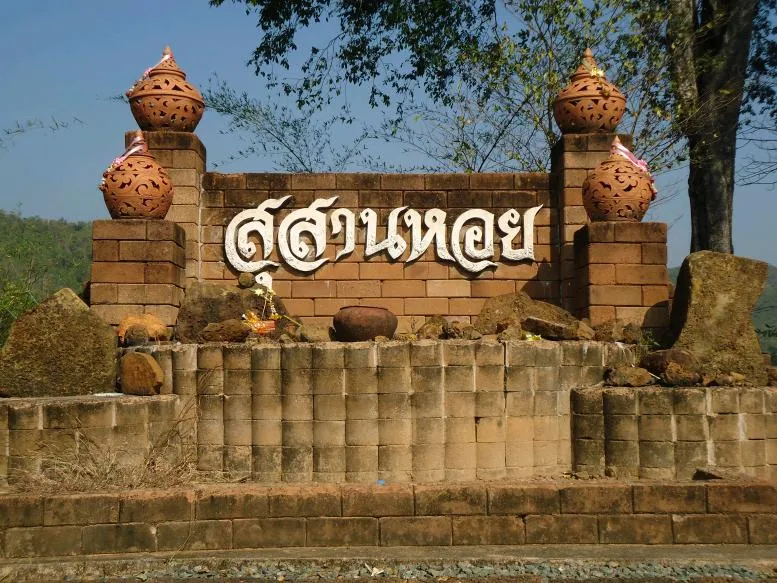
Open Days: Daily
Opening Hours: 08.00 – 17.00
Million-Year Shell Fossil Site at Ban Na Rai Diao is a small but highly distinctive natural and geological attraction in Song Hong Subdistrict, Fak Tha District, Uttaradit Province. Located on a low hill about 1 km from Ban Na Rai Diao village, the site is known for freshwater shell fossils embedded in ancient rock layers and sedimentary formations. It is a place where local legend, community memory, and geological evidence meet in a quiet rural landscape.
This fossil site is suitable for travelers who enjoy nature-based learning, local stories, and less crowded destinations. Its main appeal is not large-scale tourism infrastructure, but the visible traces of ancient freshwater shells preserved in stone. Visitors can observe fossil-like shell patterns in the rock, learn about the local name “Prong Hoi,” and understand how villagers have connected this unusual landscape with the legend of giant eagles.
In the past, villagers called this area “Prong Hoi.” In the local context, the word “prong” refers to a water-holding depression or a wet area, while “hoi” means shell. The name reflects the geography of the area and the shell-shaped stones found there. It is a simple local name, yet it clearly describes what people saw in the landscape: a wet depression with many stones resembling shells.
According to local folklore, two giant eagles once lived in a nest on a large tree in this area. Each day, the eagles flew to a great water body in the mythical Himmapan Forest to feed on shellfish, crabs, shrimp, and fish. At night, they returned to their nest and left behind shell remains beneath the tree. Over time, the shells accumulated and became a hill filled with shell-like stones. This legend gives the site a vivid cultural identity and helps visitors remember it as more than just a rock formation.
From a geological perspective, the site is associated with ancient sedimentary deposition. Freshwater shell fossils such as single-valved shells and pagoda-shaped shells are found within sandstone and shale layers. These features indicate that the area was once linked to an ancient freshwater environment, drainage system, or sedimentary basin. Over a long period of time, shell remains and sediments were compressed and preserved as part of the rock layers seen today.
The importance of the Million-Year Shell Fossil Site lies in its role as a small outdoor geological classroom. The shells embedded in the rock are not merely unusual objects; they are traces of ancient life. They help visitors imagine how landscapes change over millions of years and how living organisms can become part of the geological record. For students, families, and nature travelers, the site offers a direct and accessible way to understand fossils, sediment, and local environmental history.
The site is located in a rural setting, surrounded by low hills and local community landscapes. Some fossil-bearing rocks show shell patterns clearly, while others appear as layered stone with shell-like textures. Visitors should walk carefully, especially during or after the rainy season, when the ground and rocks may become slippery. The area is best explored slowly and respectfully, with attention to the natural details rather than rushing through it.
As a conservation-oriented attraction, visitors should not chip, scratch, move, or remove any rocks from the site. Fossil-bearing stones are valuable natural resources and part of the community’s heritage. Keeping them in place allows future visitors, students, and researchers to continue learning from the real landscape. Responsible travel is therefore essential when visiting this small but meaningful geological site.
Ban Na Rai Diao itself is a rural village in Song Hong Subdistrict, Fak Tha District. The village name is connected with local settlement history and agricultural life. Stories about the village describe earlier communities moving between cultivation areas before settling near a reliable water source. The name reflects rice farming, land use, and the memory of local people who built their lives around the landscape.
When viewed together with the village context, the shell fossil site becomes more than a geological location. It is part of a living community landscape. Local authorities and villagers have continued to care for and develop the site as a community attraction. This ongoing local involvement shows that the place still has meaning for Ban Na Rai Diao and Song Hong Subdistrict, both as a natural learning area and as a point of local identity.
The most interesting aspect of the site is the way folklore and science coexist. The legend of the giant eagles offers an imaginative explanation for the shell-like stones, while geology explains the long process of sedimentation and fossil preservation. These two perspectives do not need to compete with each other. Together, they make the site richer, more memorable, and easier for visitors to understand.
For travelers who prefer quiet, meaningful places, the Million-Year Shell Fossil Site is worth including in a trip through Fak Tha District. A visit does not require a long amount of time, but it rewards careful observation. Families with children can use the site as a natural lesson about fossils and the changing Earth. Cultural travelers can also appreciate how local stories help communities explain and protect unusual natural features.
Getting There is most convenient by private car or rental car. From Uttaradit town, drive toward Fak Tha District, continue to Song Hong Subdistrict and Ban Na Rai Diao village, then proceed about 1 km to the fossil site. Travelers should check road conditions before departure, especially during the rainy season, and prepare drinking water, sun protection, and comfortable walking shoes because the site is an outdoor natural area.
The best time to visit is in the morning or late afternoon, when sunlight is softer and walking is more comfortable. The dry season and cool season are generally easier for access and observation. During the rainy season, visitors should be careful of slippery surfaces and avoid climbing over wet rocks. The visit is best combined with nearby temples, viewpoints, and local stops in Fak Tha District.
Although this site is not a large tourist attraction, it offers a valuable experience for travelers who want to understand Uttaradit beyond the usual routes. It connects geology, folklore, rural life, and community conservation in one compact landscape. Visiting the Million-Year Shell Fossil Site is not simply about seeing shell-shaped stones; it is about reading the long history of the land through nature, stories, and local care.
| Name | Million-Year Shell Fossil Site, Ban Na Rai Diao |
| Location | Ban Na Rai Diao, Moo 5, Song Hong Subdistrict, Fak Tha District, Uttaradit Province |
| Address | Ban Na Rai Diao, Moo 5, Song Hong Subdistrict, Fak Tha District, Uttaradit Province 53160, Thailand |
| Highlights | Freshwater shell fossils preserved in ancient rock layers, combined with local folklore about Prong Hoi and giant eagles |
| History | The site contains freshwater shell fossils in sandstone and shale layers from the Neogene Period, Middle Miocene epoch, approximately 13 million years old |
| Name Origin | Locals called the area “Prong Hoi” because it was a water-holding depression with many shell-shaped stones |
| Distinctive Features | A low hill with fossil-bearing rock layers, suitable for nature study and geology learning |
| Travel Information | Drive to Song Hong Subdistrict and Ban Na Rai Diao village in Fak Tha District, then continue about 1 km to the fossil site. Private car or rental car is recommended |
| Current Status | A local natural learning site and community attraction cared for by Song Hong Subdistrict Administrative Organization and the local community |
| Open Days | Daily |
| Opening Hours | 08.00 – 17.00 |
| Caretaker | Song Hong Subdistrict Administrative Organization, Fak Tha District, Uttaradit Province |
| Main Contact Number | Chief Executive of Song Hong Subdistrict Administrative Organization, Tel. 063-2524789 |
| Official Website / Official Page | Song Hong Subdistrict Administrative Organization: www.songhongutt.go.th |
| Nearby Tourist Attractions | 1. Wat Wang Khwan, Fak Tha District, about 18 km 2. Khok That Viewpoint, about 20 km 3. Fak Tha District Town, about 20 km 4. Local Temples and Communities in Song Hong Subdistrict, about 8 km 5. Nam Pat District, about 45 km |
| Nearby Restaurants | 1. Kin Laeo Kuek Restaurant, Fak Tha District, about 20 km, Tel. 098-390-7599 2. Day Off Coffee, Fak Tha District, about 20 km, Tel. 083-270-1046 3. Moo Thong Fresh Coffee, Fak Tha District, about 20 km 4. Local Restaurants and Noodle Shops in Fak Tha Town, about 20 km 5. Local Food Stalls near Fak Tha Market, about 20 km |
| Nearby Accommodations | 1. Phuwarin Hotel, Fak Tha District, about 20 km, Tel. 081-707-8193 2. Phuwarin Hotel, Fak Tha District, about 20 km, Tel. 081-785-6710 3. Natchaya Resort, Fak Tha District, about 20 km 4. Daily Rental Rooms in Fak Tha Town, about 20 km 5. Hotels in Uttaradit Town, about 90 km |
Frequently Asked Questions (FAQ)
Q: Where is the Million-Year Shell Fossil Site located?
A: It is located at Ban Na Rai Diao, Moo 5, Song Hong Subdistrict, Fak Tha District, Uttaradit Province, about 1 km from Ban Na Rai Diao village.
Q: Why is this shell fossil site important?
A: It preserves freshwater shell fossils in ancient rock layers and serves as a local geological learning site connected with community folklore.
Q: Why is the area called Prong Hoi?
A: Locals used the name because the area was a water-holding depression with many stones that looked like shells.
Q: What is the giant eagle legend about?
A: Local folklore says two giant eagles ate shellfish and left shell remains near their nest until the shells accumulated and became the shell-filled hill seen today.
Q: Who should visit this site?
A: It is suitable for nature travelers, families, students, geology learners, and visitors interested in quiet community-based attractions.
Q: How should visitors prepare before going?
A: Visitors should travel by private car, wear comfortable walking shoes, bring drinking water and sun protection, and avoid climbing on or removing fossil-bearing rocks.
Q: What nearby places can be included in the same trip?
A: Travelers can combine the visit with Wat Wang Khwan, Khok That Viewpoint, Fak Tha town, local communities in Song Hong Subdistrict, and Nam Pat District.
 Category: ●Art, Culture and Heritage
 Group: ●Historical Sites and Monuments
Last Update : 4 MonthAgo
 Last Update : 4 MonthAgo
 Click to Access the Navigation Map GPS
Million-Year Shell Fossil Site Map
Recommend
 Historical Sites and Monuments(2)
 Landmarks and Memorials(8)
 Art, Craft Centres, Tradition(3)
 Museums(1)
 Historic Homes and Cities(1)
 Places of Worship
 Temple(42)
 Other Sacred Sites(5)
 Suburban Living
 Village, Community(4)
 Nature and Wildlife
 National Parks and Marine Reserves(4)
 Mountain (Doi)(3)
 Dam, Reservoir, Lake(3)
 Waterfalls(11)
 Caves(3)
 River, Canal(3)
 Other natural attractions(3)
 Entertainment and Agricultural
 Farms, Parks and Ecotourism(1)


