
lovethailand home >North Travel Attractions >Uttaradit Travel Attractions >Mueang Uttaradit >Tha It > Uttaradit Clock Tower
TL;DR: Uttaradit Clock Tower is located at Clock Tower Roundabout, Tha It Subdistrict, Mueang Uttaradit District, Uttaradit Province, open Daily, hours Open For Viewing Throughout The Day.

Uttaradit Clock Tower
Open Days: Daily
Opening Hours: Open For Viewing Throughout The Day
Uttaradit Clock Tower is one of the most recognizable landmarks in central Uttaradit Province. Located at a major roundabout in Mueang Uttaradit District, near the old railway station area, local streets, government offices, restaurants, hotels, and city services, the clock tower is more than a simple timekeeping structure. It is a visual symbol of the city, a familiar meeting point for local residents, and a compact architectural landmark that reflects the historical memory and urban identity of Uttaradit.
For travelers visiting Uttaradit, the clock tower is a convenient place to begin exploring the city. It stands in a central area that connects the old railway quarter, local commercial streets, city accommodation, and cultural attractions. Although the site is not large, it is important because it represents the everyday rhythm of the city. Local people use the clock tower as a reference point for directions, while visitors often stop here to take photographs before continuing to nearby historical and cultural sites.
The background of Uttaradit Clock Tower is closely connected with the city’s railway history. In the past, there was an idea to display an old steam locomotive from the World War II period at this central location as an outdoor historical exhibit. The concept was similar to other railway towns in Thailand where historic locomotives are displayed as symbols of transportation heritage. However, because the roundabout area was too limited to accommodate a large locomotive safely, the locomotive was instead placed at Sila At Railway Station.
Even though the locomotive display was not installed at this site, the desire to create a memorable city landmark remained. The clock tower was therefore built as an alternative symbol for the city center. In this sense, Uttaradit Clock Tower can be understood as an architectural answer to the city’s need for a focal point. It did not erase the railway memory of the area; rather, it created a new landmark that still stands within the broader context of railway travel, city movement, and local history.
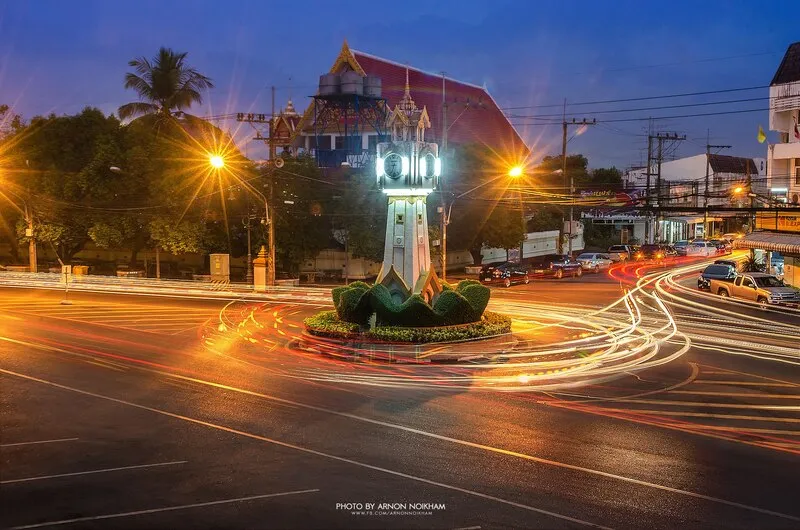
The base of the clock tower is designed in a circular form that fits naturally with the roundabout setting. Brick walls and landscaped areas around the base create a sense of weight, order, and visual depth. Ornamental plants such as Fukien tea and decorative foliage soften the structure and make the area more pleasant to view. These details help the clock tower appear not merely as a road fixture but as a designed urban feature with civic value.
One of the most distinctive features of the base is the presence of Thai-style archways at four corners. These archways give the structure a traditional architectural character while also making the base appear open and approachable. The tower does not feel like a closed monument; instead, it has the presence of a small civic pavilion placed at the heart of the city. This design makes the landmark visually accessible from every direction around the roundabout.
The section supporting the clock is composed around four main structural elements, corresponding to the four clock faces installed on each side of the tower. This four-sided arrangement allows people approaching from different directions to see the time clearly. For local residents, commuters, students, and travelers, the clock faces have long served both practical and symbolic roles. They mark time, but they also mark location.
Architecturally, Uttaradit Clock Tower is interesting because it blends Thai and Western design elements. Some parts of the supporting structure show Western-influenced lines and decorative rhythm, while the upper section is crowned with a Thai-style four-sided pavilion roof. This combination reflects the way Thai provincial cities often adapted traditional forms into modern civic architecture. The result is a landmark that feels both familiar and distinctive: modern enough to function as a clock tower, yet Thai enough to express local cultural identity.
The upper pavilion roof is the most memorable part of the structure. Designed in the style of a Thai four-sided pavilion, it gives the tower a graceful silhouette and helps distinguish it from ordinary clock towers. The roof faces all four directions, matching the four clock faces below. This gives the building visual balance and strengthens its role as a central marker in the city. From a distance, the roofline immediately identifies the structure as an important local landmark.
In the historical geography of Uttaradit, the clock tower is connected with the old railway area and the city’s development as a transportation center in the lower northern region of Thailand. Uttaradit grew with railway movement, trade, travel, and the exchange of people and goods. The clock tower’s location near the old station area therefore gives it more meaning than an ordinary traffic roundabout. It belongs to a cityscape shaped by railways, roads, markets, government offices, and local daily life.
The story of the steam locomotive also adds an important layer to the tower’s identity. Although the locomotive was eventually displayed at Sila At Railway Station, the original idea shows that this central area was once seen as a suitable place to tell the story of railway heritage. The clock tower that stands here today continues that function in a different way. It tells the story not through a vehicle, but through architecture, location, memory, and the everyday use of the space.
For local residents, the clock tower is part of the language of the city. People use it when giving directions, choosing meeting points, or describing places nearby. Phrases such as “near the clock tower” or “around the clock tower roundabout” are naturally understood in local conversation. This everyday role is one reason the landmark remains meaningful. It belongs not only to tourism but also to ordinary urban life.
For travelers, Uttaradit Clock Tower is a good photography stop. The structure can be photographed from different angles, including wide views that show the roundabout and surrounding streets, closer views of the Thai archways, and detail shots of the four clock faces and Thai pavilion roof. Morning and late afternoon are the most comfortable times to visit because the light is softer and the temperature is more pleasant. Evening visits offer a different atmosphere as road lights and city movement give the area a more urban character.
Because the clock tower stands in a traffic roundabout, visitors should always be careful when taking photographs. It is best to view and photograph the tower from safe roadside positions without stepping into traffic lanes. Visitors should not climb onto the structure or block traffic for photos. The safest way to enjoy the landmark is to treat it as part of the cityscape and observe it from appropriate pedestrian areas or nearby safe viewpoints.
What makes Uttaradit Clock Tower valuable is the way a small urban landmark can tell many stories at once. It tells the story of timekeeping and daily life, the story of a city shaped by railways, the story of Thai-Western architectural blending, and the story of how local people remember and identify their city. The tower is not large, but it holds an important place in the mental map of Uttaradit.
The surrounding area makes the clock tower especially useful for trip planning. From here, visitors can continue to Uttaradit Railway Station, Phraya Phichai Dap Hak Monument, Phraya Phichai Dap Hak Museum, Wat Tha Thanon, local restaurants, city hotels, and shopping areas. Travelers with more time can extend the route to Sila At Railway Station, Wat Phra Thaen Sila At, Wat Phra Borommathat Thung Yang, or Laplae District.
Getting There is easy because the clock tower is located in the central urban area of Uttaradit. Visitors can arrive by private car, local transport, motorcycle taxi, or train. Those arriving by train can continue from Uttaradit Railway Station or Sila At Railway Station into the city center. Since the site is close to restaurants, hotels, shops, and local services, it is convenient to include in a short city walk or as the first stop on a wider Uttaradit itinerary.
Visitors who want to understand Uttaradit more deeply should not treat the clock tower as only a quick photo stop. The details of the base, the Thai archways, the four clock faces, the Western-influenced supporting structure, and the Thai pavilion roof all reveal the intention behind its design. It was built to represent the city, not merely to display time. Its meaning comes from both its architecture and its relationship with the surrounding urban landscape.
Uttaradit Clock Tower also reflects the character of Uttaradit itself: modest, calm, historically layered, and closely connected with everyday life. The city may not be as busy as larger tourist destinations, but it has a strong sense of place. The clock tower captures that spirit well. It is simple but memorable, practical but symbolic, and local but welcoming to visitors.
In summary, Uttaradit Clock Tower is a central landmark that connects architecture, railway history, urban memory, and local identity. It is a small but meaningful stop for anyone exploring the city. Whether visited during the day for clear architectural details or in the evening for the atmosphere of the roundabout, the clock tower offers travelers a concise but valuable introduction to the story of Uttaradit.
| Name | Uttaradit Clock Tower |
| Location | Clock Tower Roundabout, Tha It Subdistrict, Mueang Uttaradit District, Uttaradit Province |
| Address | Around The Intersection Of Charoen Tham Road And Pracha Nimit Road, Near The Old Railway Station Area, Mueang Uttaradit District, Uttaradit Province 53000, Thailand |
| Highlights | Central City Landmark, Four-Sided Clock, Thai Pavilion Roof, And Old Railway Quarter Atmosphere |
| History | Connected With The Original Idea To Display A World War II-Era Steam Locomotive Before The Site Was Developed As A City Clock Tower Landmark |
| Name Origin | Named For Its Function As The Main Clock Tower Of Uttaradit City, With Four Clock Faces Visible From Different Directions |
| Distinctive Features | Circular Base, Four Thai-Style Archways, Four Clock Faces, Western-Influenced Supporting Elements, And A Thai Four-Sided Pavilion Roof |
| Travel Information | Accessible By Private Car, Local Transport, Motorcycle Taxi, Or Train With Transfer From Uttaradit Railway Station Or Sila At Railway Station |
| Current Status | A Central City Landmark, Meeting Point, Photo Spot, And Important Route Reference In Uttaradit |
| Open Days | Daily |
| Opening Hours | Open For Viewing Throughout The Day |
| Facilities | Located In The City Center Near Main Roads, Shops, Restaurants, Hotels, Railway Stations, And Local Transport Services |
| Main Areas / Zones | 1. Circular Base And Brick Wall 2. Four Thai-Style Archways 3. Four-Sided Clock Structure 4. Thai Four-Sided Pavilion Roof 5. Roundabout And Photo Viewing Area |
| Caretaker | Uttaradit Municipality |
| Main Contact Number | Uttaradit Municipality, Tel. 055-411-212 |
| Official Website / Official Page | Uttaradit Municipality: www.uttaraditcity.go.th |
| Nearby Tourist Attractions | 1. Uttaradit Railway Station, about 1 km 2. Phraya Phichai Dap Hak Monument, about 2 km 3. Phraya Phichai Dap Hak Museum, about 2 km 4. Wat Tha Thanon, about 2 km 5. Sila At Railway Station And Steam Locomotive Display, about 3 km 6. Wat Phra Thaen Sila At, about 15 km 7. Wat Phra Borommathat Thung Yang, about 15 km |
| Nearby Restaurants | 1. Nam Phrik Nam Yoi Clock Tower Branch, about 0 km, Tel. 092-425-6144 2. Kaprao Phrik Haeng Sao Diao Clock Tower Branch, about 0 km, Tel. 099-436-5624 3. Pizza Café De Laplae, about 1 km 4. Le Château, about 1 km 5. Tuecoffee, about 1 km 6. Local Restaurants In Central Uttaradit, about 1 km |
| Nearby Accommodations | 1. Friday Hotel, about 1 km, Tel. 055-832-775-9 2. Seeharaj Hotel, about 1 km, Tel. 055-832-790-6, 089-461-6339 3. Sunee Boutique Hotel, about 1 km 4. O.U.M. Hotel, about 1 km 5. Grand Vana Hotel, about 4 km, Tel. 055-403-333 6. 99 Park & Resort, about 4 km, Tel. 080-848-3848 |
Frequently Asked Questions (FAQ)
Q: Where Is Uttaradit Clock Tower Located?
A: Uttaradit Clock Tower is located at a central roundabout in Tha It Subdistrict, Mueang Uttaradit District, Uttaradit Province, near the old railway station area and the city center.
Q: Why Is Uttaradit Clock Tower Important?
A: It is an important city landmark, meeting point, route reference, and architectural symbol that reflects Uttaradit’s railway history, urban memory, and Thai-Western design character.
Q: How Is The Clock Tower Connected With Steam Locomotive History?
A: The area was once considered for displaying a World War II-era steam locomotive, but the space was too limited. The locomotive was displayed at Sila At Railway Station instead, while the clock tower became the city landmark.
Q: What Are The Main Architectural Features Of The Clock Tower?
A: The main features include a circular base, four Thai-style archways, four clock faces, Western-influenced supporting elements, and a Thai four-sided pavilion roof.
Q: What Is The Best Time To Visit Uttaradit Clock Tower?
A: Morning and late afternoon are ideal for comfortable weather and photography, while evening offers a different atmosphere with city lights around the roundabout.
Q: Is Uttaradit Clock Tower Easy To Reach?
A: Yes. It is located in the city center and can be reached by private car, local transport, motorcycle taxi, or by taking a train to Uttaradit Railway Station or Sila At Railway Station and continuing into town.
Q: What Nearby Attractions Can Be Visited With Uttaradit Clock Tower?
A: Nearby attractions include Uttaradit Railway Station, Phraya Phichai Dap Hak Monument, Phraya Phichai Dap Hak Museum, Wat Tha Thanon, Sila At Railway Station, Wat Phra Thaen Sila At, and Wat Phra Borommathat Thung Yang.
Q: What Should Visitors Be Careful About When Taking Photos?
A: Visitors should take photos from safe areas, avoid stepping into traffic lanes, avoid blocking vehicles, and should not climb onto the clock tower base or structure because the site is located in an active roundabout.
 Category: ●Art, Culture and Heritage
 Group: ●Landmarks and Memorials
Last Update : 4 MonthAgo
 Last Update : 4 MonthAgo
 Click to Access the Navigation Map GPS
Uttaradit Clock Tower Map
Recommend

 Historical Sites and Monuments(2)
Landmarks and Memorials(8)
Historical Sites and Monuments(2)
Landmarks and Memorials(8)
 Art, Craft Centres, Tradition(3)
 Museums(1)
 Historic Homes and Cities(1)
 Places of Worship
 Temple(42)
 Other Sacred Sites(5)
 Suburban Living
 Village, Community(4)
 Nature and Wildlife
 National Parks and Marine Reserves(4)
 Mountain (Doi)(3)
 Dam, Reservoir, Lake(3)
 Waterfalls(11)
 Caves(3)
 River, Canal(3)
 Other natural attractions(3)
 Entertainment and Agricultural
 Farms, Parks and Ecotourism(1)


