
lovethailand home >North Travel Attractions
>Uttaradit Travel Attractions >Lap Lae
>Si Phanom Mat
> Wat Pa Yang
TL;DR: Wat Pa Yang is located at Si Phanommat Subdistrict, Laplae District, Uttaradit Province, open Daily, hours 08.00 – 17.00.
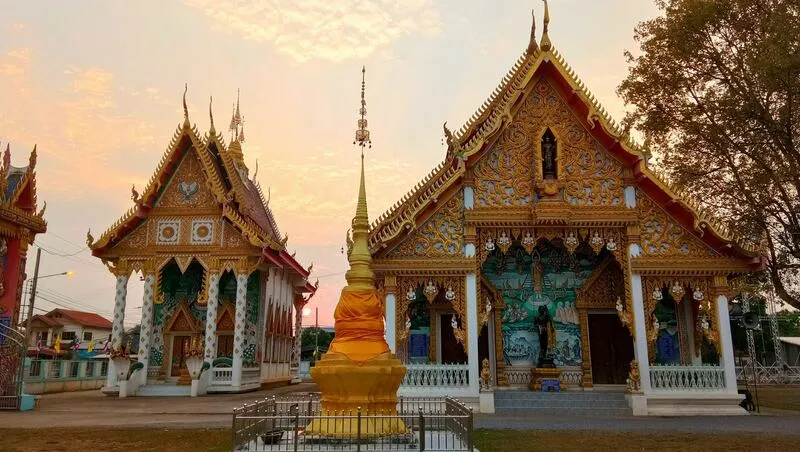
Wat Pa Yang
Open Days: Daily
Opening Hours: 08.00 – 17.00
Wat Pa Yang in Uttaradit Province is an old Buddhist temple in Si Phanommat Subdistrict, Laplae District. It is also locally known as Wat Pa Yang Nok. The temple was established around 1669 CE, or 2212 BE, and received its consecrated boundary around 1677 CE, or 2220 BE. Located on flat land beside Khlong Mae Phrong, the temple reflects the close relationship between Buddhism, waterways, agriculture, and community life in old Laplae.
Wat Pa Yang is meaningful because it is not only an old temple but also a community temple deeply connected with the daily life of local residents. Its name comes from the Pa Yang community, showing how the temple grew together with the surrounding village. In traditional Thai communities, a temple often served as the spiritual, educational, and social center of the village. Wat Pa Yang continues to reflect that role through its calm atmosphere and long religious history.
The temple’s location beside Khlong Mae Phrong is one of its most important characteristics. In the past, waterways were essential for travel, agriculture, and daily life. A temple located near a canal could naturally become a gathering place for merit-making, community ceremonies, and local activities. The canal landscape gives Wat Pa Yang a quiet and distinctive character, making it different from larger temples in busier town areas.
Historically, Wat Pa Yang dates back to the Ayutthaya period. Its establishment in 2212 BE and the granting of its consecrated boundary in 2220 BE show that it has long been a complete Buddhist institution. A consecrated boundary is important because it allows formal monastic acts such as ordination and other Sangha ceremonies to be performed properly. This gives the temple a firm religious status within the local community.
Inside the temple grounds are important religious structures such as the ordination hall, sermon hall, viharn, and merit-making areas. These buildings support the daily religious life of monks and villagers. The ordination hall is used for formal Sangha ceremonies, the sermon hall supports Dhamma listening and community gatherings, and the viharn serves as a space for worship. Together, these elements show that Wat Pa Yang remains a functioning Buddhist temple rather than only an old historical site.
Wat Pa Yang is also associated in local memory with Luang Pho Noi of Wat Pa Yang Nok, a respected monk connected with stories of Laplae’s spiritual heritage. This association gives the temple an additional layer of devotional meaning. For many local people, the value of an old temple is not measured only by buildings or dates but also by the memory of monks, teachers, and community faith preserved across generations.
Wat Pa Yang continues to play a role in Buddhist and community activities. Local residents visit the temple for merit-making, chanting, sermons, Buddhist holy days, Buddhist Lent, the end of Buddhist Lent, memorial rituals, and local ceremonies. During important Buddhist occasions such as Makha Bucha, Visakha Bucha, Asalha Bucha, and Buddhist Lent, temples like Wat Pa Yang become especially active as villagers gather to make merit and maintain their shared traditions.
The atmosphere of Wat Pa Yang is quiet and simple. It is suitable for visitors who want to experience an old community temple rather than a large tourist attraction. The temple’s value lies in its history, its riverside setting, its connection with Khlong Mae Phrong, and its continuing role in local life. Visitors can pay respect, walk quietly around the temple grounds, and observe how a local Buddhist temple remains part of the community.
For travelers interested in local history, Wat Pa Yang helps explain the development of old Laplae settlements. Many traditional communities grew near waterways, and temples were often established close to those communities. Wat Pa Yang therefore reflects the relationship between land, water, faith, and settlement in Uttaradit. A visit to the temple provides a deeper understanding of Laplae beyond its better-known legends, food, and tourist landmarks.
Getting There is convenient by private car. From Uttaradit city, travel toward Laplae District and continue to Si Phanommat Subdistrict. The temple is located in the Pa Yang community and can be combined with other nearby places such as Wat Mon Prang, Wat Sao Hin, Laplae Gate, Laplae Museum, and Laplae Market. Visitors without a private car can use local hired transport from Uttaradit city or Laplae, especially if planning to visit several sites in one day.
A good travel route can begin at Wat Pa Yang, then continue to Wat Mon Prang for its Lanna-style ordination hall, Wat Sao Hin for old Laplae community history, and Laplae Gate or Laplae Museum for cultural context. Visitors can also stop for local food in Laplae, including khao phan phak, mee phan, and other traditional dishes. This makes the temple suitable for a slow cultural trip through Laplae.
Visitors should dress modestly, speak quietly, and respect monks, local worshippers, and sacred areas. Since Wat Pa Yang is an active community temple, visitors should avoid disturbing ceremonies or private merit-making activities. Photography should be done with care, especially around worship areas and when local residents are present.
Overall, Wat Pa Yang is a worthwhile temple for travelers interested in old temples, community history, and the quiet cultural landscape of Laplae. Its long history since 2212 BE, its consecrated boundary, its canal-side setting, and its role as a local spiritual center make it a meaningful stop in Uttaradit Province. It is best appreciated slowly, with attention to the relationship between temple, waterway, and community life.
| Name | Wat Pa Yang |
| Local Name | Wat Pa Yang Nok |
| Location | Si Phanommat Subdistrict, Laplae District, Uttaradit Province |
| Address | Si Phanommat Subdistrict, Laplae District, Uttaradit 53130, Thailand |
| Highlights | Old canal-side community temple beside Khlong Mae Phrong, established around 2212 BE, with a strong connection to local Laplae faith and community life |
| History | Established around 1669 CE, or 2212 BE, during the Ayutthaya period, and received its consecrated boundary around 1677 CE, or 2220 BE |
| Name Origin | The temple name comes from the Pa Yang community, reflecting the close relationship between the temple and its surrounding village |
| Distinctive Features | A Maha Nikaya community temple on flat land beside Khlong Mae Phrong, with an ordination hall, sermon hall, viharn, and community worship areas |
| Travel Information | From Uttaradit city, travel toward Laplae District and continue to Si Phanommat Subdistrict. The temple can be included in a cultural route with Wat Mon Prang, Wat Sao Hin, Laplae Gate, and Laplae Museum. |
| Current Status | Open as an active private Buddhist temple and community religious site in Si Phanommat Subdistrict, Laplae District |
| Open Days | Daily |
| Opening Hours | 08.00 – 17.00 |
| Main Areas / Zones | Ordination hall, sermon hall, viharn, temple courtyard, merit-making areas, and the canal-side atmosphere of Khlong Mae Phrong |
| Important Associated Monk | Luang Pho Noi of Wat Pa Yang Nok, a respected monk connected with local Laplae spiritual memory |
| Nearby Tourist Attractions | 1. Wat Mon Prang, about 1 km 2. Wat Sao Hin, about 2 km 3. Laplae Gate, about 2 km 4. Laplae Museum, about 3 km 5. Laplae Market, about 2 km |
| Nearby Restaurants | 1. Local Restaurants Around Laplae Market, about 2 km 2. Pizza Cafe de Lap Lae, about 5 km, Tel. 062-657-8354 3. Lan Pho Cafe Uttaradit, about 6 km, Tel. 055-816888 4. Khao Phan Phak Restaurants in Laplae, about 2 km 5. Local Food Shops Around Si Phanommat, about 2 km |
| Nearby Accommodations | 1. Local Accommodations in Laplae District, about 2 km 2. Na Laplae, about 4 km 3. Thung Yang House, about 7 km 4. Seeharaj Hotel Uttaradit, about 9 km, Tel. 055-832790 5. Friday Hotel Uttaradit, about 9 km |
Frequently Asked Questions (FAQ)
Q: Where is Wat Pa Yang located?
A: Wat Pa Yang is located in Si Phanommat Subdistrict, Laplae District, Uttaradit Province, Thailand.
Q: When was Wat Pa Yang established?
A: Wat Pa Yang was established around 1669 CE, or 2212 BE, and received its consecrated boundary around 1677 CE, or 2220 BE.
Q: Does Wat Pa Yang have another local name?
A: Yes. The temple is also locally known as Wat Pa Yang Nok.
Q: What is the main highlight of Wat Pa Yang?
A: The main highlight is its identity as an old canal-side community temple beside Khlong Mae Phrong, reflecting the relationship between Buddhism, waterways, and local Laplae life.
Q: What are the opening days and hours?
A: The temple is open daily from 08.00 to 17.00.
Q: How can travelers get to Wat Pa Yang?
A: Travelers can drive from Uttaradit city toward Laplae District and continue to Si Phanommat Subdistrict. The temple can be included in a cultural route through old Laplae.
Q: What nearby places can be visited with Wat Pa Yang?
A: Nearby places include Wat Mon Prang, Wat Sao Hin, Laplae Gate, Laplae Museum, and Laplae Market.
Q: What type of travelers should visit Wat Pa Yang?
A: Wat Pa Yang is suitable for travelers interested in old temples, local history, canal-side community life, and quiet cultural travel in Laplae.
 Category: ●Places of Worship
 Group: ●Temple
Last Update : 7 DayAgo
 Last Update : 7 DayAgo
 Click to Access the Navigation Map GPS
Wat Pa Yang Map
Recommend
 Art, Culture and Heritage
 Historical Sites and Monuments(2)
 Landmarks and Memorials(8)
 Art, Craft Centres, Tradition(3)
 Museums(1)
 Historical Houses and The Ancient City(1)
 University Temple(42)
 Other religious and spiritural sites(5)
 Suburban Living
 Village, Community(4)
 Nature and Wildlife
 National Parks and Marine Reserves(4)
 Mountain (Doi)(3)
 Dam, Reservoir, Lake(3)
 Waterfalls(11)
 Caves(3)
 River, Canal(3)
 Other natural attractions(3)
 Entertainment and Agricultural
 Farm, Parks, Gardens and Ecotourism(1)


