
lovethailand home >North Travel Attractions
>Uttaradit Travel Attractions >Lap Lae
>Mae Phun
> Wat Phak Rak
TL;DR: Wat Phak Rak is located at Ban Fak Tha, Moo 5, Mae Phun Subdistrict, Laplae District, Uttaradit Province, open Daily, hours 08.00 – 17.00.
Wat Phak Rak
Open Days: Daily
Opening Hours: 08.00 – 17.00
Wat Phak Rak in Uttaradit Province is an old Buddhist temple in Laplae District, valued for its religious importance, local history, and Lanna-style architecture. The temple is located at No. 48, Moo 5, Ban Fak Tha, Mae Phun Subdistrict, Laplae District, Uttaradit Province. It is a Maha Nikaya temple set on 17 rai, 1 ngan, and 35 square wah of land. The temple is especially suitable for travelers who want to worship quietly, study old northern Thai Buddhist art, and experience the peaceful atmosphere of the Mae Phun community in Laplae.
Wat Phak Rak is one of the temples that clearly reflects the cultural identity of Laplae. It is not only an old community temple but also a valuable religious and artistic site. Inside the temple are a sacred stupa, Lanna-style ordination hall, old viharn, Chiang Saen-style Buddha image, ancient mural paintings, and an old bell with Lanna script. These elements make the temple an important place for visitors interested in Buddhist art, local history, and the cultural heritage of northern lower Thailand.
The temple was formerly known as Wat Suttharam before later becoming known as Wat Phak Rak. Its old name reflects its long-standing Buddhist foundation in the community, while the present name is the one by which local people and visitors know the temple today. The temple grounds are located on slightly elevated land, giving the area a quiet and open atmosphere. Visitors who enter the temple can sense the calm character of an old local temple that still retains its relationship with the surrounding community.
Wat Phak Rak was established as a temple in 1848 CE, or 2391 BE, and received its consecrated boundary on 1 December 1906 CE, or 2449 BE. A consecrated boundary is important in Buddhist tradition because it allows formal monastic acts such as ordination and other Sangha ceremonies to be properly performed. This confirms that Wat Phak Rak has long served as a complete Buddhist institution for the Mae Phun community.
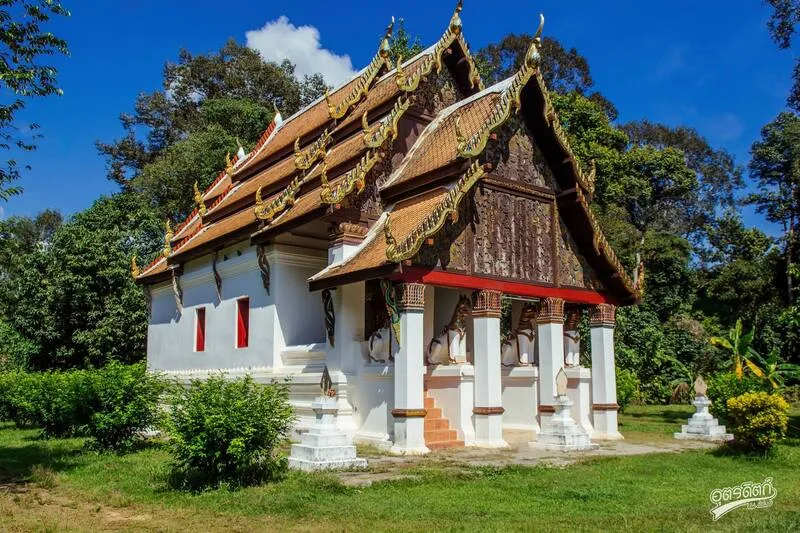
One of the most outstanding features of the temple is its Lanna-style architecture. The old viharn and ordination hall preserve important artistic details that reveal the skill of traditional craftsmen. The viharn follows an old architectural form known locally as “ma tang mai,” combining masonry and wooden structural elements. This type of construction reflects local craftsmanship, adaptation to climate, and the use of materials suitable for temples in the northern cultural sphere.
Inside the viharn is a principal Buddha image that serves as a spiritual center for local worshippers. The viharn also contains ancient mural paintings depicting the life of the Buddha, Buddhist stories, local traditions, and scenes of everyday life in Laplae. These murals are highly valuable because they function not only as religious art but also as cultural records. Through them, visitors can see how people in the past understood Buddhism, community life, clothing, ceremonies, and moral teachings.
The mural paintings at Wat Phak Rak are especially interesting because traditional natural pigments were used. Colors derived from plants and local materials give the paintings a soft and distinctive tone. This reflects the wisdom of local artisans who used resources from their environment to create religious art. The murals therefore carry both artistic beauty and historical depth.
The ordination hall is another important part of the temple. Inside is a bronze Buddha image in the diamond meditation posture, made in Chiang Saen style. The posture conveys stability, concentration, and spiritual strength, while the Chiang Saen artistic style reflects the cultural relationship between Lanna Buddhist art and the Laplae area. For travelers interested in Thai Buddhist sculpture, this Buddha image is one of the most meaningful features of the temple.
A distinctive architectural detail at the ordination hall is the lion figure placed near the front staircase. In Lanna tradition, guardian lion figures often symbolize protection, power, and auspiciousness. Their presence at the entrance to a sacred building reinforces the sense that the ordination hall is a protected religious space. This detail is small but important for understanding the symbolism of northern Thai temple architecture.
The stupa at Wat Phak Rak is a focal point of local devotion. Visitors and residents come to pay respect to the stupa, especially on Buddhist holy days and during community merit-making events. A stupa in a Buddhist temple represents sacred memory, devotion, and the continuity of faith. At Wat Phak Rak, it helps define the temple as a spiritual center for the Mae Phun community.
The old bell with Lanna script is another important cultural object. Temple bells are not merely functional objects; they are connected with ritual, timekeeping, and community life. The presence of Lanna script on the bell gives it historical and cultural value, linking the temple to the written traditions and artistic identity of the northern region.
Wat Phak Rak continues to play an important role in the religious life of local people. Residents come to the temple for merit-making, chanting, sermons, Buddhist holy days, Buddhist Lent, the end of Buddhist Lent, and Kathin ceremonies. The temple is therefore not only a place of historical interest but also a living religious site. It remains part of the everyday spiritual life of people in Mae Phun and nearby communities.
The temple is currently under the care of Phra Maha Somboon Siridhammo and has 5 resident monks. This active monastic presence keeps the temple functioning as a place for worship, religious ceremonies, community support, and moral guidance. Visitors can therefore experience a temple that is both historically significant and actively used by the local community.
For cultural travelers, Wat Phak Rak deserves a slow visit. Its value is found in the combination of the stupa, ordination hall, old viharn, Chiang Saen-style Buddha image, mural paintings, old bell, and quiet setting. Visitors should not treat the temple only as a quick photo stop. Spending time to observe the details allows a deeper appreciation of Laplae’s Buddhist art and local heritage.
Wat Phak Rak can be included in a Laplae cultural route together with Mae Phun Waterfall, old Laplae town, Laplae Gate, Laplae Museum, Wat Phra Borommathat Thung Yang, and Wat Phra Thaen Sila At. This route allows travelers to experience nature, old temples, local food, and community life in one trip. Local dishes such as khao phan phak and mee phan can also be enjoyed around Mae Phun and Laplae.
Getting There is convenient by private car. From Uttaradit city, travel toward Laplae District and continue to Mae Phun Subdistrict. The temple is located at Ban Fak Tha, Moo 5, near the travel route toward Mae Phun Waterfall. Visitors can search for Wat Phak Rak on a navigation map. Travelers without a private car can use local hired transport from Uttaradit city or Laplae, especially if they plan to visit several sites in the same day.
The best time to visit is in the morning or late afternoon, when the weather is more comfortable and the temple atmosphere is calm. During the fruit season in Laplae, visitors can combine the temple visit with orchards, local cafés, and restaurants around Mae Phun. This makes the trip more complete by connecting Buddhist heritage, nature, food, and local life.
Visitors should dress modestly, speak quietly, and respect monks, local worshippers, and sacred spaces. When viewing murals or old objects, visitors should avoid touching surfaces, using flash photography, or doing anything that may damage the artworks. Wat Phak Rak is both a sacred temple and a valuable cultural site, so responsible behavior helps preserve it for future generations.
Overall, Wat Phak Rak is one of the worthwhile temples to visit in Uttaradit Province. It offers a calm atmosphere, meaningful Buddhist history, Lanna-style architecture, ancient murals, Chiang Saen-style Buddhist art, and a direct connection with the Mae Phun community. For travelers interested in old temples and the cultural depth of Laplae, Wat Phak Rak is a destination that should not be missed.
| Name | Wat Phak Rak |
| Location | Ban Fak Tha, Moo 5, Mae Phun Subdistrict, Laplae District, Uttaradit Province |
| Address | No. 48, Moo 5, Mae Phun Subdistrict, Laplae District, Uttaradit 53130, Thailand |
| Coordinates | 17.6981609126, 100.021050028 |
| Highlights | Old Laplae temple with Lanna-style architecture, a sacred stupa, old viharn, Chiang Saen-style Buddha image, ancient murals, and an old bell with Lanna script |
| History | Established in 1848 CE, formerly known as Wat Suttharam, and received its consecrated boundary on 1 December 1906 CE |
| Name Origin | The temple was formerly called Wat Suttharam before becoming known as Wat Phak Rak, the name used by local people and visitors today |
| Distinctive Features | A Maha Nikaya temple on 17 rai, 1 ngan, and 35 square wah of land, located on elevated ground with a peaceful atmosphere suitable for worship and cultural learning |
| Travel Information | From Uttaradit city, travel toward Laplae District and continue to Mae Phun Subdistrict. The temple is located in Ban Fak Tha, Moo 5, and can be combined with Mae Phun Waterfall and old Laplae town. |
| Current Status | Open as an active private Buddhist temple and important religious art site in Mae Phun Subdistrict, Laplae District |
| Open Days | Daily |
| Opening Hours | 08.00 – 17.00 |
| Main Areas / Zones | Stupa, Lanna-style ordination hall, old viharn, Chiang Saen-style Buddha image, ancient murals, old bell with Lanna script, and community worship areas |
| Abbot / Caretaker | Phra Maha Somboon Siridhammo |
| Resident Monks | 5 monks |
| Nearby Tourist Attractions | 1. Mae Phun Waterfall, about 4 km 2. Old Laplae Town, about 7 km 3. Laplae Gate, about 8 km 4. Laplae Museum, about 8 km 5. Wat Phra Borommathat Thung Yang, about 12 km |
| Nearby Restaurants | 1. Chatanyong Mae Phun Branch by Morning Maephun, about 2 km 2. Huan Laplae, about 4 km, Tel. 091-255-1939 3. Pai Laplae, about 4 km, Tel. 081-888-8772 4. Baan Ploy Phana, about 4 km 5. Pizza Cafe de Lap Lae, about 8 km |
| Nearby Accommodations | 1. Long Suan Na Laplae, about 1 km, Tel. 081-346-6304 2. Suan Chotiraksa Laplae Resort, about 1 km, Tel. 080-504-6165 3. Na Laplae, about 8 km, Tel. 082-661-0881, 055-431-137 4. Seeharaj Hotel Uttaradit, about 14 km, Tel. 055-832790-7, 089-4616339 5. Friday Hotel Uttaradit, about 14 km, Tel. 055-832775-9, 081-5335543 |
Frequently Asked Questions (FAQ)
Q: Where is Wat Phak Rak located?
A: Wat Phak Rak is located at No. 48, Moo 5, Ban Fak Tha, Mae Phun Subdistrict, Laplae District, Uttaradit Province.
Q: What was the former name of Wat Phak Rak?
A: The temple was formerly known as Wat Suttharam before becoming widely known as Wat Phak Rak.
Q: What are the main highlights of Wat Phak Rak?
A: The main highlights include a sacred stupa, Lanna-style ordination hall and viharn, Chiang Saen-style Buddha image, ancient murals, and an old bell with Lanna script.
Q: Who is the abbot of Wat Phak Rak?
A: The abbot of Wat Phak Rak is Phra Maha Somboon Siridhammo.
Q: What are the opening days and hours?
A: The temple is open daily from 08.00 to 17.00.
Q: How can travelers get to Wat Phak Rak?
A: Travelers can drive from Uttaradit city toward Laplae District and continue to Mae Phun Subdistrict. The temple is located in Ban Fak Tha, Moo 5, near the route to Mae Phun Waterfall.
Q: What type of travelers should visit Wat Phak Rak?
A: Wat Phak Rak is suitable for travelers interested in old temples, Lanna architecture, mural paintings, Chiang Saen Buddhist art, and cultural travel in Laplae.
Q: What nearby places can be visited with Wat Phak Rak?
A: Nearby places include Mae Phun Waterfall, old Laplae town, Laplae Gate, Laplae Museum, and Wat Phra Borommathat Thung Yang.
 Category: ●Places of Worship
 Group: ●Temple
Last Update : 2 DayAgo
 Last Update : 2 DayAgo
 Click to Access the Navigation Map GPS
 Art, Culture and Heritage
 Historical Sites and Monuments(
 Landmarks and Memorials(
 Art, Craft Centres, Tradition(
 Museums(
 Historical Houses and The Ancient City(
 University
 Other religious and spiritural sites(
 Suburban Living
 Village, Community(
 Nature and Wildlife
 National Parks and Marine Reserves(
 Mountain (Doi)(
 Dam, Reservoir, Lake(
 Waterfalls(
 Caves(
 River, Canal(
 Other natural attractions(
 Entertainment and Agricultural
 Farm, Parks, Gardens and Ecotourism(


