
lovethailand home >North Travel Attractions >Phrae Travel Attractions >Muang Phrae >Cho Hae > Kin Salak Merit-Making Tradition
TL;DR: Kin Salak Merit-Making Tradition is located at Wat Phra That Cho Hae Phra Aram Luang, Cho Hae Subdistrict, Mueang Phrae District, Phrae, open Open Year-Round, hours 05:00–18:00.
Kin Salak Merit-Making Tradition
Open Days: Open Year-Round
Opening Hours: 05:00–18:00
The Kin Salak Merit-Making Tradition is one of the most meaningful cultural and religious traditions of Northern Thailand. Deeply rooted in Lanna Buddhist life, it reflects devotion, gratitude toward deceased relatives, generosity without attachment, and the strong communal bonds that continue to shape northern Thai society. This tradition is far more than a temple fair or a seasonal event. It is a living form of merit-making in which spiritual belief, local craftsmanship, family memory, and community participation come together in a highly distinctive way.
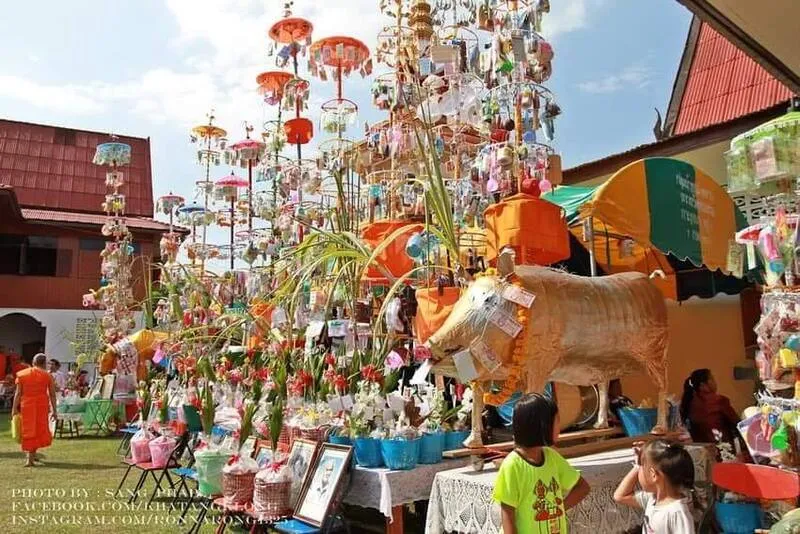
In the clearest sense, Kin Salak is a merit-making ceremony in which people prepare offering baskets known as Salak baskets and dedicate the merit to deceased relatives and loved ones. These offerings are then distributed to monks and novices through a lottery-style system using written slips. Because the donor does not know in advance which monk will receive the offering, the act of giving is regarded as especially pure. This is one of the key reasons the tradition is so highly valued in Lanna culture: it teaches generosity without preference and charity without expectation.
The tradition is found across several northern provinces such as Phrae, Nan, Lampang, Chiang Mai, and Lamphun. Each community may preserve slightly different details, but the underlying meaning remains the same. Kin Salak is a way to send merit to the departed, support Buddhism, and bring people together through a shared act of faith. In Phrae, the tradition is especially vivid, and one of the most important reference sites is Wat Phra That Cho Hae Phra Aram Luang, a major sacred temple and one of the best-known religious landmarks in the province.
The festival season usually falls between September and October each year, around the period before the end of Buddhist Lent. This timing is closely related to the seasonal rhythm of local life. In older agricultural communities, this was a period when households could gather resources, prepare offerings, and return their attention to major communal merit-making. The timing therefore reflects not only a ritual calendar but also the practical flow of village life in Northern Thailand.
The spiritual importance of Kin Salak lies in the belief that merit can be dedicated to deceased ancestors, parents, grandparents, relatives, and benefactors. For this reason, the tradition is closely linked to gratitude and remembrance. At the same time, it also serves as an act of support for Buddhism, since the baskets contain food, necessities, robes, household items, and other offerings useful to monks and the temple. The tradition therefore connects remembrance of the past with active religious support in the present.
Another reason Kin Salak is so admired is that it functions as a practical training in selfless giving. Because donors do not choose the monk who will receive their basket, the focus shifts away from preference and personal expectation. The value of the act lies in intention. This reveals a deep layer of local wisdom: the ritual has been designed in such a way that it encourages people to practice generosity with sincerity and without attachment.
The word “Salak” in this context refers to the lottery mechanism used in the ritual, while the baskets themselves are traditionally made from woven bamboo. Inside, people place food, desserts, fruit, clothing, necessities, and other temple offerings. Some areas distinguish between smaller family baskets and larger ceremonial offerings known as Salak Luang, which are often beautifully decorated and offered to the temple as a major collective merit item.
Before the festival day, communities prepare during a stage known as Wan Da Salak. This is when families gather to make desserts, pack food, prepare the baskets, and decorate larger offering sets. In many villages, this preparation day is just as culturally important as the main ceremony because it brings people together across generations. Elders pass down knowledge, adults take responsibility for organization, and younger family members learn by helping.
At Wat Phra That Cho Hae in Phrae, one distinctive local practice is the use of earthenware pots to contain certain offerings. Together with written dedication slips placed in each basket, this gives the local version of the tradition a strong identity. Such details show how Kin Salak is not a single uniform ritual across the North, but a shared tradition enriched by local expression.
On the main festival day, villagers bring their baskets to the temple grounds. Some place them neatly in designated areas, while others take part in processions carrying larger Salak Luang offerings. These processions may include Lanna dance, local music, and traditional performance, giving the event a festive yet deeply meaningful atmosphere. This blend of devotion and celebration is typical of many northern Thai merit-making traditions, where joy and reverence are not viewed as opposites.
Once the offerings are assembled, the slips are collected and brought into the temple or ordination hall. Monks and novices then draw the slips one by one and walk out to find the corresponding Salak baskets. At that moment, the donor or donor family hears the dedication read aloud, often naming the deceased relative for whom the merit is intended. This part of the ritual can be especially moving because it transforms a basket of offerings into a highly personal act of remembrance.
The spoken dedication is one of the most culturally powerful aspects of the ceremony. It often uses local language or traditional wording to express the donor’s wish that the merit may truly reach the deceased. When the monk receives the basket and gives a blessing, the ritual is complete for that offering. The process then continues until all baskets have been distributed. In some places, family members help the monks locate the correct baskets more quickly by listening for names as the slips are read aloud.
This method makes Kin Salak very different from ordinary merit-making. It is not simply a matter of handing food or goods directly to monks. Instead, it involves waiting, listening, intention, shared acknowledgment, and ritual sequence. That complexity is one reason the tradition remains so meaningful. Every stage carries symbolic weight, and every participant becomes part of a larger communal act of merit.
During the waiting periods, worshippers may chant, pray, offer lunch to the monks, and receive blessings. This quieter phase reminds visitors that despite the beauty of the processions and the strong community participation, the ritual is fundamentally centered on Buddhism. Kin Salak is not only a cultural performance. It remains a religious ceremony in which merit, remembrance, and devotion are the true core.
In Phrae, Wat Phra That Cho Hae is an especially important place to understand the tradition because it combines provincial religious significance with active community ritual life. The temple is one of the most sacred sites in Phrae and is widely known as the zodiac stupa for people born in the Year of the Tiger. Because of its prominence, any traditional ceremony held there carries wider cultural resonance for both local residents and visitors from outside the province.
Kin Salak also creates social value beyond the religious sphere. Festival days often bring together family networks, village groups, neighboring communities, and local vendors. Food, agricultural produce, desserts, and household items may be sold around the temple, helping to circulate money locally and strengthen the community economy. This practical side of the tradition helps explain why it remains vibrant. It is spiritually meaningful, socially unifying, and economically beneficial at the same time.
For cultural travelers, Kin Salak is one of the best ways to experience Lanna tradition in living form. It includes local language, basket-making, processions, dance, music, costume, merit-making, temple etiquette, and ancestral remembrance all within one event. Instead of learning about northern Thai culture only through museums or books, visitors can witness it embodied in real people, real actions, and real communal faith.
The tradition also reveals a sophisticated local understanding of fairness and distribution. Because the lottery system helps determine who receives which offering, the sharing of baskets among monks and novices follows a more balanced pattern. This suggests that Kin Salak is not only devotional but also highly organized. It is a ritual system that supports religious life while also managing community participation in an orderly way.
Spiritually, Kin Salak has a strong inner dimension. Preparing a basket requires intention. Writing the dedication requires remembrance. Waiting for the monk to draw the slip requires patience. Hearing the dedication spoken aloud often evokes gratitude and emotion. The entire process becomes a form of mindful merit-making rooted in compassion, memory, and release. This is why many people consider it one of the most profound forms of communal donation in northern Buddhism.
Even though some modern versions of the tradition now use plastic containers or updated packaging for practical reasons, the essence remains unchanged. The focus is still on sincere giving, dedication of merit, and support for the temple community. What matters most is not the external container but the continuation of the ritual meaning. Still, preserving traditional elements such as local wording, bamboo basket-making, and older ceremonial styles remains important for cultural continuity.
For visitors who want to join respectfully, it is best to dress modestly, remain aware of temple etiquette, and treat the event as a real merit-making ceremony rather than a staged attraction. Photography is usually possible, but should never interfere with ritual movement or worshippers’ concentration. A respectful presence will always lead to a richer and more meaningful experience.
Travelers interested in heritage often appreciate Kin Salak because it offers both intellectual and emotional depth. It can be understood as a Buddhist offering ritual, a northern Thai ancestral tradition, a village-based act of solidarity, and a living example of Lanna cultural continuity. Few traditions combine so many dimensions as naturally as this one.
In Phrae, visiting Kin Salak at Wat Phra That Cho Hae can also be combined with nearby attractions such as Phra That Doi Leng, Wat Phra That Chom Chaeng, Mae Sai Reservoir, Wat Pong Sunan, and Khum Chao Luang. This makes it possible to build a cultural day trip around religion, history, and local identity. Hotels in central Phrae are also convenient for overnight stays, allowing travelers to experience the tradition without rushing.
Travel Information If you use Wat Phra That Cho Hae Phra Aram Luang as your main reference site for experiencing the Kin Salak tradition in Phrae, the temple is about 9 kilometers from central Phrae and can be reached directly via Cho Hae Road. The address is 1 Moo 11, Cho Hae Road, Cho Hae Subdistrict, Mueang Phrae District, Phrae. It is easy to access by private car, local transport, or ride-hailing and navigation apps. Visitors planning to attend on the main ritual day should allow extra travel time, especially in the morning when the temple becomes busier.
Ultimately, the Kin Salak merit-making tradition is one of the finest expressions of northern Thai religious culture. It teaches gratitude to the dead, generosity to the living, support for Buddhism, and unity within the community. More than an old custom, it remains a meaningful tradition with real value in the present day. For anyone seeking a deeper understanding of Lanna heritage, Kin Salak is a tradition well worth experiencing in person.
| Name | Kin Salak Merit-Making Tradition / Tan Kuai Salak |
| Place Summary | This article uses Wat Phra That Cho Hae Phra Aram Luang in Phrae as the main reference site, where the Tan Salak basket merit-making tradition continues to be practiced |
| Location | Wat Phra That Cho Hae Phra Aram Luang, Cho Hae Subdistrict, Mueang Phrae District, Phrae |
| Address | 1 Moo 11, Cho Hae Road, Cho Hae Subdistrict, Mueang Phrae District, Phrae 54000 |
| Coordinates | 18.08622, 100.204345 |
| Season | Usually held between September and October each year |
| Highlights | Salak basket preparation, slip-drawing ritual, merit dedication for the deceased, Salak Luang procession, Lanna dance and music |
| Significance | Merit transfer to deceased relatives, support for Buddhism, and a practice of selfless giving without selecting the recipient |
| Distinctive Features | A Lanna offering tradition using a lottery slip system to distribute baskets fairly among monks and novices |
| Travel Information | About 9 km from central Phrae via Cho Hae Road; easy to reach by private car and local transport |
| Current Status | Still actively practiced every year in many northern communities, including Phrae |
| Open Days | Daily |
| Opening Hours | 05:00–18:00 |
| Admission Fee | No Admission Fee |
| Facilities | Temple Courtyard, Worship Areas, Viharn, Ceremony Space, Parking, Nearby Food Vendors |
| Main Areas / Zones | Phra That Cho Hae Chedi, Viharn, Ceremony Ground, Salak Basket Area, Slip Collection Area |
| Latest Abbot | Phra Kosai Chediyarak, Ph.D. |
| Main Contact Number | 054-599-209 |
| Official Website / Official Page | Facebook: Wat Phra That Cho Hae Phra Aram Luang |
| Nearby Tourist Attractions | 1. Phra That Doi Leng – 2 km 2. Wat Phra That Chom Chaeng – 2 km 3. Mae Sai Reservoir – 2 km 4. Wat Pong Sunan – 10 km. Tel. 063-525-3242 5. Khum Chao Luang – 10 km. Tel. 054-524-158 |
| Nearby Restaurants | 1. Krua Ruamjai – 0.1 km. Tel. 094-623-9581 2. Khao Phan Phak Cho Hae – 0.9 km. Tel. 081-777-4935 3. Koh Loh Cafe – 0.7 km. Tel. 087-569-9844 4. Krua Bor Beer Tam Som Khanom Sen & Fried Food – 0.5 km. Tel. 064-674-2395 5. Mango Tree Phare – 0.5 km. Phone inquiry via the shop page |
| Nearby Accommodations | 1. Bansuan Rimnam Resort Phrae – 6 km. Tel. 080-859-6066 2. HOP INN Phrae – 9 km. Tel. 092-248-7867 3. Taris Art Hotel Phrae – 9 km. Tel. 054-511-122 4. Phoomthai Garden Hotel – 10 km. Tel. 054-627-359 5. Phrae Nakara Hotel – 10 km. Tel. 054-521-321 |
Frequently Asked Questions (FAQ)
Q: What is the Kin Salak tradition?
A: It is a Northern Thai merit-making tradition in which offering baskets are prepared and dedicated to deceased relatives through monks and novices.
Q: When is Kin Salak usually held?
A: It is generally held between September and October each year, depending on the temple and local community calendar.
Q: What is a Salak basket?
A: It is a basket or container filled with food, household goods, and temple offerings prepared for merit-making.
Q: Why is this tradition considered spiritually meaningful?
A: Because the donor does not choose the monk who receives the offering, the act of giving is seen as selfless and spiritually pure.
Q: Can travelers join the tradition?
A: Yes. Visitors can respectfully observe or join, provided they dress modestly and follow temple etiquette.
Q: Where is one of the best places in Phrae to experience this tradition?
A: Wat Phra That Cho Hae Phra Aram Luang is one of the best-known reference sites in Phrae where the Tan Salak basket merit-making tradition continues.
 Category: ●Art, Culture and Heritage
 Group: ●Art, Craft Centres, Tradition
Last Update : 6 MonthAgo
 Last Update : 6 MonthAgo
 Click to Access the Navigation Map GPS
Kin Salak Merit-Making Tradition Map
Recommend

 Historical Sites and Monuments(4)
 Landmarks and Memorials(5)
Art, Craft Centres, Tradition(3)
Landmarks and Memorials(5)
Art, Craft Centres, Tradition(3)
 Museums(6)
 Historic Homes and Cities(2)
 Educational Places
 Museum for Study(1)
 Educational Gardens, Farm(2)
 Places of Worship
 Temple(31)
 Other Sacred Sites(8)
 Suburban Living
 Village, Community(6)
 Local Market(1)
 Nature and Wildlife
 National Parks and Marine Reserves(4)
 Dam, Reservoir, Lake(14)
 Waterfalls(6)
 Hot Springs(1)
 Caves(5)
 River, Canal(3)
 Islands(1)
 Other natural attractions(5)
 Entertainment and Agricultural
 Farms, Parks and Ecotourism(5)
 Outdoor and Adventure Activities(1)
 Travel Articles, Recipes
 Travel Review, Food Review(2)


