
lovethailand home >North Travel Attractions >Phrae Travel Attractions >Muang Phrae >Pa Maet > Hundred Pillar House (Sao Roi Ton house)
TL;DR: Hundred Pillar House (Sao Roi Ton house) is located at 59 Moo 13, Pa Maet Subdistrict, Mueang Phrae District, Phrae 54000, open Open daily, hours 08:00 - 17:00.
Hundred Pillar House (Sao Roi Ton house)
Open Days: Open daily
Opening Hours: 08:00 - 17:00
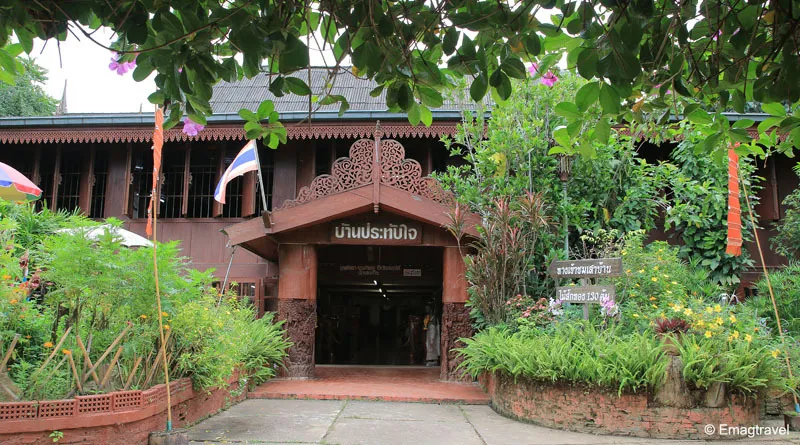
Baan Pratubjai, also known as the Hundred Pillar House, Phrae Province is one of the most remarkable architectural and cultural attractions in Phrae. It is famous not only for its beauty as a large teakwood residence, but also for the way it reflects local craftsmanship, refined design, and the long-standing relationship between Phrae and teakwood heritage. Located at 59 Moo 13, Pa Maet Subdistrict, along Highway 1023 on the Phrae–Long route, it is an easy and worthwhile stop for travelers interested in traditional wooden houses and northern Thai culture.
For a quick summary, Baan Pratubjai is a large Thai-applied teakwood house completed in 1976 after 5 years of construction. Its most famous feature is the use of 130 massive teak pillars, each said to be around 300 years old. The house is open daily from 08:00 to 17:00 and is one of the clearest examples of Phrae’s teak craftsmanship that visitors can still experience today.
The name “Hundred Pillar House” has become more widely recognized than the formal name itself. Although the actual number of pillars is 130, the nickname creates a memorable image and immediately tells visitors what makes the house so special. Once inside the grounds, the visual rhythm of the teak pillars gives the house a sense of dignity, scale, and elegance that few other private historical houses can offer.
The house was completed in 1976 after a 5-year construction period. Almost the entire structure is made of teak, a material deeply associated with Phrae’s history. The use of teak gives the house strength, durability, and a natural beauty that becomes even more striking with age. Combined with skilled workmanship and a carefully planned design, the result is a residence that stands out both as an engineering achievement and as a work of cultural art.
The 130 teak pillars are the heart of Baan Pratubjai. Each pillar is large, visually powerful, and rich in historical character. Since the pillars are said to be around 300 years old, they bring with them a strong sense of time and material value. Seeing so many mature teak pillars in a single residence makes the experience unusually impressive, even for visitors who are already familiar with old wooden houses.
Architecturally, the house is a Thai-applied design that balances traditional Thai elements with the openness and scale of a large modern residence. It demonstrates how local materials and Thai spatial concepts can be adapted into a house that feels both elegant and livable. In this sense, Baan Pratubjai reflects not only local taste, but also the broader cultural identity of Phrae as a city shaped by teakwood wealth and craftsmanship.
The property covers a little over 1 rai, giving the house enough surrounding space to appear even more graceful. From the outside, the residence feels both warm and stately. The natural tone of the teakwood, the repeated vertical lines of the pillars, and the Thai architectural details all combine to create a house that is visually distinctive without needing excessive decoration.
A visit to Baan Pratubjai is rewarding not only in terms of architecture, but also as a way to understand the social world behind such a residence. Houses like this tell stories about the values of their owners, the role of teak in local prosperity, and the importance of craftsmanship in shaping domestic space. Visitors are therefore not just seeing a beautiful house, but also learning how architecture can embody identity, status, and local history.
For photography lovers, the house offers many attractive angles. The lines of teak pillars, the layered depth of the structure, and the details of old wood surfaces create a classic and atmospheric setting. It is especially appealing to travelers who enjoy photographing heritage architecture and traditional materials.
Baan Pratubjai is also an excellent example of how a private wooden residence can be preserved and shared as a cultural attraction. Instead of remaining inaccessible, the house has been opened to visitors, allowing the public to appreciate teak architecture at close range. This makes the site important not only for tourism, but also for public cultural education.
Its location makes it easy to include in a wider Phrae itinerary. Visitors can combine the house with other nearby attractions such as Khum Chao Luang, Vongburi House, Wat Phra Bat Ming Mueang, and Wat Chom Sawan. This makes it suitable both for first-time visitors to Phrae and for travelers who want to explore the city’s wooden heritage in greater depth.
Another practical advantage is that visitor information is clear and easy to plan around. The house is open every day from 08:00 to 17:00, making it ideal for a morning or afternoon visit. Travelers interested in teak houses, cultural heritage, local history, or architectural photography will find this place especially rewarding.
Travel Information Baan Pratubjai can be reached via Highway 1023 on the Phrae–Long route. It is located in Pa Maet Subdistrict, Mueang Phrae District, and is easy to access from Phrae city center by private car or local transport. It works very well as part of a one-day route focused on old wooden houses and cultural attractions in Phrae.
| Name | Baan Pratubjai, also known as the Hundred Pillar House |
| Location | 59 Moo 13, Pa Maet Subdistrict, Mueang Phrae District, Phrae 54000 |
| Place Summary | A large Thai-applied teakwood residence famous for its 130 massive teak pillars, ideal for travelers interested in architecture, teak heritage, and local history |
| History / Period | Completed in 1976 after 5 years of construction |
| Distinctive Features | Entirely built of teakwood, covering a little over 1 rai, with 130 large teak pillars said to be around 300 years old |
| Travel Information | Located along Highway 1023 on the Phrae–Long route in Pa Maet, easy to reach from Phrae city center |
| Current Status | Open and operating as a visitor attraction |
| Open Days | Daily |
| Opening Hours | 08:00 - 17:00 |
| Entrance Fee | Thai visitors 15 baht, foreign visitors 20 baht |
| Caretaker | Private management |
| Main Contact Number | 0 5451 1008, 0 5451 1282 |
| Nearby Tourist Attractions | 1. Khum Chao Luang – 4 km 2. Vongburi House – 4 km 3. Wat Phra Bat Ming Mueang Worawihan – 4 km 4. Wat Chom Sawan – 5 km 5. Khum Wongburi – 4 km |
| Nearby Restaurants | 1. Khanom Baan Pratubjai – 1 km – Tel. 089-851-2981 2. Huan Somtam – 2 km – Tel. 063-914-4624 3. Pa Da Nam Yoi Rice Noodle Restaurant – 4 km – Tel. 099-292-8598 4. Paeng Mak Restaurant – 4 km – Tel. 086-440-2162 5. Mae Lan Nam Yoi Rice Noodles – 14 km – Tel. 091-071-8117 |
| Nearby Accommodations | 1. B2 Phrae Boutique & Budget Hotel – 1 km 2. Chatawan Homestay – 1 km 3. Huern Nana Boutique Hotel – 4 km – Tel. 054-524-800 4. Phrae Nakara Hotel – 5 km – Tel. 054-521-321 5. Rittiboon Vintage Hotel – 6 km – Tel. 054-522-865 |
Frequently Asked Questions (FAQ)
Q: Why is Baan Pratubjai called the Hundred Pillar House?
A: Because the house is famous for its many teak pillars. In fact, it has 130 pillars, which became its most memorable feature.
Q: When was Baan Pratubjai completed?
A: The house was completed in 1976 after 5 years of construction.
Q: How much is the entrance fee?
A: The entrance fee is 15 baht for Thai visitors and 20 baht for foreign visitors.
Q: Who should visit this attraction?
A: It is ideal for travelers interested in teak houses, Thai-applied architecture, local history, and photography.
Q: How long should I spend there?
A: Most visitors spend around 45 minutes to 1.5 hours, depending on how closely they explore the house and take photographs.
 Category: ●Art, Culture and Heritage
 Group: ●Historic Homes and Cities
Last Update : 6 MonthAgo
 Last Update : 6 MonthAgo
 Click to Access the Navigation Map GPS
Hundred Pillar House (Sao Roi Ton house) Map
Recommend

 Historical Sites and Monuments(4)
 Landmarks and Memorials(5)
 Art, Craft Centres, Tradition(3)
 Museums(6)
Historic Homes and Cities(2)
Museums(6)
Historic Homes and Cities(2)
 Educational Places
 Museum for Study(1)
 Educational Gardens, Farm(2)
 Places of Worship
 Temple(31)
 Other Sacred Sites(8)
 Suburban Living
 Village, Community(6)
 Local Market(1)
 Nature and Wildlife
 National Parks and Marine Reserves(4)
 Dam, Reservoir, Lake(14)
 Waterfalls(6)
 Hot Springs(1)
 Caves(5)
 River, Canal(3)
 Islands(1)
 Other natural attractions(5)
 Entertainment and Agricultural
 Farms, Parks and Ecotourism(5)
 Outdoor and Adventure Activities(1)
 Travel Articles, Recipes
 Travel Review, Food Review(2)


