
lovethailand home >North Travel Attractions >Phrae Travel Attractions >Muang Phrae >Kanchana > Phra That Mo Kwam
TL;DR: Phra That Mo Kwam is located at Wat Nong Bo, Ban Nong Bo, Moo 4, Kanchana Subdistrict, Mueang Phrae District, Phrae Province, open Open daily, hours 8:00 AM - 6:00 PM.
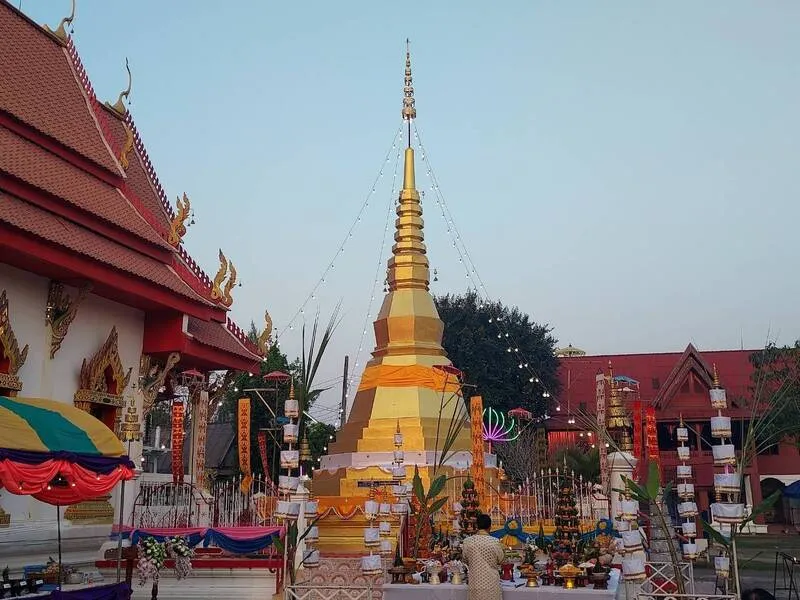
Phra That Mo Kwam
Open Days: Open daily
Opening Hours: 8:00 AM - 6:00 PM
Phra That Mo Kwam is an important historical religious site in Ban Nong Bo, Kanchana Subdistrict, Mueang Phrae District, Phrae Province. It holds value not only in terms of faith, but also in local history and the collective memory of the community that has been passed down for generations. This place is appealing not merely because it is an old stupa where people come to pay respect, but also because of the remarkable legend behind its origin. The story tells of a sacred omen that determined the place where the relics would remain, making Phra That Mo Kwam one of the cultural destinations worth discovering for travelers interested in the history of Phrae, local Buddhist sites, and Lanna beliefs that remain closely tied to everyday community life.
If Phra That Mo Kwam were to be described briefly, it is an ancient stupa located within Wat Nong Bo. Its legend tells of a group of wandering monks who carried Buddha relics or sacred objects from the north. At one point, the pot containing those relics mysteriously overturned on its own, without anyone touching it. This was taken as a sign that the relics wished to remain at that very place. The monks and local people then built a stupa over the overturned pot and continued to restore and care for it over the years. As a result, it has become an important local sacred monument that still plays a role in the religious life and annual traditions of the community today.
One of the most fascinating aspects of Phra That Mo Kwam is that it is a relatively small site with a very substantial story. It is not a large tourist attraction, nor is it a highly commercialized temple complex crowded with visitors all day long. Instead, it is rich in layers of cultural meaning that allow visitors to experience peace, sacredness, and a close connection to the local community. A visit here is therefore not just about looking at a religious structure. It is also about seeing how this place functions as a repository of local memory, a center of annual merit-making, and a part of the sacred network of important stupas throughout Phrae.
According to the legend preserved in the community, the area west of Ban Nong Bo used to be a vast swamp or wetland extending as far as what are now Ban Ka Song Rong Ped and Ban Mueang Kha Sabu. This old landscape helps explain that the present-day village and religious site once formed part of a much larger watery environment. Such a terrain would naturally have played an important role in settlement, travel, livelihood, and even in the designation of sacred ground. When the community speaks of the old marshland, the legend of Phra That Mo Kwam becomes more than a sacred tale. It also reflects the original geography of the area in a very meaningful way.
The key part of the legend begins when news of the construction of a great stupa associated with Wiang Kosai spread far and wide. In the Lanna cultural context, carrying Buddha relics to be enshrined in an important stupa was considered a highly meritorious act. It is therefore unsurprising that a group of wandering monks traveled from the north with sacred relics, intending to join in the enshrinement of that great stupa. Their journey reflects more than a single episode in a legend. It also represents the Buddhist culture of pilgrimage, the religious connections between regional towns, and the strength of faith that inspired people to travel long distances in order to participate in major religious acts.
When the monks arrived at a raised area beside the swamp, they stopped to rest there for the night. During that night, a miraculous event occurred. The pot containing the Buddha relics or sacred objects suddenly overturned on its own, even though no one had touched it. There was no disturbance in the area, and the atmosphere was unusually calm. This moment forms the heart of the name “Mo Kwam,” meaning “overturned pot,” and it is also the foundation of the site’s sacred reputation. In the community’s view, this was not an accident. It was a declaration of intention from the relics themselves that they did not wish to go anywhere else, but instead intended to remain at that specific place.
Within local belief systems, events that cannot be explained by ordinary causes are often interpreted as omens. In this case, the omen meant far more than a mysterious occurrence. It determined the destiny of the site itself. The leading monk of the group therefore regarded the event as a favorable sign, interpreting it as the wish of the Buddha relics to remain on that raised piece of land. The monks then constructed a stupa over the overturned pot with the intention that it would become a sacred place dedicated to the memory of the Buddha. This is why Phra That Mo Kwam is seen as a place that was “chosen,” rather than simply a site selected by human decision alone.
From a cultural perspective, the legend of Phra That Mo Kwam clearly reflects how sacred places are defined in Lanna communities. Many sacred places are important not because of their size or grandeur, but because of the stories, beliefs, and rituals that communities collectively accept and carry on over time. The more closely a story is connected with Buddha relics or supernatural signs, the stronger the sense of devotion becomes. Phra That Mo Kwam is therefore an excellent example of a religious site with powerful narrative capital. It is this deep narrative significance that has kept the place alive in the memory of the community, even after more than two centuries.
Official information from the state’s cultural environment database records that Wat Nong Bo was established in 1802 CE, and that the temple contains two important historic elements: the stupa and the ordination hall. The same source also explains the origin of the name Phra That Mo Kwam in a way that closely matches the community’s oral tradition. It refers to wandering monks carrying relics, the miraculous overturning of the pot, and the interpretation of that event as the reason for both the name and the establishment of the stupa. This official recognition demonstrates that Phra That Mo Kwam is not only part of oral memory, but is also acknowledged as an important element of local cultural heritage.
Another aspect that makes Phra That Mo Kwam especially interesting is its relationship with Phra That Cho Hae, the province’s most important stupa. Local people have long said, “Our stupa is the elder sibling of Phra That Cho Hae.” This saying carries more than a poetic meaning. It reflects how people in Phrae imagine spiritual relationships between stupas. In other words, stupas are not seen as isolated structures. They are connected within an extended sacred network, linked through merit, reverence, and local understanding. This worldview helps explain why people still travel between these sites as part of a broader devotional landscape.
For this reason, Phra That Mo Kwam is significant beyond the limits of its own village. When people in Phrae speak about worshipping the region’s important stupas, Phra That Mo Kwam is often included alongside Phra That Chom Chaeng, Phra That Cho Hae, and Phra That Pu Chae. A local saying states that “people of Phrae should pay respect to Chom Chaeng, Cho Hae, Pu Chae, and Mo Kwam.” This reflects that Phra That Mo Kwam is one of the shared sacred destinations of the wider Phrae area. It is not merely a neighborhood shrine, but an integral part of the spiritual map of the province.
The annual worship tradition connected with Phra That Mo Kwam further confirms its living role in the community. It is not simply an old monument to be looked at. It continues to exist within the real ritual calendar of local people. Public announcements from the Kanchana Subdistrict Administrative Organization have promoted annual worship events for Phra That Mo Kwam at Wat Nong Bo, including merit-making, traditional dance offerings, and community activities. This shows that the worship festival remains a meaningful event in the life of Ban Nong Bo. The site therefore functions not only as a spiritual center, but also as a social one.
For travelers who are interested in meaningful cultural journeys, Phra That Mo Kwam is best appreciated slowly. Its value does not lie in commercial tourism facilities or large-scale attractions. Rather, its strength lies in its peaceful atmosphere, simplicity, and the opportunity to experience local faith up close. Visitors who enjoy cultural travel often appreciate places like this because they offer something different from famous sites in larger cities. Here, one can spend time quietly observing the stupa, listening to stories preserved by the community, and understanding why this modest religious site has remained deeply important to local people for so long.
As a travel experience, Phra That Mo Kwam is especially suitable for those who wish to explore Phrae in greater depth rather than only visiting the most famous landmarks. A stop here reveals another layer of the province: the layer of village temples, local stupas, and stories rooted in the landscape of the countryside, rather than only the historic mansions and urban heritage sites in town. Travelers who are interested in secondary cities with rich cultural substance will find that Phra That Mo Kwam opens up a more nuanced understanding of Phrae. It shows that the province is not defined only by Phra That Cho Hae or Khum Wongburi, but also by a network of sacred local places connected through faith and memory.
Looking at the stupa symbolically, the name “Mo Kwam,” or “overturned pot,” gives it an immediately memorable identity. This makes it stand out from many other stupas that are named after people, Pali terms, or flowers. A name that refers directly to a dramatic event makes the story easy to remember and easy to pass on. It also gives visitors a clear sense of what makes the place unique. This linguistic and narrative distinctiveness gives Phra That Mo Kwam very strong storytelling power, making it highly suitable for cultural tourism writing that is both accessible and memorable.
For those interested in the relationship between religion and community, Phra That Mo Kwam is a very compelling case. It demonstrates how a single religious site can encompass many dimensions at once: ritual, history, settlement patterns, and local identity. The stupa does not stand apart from daily life. It functions as a center for merit-making, annual festivals, local memory, and the symbolic language through which people explain their relationship to other stupas in the province. This is why visiting Phra That Mo Kwam is not just a matter of “seeing a temple.” It is an encounter with the deeper meaning structures of the community itself.
In terms of atmosphere, Phra That Mo Kwam is appealing because it remains a simple community temple rather than an overdeveloped tourist site. The experience is therefore very different from visiting heavily promoted attractions. Visitors can stand quietly before the stupa, rest their minds, or walk around the temple grounds at a natural pace. That kind of calm is especially valuable today, when many people are looking for places that offer peace rather than spectacle. Listening to the legend of the overturned relic pot within such a quiet temple setting allows the sacred story and the historical imagination to resonate more deeply.
In practical travel planning, Phra That Mo Kwam fits very well into a half-day or full-day cultural route in Phrae. It works especially well when combined with visits to Phra That Cho Hae, Phra That Chom Chaeng, or other important temples in Mueang Phrae District. Organizing a route that links these places helps visitors understand the sacred network long recognized by the community. Seen in relation to those other sites, Phra That Mo Kwam becomes even more meaningful, because it reveals itself as one important piece within the larger religious landscape of the city.
Starting from Phrae town, travel to Phra That Mo Kwam is relatively straightforward. Visitors can use a private car, motorcycle, or digital navigation to reach Wat Nong Bo. Tourism information identifies the site as being within Wat Nong Bo, Ban Nong Bo, Moo 4, Kanchana Subdistrict, Mueang Phrae District, Phrae Province. The official cultural heritage database also provides coordinates, making it easier to locate the temple accurately. Private transport is the most convenient option, especially for travelers who plan to combine several cultural attractions in Mueang Phrae in the same trip.
Although places like this do not usually have complicated visitor regulations, it is still important to observe basic temple etiquette when visiting Phra That Mo Kwam. Visitors should dress respectfully, keep their voices low, and avoid disturbing worshippers or local residents who come to make merit. Photography should also be done with sensitivity and respect for the sacred setting. Such behavior is not only a matter of courtesy. It also allows visitors to engage with the place in the way the community itself understands it: as both a cultural destination and a living sacred space, not merely as a backdrop for photographs.
For those who are interested in deeper Lanna culture, Phra That Mo Kwam is particularly valuable because it preserves a strong oral tradition. Its story contains all the elements of a complete local sacred legend: the original landscape, the journey of the wandering monks, the miraculous event, the interpretation of that event as an omen, the building of the stupa, and the continuation of annual ritual practice. Because the story has such a clear structure, it has remained easy for generations to remember and retell. This is one reason why the legend of Phra That Mo Kwam has endured through many social and historical changes.
At the same time, the site illustrates how local beliefs can coexist harmoniously with formal Buddhism. The tale of the overturned pot does not diminish Buddhist meaning. Instead, it deepens it by giving the enshrinement of relics a supernatural dimension. People who come here do not see the site only as an old structure. They come because they believe the place carries sacred power that has been recognized and honored by the community for generations. This combination of doctrinal reverence and local miraculous narrative is one of the reasons the site remains spiritually meaningful.
Phra That Mo Kwam is also ideal for travelers who appreciate slow travel. The value of the place becomes clearer the more time one gives to understanding its context. When visitors learn about the former wetland landscape, the monks’ pilgrimage, the sacred omen of the overturned relic pot, and the relationship between this stupa and others such as Phra That Cho Hae, Phra That Chom Chaeng, and Phra That Pu Chae, the site becomes much richer in meaning. Spending unhurried time here allows the visit to become something more than a simple stop for photos. It becomes an act of cultural understanding.
From the perspective of travel writing, Phra That Mo Kwam is a highly promising subject because it appeals to both Thai and international readers interested in culture. For Thai readers, it offers a compelling combination of legend, Lanna belief, and local ritual continuity. For international travelers who prefer cultural depth over mainstream tourism, it represents a hidden site that reflects village-level sacred traditions rather than only famous provincial landmarks. In that sense, Phra That Mo Kwam is very well suited to being presented as one of Phrae’s quieter but more meaningful cultural treasures.
In terms of heritage conservation, Phra That Mo Kwam matters because it represents a type of local religious monument whose significance lies less in monumental scale and more in meaning. Preserving such a place involves more than maintaining the physical structure. It also requires preserving the story, the annual rites, and the shared understanding of the community. If the story disappears, the site risks becoming only an old structure without its full cultural significance. The fact that local people still organize annual worship and continue to tell the legend to younger generations is therefore an important part of preserving the heritage of Phra That Mo Kwam.
For photography enthusiasts, Phra That Mo Kwam may not offer the grand panoramic views associated with major temple complexes, but it offers something equally valuable: atmosphere and narrative depth. The stupa set within a quiet temple environment, the village surroundings, and the worship festival when local people gather for merit-making and ritual dance all provide rich visual material. This makes the site more suitable for documentary-style or cultural photography than for highly stylized tourism imagery. That, too, is part of its distinctive charm.
From the perspective of the general traveler, Phra That Mo Kwam answers several interests at once. It is a place for worship, a place to learn local legend, a place to experience village atmosphere, and a place that can easily be added to a broader Phrae cultural route. If time is limited and one wishes to choose a destination that offers more depth than surface-level sightseeing, this site is well worth visiting. The area may not be large, but the story is substantial. The more one understands the legend before arriving, the more meaningful it becomes to stand before the stupa itself.
For visitors seeking a quiet and respectful experience, mornings are often the best time to come, as the weather is usually more comfortable and the temple atmosphere feels especially calm. Those who want to see the site as a living center of community life may prefer to come during the annual worship festival, when Phra That Mo Kwam takes on its fullest role as a gathering place for ritual, merit-making, and shared local identity.
In summary, Phra That Mo Kwam is not simply another place to visit in Phrae. It is a cultural site that helps visitors understand how sacred local places are created and sustained. It emerged from a legend accepted by the community, grew through generations of faith, and continues to live through ritual practice that local people still maintain. For that reason, Phra That Mo Kwam deserves recognition not only as a religious site, but also as a historical monument and a window into the heart of Phrae’s cultural life. For anyone visiting Phrae and looking for a destination that is peaceful, layered, and meaningful, Phra That Mo Kwam is a place that should not be overlooked.
| Name | Phra That Mo Kwam |
| Location | Wat Nong Bo, Ban Nong Bo, Moo 4, Kanchana Subdistrict, Mueang Phrae District, Phrae Province |
| Address | Kanchana Subdistrict, Mueang Phrae District, Phrae 54000, Thailand |
| Coordinates | 18.1299643504, 100.187357694 |
| Highlights | An ancient stupa with a legend about a relic pot overturning on its own, and a long-standing center of local faith in Ban Nong Bo |
| History / Period | Wat Nong Bo was established in 1802 CE, and Phra That Mo Kwam is one of the important historic monuments within the temple grounds |
| Name Origin | The name comes from the legend of the pot containing Buddha relics overturning on its own, which was interpreted as a sacred sign to build the stupa there |
| Distinctive Features | A sacred local stupa with a strong miracle legend, connected to the wider worship route of Phrae’s important stupas, and still associated with an annual community festival |
| Travel Information | Travel from Phrae town to Wat Nong Bo in Kanchana Subdistrict by private car or motorcycle. It is convenient to include this site in a temple route around Mueang Phrae District |
| Current Status | Still an active place of worship and the site of an annual local festival |
| Open Days | Open daily |
| Opening Hours | 8:00 AM - 6:00 PM |
| Main Contact Number | 054-531447 |
| Nearby Tourist Attractions | 1. Phra That Cho Hae 6 km 2. Phra That Chom Chaeng 5 km 3. Phra That Pu Chae 7 km 4. Wat Phra Bat Ming Mueang Worawihan 6 km 5. Khum Wongburi 7 km |
| Nearby Restaurants | 1. Restaurants in the Khum Wongburi area 7 km 2. Northern Thai restaurants along Yantrakit Kosol Road 7 km 3. Noodle shops and made-to-order eateries in Mueang Phrae 6 km 4. Cafés and coffee shops in Phrae town 7 km 5. Restaurants near Phra That Cho Hae 6 km |
| Nearby Accommodations | 1. Hotels in the old town area of Phrae 7 km 2. Accommodation near Khum Wongburi 7 km 3. Mid-range hotels in Mueang Phrae 6 km 4. Guesthouses in Phrae town 7 km 5. Accommodation on the route toward Phra That Cho Hae 6 km |
Frequently Asked Questions (FAQ)
Q: Where is Phra That Mo Kwam located?
A: Phra That Mo Kwam is located within Wat Nong Bo, Ban Nong Bo, Moo 4, Kanchana Subdistrict, Mueang Phrae District, Phrae Province.
Q: Why is Phra That Mo Kwam important?
A: It is an ancient sacred stupa associated with a miracle legend about an overturned relic pot, and it remains a center of faith for the local community.
Q: How is Phra That Mo Kwam connected to Phra That Cho Hae?
A: In local belief, Phra That Mo Kwam is spiritually connected to Phra That Cho Hae and is often included in the worship route of Phrae’s important stupas.
Q: Is there an annual festival at Phra That Mo Kwam?
A: Yes. An annual worship festival is still held here and remains an important community tradition in Ban Nong Bo.
Q: What time is Phra That Mo Kwam open to visitors?
A: Published information indicates that it is open daily from 8:00 AM to 6:00 PM.
Q: Is it easy to travel to Phra That Mo Kwam?
A: Yes. It is easy to reach from Phrae town, especially by private car or motorcycle, and it can be included in a broader temple route around Mueang Phrae District.
Q: What kind of travelers would enjoy visiting this site?
A: It is ideal for cultural travelers, Buddhist pilgrims, visitors interested in local legends, and anyone looking for a peaceful temple setting in Phrae.
 Category: ●Places of Worship
 Group: ●Other Sacred Sites
Last Update : 2 MonthAgo
 Last Update : 2 MonthAgo
 Click to Access the Navigation Map GPS
 Art, Culture and Heritage
 Historical Sites and Monuments(4)
 Landmarks and Memorials(5)
 Art, Craft Centres, Tradition(3)
 Museums(6)
 Historic Homes and Cities(2)
 Educational Places
 Museum for Study(1)
 Educational Gardens, Farm(2)
 Temple(31)
Other Sacred Sites(8)
Temple(31)
Other Sacred Sites(8)
 Suburban Living
 Village, Community(6)
 Local Market(1)
 Nature and Wildlife
 National Parks and Marine Reserves(4)
 Dam, Reservoir, Lake(14)
 Waterfalls(6)
 Hot Springs(1)
 Caves(5)
 River, Canal(3)
 Islands(1)
 Other natural attractions(5)
 Entertainment and Agricultural
 Farms, Parks and Ecotourism(5)
 Outdoor and Adventure Activities(1)
 Travel Articles, Recipes
 Travel Review, Food Review(2)


