
lovethailand home >North Travel Attractions >Phrae Travel Attractions >Sung Men >Don Mun > Wat Phraluang That Noeng
TL;DR: Wat Phraluang That Noeng is located at 177 Moo 5, Phraluang Subdistrict, Sung Men District, Phrae 54130, open Daily, hours Best visited during daytime.

Wat Phraluang That Noeng
Open Days: Daily
Opening Hours: Best visited during daytime
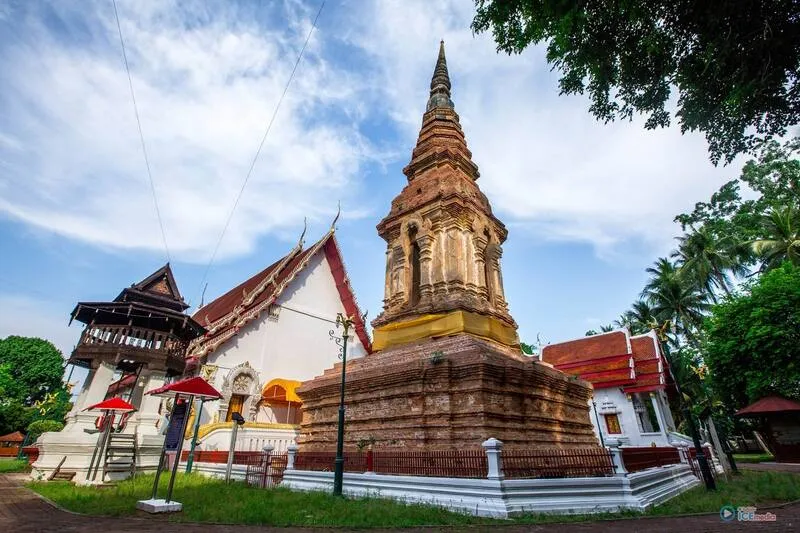
Wat Phraluang That Noeng is one of the most distinctive temple attractions in Phrae Province because it combines an old sacred monument, a deeply rooted community legend, and a very recognizable architectural identity in one place. Located at 177 Moo 5, Phraluang Subdistrict, Sung Men District, this temple is best known for That Noeng, an ancient stupa whose slightly leaning form has become the origin of its famous name.
In simple terms, this is not just another old temple in Phrae. Wat Phraluang That Noeng is an important heritage site closely tied to the settlement history of the Phraluang community. It is also a place where visitors can see a historic Sukhothai-style chedi that villagers still revere today. The word “Noeng” means “leaning”, which refers directly to the visible tilt of the stupa. That single physical detail gives the temple an identity that is easy to remember and unlike many other temples in northern Thailand.
What makes the temple especially compelling is the way historical memory and local legend overlap. There is no definitive evidence identifying the exact period in which the temple was first built. However, it has long been regarded as an ancient monument of major importance to the local community. In local understanding, this temple is not only a sacred place but also one of the foundations of the identity of Ban Phraluang itself.
According to the temple legend later compiled by Phra Khru Panyaphichai, the area was once a vast forest known as Dong Luang. Wild animals were abundant there, and a giant serpent was believed to live in the forest, preying on animals that wandered into the area. Chinese Haw traders who traveled through the region eventually decided to get rid of the serpent. They used a traditional northern trap made from bamboo, known locally as a ta laew, to block the snake’s hole and finally killed it.
The legend then turns miraculous. After the serpent was killed and its body was cut into pieces, the remains were said to transform into bars of silver and gold. The treasure was divided into three parts: one for the traders, one for the ruler, and one buried at the site of the serpent’s hole. This buried sacred place later became the focal point of the monument. Whether taken literally or symbolically, the story gives the temple a mythic origin that still shapes how local people understand the sacred value of the place.
Later, another group of settlers, believed in local memory to have been Mon or Burmese-related people, came to clear the forest, establish a community, and build a temple there. A stupa was then built over the serpent’s hole, turning the site into a religious center. That first community eventually disappeared, leaving the temple abandoned for a long period. The grounds became overgrown, and the old structures fell into ruin. Even so, the stupa, the sacred zone, and the broader temple boundary remained in memory.
A new chapter began in 1787 when groups of Tai Lue migrants from Chiang Saen moved south into the Phrae area. They arrived with monks, novices, and lay villagers from three temples and three communities. These settlers restored the ruined temple, repaired the large principal Buddha image, and revived the site as a functioning monastery again. The temple was then named Wat Phraluang, while the surrounding settlement became known as Ban Phraluang. The word “luang,” meaning “great” or “royal,” reflected the scale and importance of both the temple and the settlement.
This history gives Wat Phraluang That Noeng unusual cultural depth. It is not simply an old monument that survived by chance. It is a place repeatedly renewed by different communities across time. That makes it especially interesting for travelers who enjoy temple visits with a strong historical narrative rather than only visual appeal.
The main highlight, of course, is That Noeng itself. The stupa is commonly described as having Sukhothai artistic influence, yet it exists within the cultural and religious context of Phrae and the northern region. The slightly tilted form is what gives the monument its local nickname and identity. For visitors, this visual character makes the temple immediately memorable. Rather than being perfectly symmetrical, the stupa shows the marks of age and time, which adds to its atmosphere rather than diminishing it.
Beyond the stupa, the temple also contains other significant structures such as the viharn, the scripture hall, the bell tower, and the large principal Buddha image. Together, these features show that Wat Phraluang is not just centered on one relic tower. It is a full religious complex with multiple layers of historical and devotional importance.
Another important part of the temple’s continuing life is the annual worship festival of That Noeng. The event is still held today and remains an important religious and cultural gathering for the local community. This matters because it confirms that the temple is not merely a historic ruin or an isolated monument. It is still actively woven into the ceremonial calendar and spiritual life of the area.
The everyday atmosphere of the temple is one of its strongest appeals. On ordinary days, the grounds feel calm, local, and unforced. This is not a highly commercialized tourist temple. Instead, it retains the feel of a community temple where the monument still belongs first to the people who live around it. For many travelers, that gives the visit more authenticity and emotional weight.
From a travel perspective, Wat Phraluang That Noeng works well for several different types of visitors. Pilgrims come to pay respect to the sacred stupa. Heritage travelers come to study the ancient leaning chedi and its architectural character. Cultural travelers come because the temple reveals how legend, migration history, and local identity can become inseparable in one place.
Getting There is straightforward. The temple lies in Phraluang Subdistrict, Sung Men District, and can be reached by turning left at Ban Hua Dong and continuing for around 700 meters. Private car travel is the most convenient option. Because the temple is not far from Phrae town and the Sung Men area, it can easily be included in a one-day route covering both local temples and old-town attractions in the province.
The surrounding area is also convenient for a short stop or a longer cultural outing. Nearby local cafés, casual eateries, and small resorts make it easy to combine the temple with a relaxed half-day trip. This practical accessibility adds to the temple’s appeal, especially for visitors who want a heritage destination without a complicated journey.
In the end, Wat Phraluang That Noeng stands out because it brings together sacred architecture, local legend, migration memory, and community devotion in one setting. Its leaning ancient stupa may be the first thing visitors notice, but the deeper value of the site lies in the story of how a monument can become the heart of a community across generations. For anyone looking for a culturally rich place to visit in Phrae, this temple is well worth the stop.
| Name | Wat Phraluang That Noeng |
| Location | 177 Moo 5, Phraluang Subdistrict, Sung Men District, Phrae 54130 |
| Highlights | Ancient Sukhothai-style leaning chedi, strong local legend, important heritage site of the Phraluang community, annual worship festival |
| History | An ancient monument with no clearly recorded original construction date, later restored and revived by Tai Lue migrants from Chiang Saen in 1787 |
| Name Origin | “That Noeng” means “leaning,” referring to the visible tilt of the old stupa |
| Distinctive Features | An old Sukhothai-style chedi with a leaning profile, a major symbol of local identity, and a temple shaped by legend and migration history |
| Travel Information | Turn left at Ban Hua Dong and continue around 700 meters; easiest to reach by private car |
| Current Status | Active temple and still hosts the annual worship event of That Noeng |
| Open Days | Daily |
| Opening Hours | Best visited during daytime |
| Facilities | Parking available |
| Main Areas / Zones | That Noeng stupa, viharn, scripture hall, bell tower, temple courtyard |
| Official Website / Official Page | Facebook: Wat Phraluang That Noeng |
| Nearby Tourist Attractions | 1. Wat Sung Men – approx. 1 km 2. Pratu Chai Phrae – approx. 6 km 3. Chetawan Arboretum – approx. 9 km 4. Khum Chao Luang – approx. 9 km 5. Phrae City Pillar Shrine – approx. 9 km |
| Nearby Restaurants | 1. APO – approx. 100 m 2. Niku Grilled Meatballs – approx. 100 m 3. Krua Nai Baan Phraluang – approx. 300 m 4. Kham Khua Cha Traditional Coffee, Ban Hua Dong – approx. 400 m 5. Model Coffee – approx. 500 m |
| Nearby Accommodations | 1. Ruean Kaeo Resort – approx. 1 km 2. Bannoi Resort – approx. 2 km 3. Huean Amphon Resort – approx. 3 km 4. B2 Phrae Boutique & Budget Hotel – approx. 8 km 5. Taris Art Hotel Phrae – approx. 9 km |
Frequently Asked Questions (FAQ)
Q: Where is Wat Phraluang That Noeng located?
A: It is located at 177 Moo 5, Phraluang Subdistrict, Sung Men District, Phrae Province.
Q: What does “That Noeng” mean?
A: “Noeng” means “leaning,” referring to the slightly tilted form of the ancient stupa.
Q: Why is this temple important?
A: It is an important ancient monument of the Phraluang community, known for its old Sukhothai-style chedi, local legends, and continuing annual worship tradition.
Q: Is Wat Phraluang That Noeng still active today?
A: Yes. It is still an active temple and continues to hold the annual worship event of That Noeng.
Q: How do I get there?
A: The easiest way is by private car, turning left at Ban Hua Dong and driving about 700 meters to the temple.
Q: What can I visit nearby?
A: Nearby places include Wat Sung Men, Pratu Chai Phrae, Khum Chao Luang, and other attractions in and around Phrae town.
 Category: ●Places of Worship
 Group: ●Temple
Last Update : 6 MonthAgo
 Last Update : 6 MonthAgo
 Click to Access the Navigation Map GPS
Wat Phraluang That Noeng Map
Recommend

 Art, Culture and Heritage
 Historical Sites and Monuments(4)
 Landmarks and Memorials(5)
 Art, Craft Centres, Tradition(3)
 Museums(6)
 Historic Homes and Cities(2)
 Educational Places
 Museum for Study(1)
 Educational Gardens, Farm(2)
Temple(31)
Educational Gardens, Farm(2)
Temple(31)
 Other Sacred Sites(8)
 Suburban Living
 Village, Community(6)
 Local Market(1)
 Nature and Wildlife
 National Parks and Marine Reserves(4)
 Dam, Reservoir, Lake(14)
 Waterfalls(6)
 Hot Springs(1)
 Caves(5)
 River, Canal(3)
 Islands(1)
 Other natural attractions(5)
 Entertainment and Agricultural
 Farms, Parks and Ecotourism(5)
 Outdoor and Adventure Activities(1)
 Travel Articles, Recipes
 Travel Review, Food Review(2)


