
lovethailand home >North Travel Attractions >Phrae Travel Attractions >Muang Phrae >Nai Wiang > Wat Phrabat Ming Mueang Worawihan
TL;DR: Wat Phrabat Ming Mueang Worawihan is located at Charoen Mueang Road, Nai Wiang, Mueang Phrae District, Phrae, open Daily, hours 07:30 - 16:30.

Wat Phrabat Ming Mueang Worawihan
Open Days: Daily
Opening Hours: 07:30 - 16:30
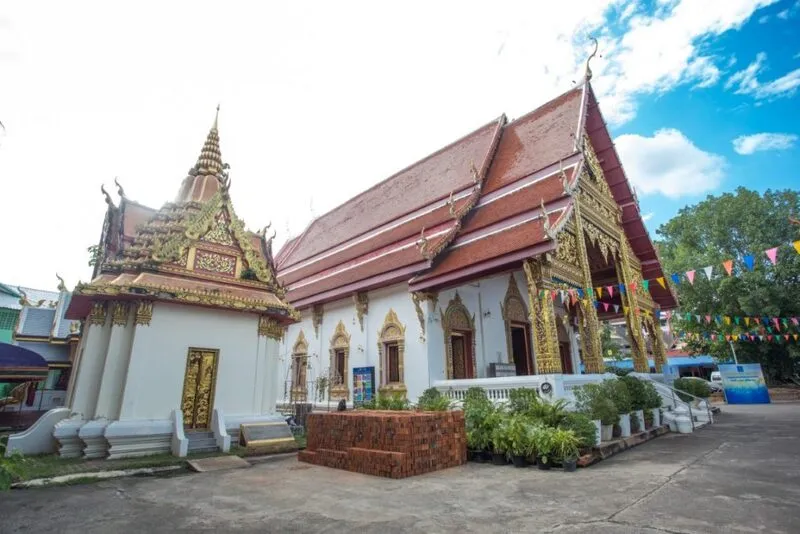
Wat Phrabat Ming Mueang Worawihan is one of the most important temples in Phrae and one of the strongest cultural anchors in the old city area. Located along Charoen Mueang Road near the Phrae Provincial Hall, the temple stands at the intersection of religion, civic memory, local history, and literary heritage. For travelers exploring Phrae beyond its teak mansions and café-lined streets, this temple offers a richer view of the province’s spiritual and historical identity.
The temple as it exists today was formed in 1955 through the unification of two older temples: Wat Phrabat and Wat Ming Mueang. This origin is important because the site is not merely a twentieth-century foundation, but a preserved and reconfigured continuation of earlier sacred spaces connected to the old urban structure of Phrae. The merged identity of the temple gives it unusual depth, allowing visitors to experience more than one historical layer in the same compound.
The temple’s greatest spiritual importance comes from the enshrinement of Phra Phuttha Kosai Siri Chai Maha Sakyamuni, the principal Buddha image revered as the guardian Buddha of Phrae Province. For local people, this is not only a sacred image within a temple hall, but a deeply rooted symbol of the city itself. Many visitors come specifically to pay respect to this Buddha image before continuing to other parts of Phrae.
Another major feature is the Ming Mueang Chedi, an older stupa that preserves a replica of the Buddha’s footprint inside. This structure gives the temple an additional devotional focus and also preserves the memory of the earlier Wat Ming Mueang. As a result, the temple is not centered on a single monument alone. It holds multiple sacred and historical points of interest within one integrated urban religious space.
One of the elements that makes the temple especially distinctive is the presence of the Yakob Memorial Foundation. Yakob, the pen name of Choti Phraephan, was a major Thai writer and also a descendant of the last ruler of Phrae. The foundation inside the temple means that the site extends beyond religious significance into literary and cultural remembrance. This creates a rare connection between temple space, regional identity, and modern Thai intellectual history.
The temple is also notable in provincial Buddhist administration. Current provincial Buddhist office news identifies the abbot as Phra Ratchakhemakorn, who also holds an important provincial ecclesiastical role. This confirms that Wat Phrabat Ming Mueang Worawihan is not simply a heritage monument preserved for visitors. It remains a living and active religious center with continued institutional importance.
Architecturally, the temple reflects both continuity and change. Because parts of the older structures declined and some areas were later rebuilt, the temple today shows a layered architectural character rather than a single intact historical style. That makes it especially interesting for travelers who enjoy reading the visible signs of restoration, adaptation, and continuity in sacred sites. It is a place where Phrae’s older religious memory remains alive within a functioning modern temple compound.
For visitors exploring central Phrae, the temple is extremely convenient. It lies close to Khum Chao Luang, Vongburi House, Wat Pong Sunan, Wat Luang, Wat Phra Non, and the Kad Kong Kao district. This makes it an ideal starting point for a city-based cultural route that includes religion, heritage architecture, food, and local history in a compact area.
The atmosphere of the temple is another of its strengths. Although it sits in the city, the grounds remain calm enough for quiet worship and reflective sightseeing. The compound feels accessible rather than overwhelming, and because it is not far from important civic landmarks, the temple also communicates how closely religious and public life have historically been linked in Phrae.
Getting There is straightforward. The temple is located on Charoen Mueang Road near the provincial hall and close to the Pratu Chai intersection, making it easy to reach by car, local hired transport, or as part of a walking route through old Phrae. Because several other heritage sites are nearby, it works well either as a stand-alone stop or as part of a half-day urban itinerary.
Overall, Wat Phrabat Ming Mueang Worawihan is one of the most essential cultural and religious destinations in Phrae. It brings together a guardian Buddha image, an old city stupa, a remembered royal-era urban past, and a memorial to one of Thailand’s major literary figures. For anyone who wants to understand Phrae through more than surface impressions, this temple deserves serious time and attention.
| Name | Wat Phrabat Ming Mueang Worawihan |
| Place Summary | A major royal monastery in central Phrae, enshrining Phra Phuttha Kosai Siri Chai Maha Sakyamuni, preserving the Ming Mueang Chedi with a replica Buddha footprint, and housing the Yakob Memorial Foundation |
| Location | Charoen Mueang Road, Nai Wiang, Mueang Phrae District, Phrae |
| Address | 16 Charoen Mueang Road, Nai Wiang, Mueang Phrae, Phrae 54000 |
| Highlights | Phra Phuttha Kosai Siri Chai Maha Sakyamuni, Ming Mueang Chedi, replica Buddha footprint, Yakob Memorial Foundation, and the temple’s role as Phrae’s major royal monastery |
| History | The temple was formally established in 1955 by combining two older temples, Wat Phrabat and Wat Ming Mueang, and was elevated to royal monastery status |
| Site Origin | Created by merging two old city temples that once stood separately with only a road between them |
| Distinctive Features | A living provincial religious center that combines guardian-Buddha worship, historic urban temple memory, and literary commemoration in one compound |
| Main Sacred Features | Phra Phuttha Kosai Siri Chai Maha Sakyamuni, Ming Mueang Chedi, replica Buddha footprint, silk-embroidered scriptures, and the Yakob Memorial Foundation |
| Travel Information | Very easy to reach in central Phrae near the provincial hall and Pratu Chai intersection; ideal for combining with old-town cultural attractions |
| Current Status | Open to visitors and still active as a major religious and ceremonial center in Phrae Province |
| Open Days | Daily |
| Opening Hours | 07:30 - 16:30 |
| Entrance Fee | No entrance fee |
| Latest Abbot | Phra Ratchakhemakorn |
| Main Contact Number | 054-511722, 096-6971616 |
| Official Website / Official Page | Tourism Thailand, Amazing Thailand, and Facebook: Wat Phrabat Ming Mueang Worawihan |
| Nearby Tourist Attractions | 1. Khum Chao Luang, approx. 0.4 km, Tel. 054-524158 2. Vongburi House, approx. 0.6 km, Tel. 054-620153, 054-511189 3. Wat Pong Sunan, approx. 0.8 km, Tel. 054-511279, 063-5253242 4. Wat Luang, approx. 0.9 km, Tel. 054-541327 5. Wat Phra Non, approx. 1.2 km, Tel. 093-1366523 |
| Nearby Restaurants | 1. Pan Chai, approx. 0.4 km, Tel. 054-620727, 081-8858727, 091-7534532 2. Gingerbread House Gallery, approx. 0.5 km, Tel. 054-523671 3. Je Bar Coffee & Pastry, approx. 0.4 km 4. Na Buree Phrae, approx. 0.7 km, Tel. 093-2876677, 099-2920256 5. Le Kong Gao de phraeris, approx. 0.8 km, Tel. 090-3324189 |
| Nearby Accommodations | 1. Taris Art Hotel Phrae, approx. 0.4 km, Tel. 054-511122, 088-2523098 2. Hug Inn Phrae Hotel, approx. 0.5 km, Tel. 062-5720077 3. Huen Him Kong Hotel Phrae, approx. 0.8 km, Tel. 054-533777, 093-2185533 4. Huern Na Na Boutique Hotel Phrae, approx. 1.1 km, Tel. 054-524800, 088-5477002 5. B2 Phrae Boutique & Budget Hotel, approx. 1.4 km, Tel. 1328, 054-060633 6. Phrae Nakara Hotel, approx. 1.6 km, Tel. 054-521321 |
Frequently Asked Questions (FAQ)
Q: Where is Wat Phrabat Ming Mueang Worawihan located?
A: It is located on Charoen Mueang Road in Nai Wiang, Mueang Phrae District, near the Phrae Provincial Hall and Pratu Chai intersection.
Q: Why is this temple important in Phrae?
A: It is a major royal monastery in Phrae and enshrines Phra Phuttha Kosai Siri Chai Maha Sakyamuni, the province’s revered guardian Buddha image.
Q: How was the temple formed?
A: The present temple was created in 1955 by merging two older temples, Wat Phrabat and Wat Ming Mueang.
Q: What can visitors see inside the temple?
A: Visitors can see the guardian Buddha image, the Ming Mueang Chedi, a replica Buddha footprint, silk-embroidered scriptures, and the Yakob Memorial Foundation.
Q: Is there an entrance fee?
A: No. The temple is generally open to visitors without an entrance fee.
Q: Who is the current abbot?
A: Recent provincial Buddhist office reports identify the abbot as Phra Ratchakhemakorn.
Q: Can this temple be combined with other attractions in the same trip?
A: Yes. It pairs very well with Khum Chao Luang, Vongburi House, Wat Pong Sunan, Wat Luang, and other old-town Phrae attractions.
 Category: ●Places of Worship
 Group: ●Temple
Last Update : 4 MonthAgo
 Last Update : 4 MonthAgo
 Click to Access the Navigation Map GPS
Wat Phrabat Ming Mueang Worawihan Map
Recommend

 Art, Culture and Heritage
 Historical Sites and Monuments(4)
 Landmarks and Memorials(5)
 Art, Craft Centres, Tradition(3)
 Museums(6)
 Historic Homes and Cities(2)
 Educational Places
 Museum for Study(1)
 Educational Gardens, Farm(2)
Temple(31)
Educational Gardens, Farm(2)
Temple(31)
 Other Sacred Sites(8)
 Suburban Living
 Village, Community(6)
 Local Market(1)
 Nature and Wildlife
 National Parks and Marine Reserves(4)
 Dam, Reservoir, Lake(14)
 Waterfalls(6)
 Hot Springs(1)
 Caves(5)
 River, Canal(3)
 Islands(1)
 Other natural attractions(5)
 Entertainment and Agricultural
 Farms, Parks and Ecotourism(5)
 Outdoor and Adventure Activities(1)
 Travel Articles, Recipes
 Travel Review, Food Review(2)


