
lovethailand home >South Travel Attractions >Yala Travel Attractions >Ka Bang >Ba La > Ban Si Sip Ancient Boat Museum
TL;DR: Ban Si Sip Ancient Boat Museum is located at Ban Si Sip, Village No. 5, Bala Subdistrict, Kabang District, Yala Province, open Daily, hours 08.30 – 16.30.

Ban Si Sip Ancient Boat Museum
Open Days: Daily
Opening Hours: 08.30 – 16.30
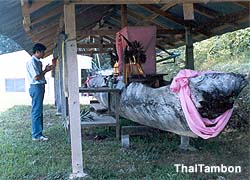
Ban Si Sip Ancient Boat Museum, Yala Province is a small community learning site in Bala Subdistrict, Kabang District, preserving a large ancient rowing boat closely connected with the traditional way of life of local people in the past. The boat is approximately 1 meter wide and about 12 meters long. It was built in 1938 under the leadership of Kamnan Khun Utsa and is located at Ban Si Sip, Village No. 5, Bala Subdistrict, Kabang District, Yala Province. The museum’s main value is not a large collection of artifacts, but this single ancient boat, which serves as important evidence of a time when people in the area depended on waterways, forests, and local craftsmanship in their daily lives.
Ban Si Sip Ancient Boat Museum is suitable for travelers who want to experience Yala from the perspective of local community culture, beyond ordinary city sightseeing or nature tourism. This boat helps visitors understand Kabang District in a concrete way. Before roads and land transportation became convenient, many communities in southern forest areas depended heavily on waterways. Boats were not merely vehicles; they were tools for livelihood, trade, agricultural transport, travel between communities, and connection between villages, markets, schools, temples, mosques, relatives’ homes, and the wider center of Yala.
The Ban Si Sip ancient boat is especially valuable because it is a long rowing boat that reflects the boat-building wisdom of southern border communities. Its long and relatively narrow shape allowed it to move efficiently along waterways, especially streams and rivers with winding courses, seasonal currents, and banks connected with rubber plantations, orchards, and humid tropical forest. Building a boat of this size required knowledge of wood, weight, balance, durability, and actual use. A 12-meter boat could not be made carelessly; if its thickness and weight were not properly controlled, it would be difficult to use and unstable on the water.
The materials associated with boats of this type reflect the relationship between people and forests in the past. Bala Subdistrict and Kabang District are connected with mountains, waterways, and agricultural communities. The existence of a large rowing boat shows that Ban Si Sip community did not live separately from nature, but used natural resources as part of its living system. Forest timber was shaped through the knowledge of local craftsmen, waterways became routes of movement, and the boat became a tool that carried families, produce, and news together.
The importance of Ban Si Sip Ancient Boat Museum lies in preserving community memory through a real object. Visitors can see the size of the boat, observe its proportions, and imagine how moving, rowing, and using such a boat in daily life required strength and cooperation. This boat turns local history from spoken memory into something visible and tangible in the actual community.
Ban Si Sip, Village No. 5, Bala Subdistrict, is a community in Kabang District, Yala Province. The community appears in local records and cultural documents of Yala, and Ban Si Sip Ancient Boat Museum is identified as one of the province’s historical learning sites. A small community museum like this adds diversity to Yala’s tourism map. Many visitors may think of Yala in terms of Yala city, Betong, Hala-Bala Forest, Wat Khuhaphimuk, or Bang Lang Dam, but Ban Si Sip Museum opens another perspective: village-level history told through a wooden boat and a river-based way of life.
From a local historical perspective, 1938 was a period before modern transportation networks reached many rural areas of southern Thailand. The fact that the community built a large rowing boat during that period reflects the necessity of using boats as essential tools. This boat is therefore evidence of an agricultural and waterway-based society in Kabang. At that time, local people relied on natural routes and traditional knowledge to live. A single journey could mean taking agricultural produce out of the village, visiting relatives, crossing flooded areas, or traveling to a nearby community for errands.
The name of Kamnan Khun Utsa, who was involved in creating this ancient boat, gives the museum an added dimension of local leadership. A boat of this size was not the result of one person’s labor alone. Having a leader in the project reflects the cooperative structure of the community in the past. A local leader had to recognize the need for a communal boat, gather people and knowledge, choose suitable materials, and ensure that the boat benefited many residents. This boat was therefore not only an object owned by one person, but a symbol of collective effort in the community.
A visit to Ban Si Sip Ancient Boat Museum should be taken slowly. The details of the boat lie in its form, size, proportions, and the story behind it, not in a quick glance. Visitors should observe the boat’s length, hull, suitable width for rowing in waterways, and traces of use that show how it once belonged to the real life of the community. Seeing the boat as a historical object helps visitors understand why the community chose to preserve it rather than allow it to disappear with time.
The museum should also be connected with learning about the geography of Kabang District. Kabang contains agricultural communities, forested hills, and rural routes. Some parts of Bala Subdistrict require familiarity with local roads. Visitors should therefore plan ahead, travel by private car, or coordinate clearly with local people. From Yala city, the route leads toward Yaha District, then continues to Kabang District and Bala Subdistrict. Once arriving in the Ban Si Sip area, visitors should ask local residents or local authorities for directions, because the display site is within a community rather than a large museum with extensive tourist signage.
Getting There from Yala city is by taking the route toward Yaha District, then continuing to Kabang District and Bala Subdistrict. The destination is Ban Si Sip, Village No. 5, Bala Subdistrict. Traveling by private car is the most convenient option because visitors can combine the trip with nearby attractions in Kabang and surrounding districts. Travelers using public transport should check services to Kabang District and arrange local transport in advance, as some routes in Bala Subdistrict are not main tourist routes. Traveling with a local person or someone familiar with the route will make access to the community easier.
Ban Si Sip Ancient Boat Museum is suitable for a half-day or one-day cultural route in Kabang District. Starting from Yala city in the morning, visitors can travel to the museum, then continue to Wat Bala or Thuad Kulam at Wat Bala, an important site in Bala Subdistrict. The trip can then be combined with natural attractions in Kabang, such as streams, community tourism areas, rafting sites, or camping spots. This type of route allows a Kabang trip to include history, community culture, and nature in one day.
Visitors interested in museums and learning sites will find that Ban Si Sip Ancient Boat Museum has a different kind of value from large museums. Much of the story in a community museum lives with people rather than in complex exhibition systems. When visitors have a chance to talk with community leaders, elders, or knowledgeable local residents, they can better understand the boat’s context, including how it was used in the past, which waterways were important, how roads changed local travel, how water transport shifted to land transport, and what memories local people still hold about the boat.
In the cultural context of the southern border, Ban Si Sip Ancient Boat Museum helps broaden the understanding of Yala. The province is not only about religion, food, or border towns; it also has stories of local technology and wisdom in using natural resources. An ancient rowing boat is a form of local technology designed to suit the realities of its time and place. People in the past did not build boats mainly for beauty; they built them to function, endure, carry weight, move efficiently, and respond to the geography of their community. Seeing this boat as local technology makes the intelligence of earlier generations clear.
What makes the Ban Si Sip ancient boat worth preserving is the rarity of this kind of object. Large wooden boats that were once actually used often deteriorate over time, are abandoned, reused, or disappear when forms of transport change. The fact that the community still preserves this boat is significant because it keeps evidence of the period before roads and modern transport reshaped local life. Preserving the boat within the community allows younger generations to see the past without relying only on imagination.
Students and people interested in local history can use this museum as a case study of the relationship between community and environment. One boat connects many themes: geography, forests, waterways, community economy, agriculture, transportation, trade, and the role of local leaders. It raises useful questions for learning. Why did the community need a large boat? Who used it? Where did it travel? What did it carry? How did the arrival of roads change the role of the boat? These questions make the museum visit more meaningful than simply looking at an old object.
Visitors should respect the community space when visiting Ban Si Sip Ancient Boat Museum. They should dress modestly, avoid climbing onto the boat, avoid knocking or touching it forcefully, and avoid moving objects in the display area. The ancient boat is a fragile cultural object that needs careful preservation. Photos should be taken from an appropriate distance. If local residents are nearby, visitors should ask permission before photographing people or homes around the site. These practices allow cultural tourism to benefit both visitors and the host community.
The atmosphere of Ban Si Sip and Bala Subdistrict has the character of a rural southern border community, very different from large tourist cities. Traveling here offers a slower and more place-based experience. Visitors can see village life, rural roads, the environment of Kabang District, and the context that gives this ancient boat its meaning. Seeing the boat in its real setting is different from seeing it in photographs online. Visitors understand where the boat belongs in the community landscape, why people once depended on boats, and how Ban Si Sip remains a community with its own stories.
For those planning to continue traveling after the museum visit, the route can be linked with natural attractions in Kabang District, such as community riverside areas, rafting routes, and nature-based resting spots. It can also connect with historical sites in nearby districts, such as Wat Khuhaphimuk in Mueang Yala District or learning sites in Than To and Betong. Travel planning should consider actual distances and travel time, as many attractions in Yala are located in different districts. Visitors who want to include several places in one day should choose destinations along the same route.
Restaurants near the museum in Kabang District are fewer than in Yala city. Travelers who want convenience should bring drinking water and plan meals before departure. Those who want to eat along the way can stop at local restaurants in Kabang District or return to Yala city, where there are more choices, including halal food, local dishes, tea shops, made-to-order restaurants, and cafés. Planning meals in advance makes the trip to Ban Si Sip Ancient Boat Museum smoother, especially for families traveling with children or elderly people.
Hotel-style accommodation near Ban Si Sip Ancient Boat Museum is limited in Bala Subdistrict and Kabang District. Most travelers stay in Yala city and visit Kabang as a day trip, while some choose camping or community homestays where available. When choosing accommodation, travelers should consider driving routes, travel time, access to fuel stations, nearby food options, and the next day’s itinerary. Those planning to visit several districts, such as Kabang, Than To, and Betong, should divide the trip into suitable days rather than rushing to cover too many places at once.
Overall, Ban Si Sip Ancient Boat Museum is a cultural tourism site that should be seen as a community learning site rather than a simple check-in point. The key information lies in the boat’s history, the year it was built, its dimensions, the person who initiated it, and its relationship with the local way of life. This boat shows that culture is not limited to rituals or performing arts. Culture also exists in tools of livelihood, vehicles, waterways, and the memory of a community that chooses to preserve what matters for later generations.
Ban Si Sip Ancient Boat Museum, Yala Province, is therefore an ideal destination for travelers interested in local history, southern border community life, boat-building wisdom, and slow learning-based tourism. Although the site is not large, its content is deep. The rowing boat, approximately 1 meter wide and 12 meters long, built in 1938 under the leadership of Kamnan Khun Utsa, is clear evidence of the time when Ban Si Sip people used waterways as part of life. A visit here is not simply a look at one old boat; it opens a door to the story of people, forests, water, and Kabang community life in the past.
| Name | Ban Si Sip Ancient Boat Museum |
| Location | Ban Si Sip, Village No. 5, Bala Subdistrict, Kabang District, Yala Province |
| Address | Village No. 5, Ban Si Sip, Bala Subdistrict, Kabang District, Yala Province 95120 |
| Highlights | An ancient rowing boat approximately 1 meter wide and 12 meters long, built in 1938 under the leadership of Kamnan Khun Utsa. |
| History / Period | Evidence of Ban Si Sip community life during the period when waterways played an important role in travel, trade, and agricultural transport. |
| Name Origin | Named after its location in Ban Si Sip, Village No. 5, Bala Subdistrict, Kabang District, Yala Province. |
| Distinctive Features | A community museum focused on preserving an ancient rowing boat and telling the relationship between people, forests, water, and agricultural life in Kabang. |
| Travel Information | From Yala city, travel toward Yaha District, then continue to Kabang District and Bala Subdistrict. Upon arriving at Ban Si Sip, Village No. 5, ask local residents or local authorities for directions. |
| Current Status | Open as a community learning site and historical attraction in Kabang District, Yala Province. |
| Open Days | Daily |
| Opening Hours | 08.30 – 16.30 |
| Fees | Free Admission |
| Facilities | Ancient boat display area within the community, photo area, and route connections to community attractions in Kabang District. |
| Main Areas / Zones | Ancient rowing boat display area, boat history learning area, Ban Si Sip community area, and spaces connected with local waterway stories. |
| Caretaker / Local Coordinator | Ban Si Sip community and local authorities in Bala Subdistrict |
| Nearby Tourist Attractions | 1. Thuad Kulam, Wat Bala 8 km 2. Dee Rim Khlong Camp Kabang 15 km 3. Ban Chulabhorn Phatthana 11 Communist Museum 25 km 4. Sala Du Duang Chan, Khao Pareh 32 km 5. Wat Khuhaphimuk 39 km 6. Suan Khwan Mueang Yala 43 km |
| Nearby Restaurants | 1. Ban Billa Cafe 14 km 2. Akita 18 km, Tel. 087-287-6191 3. Friend of Yours Organic Farm 9 km, Tel. 095-467-0095 4. Okapang 42 km, Tel. 086-955-2990 5. Cha Bang 5 Cha Bang Limo 43 km, Tel. 085-831-6357 6. Bang Zab Kuru 43 km, Tel. 081-098-1003 |
| Nearby Accommodations | 1. Dee Rim Khlong Camp Kabang 15 km, Tel. 098-690-7636 2. Park View Yala Hotel 43 km, Tel. 073-217001-5 3. Yala Rama Hotel 43 km, Tel. 073-212563, 073-212841 4. Yala Grand Palace Hotel 44 km, Tel. 073-215711, 092-2814591 5. @INN YRU Hotel 44 km 6. The Linux Garden Hotel Yala 44 km |
Frequently Asked Questions (FAQ)
Q: Where is Ban Si Sip Ancient Boat Museum located?
A: It is located at Ban Si Sip, Village No. 5, Bala Subdistrict, Kabang District, Yala Province 95120.
Q: What is interesting about Ban Si Sip Ancient Boat Museum?
A: The highlight is an ancient rowing boat approximately 1 meter wide and 12 meters long, built in 1938 under the leadership of Kamnan Khun Utsa.
Q: Why is the Ban Si Sip ancient boat important?
A: The boat is evidence of the community’s past way of life, when people depended on waterways for travel, trade, and agricultural transport.
Q: What are the opening hours of Ban Si Sip Ancient Boat Museum?
A: The museum is open daily from 08.30 to 16.30.
Q: Is there an admission fee for Ban Si Sip Ancient Boat Museum?
A: No. Visitors can see the ancient boat and learn about the community free of charge.
Q: How do visitors get to Ban Si Sip Ancient Boat Museum?
A: From Yala city, travel toward Yaha District, then continue to Kabang District and Bala Subdistrict. The destination is Ban Si Sip, Village No. 5. Traveling by private car is the most convenient option.
Q: What places can be visited together with Ban Si Sip Ancient Boat Museum?
A: Visitors can combine the trip with Thuad Kulam at Wat Bala, Dee Rim Khlong Camp Kabang, Ban Chulabhorn Phatthana 11 Communist Museum, Sala Du Duang Chan, Wat Khuhaphimuk, and Suan Khwan Mueang Yala.
Q: How should visitors behave at Ban Si Sip Ancient Boat Museum?
A: Visitors should dress modestly, avoid climbing onto the boat, avoid knocking or touching it forcefully, and respect the Ban Si Sip community space.
 Category: ●Art, Culture and Heritage
 Group: ●Museums
Last Update : 2 WeekAgo
 Last Update : 2 WeekAgo
 Click to Access the Navigation Map GPS
Ban Si Sip Ancient Boat Museum Map

 Landmarks and Memorials(1)
 Art, Craft Centres, Tradition(2)
Museums(2)
Art, Craft Centres, Tradition(2)
Museums(2)
 Educational Places
 Educational Gardens, Farm(1)
 Places of Worship
 Temple(6)
 Mosque(2)
 Other Sacred Sites(3)
 Suburban Living
 Village, Community(4)
 Nature and Wildlife
 National Parks and Marine Reserves(2)
 Mountain (Doi)(5)
 Dam, Reservoir, Lake(5)
 Waterfalls(13)
 Hot Springs(2)
 Caves(7)
 River, Canal(4)
 Islands(1)
 Other natural attractions(8)
 Entertainment and Agricultural
 Stadium(1)
 Farms, Parks and Ecotourism(4)
 Outdoor and Adventure Activities(1)
 Travel Articles, Recipes
 Travel Review, Food Review(2)


