
lovethailand home >South Travel Attractions >Surat Thani Travel Attractions >Khiri Rat Nikhom >Ban Tham Niap > Tham Bueang Baep
TL;DR: Tham Bueang Baep, Surat Thani attractions : Nature and Wildlife, Caves.

Tham Bueang Baep
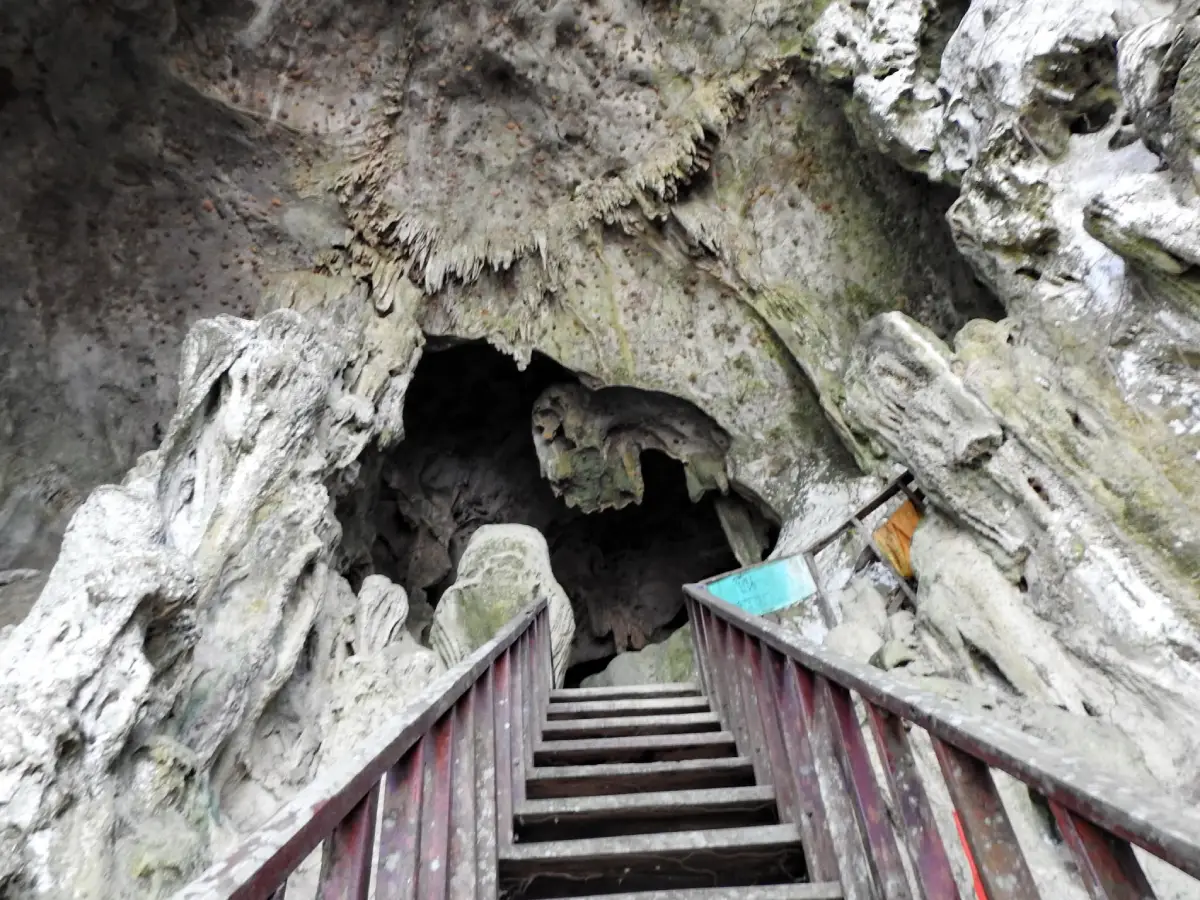
Open Days: Official local tourism information lists the site as open on working days
Opening Hours: Travelers should confirm the exact visiting hours in advance with Ban Tham Niap Subdistrict Administrative Organization at +66 77 953121
Tham Bueang Baep in Surat Thani is a limestone cave complex, Buddhist hermitage and major prehistoric archaeological site in Moo 3, Ban Tham Niap Subdistrict, Khiri Rat Nikhom District. The site preserves evidence of human activity dating back approximately 6,500–4,200 years and is one of the most informative prehistoric cave sites studied in Surat Thani. Archaeological excavations uncovered incomplete human skeletal remains, animal bones, shells, pottery, stone ornaments, shell beads, polished stone implements and more than 1,000 flaked stone tools and flakes. Together, these finds provide an unusually detailed view of how prehistoric communities in southern Thailand obtained food, manufactured tools, cooked, processed plant materials and interacted with environments extending from inland forests to the coast.
Tham Bueang Baep is therefore much more than a scenic cave. The limestone hill contains a record of human activity spanning several periods and preserves evidence that allows archaeologists to reconstruct everyday life thousands of years before written historical records existed in this part of Thailand. The archaeological material reveals how people selected a sheltered location, exploited nearby freshwater and forest resources, used both flaked and polished stone technologies, manufactured pottery for different purposes, produced personal ornaments and processed tree bark into cloth-like material.
The site occupies an isolated limestone hill rising approximately 50 meters above the surrounding agricultural plain. Archaeological descriptions place different parts of the hill between roughly 30 and 72 meters above mean sea level. Today, the surrounding landscape is dominated by rural settlement and cultivation. Important local crops include rubber, bananas, rambutan, stink beans, coffee and cassava. Houses, agricultural plots and the Buddhist hermitage now share the landscape with a hill that was used by humans thousands of years before the modern community developed around it.
The archaeological site also has a close relationship with water. Tham Bueang Baep lies approximately 126.5 meters from Khlong Maloh. The stream originates around the Nam Rat mountain area and forms part of the wider drainage system connected to the Phum Duang River. The Phum Duang eventually joins the Tapi River, which flows toward Bandon Bay and the Gulf of Thailand. For prehistoric inhabitants, proximity to freshwater, forest and a variety of ecological zones would have provided essential drinking water, food resources and routes through the landscape.
The physical setting helps explain why the hill was suitable for prehistoric occupation. Limestone caves and rock shelters provided protection from heavy rain and intense sun while still allowing access to surrounding forests and waterways. Open rock shelters could be used for activities requiring light and ventilation, while deeper cave areas offered different forms of shelter. Archaeological evidence from terrestrial mammals, aquatic animals, amphibians, birds, freshwater shells, land shells, marine shells and wild plants demonstrates that the inhabitants exploited several ecological zones rather than relying on a single food source.
Tham Bueang Baep became particularly important to Thai archaeology in 1982–1983, when the Archaeology Division of Thailand's Fine Arts Department carried out systematic surveys and excavations as part of the Chiao Lan Archaeological Project. The project was associated with archaeological work undertaken in connection with the environmental impacts of the Chiao Lan hydroelectric development. These excavations established Tham Bueang Baep as one of the early prehistoric communities in Surat Thani to receive detailed archaeological investigation.
The excavation sequence revealed evidence from at least two broad periods. Material close to the surface represented historical occupation, particularly from the Rattanakosin period, while deeper deposits contained substantial prehistoric remains. This stratigraphic sequence demonstrates that the hill was meaningful to people during very different periods. In the modern era, the area has developed into a Buddhist hermitage and meditation site, adding another layer to the long history of human use at the location.
Archaeologists identified three main areas where evidence of prehistoric occupation occurred. These are Bueang Baep Cave 1, also known as the Upper Cave, Great Cave or High Cave; Bueang Baep Cave 2, the Lower Cave or Buddha Cave; and Bueang Baep Cave 3, the Rear Cave, which is also known locally as the Ghost Cave. Each section has a different physical form and archaeological assemblage, allowing researchers to examine how different parts of the same limestone hill may have been used.
Bueang Baep Cave 1 is the largest chamber in the complex. It contains a broad hall with accumulated soil deposits and a major opening in the roof approximately 12 meters above the lower ground level. Natural light enters through this upper opening, while passages and spaces near the ceiling connect toward another opening and higher parts of the hill. Its large interior and light-filled sections distinguish Cave 1 from the smaller rock shelters and help explain why it contains the most diverse archaeological evidence.
One of the most significant discoveries in Cave 1 was an incomplete human skeleton. Study of the remains identified abrasion or deliberate modification around the anterior teeth, an important detail for research into the physical characteristics and behavior of the prehistoric population. Although the human remains are incomplete, their archaeological context contributes to the study of both biological anthropology and prehistoric mortuary practices in southern Thailand.
Cave 1 also produced a wide range of animal remains. Identified species include wild pig, bamboo rat, deer, turtles, softshell turtles, birds and freshwater crabs. These remains provide evidence of hunting and food gathering across forest and aquatic habitats. Some animal bones show evidence of heating, while residues on pottery indicate that food was cooked over fire. These two lines of evidence help archaeologists reconstruct food preparation rather than simply identifying the species that prehistoric people consumed.
The shell assemblage is especially informative. Archaeologists recovered land snails, freshwater shells, brackish-water shells and marine shells. Because the cave itself is inland, the presence of marine material is significant. Combined with shell ornaments, it supports the interpretation that the inhabitants either traveled toward coastal areas or maintained contact and exchange relationships with communities that had access to the coast.
Wild plant seeds were also found within the archaeological deposits. No convincing evidence of prehistoric agriculture has been identified at the site, so the overall subsistence pattern is interpreted as hunting and gathering. This does not imply a lack of botanical knowledge. On the contrary, the inhabitants would have needed detailed understanding of edible plants, seasonal resources, fibers and useful tree species in order to survive successfully in the landscape.
The pottery assemblage is one of the richest categories of evidence at Tham Bueang Baep. Many fragments are made from ordinary earthenware clay and have cord-marked surfaces. Vessel forms include round-bottomed cooking pots, tripod pots, carinated vessels, carinated bowls, flared goblet-like containers, pedestal forms, pot stands and horn-shaped supports. Clay pellets were also recovered. The variety demonstrates that pottery was designed for several functions rather than produced in a single standardized shape.
Round-bottomed pots would have worked well for heating and cooking, while tripod vessels could stand above a surface or fire without a separate base. Carinated containers and flared vessels offered different capacities and handling characteristics. Pot stands and horn-shaped supports indicate that cooking technology included accessories used together with vessels. Burned food residue surviving on pottery provides direct evidence that some vessels were used for food preparation.
The inhabitants also produced and used numerous stone implements. The Fine Arts Department reports more than 1,000 flaked tools and stone flakes from the excavations. Other objects include core tools, blade-like implements, stone hammers, anvils, sharpening stones, polished stone axes and polished chisels. This assemblage demonstrates intensive manufacture, maintenance and use of stone equipment at or around the cave.
An important technological characteristic of Tham Bueang Baep is the simultaneous use of flaked and polished stone tools. Flaking allowed people to create sharp working edges by removing pieces from stone cores, while grinding and polishing produced smoother and often more durable cutting surfaces. The coexistence of the two techniques shows that prehistoric toolmakers selected manufacturing methods according to practical needs rather than replacing one technology immediately with another.
Polished axes and chisels would have been particularly effective for working wood and other hard materials. Hammers and anvils indicate striking and shaping activities, while whetstones were used to maintain cutting edges. Flakes were both by-products of tool manufacture and useful cutting implements in their own right. The number and range of objects show that Tham Bueang Baep functioned as an active living space where equipment was made, repaired and used.
Bueang Baep Cave 2, or the Lower Cave, is a semi-enclosed rock shelter approximately 1.80 meters above the lower ground level. Its more open form differs from the large chamber of Cave 1. Archaeologists recovered animal bones and teeth, land shells, freshwater shells, marine shells, wild plant seeds, tripod pottery, carinated pots, pot stands and horn-shaped supports. The assemblage shows that daily activities also took place in this relatively open shelter.
The most distinctive object associated with Cave 2 is a stone bark-cloth beater. This type of implement was used to pound bark or plant fibers until the material became soft and flattened enough to form a cloth-like sheet. Organic textiles rarely survive for thousands of years in tropical archaeological deposits, so the tool is particularly valuable because it provides indirect evidence for fiber processing and clothing or other bark-based products.
The bark-cloth beater expands the archaeological picture beyond hunting, cooking and stone-tool production. Manufacturing bark cloth required people to recognize suitable tree species, remove and prepare bark correctly, soften the fibers and repeatedly work the material with specialized equipment. It therefore represents a body of technical knowledge related to plants and craft production that would otherwise be almost invisible in the archaeological record.
Bueang Baep Cave 3, or the Rear Cave, lies approximately 15 meters above the lower ground. The entrance takes the form of a low-ceilinged rock shelter leading toward a cave cavity. Archaeological finds include animal bones, shells, flaked stone tools, stone flakes, a whetstone, polished stone axes and cord-marked pottery. Although Cave 3 differs physically from the larger Cave 1, its material confirms that it formed part of the broader system of human activity around the hill.
The presence of three occupied areas is itself important. The large illuminated Cave 1, the more accessible open shelter of Cave 2 and the elevated low-ceilinged Cave 3 provided different physical conditions. Prehistoric inhabitants could therefore use different spaces within the same hill according to activity, weather, group size or other practical considerations. Archaeologists cannot assign a precise function to every space, but the evidence clearly demonstrates that human activity was distributed across more than one cave opening.
Personal ornaments add another dimension to the site. Archaeologists found stone bracelets or ring-shaped stone ornaments as well as shell beads. These objects had functions beyond the basic requirements of food procurement and shelter. Their manufacture required time, skill and careful material selection, indicating that appearance, social identity or symbolic meaning formed part of prehistoric life at Tham Bueang Baep.
The ornaments also challenge simplistic assumptions about hunter-gatherer communities. People at Tham Bueang Baep not only hunted animals and gathered plants but also invested labor in pottery of different forms, specialized stone equipment, bark-cloth production and decorative objects. These activities point to a community with technical knowledge and cultural practices that extended well beyond immediate subsistence.
The incomplete human remains may also provide evidence relating to mortuary practices. Archaeological interpretation has considered practices such as partial burial or secondary burial, in which human remains were handled or rearranged after an earlier stage of burial or decomposition. Such interpretations depend on archaeological context rather than the absence of bones alone, making preservation of the original deposit essential for understanding the behavior represented by the remains.
The food evidence shows a highly flexible adaptation to the environment. Forest mammals, aquatic animals, birds, freshwater organisms, shells and wild plants indicate that prehistoric people exploited several habitats. Diversifying food sources would have reduced dependence on a single seasonal resource and required detailed knowledge of animal behavior, plant cycles, streams and forest geography.
Marine shells are particularly important because they reveal connections beyond the immediate inland setting. Coastal materials could have reached Tham Bueang Baep through direct travel, movement of individuals or exchange between communities. The archaeological record therefore places the site within a wider network rather than portraying its inhabitants as an isolated cave population.
Pottery, stone implements and food remains together reveal several stages of daily activity. Animals and plants were obtained in the surrounding landscape, brought back to the settlement, processed with stone tools and cooked using fire and ceramic vessels. Broken pots, discarded bones, shells, charcoal and stone flakes accumulated gradually in occupation deposits. Thousands of years later, these ordinary traces became archaeological evidence from which daily behavior could be reconstructed.
Scientific dating has played a central role in determining the age of the site. Charcoal, animal bones and human bones were subjected to radiocarbon analysis. Earlier excavation documentation cited individual results ranging from approximately 4,750±210 to 6,510±360 years, while the Fine Arts Department's current public summary places prehistoric activity at Tham Bueang Baep within an approximate range of 6,500–4,200 years ago.
This chronology places Tham Bueang Baep within an important period of southern Thai prehistory when communities possessed pottery, polished stone implements and sophisticated craft knowledge while still depending heavily on hunting and gathering. No agricultural evidence has been identified from the prehistoric layers described at this site. The inhabitants instead combined forest and aquatic resources with technical traditions including pottery, stone working, ornament manufacture and bark-cloth processing.
The absence of agricultural evidence does not imply limited knowledge of plants. The bark-cloth technology demonstrates detailed understanding of useful trees and fibers, while wild seeds document plant use as part of subsistence. Prehistoric botanical knowledge therefore extended to both food and raw materials even though the archaeological evidence does not show farming as the community's economic foundation.
Tham Bueang Baep is also an excellent place for understanding why archaeological context matters. A small stone flake, fragment of charcoal, shell or broken pot may appear insignificant when removed from its original position. When recorded within a specific layer beside other material, however, it can contribute to dating, activity reconstruction and environmental interpretation. Visitors should therefore never dig, collect or move objects encountered in the cave area.
Archaeological objects recovered during the excavations are not simply left exposed at the site. Tourism information notes that excavated material was collected under the care of the Fine Arts Department. Individual registered objects provide additional documentation: a sandstone whetstone recovered from the cave in 1982, for example, was later received by Thalang National Museum in 1989. Museum conservation allows original artifacts to remain available for research and long-term preservation.
For present-day visitors, understanding the archaeological background transforms the experience of entering the cave. Cave 1 can be viewed in relation to human remains, food refuse, pottery, stone tools and ornaments; Cave 2 is especially important for the evidence of bark-cloth production; and Cave 3 adds another set of stone tools and ceramics. The physical landscape becomes easier to understand when each cave section is connected with the evidence discovered there.
The cave area now also functions as a Buddhist hermitage and meditation location. Official local tourism information lists both archaeological learning and meditation among activities at the site. Visitors should therefore respect two forms of significance simultaneously: Tham Bueang Baep is an archaeological heritage site and an active religious environment. Modest clothing and quiet behavior are appropriate throughout the visit.
No visitor should scratch or write on cave walls, strike rock surfaces, remove stones, collect pottery fragments or disturb soil deposits. Any object resembling an artifact should remain exactly where it is found. The position of an object can be as important as the object itself, and moving it may permanently destroy archaeological information that has survived for thousands of years.
Photography should also be approached responsibly. Visitors should avoid climbing unstable or undesignated surfaces merely to obtain photographs and should keep equipment away from meditation areas. Shoes with reliable grip are preferable for cave visits because limestone and soil can become damp. Although official tourism information describes the site as suitable for year-round visits, checking local weather before traveling is advisable.
Parking is the clearly documented visitor facility at the site. Other visitor services are not described with the same level of current confirmation, so travelers should bring drinking water and essential personal supplies. Rubbish should be taken away from the cave and hermitage rather than left in the archaeological landscape.
Tham Bueang Baep continues to appear in current tourism databases and map listings as both an archaeological attraction and the Tham Bueang Baep Priest's Camp Site. Local tourism information lists service on working days, while current travel listings recommend contacting the attraction to confirm exact opening hours. Travelers coming from outside the district should call Ban Tham Niap Subdistrict Administrative Organization at +66 77 953121 before departure.
The current map reference for Tham Bueang Baep Priest's Camp Site is Plus Code WX6M+76C in Khiri Rat Nikhom, Surat Thani 84180. Searching the site name together with this Plus Code is useful for navigation. Local road signs should still be followed once travelers enter Ban Tham Niap because small rural access roads may not always be represented with the same detail as major highways.
Getting There from Surat Thani city, travel along the Surat Thani–Takua Pa route toward Khiri Rat Nikhom District. At the junction around kilometer 44, turn onto Surat Thani Rural Road 3303 and continue for approximately 4.5 kilometers toward Ban Tham Niap before following local access roads to the cave and hermitage. A private car is the most practical option and makes it easier to combine Tham Bueang Baep with other attractions in Khiri Rat Nikhom.
Visitors with a strong interest in archaeology should read about the three excavation areas before arriving and then use the physical landscape to understand how the site was organized. Knowing where different forms of evidence were recovered makes the cave much more meaningful than viewing it simply as a limestone formation. This approach is particularly useful for students, families and travelers interested in the prehistoric archaeology of southern Thailand.
Several nearby places can be combined with Tham Bueang Baep on a one-day route. Tham Wang Badan is another cave and religious site in the Ban Tham Niap area. Ban Nam Rat Headwater Forest and Khlong Nam Sai offer contrasting freshwater landscapes, while Wat Tham Singkhon contains important historic architecture and cultural material. Together, these places demonstrate that Khiri Rat Nikhom has its own dense network of natural and cultural attractions beyond being a gateway to Khao Sok and Ratchaprapha Dam.
Ban Nam Rat Headwater Forest is especially relevant to the environmental story of Tham Bueang Baep because the Nam Rat area forms part of the local water landscape. Combining both sites allows travelers to consider how freshwater resources have shaped human life in Ban Tham Niap from prehistory to the present. At Tham Bueang Baep, shells, animal remains and the location beside Khlong Maloh reveal ancient resource use; at Ban Nam Rat, visitors can observe the modern headwater environment directly.
Wat Tham Singkhon adds a later historical dimension to the route. Its religious architecture, artwork and cultural remains represent periods much later than the prehistoric occupation of Tham Bueang Baep. Visiting both sites provides a broader chronological perspective, moving from prehistoric communities without written records to historical Buddhist culture expressed through architecture and sacred objects.
Travelers who want to stay overnight can choose from several small resorts and guesthouses in Ban Tham Niap. Current accommodation listings include Baan Kiang Klong Resort, OngSa Resort, Thumneab Guesthouse, Banrak Resort and Shong Hai Resort. Staying locally reduces the need to return to Surat Thani city and makes it easier to visit Ban Nam Rat Headwater Forest, Khlong Nam Sai and other Khiri Rat Nikhom attractions early in the day.
In the wider history of Surat Thani, Tham Bueang Baep is important because it extends the human story of the province far beyond historic towns, temples and trading communities. Thousands of years before written documents described the region, people were already living among these limestone hills, cooking in ceramic vessels, producing large quantities of stone tools, making ornaments, processing bark into cloth and maintaining connections with resources beyond the inland valley.
Tham Bueang Baep ultimately brings together three forms of heritage in one place: a natural limestone landscape, a prehistoric archaeological record and a living Buddhist religious setting. Visitors who recognize all three dimensions can appreciate the site far more deeply than those who see it only as another cave. A relatively small isolated hill has preserved evidence of human adaptation and changing land use across thousands of years.
Responsible visitation is essential. Archaeological material should never be removed, cave walls should not be marked or damaged, religious activities should not be disturbed and all rubbish should leave the site with the visitor. The survival of the archaeological context depends not only on professional conservation but also on the behavior of every person who enters the cave.
For travelers seeking a less conventional cultural destination in Surat Thani, Tham Bueang Baep offers an exceptional combination of archaeology, landscape and local spirituality. The evidence ranges from everyday food residues and thousands of stone flakes to pottery, bark-cloth technology, ornaments and human remains. Seen together, these materials turn a quiet limestone cave in Khiri Rat Nikhom into one of the most revealing windows onto prehistoric life in southern Thailand.
| Name | Tham Bueang Baep / Tham Bueang Baep Priest's Camp Site |
| Location | Moo 3, Ban Tham Niap Subdistrict, Khiri Rat Nikhom District, Surat Thani Province |
| Address | Moo 3, Ban Tham Niap, Khiri Rat Nikhom, Surat Thani 84180, Thailand |
| Coordinates | Plus Code: WX6M+76C, Khiri Rat Nikhom, Surat Thani |
| Type | Prehistoric archaeological site, limestone cave and rock shelters, and Buddhist hermitage |
| Landscape | Isolated limestone hill approximately 50 meters above the surrounding plain; archaeological areas lie roughly 30–72 meters above mean sea level |
| Archaeological Age | The Fine Arts Department currently summarizes the prehistoric occupation as approximately 6,500–4,200 years ago; earlier excavation documentation reported radiocarbon results of approximately 4,750±210 to 6,510±360 years |
| Excavation History | Surveyed and excavated by the Archaeology Division, Fine Arts Department, in 1982–1983 under the Chiao Lan Archaeological Project |
| Occupation Periods | Prehistoric deposits beneath surface evidence associated with the historical period, particularly the Rattanakosin era |
| Main Areas / Zones | 1. Bueang Baep Cave 1 / Upper Cave / Great Cave / High Cave: the largest chamber, with a roof opening approximately 12 m above lower ground 2. Bueang Baep Cave 2 / Lower Cave / Buddha Cave: semi-enclosed rock shelter approximately 1.80 m above lower ground 3. Bueang Baep Cave 3 / Rear Cave / Ghost Cave: low-ceilinged rock shelter approximately 15 m above lower ground |
| Human Evidence | Incomplete human skeletal remains, including evidence of abrasion or modification on anterior teeth |
| Food Evidence | Animal bones and teeth, land, freshwater, brackish and marine shells, crab remains, wild plant seeds and evidence of cooking with fire |
| Pottery | Cord-marked pottery, round-bottomed cooking pots, tripod vessels, carinated vessels, carinated bowls, flared goblets, pedestal forms, pot stands, horn-shaped supports and clay pellets |
| Stone Tools and Ornaments | More than 1,000 flaked tools and flakes, core tools, hammers, anvils, whetstones, polished axes, polished chisels, bark-cloth beater, stone bracelets and shell beads |
| Prehistoric Lifestyle | Hunting and gathering, use of forest and freshwater resources, pottery production, flaked and polished stone technologies, ornament making, fire-based cooking and bark-cloth production |
| Nearby Water Source | Approximately 126.5 m from Khlong Maloh, within the drainage system linked to the Phum Duang River, Tapi River and Bandon Bay |
| Activities | Archaeological learning, cave and rock-shelter observation, and meditation |
| Facilities | Parking area |
| Visitor Guidelines | Dress modestly, remain quiet, do not damage cave surfaces, do not move or collect archaeological material, and respect meditation activities |
| Travel Information | From Surat Thani city, take the Surat Thani–Takua Pa route, turn at the junction around Km 44 onto Surat Thani Rural Road 3303 and continue approximately 4.5 km toward Ban Tham Niap |
| Current Status | Currently listed as an archaeological learning attraction and Buddhist hermitage used for meditation |
| Open Days | Working days according to official local tourism information |
| Opening Hours | Confirm exact visiting hours before travel |
| Main Contact Number | Ban Tham Niap Subdistrict Administrative Organization: +66 77 953121 |
| Nearby Tourist Attractions | 1. Tham Wang Badan Priest's Camp Site, about 5 km, Tel. 093-6705249 2. Ban Nam Rat Headwater Forest, about 8 km 3. Khlong Nam Sai, about 9 km 4. Wat Tham Singkhon, about 12 km, Tel. 077-294888 5. Than Thong Waterfall, about 20 km, Tel. 062-2599113 |
| Nearby Restaurants | 1. KOB • KORN • GUN COFFEE, Ban Bueang Baep, about 2 km, Tel. 082-2850650 2. Thamniap Phochana Restaurant, about 5 km, Tel. 086-2734526 3. Cha Payom P'Sam, about 5 km, Tel. 090-9845023 4. Local Coffee Shop, Ban Tham Niap, about 6 km 5. Isan Chao Suan Restaurant, Ban Khlong Khanan, Moo 7, about 8 km |
| Nearby Accommodations | 1. Baan Kiang Klong Resort, about 4 km, Tel. 094-3919979 2. OngSa Resort, about 4 km, Tel. 091-8264176 3. Thumneab Guesthouse, about 5 km, Tel. 081-5372945 4. Banrak Resort, about 7 km, Tel. 087-2748250 5. Shong Hai Resort, about 7 km, Tel. 065-4644156 |
Frequently Asked Questions (FAQ)
Q: Where is Tham Bueang Baep located?
A: Tham Bueang Baep is in Moo 3, Ban Tham Niap Subdistrict, Khiri Rat Nikhom District, Surat Thani Province, within an isolated limestone hill now associated with the Tham Bueang Baep Buddhist hermitage.
Q: How old is the prehistoric occupation at Tham Bueang Baep?
A: The Fine Arts Department currently places the prehistoric occupation at approximately 6,500–4,200 years ago, based in part on radiocarbon dating of charcoal, animal bones and human remains.
Q: What archaeological remains were found at Tham Bueang Baep?
A: Excavations recovered incomplete human remains, animal bones and teeth, shells, wild plant seeds, many pottery forms, more than 1,000 flaked stone tools and flakes, polished axes, chisels, whetstones, a bark-cloth beater, stone bracelets, shell beads and evidence of cooking with fire.
Q: How many archaeological cave areas are there at Tham Bueang Baep?
A: Three principal occupation areas were identified: Bueang Baep Cave 1 or the Upper Cave, Cave 2 or the Lower Cave, and Cave 3 or the Rear Cave.
Q: How did the prehistoric inhabitants of Tham Bueang Baep live?
A: They relied primarily on hunting and gathering, exploited forest and freshwater resources, cooked with pottery and fire, used both flaked and polished stone tools, made ornaments, and processed bark fibers into cloth-like material.
Q: What are the opening hours of Tham Bueang Baep?
A: Official local tourism information lists service on working days, but exact opening hours should be confirmed before travel by calling Ban Tham Niap Subdistrict Administrative Organization at +66 77 953121.
Q: Is there an admission fee for Tham Bueang Baep?
A: No current official admission fee has been published in the verified tourism information used for this guide. Travelers should ask the local administrative organization if they need the latest access information.
Q: What attractions can be combined with a visit to Tham Bueang Baep?
A: Nearby options include Tham Wang Badan, Ban Nam Rat Headwater Forest, Khlong Nam Sai, Wat Tham Singkhon and Than Thong Waterfall, making it possible to combine archaeology, caves, freshwater environments and cultural sites in one Khiri Rat Nikhom itinerary.
 Category: ●Nature and Wildlife
 Group: ●Caves
Last Update : 2 WeekAgo
 Last Update : 2 WeekAgo
 Click to Access the Navigation Map GPS
Tham Bueang Baep Map
Recommend

 Art, Culture and Heritage
 Landmarks and Memorials(1)
 Art, Craft Centres, Tradition(8)
 Museums(5)
 Educational Places
 Educational Gardens, Farm(1)
 Places of Worship
 Temple(32)
 Other Sacred Sites(8)
 Research and Development
 Royal Project(1)
 Suburban Living
 Village, Community(6)
 Local Market(1)
 National Parks and Marine Reserves(8)
 Mountain (Doi)(2)
 Dam, Reservoir, Lake(8)
 Waterfalls(34)
 Hot Springs(7)
Caves(18)
Hot Springs(7)
Caves(18)
 River, Canal(11)
 Bays and Beaches(30)
 Islands(16)
 Other natural attractions(10)
 Entertainment and Agricultural
 Animal camps and shows(6)
 Farms, Parks and Ecotourism(7)
 Outdoor and Adventure Activities(2)
 Shopping
 Shopping and Night Market(1)
 Travel Articles, Recipes
 Southern Food Menu, Southern Food Recipes(1)


