
lovethailand home >South Travel Attractions >Surat Thani Travel Attractions >Koh Samui >Ma Ret > Phra That Hin Ngu (Phra That Sila Ngu)
TL;DR: Phra That Hin Ngu (Phra That Sila Ngu) is located at Moo 1, Maret Subdistrict, Koh Samui District, Surat Thani Province, open Daily, hours 07.00 – 17.00.
Phra That Hin Ngu (Phra That Sila Ngu)
Open Days: Daily
Opening Hours: 07.00 – 17.00
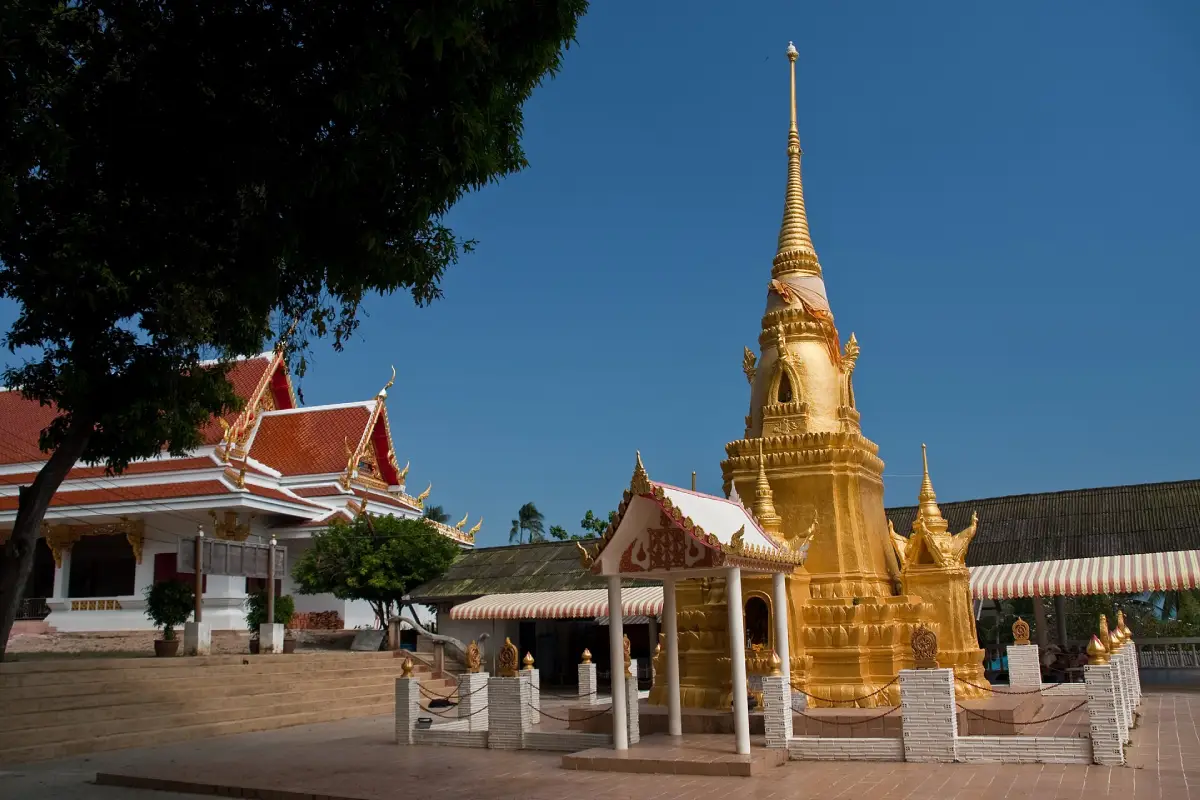
Phra That Hin Ngu, also known as Phra That Sila Ngu, is a sacred seaside chedi inside Wat Ratchathammaram or Wat Sila Ngu in Maret, Koh Samui, Surat Thani. The golden stupa enshrines relics of the Buddha and is one of the most respected religious landmarks for local Samui residents. King Rama IX and Queen Sirikit visited the relic stupa on 24 April 1962, and local people have continued to observe an annual worship tradition on 24 April.
Phra That Hin Ngu in Surat Thani is the local name for Phra That Sila Ngu, a sacred relic stupa located inside Wat Ratchathammaram, commonly known as Wat Sila Ngu, in Maret Subdistrict, Koh Samui District, Surat Thani Province. This site is one of the most meaningful Buddhist landmarks on Koh Samui. It combines a revered relic stupa, a distinctive local temple, a peaceful seaside setting, and an important cultural memory shared by the people of the island.
The name Hin Ngu or Sila Ngu means snake rock. It comes from the natural rock formation near the shoreline, where the stones are said to resemble snake scales. When the tide is low, the rocks can appear like a snake lying in the sea. Local people therefore used this visual feature to name the area, the temple, and the sacred stupa. The name is not just descriptive; it reflects the close relationship between the sea, local geography, community belief, and Buddhist devotion on Koh Samui.
According to local history, Phra That Hin Ngu, also known as the Buddha relic stupa of Koh Samui, is located about 17 km from the Koh Samui District Office. The stupa was built through the faith of local people in Maret, including a local devotee named Si Thong or Luang Pho Si Thong Srichai, together with other supporters. The relic enshrinement ceremony was held on 12 June 1955, with the relics given by Chao Khun Phra Atthathasi Sutthiphong of Wat Chithon in Phak Hai District, Phra Nakhon Si Ayutthaya Province.
Another important cultural record identifies the stupa as a significant sacred object of Wat Ratchathammaram. It states that Phra Khru Wibun Thammasan, also known as Phet Tisso, a former senior monk of Koh Samui, initiated the construction of the chedi to enshrine Buddha relics that had been kept beneath the principal Buddha image at Wat Chaeng. These relics were associated with a pilgrimage to Lanka, or Sri Lanka. This background gives Phra That Hin Ngu a deeper religious significance beyond its coastal beauty.
The date 24 April 1962 is a major milestone in the history of the site. On that day, King Rama IX and Queen Sirikit visited Koh Samui and paid homage to Phra That Sila Ngu. This royal visit strengthened the importance of the stupa in the hearts of local people. Since then, Samui residents have continued to regard 24 April as the annual worship day of Phra That Sila Ngu, preserving the memory of the royal visit and the sacred role of the stupa.
The golden stupa stands on a seaside platform, close to the water and open sky. Its location gives the site a rare spiritual atmosphere: quiet, bright, and connected to the Gulf of Thailand. Visitors approach the chedi by a stairway decorated with naga railings, then reach the area where the golden stupa rises against the sea and surrounding trees. For Thai Buddhist visitors, this is a place for reverence and merit-making. For cultural travelers, it is also a valuable place to see how Buddhist belief and island landscape coexist.
Architecturally, Phra That Sila Ngu is important as a local Koh Samui-style chedi. Its lower base is decorated with overlapping petal-like forms and includes niches on all 4 sides. Above this is an upper base with slightly sloping walls in a recessed twelve-corner plan, topped by 2 layers of lotus motifs. The central bell section is distinctive because it is arranged in 2 levels and decorated with small niches. The upper section supports the ringed spire, finial, and a small vase-like top element. This structure marks the chedi as a well-preserved example of local religious craftsmanship.
The form of Phra That Hin Ngu shows how local craftsmen adapted Buddhist architectural language to the island setting. The base feels stable and grounded, while the upper section rises in a refined, elegant sequence. The golden surface gives the chedi a luminous presence, especially in morning or late-afternoon light. It is worth observing the structure carefully, because the site offers more than a quick photo opportunity. It is a living religious monument with historical, artistic, and community value.
Wat Ratchathammaram is also widely known for its red ordination hall, often called the Red Temple of Koh Samui. The building has a deep terracotta-red appearance and is decorated with detailed reliefs. Its style is often described as influenced by Srivijaya and Bayon artistic forms. Local accounts explain that the red appearance is connected to the use of salty limestone from Koh Samui, which was crushed and mixed with cement before red color was added. This gives the building its distinctive character and makes it different from most temples on the island.
The red ordination hall has made Wat Sila Ngu popular with modern travelers, photographers, and visitors looking for distinctive temple architecture. However, the heart of the site remains Phra That Sila Ngu, the sacred relic stupa revered by local people. A good visit should include both main areas: the golden chedi by the sea and the red ordination hall inside the temple grounds. The chedi represents faith, continuity, and community memory, while the red hall represents artistic creativity and local temple craftsmanship.
The atmosphere around Wat Sila Ngu is calm and accessible. The temple sits near the coastline and directly along Koh Samui’s main ring road, Route 4169. Visitors can feel the sea breeze, hear the sound of waves, and enjoy the quiet rhythm of the temple grounds. When the sky is clear, sunlight reflects beautifully on the golden chedi, making the site especially photogenic in the morning and late afternoon.
Phra That Hin Ngu is suitable for travelers who want to see a deeper side of Koh Samui beyond beaches, resorts, and nightlife. It reveals the island as a place of old communities, Buddhist faith, local art, and royal memory. Visiting the stupa is therefore a way to understand Koh Samui through its cultural roots, not only through its coastal scenery.
The location also makes it easy to combine Phra That Hin Ngu with other nearby places. Hin Ta and Hin Yai Rocks are about 1 km away, Lamai Beach is nearby, and travelers can continue to Lamai Viewpoint, Guan Yu Shrine, Hua Thanon village, or Wat Khunaram. This makes the temple a convenient stop on a cultural or scenic drive around the southern and eastern parts of Koh Samui.
The annual worship tradition of Phra That Sila Ngu remains important for local Samui residents. It is observed on 24 April every year, the date associated with the royal visit of King Rama IX and Queen Sirikit in 1962. During this period, the stupa becomes a focus of community faith and remembrance. Visitors who come during the annual ceremony can see the living religious culture of Koh Samui, while those visiting on ordinary days can still pay respect throughout the temple’s regular opening hours.
Visitors should dress respectfully because Wat Sila Ngu is an active Buddhist temple. Swimwear and revealing clothes are not suitable inside the temple grounds. Keep noise low, do not climb onto restricted areas, avoid touching sacred structures unnecessarily, and take photos with consideration for people who are praying. The seaside location can be sunny, so a hat, water, and a short visit during cooler hours will make the experience more comfortable.
Getting There is straightforward by private car, rental car, rental motorcycle, or local taxi. Wat Sila Ngu is on Koh Samui’s Route 4169, east of Hua Thanon village, about 1 km from Hin Ta and Hin Yai Rocks and about 17 km from the Koh Samui District Office. Travelers can search for Wat Ratchathammaram, Wat Sila Ngu, or Phra That Hin Ngu on navigation apps.
In summary, Phra That Hin Ngu or Phra That Sila Ngu is one of the most meaningful cultural sites on Koh Samui. It offers a sacred Buddha relic stupa, a preserved local chedi form, the striking red ordination hall of Wat Ratchathammaram, sea views, and an annual worship tradition tied to royal memory. For travelers who want to understand Koh Samui beyond its beaches, this temple is a highly worthwhile stop.
| Name | Phra That Hin Ngu or Phra That Sila Ngu, inside Wat Ratchathammaram or Wat Sila Ngu |
| Location | Moo 1, Maret Subdistrict, Koh Samui District, Surat Thani Province |
| Address | 449 National Highway 4169, Maret Subdistrict, Koh Samui District, Surat Thani 84310, Thailand |
| Coordinates | 9.45115, 100.03088 |
| Highlights | Golden seaside relic chedi, red ordination hall with Srivijaya-Bayon influence, and peaceful sea views of Koh Samui |
| History | The relic enshrinement ceremony was held on 12 June 1955. King Rama IX and Queen Sirikit paid homage to the stupa on 24 April 1962. |
| Name Origin | The name comes from snake-scale-like rocks near the shoreline. At low tide, the rocks appear like a snake in the sea. |
| Distinctive Features | A local Koh Samui-style chedi with overlapping base petals, 4 niches, a recessed twelve-corner upper base, 2-level bell section, ringed spire, finial, and top element |
| Key Sacred Elements | Buddha relics, Phra That Sila Ngu chedi, red ordination hall, Srivijaya-Bayon style carvings, and seaside worship area |
| Travel Information | Located on Route 4169 east of Hua Thanon village, about 1 km from Hin Ta and Hin Yai Rocks and about 17 km from the Koh Samui District Office |
| Current Status | Open for worship and sightseeing as an important Buddhist and cultural attraction of Koh Samui |
| Open Days | Daily |
| Opening Hours | 07.00 – 17.00 |
| Fees | No admission fee |
| Facilities | Parking area, worship area, chedi platform, temple walking area, and photo spots around the temple |
| Main Areas / Zones | Phra That Sila Ngu chedi platform, red ordination hall, naga stairway, seaside area, temple courtyard, and sea-view area |
| Abbot / Caretaker | Phra Mettarai Piasai-ngam / Wat Sila Ngu |
| Main Contact Number | 077 232 206 |
| Nearby Tourist Attractions | 1. Hin Ta and Hin Yai Rocks, about 1 km 2. Lamai Beach, about 2 km 3. Lamai Viewpoint and Valentine Stone, about 2 km 4. Guan Yu Shrine Koh Samui, about 3 km 5. Hua Thanon Village, about 2 km 6. Wat Khunaram, about 4 km |
| Nearby Restaurants | 1. Krua Chao Baan Samui, about 0.2 km, Tel. 077 418 589, 087 893 7766, 089 009 5560 2. Melayu Samui Seafood & Resort, about 2 km, Tel. 089 975 1165 3. Bamboo Restaurant Lamai Beach, about 3 km, Tel. 080 524 9400 4. The Cliff Bar & Grill, about 6 km 5. Ko Wat Restaurant, about 3 km, Tel. 086 120 9553 6. Seagrill Bangkao Bar & Restaurant Diamond Beach, about 7 km, Tel. 098 674 1861 |
| Nearby Accommodations | 1. Mali Samui Resort, about 0.1 km, Tel. 085 473 3486 2. Chill Inn Lamai Hostel & Beach Cafe, about 0.2 km 3. Rocky’s Boutique Resort, about 0.3 km, Tel. 077 332 888 4. Three Trees Samui Resort – Sarocha Villa, about 1 km 5. Tolani Resort Koh Samui, about 2 km 6. Lamai Coconut Beach Resort, about 3 km |
Frequently Asked Questions (FAQ)
Q: Where is Phra That Hin Ngu located?
A: Phra That Hin Ngu is located inside Wat Ratchathammaram or Wat Sila Ngu in Moo 1, Maret Subdistrict, Koh Samui District, Surat Thani Province, near Hin Ta and Hin Yai Rocks.
Q: What are the opening hours of Phra That Hin Ngu?
A: The temple is open daily from 07.00 to 17.00.
Q: Is there an admission fee?
A: No. There is no admission fee to visit the temple, pay respect to the relic stupa, or walk around the grounds.
Q: Why is Phra That Hin Ngu important?
A: It is a sacred chedi enshrining relics of the Buddha and is one of the most respected Buddhist sites for local Koh Samui residents.
Q: Why is it called Phra That Hin Ngu or Phra That Sila Ngu?
A: The name comes from rocks near the shoreline that look like snake scales. At low tide, the formation appears like a snake in the sea.
Q: When is the annual worship tradition held?
A: Local people observe the annual worship tradition on 24 April, commemorating the royal visit of King Rama IX and Queen Sirikit on 24 April 1962.
Q: What nearby attractions can travelers visit after Phra That Hin Ngu?
A: Nearby attractions include Hin Ta and Hin Yai Rocks, Lamai Beach, Lamai Viewpoint, Guan Yu Shrine, Hua Thanon Village, and Wat Khunaram.
 Category: ●Places of Worship
 Group: ●Other Sacred Sites
Last Update : 2 MonthAgo
 Last Update : 2 MonthAgo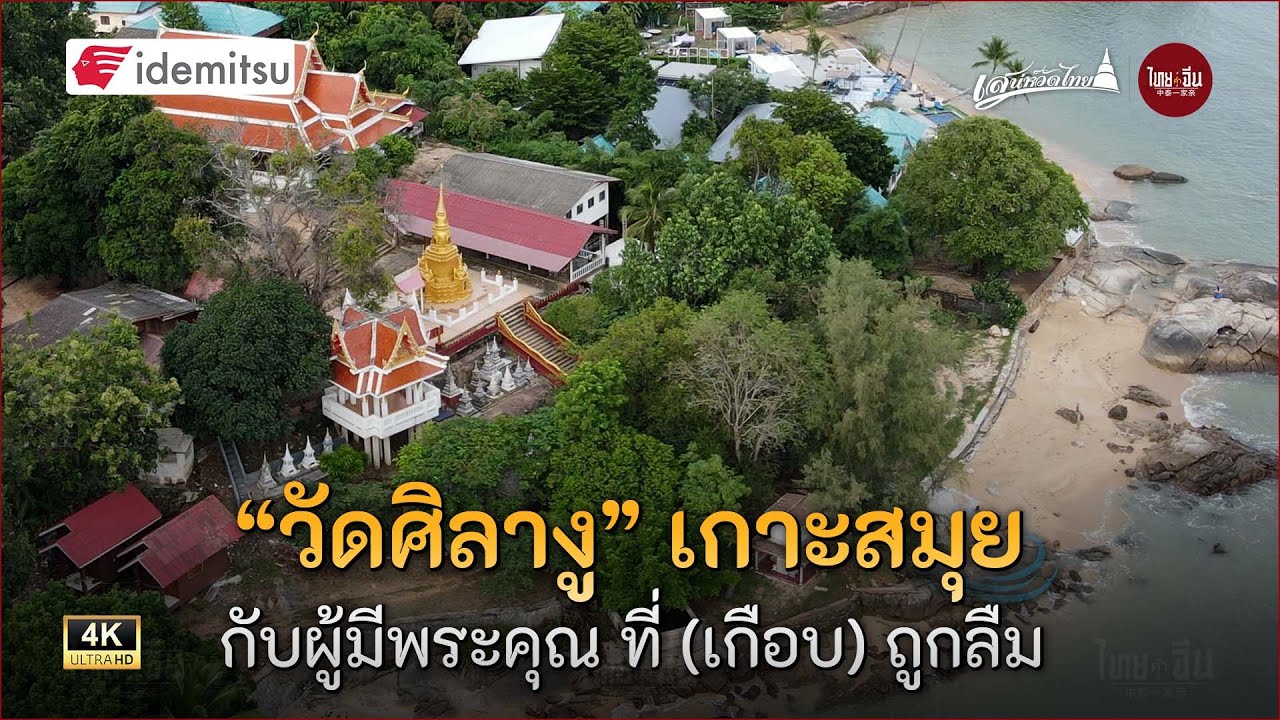
 Click to Access the Navigation Map GPS
Phra That Hin Ngu (Phra That Sila Ngu) Map
Recommend

 Art, Culture and Heritage
 Landmarks and Memorials(1)
 Art, Craft Centres, Tradition(8)
 Museums(5)
 Educational Places
 Educational Gardens, Farm(1)
 Temple(32)
Other Sacred Sites(8)
Temple(32)
Other Sacred Sites(8)
 Research and Development
 Royal Project(1)
 Suburban Living
 Village, Community(6)
 Local Market(1)
 Nature and Wildlife
 National Parks and Marine Reserves(8)
 Mountain (Doi)(2)
 Dam, Reservoir, Lake(8)
 Waterfalls(34)
 Hot Springs(7)
 Caves(18)
 River, Canal(11)
 Bays and Beaches(30)
 Islands(16)
 Other natural attractions(10)
 Entertainment and Agricultural
 Animal camps and shows(6)
 Farms, Parks and Ecotourism(7)
 Outdoor and Adventure Activities(2)
 Shopping
 Shopping and Night Market(1)
 Travel Articles, Recipes
 Travel Review, Food Review(1)
 Southern Food Menu, Southern Food Recipes(1)


